

NPP 150 mg is an oil-based Nandrolone Phenylpropionate injectable manufactured by Dragon Pharma and dosed at 150 mg/mL in a 10 mL vial.
NPP 150 mg contains nandrolone phenylpropionate, a short-acting ester of the anabolic-androgenic steroid nandrolone. Nandrolone is structurally derived from testosterone by the removal of a carbon atom at the 19 position, which enhances its anabolic properties while attenuating its androgenic effects. The phenylpropionate ester provides a moderate duration of action, with a half-life of approximately 25 hours according to pharmacokinetic data.
In clinical practice, nandrolone phenylpropionate has been used for the treatment of refractory deficient red cell production anemias, breast carcinoma, and hereditary angioedema. It is classified as a Schedule III controlled substance in the United States. In non-medical bodybuilding contexts, NPP 150 mg is commonly referenced for its ability to promote lean muscle gains, strength, and joint comfort, with a faster onset and shorter clearance time compared to the longer-acting nandrolone decanoate.
The shorter ester chain of NPP means it requires more frequent administration than nandrolone decanoate, typically every 2-3 days, but this also allows for more rapid clearance if side effects occur. Like other 19-nor compounds, nandrolone can suppress endogenous testosterone production and may elevate prolactin in some individuals.
NPP 150 mg uses MCT oil as its carrier, providing an oil base for the nandrolone phenylpropionate formulation. The 150 mg/mL concentration is higher than standard 100 mg/mL preparations, allowing for reduced injection volume at equivalent doses.
Nandrolone phenylpropionate is a short-acting anabolic steroid that is an ester of nandrolone. Its moderate duration of action and rapid clearance distinguish it from the longer-acting nandrolone decanoate.
Nandrolone phenylpropionate functions as a prodrug that is hydrolyzed in the body to release the active hormone nandrolone. The phenylpropionate ester has a half-life of approximately 25 hours, compared to 130 hours for the decanoate ester, which means it is cleared from the body much more rapidly. This pharmacokinetic difference requires more frequent injections but allows for greater control over blood levels.
Nandrolone exerts its anabolic effects through androgen receptor binding, leading to increased protein synthesis and a positive nitrogen balance. The parent hormone has a more favorable anabolic-to-androgenic ratio compared to testosterone due to the absence of the C19 methyl group.
In clinical settings, nandrolone phenylpropionate has been used for conditions including refractory anemias, breast carcinoma, and hereditary angioedema. It is no longer actively marketed for human medical use in many countries but remains available through some compounding pharmacies and is widely referenced in bodybuilding contexts.
The phenylpropionate ester of NPP 150 mg produces a moderate duration of action, with effects lasting approximately 5-8 days. In non-medical contexts, this necessitates injections every 2-3 days to maintain stable blood levels. The shorter half-life means that if side effects occur, they may resolve more quickly upon discontinuation compared to nandrolone decanoate.
Dragon Pharma offers several nandrolone-based injectables with different release profiles. The longer-acting Deca 300 contains nandrolone decanoate at 300 mg/mL and requires less frequent injections. For those seeking a combination product, Deca 200/NPP 150 blends both nandrolone esters in a single formulation.
In non-medical bodybuilding contexts, NPP is frequently stacked with a testosterone base such as Cypionate 250. Some users also combine NPP with Masteron 100 to help manage estrogenic side effects and provide additional hardening effects.
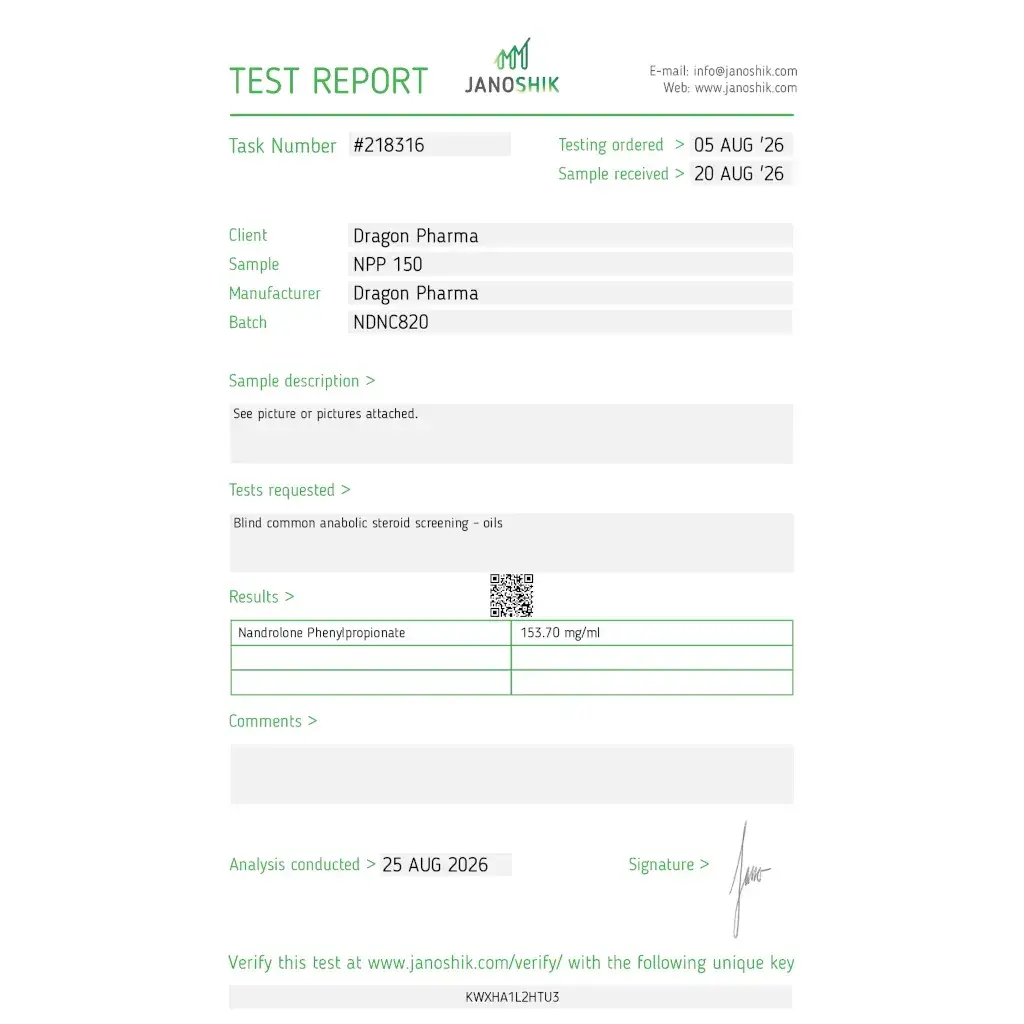
Published laboratory reports for NPP 150 mg are shown below with the test date, measured concentration and percentage of the product's 150 mg/mL label claim.
 View Report
 View Report
 View Report
 View Report
Laboratory results apply to the specific tested sample represented in each published report and should not be interpreted as a measurement of every vial or production batch.
The information below is provided for educational reference only. Nandrolone phenylpropionate is a Schedule III controlled substance; medical use requires appropriate diagnosis, clinical supervision and ongoing monitoring. Non-medical use falls outside approved indications.
In non-medical bodybuilding contexts, NPP 150 mg is commonly referenced in the range of 200–400 mg per week for general use, with some experienced users referencing up to 600 mg per week. Because of its short phenylpropionate ester and approximately 25-hour half-life, the weekly total is typically divided into injections administered every 2-3 days. The 150 mg/mL concentration means that 1 mL provides 150 mg of nandrolone phenylpropionate.
| Use Case | Common Reference Range | Injection Frequency |
|---|---|---|
| Beginner (non-medical) | 150–200 mg / week | Every 2-3 days |
| Intermediate (non-medical) | 250–400 mg / week | Every 2-3 days |
| Advanced (non-medical) | 400–600 mg / week | Every other day |
In non-medical bodybuilding contexts, NPP is commonly stacked with a testosterone base. Dragon Pharma's Cypionate 250 is frequently referenced in this context. Some users also combine NPP with Masteron 100 to help manage estrogenic side effects.
Cycle lengths of 8–12 weeks are commonly referenced in non-medical contexts. The shorter ester allows for more rapid clearance, which can be advantageous for users who want to minimize detection time or manage side effects more quickly.
Nandrolone can suppress endogenous testosterone production and may elevate prolactin in some individuals. Some users reference prolactin management with agents such as P5P (pyridoxal-5-phosphate) or cabergoline in non-medical contexts. Estrogenic side effects such as water retention may occur, and aromatase inhibitors or SERMs are sometimes referenced for management.
Nandrolone is not a 17-alpha-alkylated oral steroid and therefore is not considered hepatotoxic in the same manner. However, it can negatively affect lipid profiles, with documented decreases in HDL cholesterol. Blood pressure and cardiovascular markers should be monitored during use.
After completing a cycle with NPP 150 mg, post-cycle therapy is commonly recommended in non-medical contexts to help restore endogenous testosterone production. Agents such as Clomid or Nolvadex are frequently referenced for this purpose.
Because nandrolone phenylpropionate has a shorter half-life than the decanoate ester, PCT can typically begin sooner after the final injection. Bloodwork and, where possible, medical guidance can help inform recovery strategy.
Dosing strategies, support compounds and recovery protocols should be adjusted based on experience level and bloodwork where possible. The information above is for educational reference and does not constitute medical advice.
Nandrolone phenylpropionate is a Schedule III controlled anabolic steroid that can affect hormonal, cardiovascular, hepatic and reproductive function. Medical use requires appropriate diagnosis, clinical supervision and ongoing monitoring.
Nandrolone phenylpropionate is classified as a Schedule III controlled substance in the United States. It has not been shown to be safe and effective for the enhancement of athletic performance, and the FDA label for nandrolone decanoate explicitly states it should not be used for such purpose. Non-medical use falls outside approved indications and may carry significant health risks.
Anabolic steroids in general have been associated with serious adverse effects including peliosis hepatis, liver cell tumors, and blood lipid changes that may increase the risk of atherosclerosis and coronary artery disease.
Use of nandrolone phenylpropionate for bodybuilding or performance enhancement falls outside approved medical indications. Higher-than-physiologic exposure can increase the risk of serious adverse effects including cardiovascular, hepatic and endocrine complications.
Nandrolone can suppress gonadotropic functions of the pituitary and may exert direct effects on the testis, leading to reduced sperm production and testicular atrophy. Sexual dysfunction is a recognized risk, particularly without appropriate management.
Anabolic steroids including nandrolone have been reported to increase low-density lipoproteins and decrease high-density lipoproteins. These changes may have a serious impact on the risk of atherosclerosis and coronary artery disease.
Other potential effects include fluid retention, acne, and changes in prostate-related symptoms. In women, virilization signs such as deepening of the voice, hirsutism, acne, and clitoromegaly may occur and can be irreversible if the drug is continued after symptoms appear.
Anabolic steroids are contraindicated in certain circumstances. The FDA label for nandrolone decanoate lists contraindications including male patients with carcinoma of the breast or known/suspected carcinoma of the prostate, carcinoma of the breast in females with hypercalcemia, pregnancy, and nephrosis or the nephrotic phase of nephritis.
Caution is required in administering these agents to patients with cardiac, renal or hepatic disease. Cholestatic jaundice has been associated with therapeutic use of anabolic and androgenic steroids, and edema may occur occasionally with or without congestive heart failure.
If nandrolone phenylpropionate is used in any context, monitoring of hemoglobin and hematocrit should be performed periodically for polycythemia in patients receiving high doses. Serum lipids and high-density lipoprotein cholesterol should also be determined periodically.
Because of the hepatotoxicity associated with 17-alpha-alkylated anabolic steroids, liver function tests should be obtained periodically. Laboratory testing of the product itself, such as the published potency reports shown in the Lab Reports tab, is separate from clinical monitoring of the person using the medication.
Keep the vial securely stored and protected from conditions that could compromise the product or container. Store at controlled room temperature and protect from light. Inspect the vial and solution before use and do not use a product that appears damaged, contaminated or otherwise abnormal.
Keep all medications and injectable products out of the reach of children. Follow the storage instructions provided with the product packaging.
NPP 150 mg by Dragon Pharma is shipped in original manufacturer packaging with discreet, privacy-focused handling.
The outer shipping package remains discreet, with privacy-focused handling and no unnecessary external product details.
To verify your NPP 150 mg product, use the security code on the vial label and cross-check it on the Dragon Pharma official site. Original Dragon Pharma packaging and batch-linked lab proof help reinforce product legitimacy.
For complete delivery details, tracking policy, and reshipment terms, please see our Shipping Info page.
Proper storage conditions help preserve formulation stability and overall product integrity throughout shelf life.
Store at controlled room temperature (15–25°C) and protect from excessive heat, moisture, and direct light. Maintaining stable conditions helps preserve the integrity of the oily formulation.
Keep the vial in its original packaging until use. Do not freeze. Before administration, inspect the solution and avoid use if it appears cloudy, discolored, contains particulate matter, or if the vial or seal is compromised.
Keep out of reach of children. Follow proper handling and sterile injection practices when administering the product.
Answers to common questions about NPP 150 mg, nandrolone phenylpropionate, usage considerations, product strength and laboratory testing.
NPP 150 mg contains nandrolone phenylpropionate, which has been used clinically for refractory anemias, breast carcinoma, and hereditary angioedema. In non-medical bodybuilding settings, NPP 150 mg is commonly referenced for lean muscle gains, strength, and joint comfort, with a faster onset than the longer-acting decanoate ester.
Because of its short phenylpropionate ester and approximately 25-hour half-life, nandrolone phenylpropionate is typically referenced as being administered every 2-3 days in non-medical contexts. The 150 mg/mL concentration means that 1 mL provides 150 mg of nandrolone phenylpropionate.
In non-medical bodybuilding contexts, post-cycle therapy is commonly recommended after a nandrolone phenylpropionate cycle to help restore endogenous testosterone production. Agents such as Clomid or Nolvadex are commonly referenced for this purpose. Because of the shorter ester, PCT can typically begin sooner than with nandrolone decanoate.
Nandrolone phenylpropionate is an ester of nandrolone that is hydrolyzed in the body to release the active hormone. Nandrolone binds to the androgen receptor and promotes nitrogen retention, increases protein synthesis, and supports anabolic activity in muscle tissue. It has a more favorable anabolic-to-androgenic ratio compared to testosterone.
Because of its moderate phenylpropionate ester, nandrolone phenylpropionate reaches stable blood levels relatively quickly compared to the decanoate ester. In non-medical contexts, users commonly reference noticing effects on muscle fullness, strength, and joint comfort within the first 2-3 weeks of use.
There is no single compound that is universally best for bulking. NPP 150 mg is commonly referenced in bodybuilding contexts for its ability to promote lean gains and joint comfort with a faster onset than decanoate. Many non-medical cycles combine NPP with a testosterone base such as Cypionate 250.
The primary difference is the ester and release profile. NPP 150 mg contains nandrolone phenylpropionate, a short-acting ester requiring more frequent injections. Deca 300 contains nandrolone decanoate, a long-acting ester requiring less frequent administration. Both ultimately provide the same parent hormone, nandrolone.
NPP 150 mg contains nandrolone phenylpropionate, a 19-nor compound with moderate androgenic activity. Trenbolone 100 contains trenbolone acetate, a more potent and androgenic 19-nor compound with a different side effect profile. Both are referenced in bodybuilding contexts, but they have distinct characteristics and risk profiles.
A milligram amount cannot be classified as appropriate or excessive without considering the specific context, individual response, and other factors. In non-medical bodybuilding contexts, nandrolone phenylpropionate is commonly referenced in the 200–400 mg per week range, divided into injections every 2-3 days. Such use falls outside approved indications.
NPP 150 mg is labeled at 150 mg of nandrolone phenylpropionate per mL. It is supplied in a 10 mL vial, giving 1,500 mg of total labeled nandrolone phenylpropionate content per vial.
Yes. A published laboratory report dated August 25, 2026 measured NPP 150 mg at 153.70 mg, equivalent to 102.47% of its 150 mg/mL label claim.
The complete report can be viewed in the Lab Reports tab. Laboratory results apply to the tested sample represented by the individual report and should not be interpreted as a measurement of every vial.
The published laboratory reports for NPP 150 mg reference multiple batches including NDNC820 (tested August 25, 2026), MT23LSNP (tested March 25, 2026 and May 16, 2024), and NPHD4 (tested March 23, 2026).