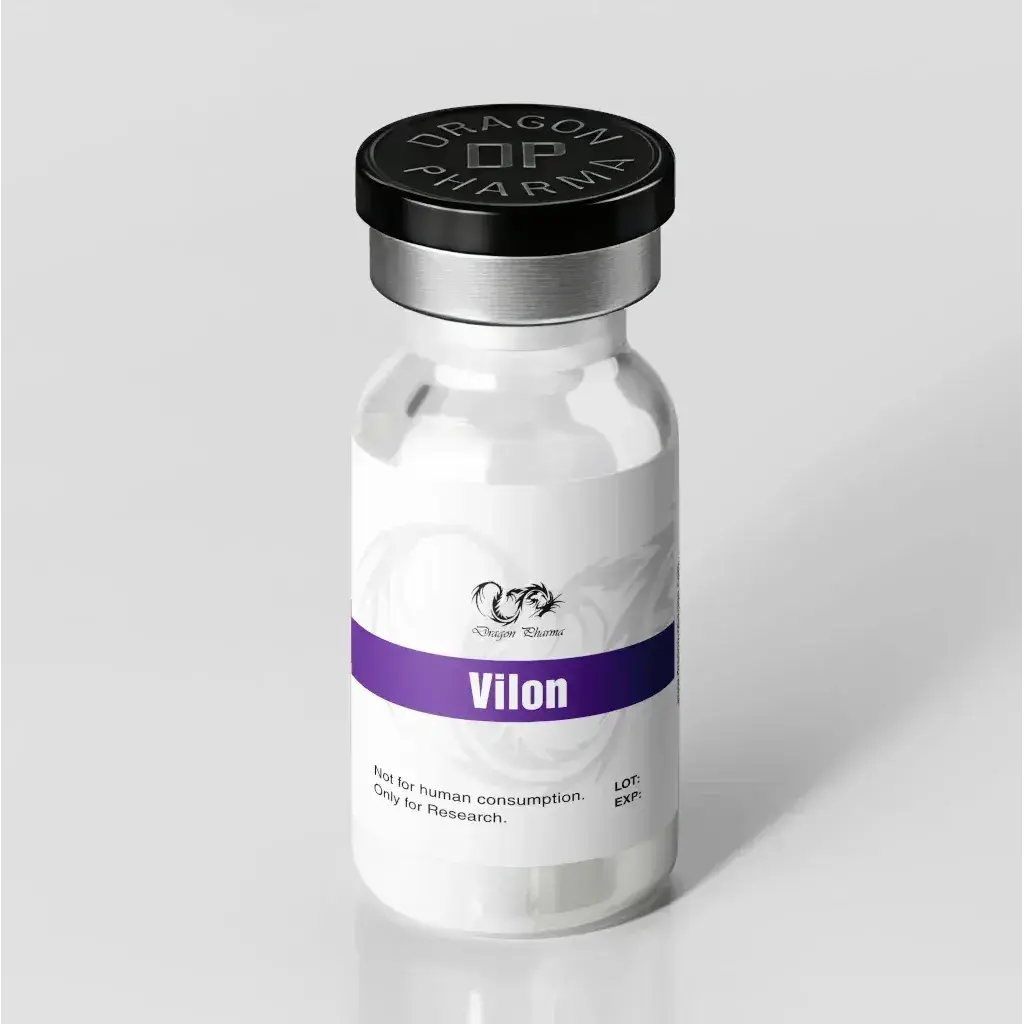
Vilon Injectable
Vilon 20 mg contains the Lys-Glu (Lysylglutamic acid) dipeptide, a synthetic bioregulator developed by the Khavinson research group at the St. Petersburg Institute of Bioregulation and Gerontology. It is the shortest member of the Khavinson peptide class, consisting of just two amino acids: lysine and glutamic acid. Vilon is also known by the synonym lysylglutamic acid and is indexed in the NIH PubChem database as CID 7010502.
In preclinical research, Vilon is studied for its proposed epigenetic and immunomodulatory mechanisms. A 2004 study published in Biogerontology demonstrated that Vilon induces deheterochromatinization of facultative heterochromatin in cultured lymphocytes from older donors, activating synthetic processes and releasing genes repressed by aging-related chromatin condensation. A 2000 study found that Vilon stimulated interleukin-2 gene expression in mouse spleen lymphocytes in vitro, suggesting a role in immune regulation. In animal models, chronic subcutaneous Vilon administration to female CBA mice starting at 6 months of age increased physical activity and endurance, decreased body temperature, prolonged lifespan, and prevented spontaneous neoplasms.
In bodybuilding and longevity contexts, Vilon is referenced anecdotally for immune support and its proposed geroprotective effects. However, **no Western clinical trials have been registered** for Vilon, and no human pharmacokinetic data exists. All published research originates from a single Russian research program without independent replication. Community protocols are extrapolated from preclinical animal studies and Russian bioregulator marketing, and reported doses vary widely from 67 mcg to 10 mg daily. Such use falls outside any approved indication.
Research Properties of Vilon 20 mg
- Lys-Glu dipeptide — the shortest Khavinson bioregulator
- Proposed epigenetic modulation of chromatin structure
- Investigated for interleukin-2 gene expression stimulation
- Preclinical evidence for lifespan extension in mice
- 20 mg per vial for research applications
Lys-Glu Dipeptide Bioregulator
Vilon belongs to the Khavinson bioregulator class, a family of ultrashort peptides developed at the St. Petersburg Institute of Bioregulation and Gerontology for proposed tissue-specific regulatory effects. The Lys-Glu sequence is derived from amino acid analysis of the thymus preparation Thymalin and is proposed to mimic the immunoregulatory properties of thymic peptides.
The proposed mechanism involves direct interaction with DNA and core histones after cellular penetration. A 2004 study demonstrated that Vilon induces progressive activation (deheterochromatinization) of facultative heterochromatin in cultured lymphocytes from old people, increasing with aging. This chromatin remodeling is thought to reactivate genes silenced by age-related condensation, including ribosomal genes and genes repressed by euchromatic condensation.
Vilon has also been investigated for its effects on interleukin-2 gene expression. A 2000 study found that Lys-Glu at 5 ng/mL stimulated IL-2 mRNA synthesis in mouse spleen lymphocytes after 5-hour incubation, and prolonged incubation (20 hours) sustained this effect even without mitogen stimulation. In vivo, chronic subcutaneous Vilon administration to female CBA mice starting at 6 months of age increased physical activity and endurance, decreased body temperature, prolonged lifespan, and prevented spontaneous neoplasm development.
Defining Characteristic
Proposed Epigenetic Chromatin Remodeling
Vilon's defining research characteristic is its proposed ability to induce deheterochromatinization and reactivate dormant genes in aged cells. This epigenetic mechanism differs fundamentally from receptor-mediated immune modulation.
Vilon 20 mg vs Other Dragon Pharma Preparations
Dragon Pharma offers several Khavinson bioregulators with different sequences and proposed targets. Epitalon (Ala-Glu-Asp-Gly) is a tetrapeptide studied for telomerase activation and pineal regulation. Vesugen (Lys-Glu-Asp) is a tripeptide for vascular endothelium. Cartalax (Ala-Glu-Asp) targets cartilage tissue. Vilon's Lys-Glu sequence is the shortest in this family and is associated with immune and geroprotective research.
Typical Dosage Ranges
Common reference ranges for Vilon are not well characterized in publicly available research literature. No validated human dosing protocol exists. Preclinical mouse studies used chronic subcutaneous administration starting at 6 months of age. Community protocols reference a wide range from 67 mcg to 10 mg daily, typically in short 5–10 day cycles, but these are anecdotal extrapolations from animal data and Russian bioregulator marketing.
| Use Case |
Common Reference Range |
Frequency |
| Preclinical (mouse lifespan study) |
Chronic subcutaneous |
Long-term administration |
| Community protocol (low dose) |
67–667 mcg |
5 consecutive days per month |
| Community protocol (high dose) |
5–10 mg |
10 consecutive days, repeat every 3–6 months |
Reconstitution & Handling
Vilon 20 mg is supplied as a lyophilized powder requiring reconstitution. Bacteriostatic Water is commonly referenced for reconstituting research peptides. A 20 mg vial reconstituted with 2 mL yields a concentration of 10 mg/mL; with 3 mL yields approximately 6.67 mg/mL. Slowly inject the diluent against the vial wall and gently swirl until fully dissolved. Do not shake. Store reconstituted solution refrigerated at 2–8°C and use within one week or aliquot and freeze.
Stacking & Research Considerations
In Khavinson bioregulator protocols, Vilon is sometimes referenced alongside other tissue-specific peptides. Epitalon (pineal/telomerase) is the most commonly mentioned companion in combined longevity protocols. However, no controlled studies have examined the safety or efficacy of these combinations in humans.
Important
Individual Response Varies
The information above is for educational reference and does not constitute medical advice. Vilon has not been evaluated by the FDA for safety or efficacy in humans.
Important Safety Information
No formal safety data exists for Vilon from Western regulatory authorities. All published research originates from a single Russian research program, and no independent Western replication or controlled human trials have been conducted. In preclinical studies, long-term administration of Vilon to mice caused no unfavourable effects on animal development. However, these findings do not establish human safety.
Important
Non-Medical Use
Non-medical use of Vilon falls outside any approved indication. Product purity does not establish that non-medical use is safe or appropriate for an individual. Material sold online is research-chemical grade, not pharmaceutical grade.
Potential Adverse Effects
Community reports describe brain fog and ringing in the ears at doses of 1–3 mg. Because Vilon is proposed to induce chromatin decondensation and gene reactivation, theoretical risks include unintended activation of oncogenes or transposable elements, though these concerns remain speculative and no such effects have been observed in animal studies. The Russian bioregulator product has been marketed as safe, but this lacks independent Western validation.
Conditions Requiring Medical Evaluation
Individuals with active cancer, known hypersensitivity to peptide products, or pregnancy/breastfeeding status should exercise particular caution. No formal contraindication list exists for Vilon because it has not undergone Western regulatory review.
Monitoring Considerations
If Vilon is used in any research context, monitoring of immune markers (CBC with differential) and general metabolic parameters may be considered, though no standardized protocol exists. Laboratory testing of the product itself is separate from clinical monitoring of the individual.
Product Care
Storage & Handling
Store lyophilized powder at -20°C, protected from light and moisture. After reconstitution, store at 2–8°C and use within one week or aliquot and freeze. Do not use if solution becomes cloudy or develops particulate matter.
Keep all research peptides and injectable products out of the reach of children.
Further Safety Information
USA Domestic 3–5 business days
International 10–15 business days
Order Processing 24–48 business hours
Tracking Provided after dispatch
Direct Supply
Discreet Delivery & Original Packaging
The outer shipping package remains discreet, with no external product details. Products are supplied through the official Dragon Pharma distribution chain.
What to Expect
- Orders are processed after payment confirmation
- USA Domestic shipping is typically faster when local stock is available
- International orders include tracking, though update frequency may vary by destination
- Multiple warehouses may result in separate shipments when applicable
Authenticity Verification
To verify your Vilon 20 mg product, use the security code on the vial label and cross-check it on the official Dragon Pharma site. A credible certificate of analysis should show HPLC purity above 97 percent and mass spectrometry confirmation of the correct molecular weight (275.30 g/mol). Original packaging and batch documentation help reinforce product legitimacy.
For complete delivery details, tracking policy, and reshipment terms, please see our Shipping Info page.
Recommended Conditions
Store lyophilized powder at -20°C, protected from light and moisture. The unopened vial should be kept under conditions that preserve the peptide's structural integrity until reconstitution.
Once reconstituted, Vilon solution should be stored at 2–8°C and used within one week, or aliquoted and frozen for longer storage. Do not freeze reconstituted solution if planning to use within the week. Discard if solution becomes cloudy or develops particulate matter.
Keep out of reach of children. Follow proper handling practices for research peptides and use appropriate sterile technique during reconstitution.
Quick Reference
Do & Don't
- Do store lyophilized powder at -20°C
- Do protect from light and moisture
- Do use reconstituted solution within one week
- Don't freeze reconstituted solution for short-term use
- Don't expose to excessive heat
- Don't use if powder appears discolored
What is Vilon 20 mg used for?
Vilon 20 mg is a research peptide supplied as a lyophilized powder. It contains the Lys-Glu dipeptide, which is investigated for proposed epigenetic effects on chromatin structure and immune gene expression. There is no FDA-approved human indication for Vilon.
How often should Vilon 20 mg be administered?
Common reference ranges for Vilon are not well characterized in publicly available research literature. No validated human dosing protocol exists. Community protocols reference doses from 67 mcg to 10 mg daily, typically in short 5–10 day cycles, but these are anecdotal.
Does Vilon 20 mg require PCT?
Vilon is not an anabolic steroid and does not suppress endogenous testosterone production. Post-cycle therapy designed for steroid cycles is not applicable. Its proposed epigenetic mechanism is distinct from hormonal suppression.
What does Vilon do?
Vilon is proposed to penetrate cell nuclei and induce deheterochromatinization, reactivating genes silenced by age-related chromatin condensation. It has been shown to stimulate interleukin-2 gene expression in lymphocytes. These mechanisms remain investigational and have not been independently validated.
How long does Vilon take to work?
No established onset timeline exists for Vilon in humans because no controlled trials have been completed. Its proposed epigenetic mechanism would theoretically involve gene expression changes that develop over days to weeks, with effects potentially persisting after the peptide clears.
Is Vilon the best immune peptide?
No single immune peptide is universally superior. Vilon's research focus on chromatin remodeling and immune gene reactivation is distinct from other peptides in Dragon Pharma's catalog. It has been indexed in NIH PubChem and studied in Russian preclinical models, but lacks independent Western validation.
What is the difference between Vilon and Epitalon?
Vilon (Lys-Glu) and Epitalon (Ala-Glu-Asp-Gly) are both Khavinson bioregulators but have different sequences and proposed targets. Vilon is associated with immune modulation and chromatin remodeling, while Epitalon is studied for telomerase activation and pineal regulation.
What is the difference between Vilon and Vesugen?
Vilon (Lys-Glu) and Vesugen (Lys-Glu-Asp) share the first two amino acids, but Vesugen has an additional aspartic acid residue and is associated with vascular endothelium. Vilon is the shorter dipeptide and is studied for immune and geroprotective effects.
Is 20 mg of Vilon a lot?
20 mg is the total labeled content of the Vilon 20 mg vial. Because no standardized human dosage exists for this research peptide, the milligram amount cannot be classified as high or low relative to established protocols. Community protocols reference doses from 67 mcg to 10 mg per injection.
What strength is Vilon 20 mg?
Vilon 20 mg by Dragon Pharma contains 20 mg of Vilon per vial as a lyophilized powder. The vial size is 2 mL. This is a research presentation.
Can Vilon be stacked with other peptides?
In Khavinson bioregulator protocols, Vilon is sometimes referenced alongside other tissue-specific peptides. Epitalon is the most commonly mentioned companion in combined longevity protocols. However, no controlled studies have examined these combinations.
What are the risks of Vilon's epigenetic mechanism?
Theoretical concerns include unintended activation of oncogenes or transposable elements through chromatin decondensation. However, in mouse lifespan studies, Vilon prevented spontaneous neoplasm development rather than promoting it. These theoretical risks have not been observed in animal models but lack human safety data.
No reviews found
Please log in to write Vilon 20 mg review.