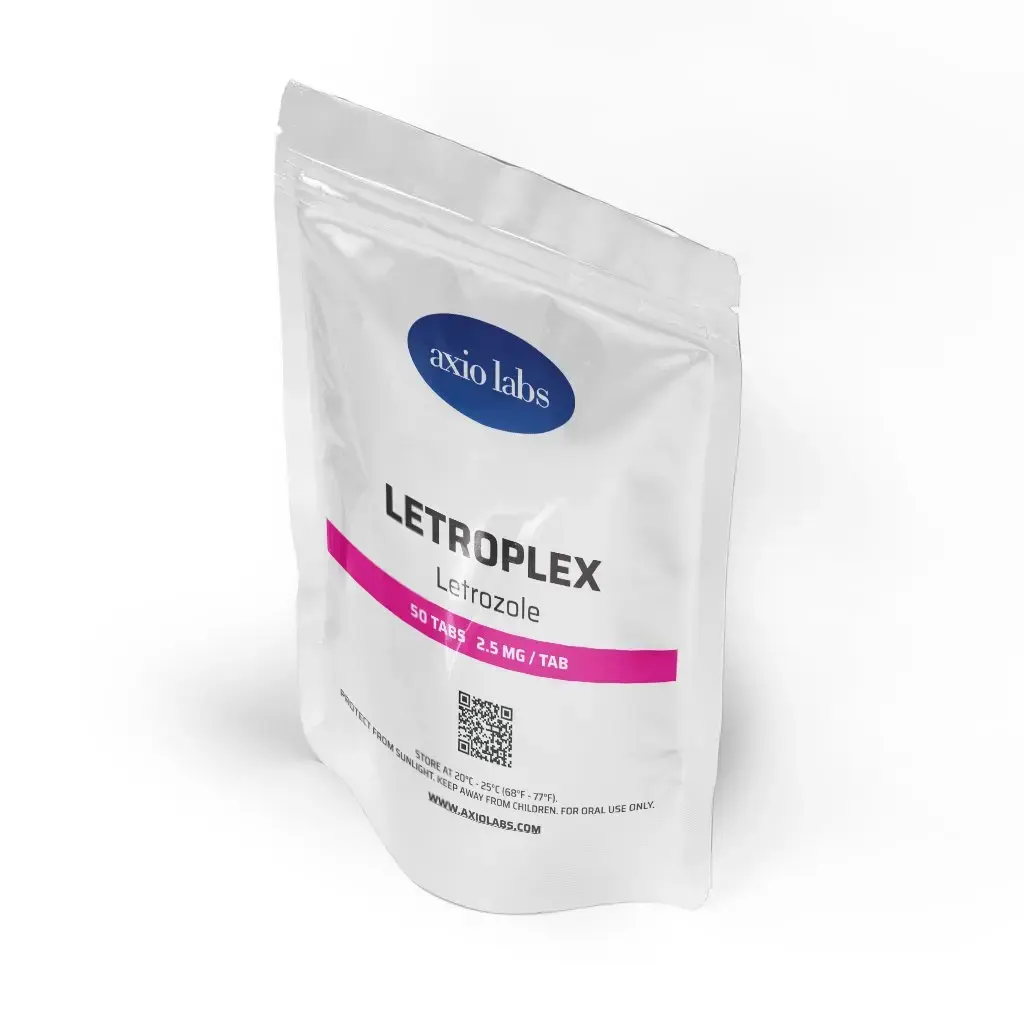
Letroplex 2.5 mg is an oral tablet containing Letrozole, manufactured by Axiolabs and supplied as 2.5 mg per tablet in 50 or 100 tablet packages.
Letroplex 2.5 mg contains letrozole, a potent nonsteroidal competitive inhibitor of the aromatase enzyme system. It works by binding reversibly to the aromatase enzyme (CYP19), inhibiting the conversion of androgens such as testosterone and androstenedione to estrogens including estradiol and estrone. This mechanism reduces circulating estrogen levels, which is the basis for its clinical use in hormone receptor-positive breast cancer.
Letrozole is FDA-approved under the brand name Femara for three indications: adjuvant treatment of postmenopausal women with hormone receptor-positive early breast cancer, extended adjuvant treatment of early breast cancer in postmenopausal women who have received 5 years of adjuvant tamoxifen therapy, and first-line or second-line treatment of advanced breast cancer in postmenopausal women. The standard dose is 2.5 mg once daily, without regard to meals.
In non-medical bodybuilding contexts, letrozole is referenced off-label for managing estrogenic side effects during anabolic steroid cycles and for gynecomastia reversal. A 2022 analysis of a French bodybuilding forum reported a mean letrozole dose of **2 mg/day** with a median treatment duration of **30 days** among users. However, letrozole is **not approved for this use**, and its profound estrogen suppression carries significant risks including bone mineral density loss, lipid disruption, and joint pain. Such use falls outside approved indications.
Letrozole is a third-generation nonsteroidal aromatase inhibitor with established efficacy in hormone receptor-positive breast cancer. Its research profile includes extensive clinical trial data spanning over two decades.
Letrozole belongs to the class of aromatase inhibitors, which are classified as steroidal (type I, irreversible) or nonsteroidal (type II, reversible). Letrozole is a nonsteroidal, reversible competitive inhibitor that binds to the aromatase enzyme's substrate-binding site. Aromatase is responsible for the final step in estrogen biosynthesis, converting androgens to estrogens in peripheral tissues including adipose tissue, muscle, and breast tissue.
The pharmacokinetic profile of letrozole includes a plasma terminal half-life of approximately 42 hours in healthy volunteers and 82 hours in breast cancer patients. Steady-state concentrations are reached after 2–6 weeks of daily dosing. The major route of elimination is via metabolism by CYP3A4 and CYP2A6 into a pharmacologically inactive carbinol metabolite.
Letrozole is a highly potent and selective inhibitor of aromatase, with IC50 values in the low nanomolar range (1–13 nM) in non-cellular systems. It completely lacks inhibition of progesterone or corticosterone production at high concentrations, demonstrating selectivity for the estrogen synthesis pathway.
Letrozole's defining pharmacological characteristic is its reversible, competitive inhibition of aromatase, distinguishing it from irreversible steroidal inhibitors like exemestane.
Axiolabs offers several ancillary and hormone-related products referenced in bodybuilding research. Exeplex (exemestane) is a steroidal aromatase inhibitor that irreversibly binds aromatase. Arimiplex (anastrozole) is a nonsteroidal aromatase inhibitor with lower potency than letrozole. Tamoxiplex (tamoxifen) is a selective estrogen receptor modulator that blocks estrogen action rather than inhibiting its synthesis. Letroplex provides reversible aromatase inhibition with the greatest potency among these options.
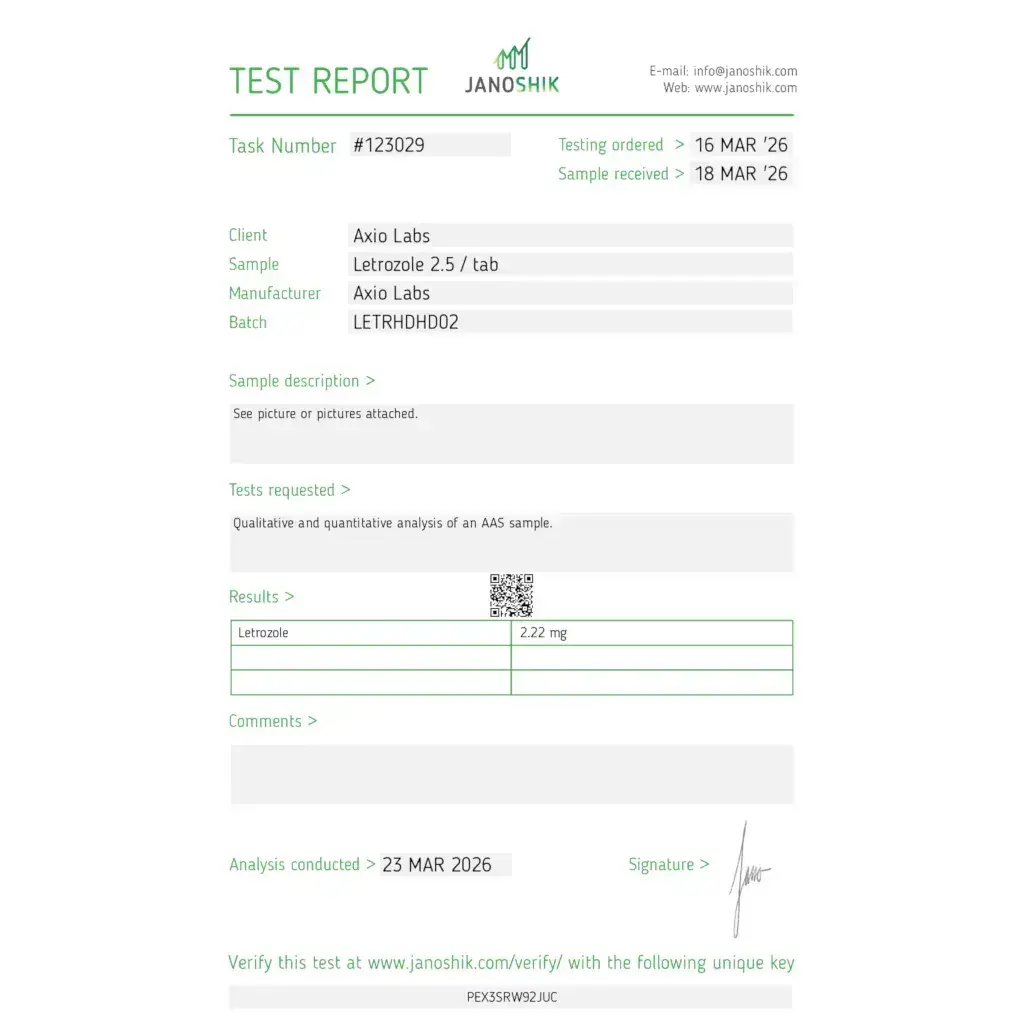
Published laboratory reports for Letroplex 2.5 mg by Axiolabs are shown below with the test date, batch number, measured content and percentage of the product's 2.5 mg label claim.
 View Report
Laboratory results apply to the specific tested sample represented in each published report and should not be interpreted as a measurement of every vial or production batch.
The information below is provided for educational reference only. Letrozole is a prescription medicine; medical use requires appropriate diagnosis, clinical supervision and monitoring. Non-medical use falls outside approved indications.
In medically supervised breast cancer treatment, the standard letrozole dose is 2.5 mg once daily, without regard to meals. For patients with cirrhosis and severe hepatic dysfunction, the recommended dose is 2.5 mg administered every other day. In non-medical bodybuilding contexts, letrozole is referenced at lower doses for managing estrogenic side effects, though this use is not supported by the FDA label. A 2022 forum analysis reported a mean dose of 2 mg/day with a median duration of 30 days.
| Use Case | Common Reference Range | Frequency |
|---|---|---|
| Medical (breast cancer) | 2.5 mg | Once daily |
| Medical (severe hepatic impairment) | 2.5 mg | Every other day |
| Non-medical (not approved) | Mean 2 mg/day | Median duration 30 days |
Letrozole is associated with significant adverse effects that require monitoring. The FDA label warns of decreases in bone mineral density, with a median decrease in lumbar spine BMD of 4.1% at 24 months compared to a median increase of 0.3% with tamoxifen. In the adjuvant trial, the incidence of bone fractures was 14.7% for letrozole versus 11.4% for tamoxifen at a median follow-up of 96 months. Hypercholesterolemia was reported in 52.3% of letrozole patients versus 28.6% of tamoxifen patients.
Letrozole is contraindicated in pregnancy (it can cause fetal harm) and in patients with known hypersensitivity to the active substance or excipients. It should not be used in premenopausal women. Strong CYP3A4 inducers may decrease letrozole exposure, and CYP2A6 inhibitors may increase it. Letrozole strongly inhibits CYP2A6 and moderately inhibits CYP2C19 in human liver microsomes.
The information above is for educational reference and does not constitute medical advice. Letrozole is a prescription medicine with significant adverse effects.
Letrozole is a prescription aromatase inhibitor with significant adverse effects. Medical use requires appropriate diagnosis, clinical supervision and monitoring.
Letrozole therapy is associated with several important risks. Decreases in bone mineral density may occur, and bone mineral density monitoring is recommended. Increases in total cholesterol may occur, warranting cholesterol monitoring. Letrozole can cause fetal harm and is contraindicated in pregnancy. In the extended adjuvant setting, the incidence of bone fractures was 13.3% for letrozole versus 7.8% for placebo, and new osteoporosis was 14.5% versus 7.8% respectively.
Non-medical use of letrozole falls outside approved indications. Letrozole is not approved for managing estrogenic side effects in men or for performance enhancement. Aromatase inhibitors are prohibited in sport and subject to doping control.
Common adverse reactions in clinical trials include hot flushes, fatigue, arthralgia, headache, insomnia, increased sweating, and nausea. Cardiovascular events including myocardial infarction and thromboembolic events have been reported. Letrozole can cause decreases in bone mineral density leading to osteoporosis and fractures. Hypercholesterolemia is common, reported in 52.3% of letrozole patients versus 28.6% of tamoxifen patients in the adjuvant trial.
Letrozole should not be used in premenopausal women or during pregnancy. Bone mineral density should be monitored, particularly in patients with osteoporosis risk factors. Cholesterol levels should be monitored as letrozole may increase total cholesterol. Letrozole should be used with caution in patients with severe hepatic impairment, requiring a 50% dose reduction.
During letrozole therapy, monitoring may include bone mineral density assessment, lipid panel, and liver function tests. In clinical trials, patients receiving letrozole had a median decrease in lumbar spine BMD of 4.1% at 24 months, while tamoxifen patients had a median increase of 0.3%. Cholesterol monitoring is recommended, with lipid-lowering medications required for 29% of letrozole patients versus 20% of tamoxifen patients.
Store tablets in a closed container at controlled room temperature, away from excessive heat, moisture, and direct light. Keep out of reach of children. Do not use if the packaging is damaged or if tablets appear discolored.
Letroplex 2.5 mg by Axiolabs is supplied through the official distribution chain and shipped with discreet, privacy-focused handling.
The outer shipping package remains discreet, with no external product details. Products are supplied through the official Axiolabs distribution chain.
To verify your Letroplex 2.5 mg product, use the security code on the packaging and cross-check it on the official Axiolabs site. A laboratory report dated March 23, 2026 measured the content at 2.22 mg per tablet, equivalent to 88.80% of the 2.5 mg label claim. Original packaging and batch documentation help reinforce product legitimacy.
For complete delivery details, tracking policy, and reshipment terms, please see our Shipping Info page.
Proper storage conditions help preserve tablet integrity and maintain product stability throughout shelf life.
Store tablets in a closed container at controlled room temperature (15–25°C), away from excessive heat, moisture, and direct light. Keep the product in its original packaging until use.
Do not use if the packaging is damaged or if tablets appear discolored or degraded. Keep out of reach of children.
Answers to common questions about Letroplex 2.5 mg, letrozole research, and product details.
Letroplex 2.5 mg contains letrozole, an aromatase inhibitor. In medical practice, it is FDA-approved for hormone receptor-positive breast cancer in postmenopausal women. In non-medical bodybuilding contexts, it is referenced off-label for managing estrogenic side effects, though this use is not approved.
The FDA-approved dose is 2.5 mg once daily, without regard to meals. For patients with severe hepatic impairment, the recommended dose is 2.5 mg every other day. Non-medical dosing is not standardized and falls outside approved indications.
Letrozole is not an anabolic steroid and does not suppress testosterone production in the same way. Post-cycle therapy designed for steroid cycles is not applicable. Its mechanism involves aromatase inhibition and estrogen suppression, not hormonal suppression of the HPTA.
Letrozole binds reversibly to the aromatase enzyme (CYP19), blocking the conversion of androgens such as testosterone to estrogens including estradiol. This reduces circulating estrogen levels and is the basis for its use in hormone receptor-positive breast cancer.
Letrozole has a plasma terminal half-life of approximately 42 hours in healthy volunteers and 82 hours in breast cancer patients. Steady-state concentrations are reached after 2–6 weeks of daily dosing. Estrogen suppression occurs rapidly after initiating therapy.
No single aromatase inhibitor is universally superior. Letrozole, anastrozole, and exemestane are all approved for breast cancer treatment. A 2025 comparative effectiveness study suggested that anastrozole or letrozole may be favored as initial treatment over exemestane.
Arimiplex (anastrozole) is a nonsteroidal aromatase inhibitor with lower potency than letrozole. Letrozole has been shown to be a more potent inhibitor of aromatase in vitro. Both are reversible competitive inhibitors.
Exeplex (exemestane) is a steroidal aromatase inhibitor that irreversibly binds aromatase. Letroplex (letrozole) is a nonsteroidal inhibitor that binds reversibly. Both reduce estrogen synthesis but through different mechanisms.
2.5 mg is the FDA-approved daily dose for breast cancer treatment. The laboratory report for this Letroplex product measured 2.22 mg per tablet, which is 88.80% of the 2.5 mg label claim. This represents a slight underage relative to label.
Letroplex 2.5 mg by Axiolabs contains 2.5 mg of letrozole per tablet. It is supplied in packages of 50 or 100 tablets. A laboratory report dated March 23, 2026 measured the content at 2.22 mg, equivalent to 88.80% of the label claim.
Yes. A published laboratory report dated March 23, 2026 measured Letroplex 2.5 mg at 2.22 mg per tablet, equivalent to 88.80% of its 2.5 mg label claim. The complete report can be viewed in the Lab Reports tab.
Letrozole is not approved for use in men. Its profound estrogen suppression can cause joint pain, bone mineral density loss, lipid disruption, and sexual dysfunction. Estrogen is important for male bone health, libido, and cardiovascular function.