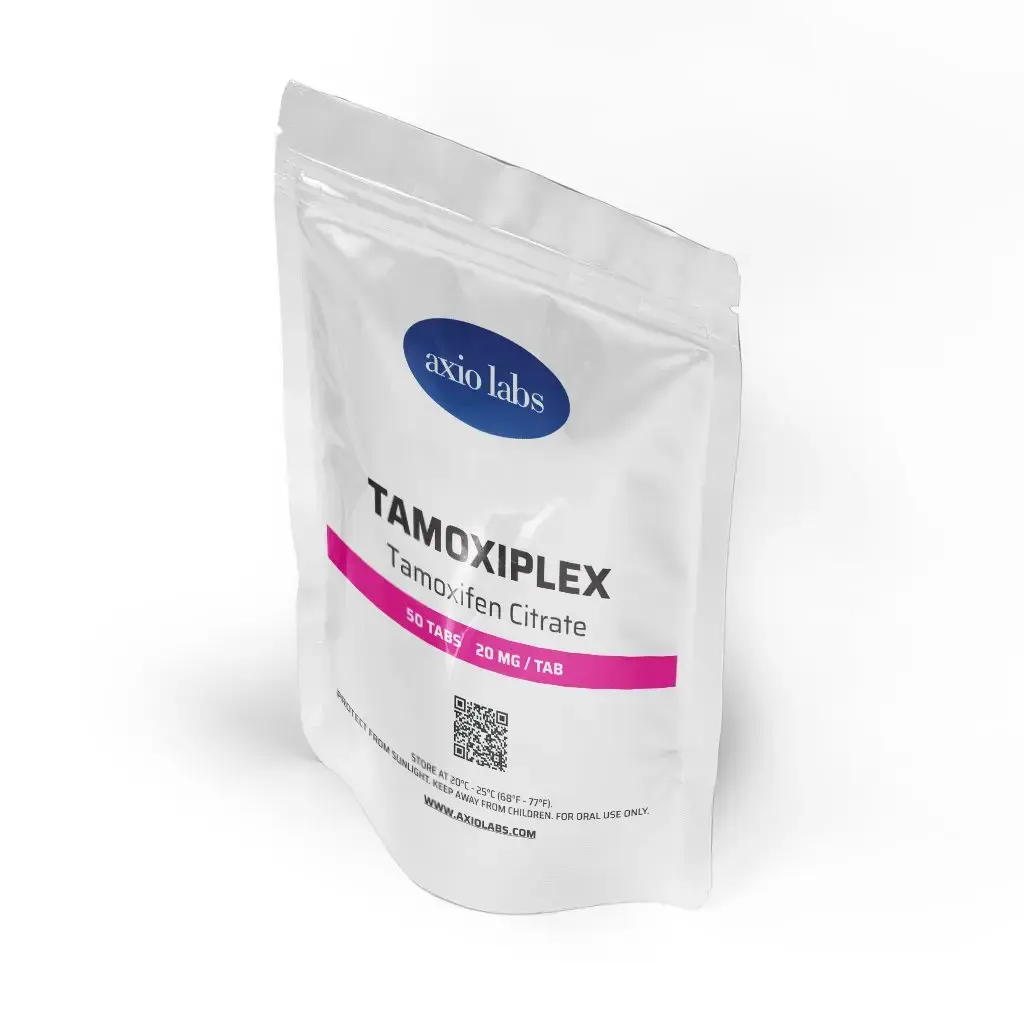
Tamoxiplex 20 mg is an oral tamoxifen citrate product manufactured by Axiolabs and supplied as 20 mg tablets in 50-tablet or 100-tablet packages.
Tamoxiplex 20 mg contains tamoxifen citrate, a selective estrogen receptor modulator (SERM) that has been FDA-approved since 1977 for the treatment of breast cancer and later for breast cancer risk reduction in high-risk women . Tamoxifen is a non-steroidal triphenylethylene derivative that displays a complex spectrum of estrogen antagonist and estrogen agonist-like effects in different tissues . Its primary mechanism in breast tissue involves competing with estradiol for binding to estrogen receptor proteins, thereby blocking estrogen's proliferative effects.
In clinical medicine, tamoxifen is indicated for the treatment of metastatic breast cancer, adjuvant therapy of node-positive and node-negative breast cancer, and reduction of breast cancer incidence in women at high risk . The standard clinical dose for breast cancer treatment is 20 mg daily, with pharmacokinetic studies showing that steady-state concentrations are achieved in about 4 weeks . In bodybuilding and performance-enhancement contexts, tamoxifen is commonly referenced for two primary purposes: preventing and treating gynecomastia during cycles involving aromatizable compounds, and as a component of post-cycle therapy (PCT) to help restore endogenous testosterone production.
Tamoxifen's effects in bodybuilding contexts are attributed to its ability to block estrogen receptors in breast tissue while potentially acting as an estrogen agonist in other tissues such as the liver and bone. In the pituitary, tamoxifen's anti-estrogenic action reduces negative feedback from estrogen, which can stimulate the release of luteinizing hormone (LH) and follicle-stimulating hormone (FSH), supporting the restart of natural testosterone production during PCT. These applications fall outside approved medical indications, and tamoxifen carries significant risks including thromboembolic events and endometrial changes.
Tamoxifen citrate is a first-generation selective estrogen receptor modulator with a long half-life and a complex tissue-specific profile, making it a mainstay in both oncology and, in non-medical contexts, hormonal management.
Tamoxifen is classified as a non-steroidal triphenylethylene-based drug that displays both estrogen antagonist and estrogen agonist-like pharmacological effects depending on the target tissue. In breast tissue, it acts as an estrogen antagonist, competing with estradiol for estrogen receptor binding and inhibiting estrogen-dependent cell proliferation. In tissues such as bone and liver, it can exhibit estrogen agonist-like effects, which contributes to its complex risk-benefit profile.
The pharmacokinetics of tamoxifen are characterized by a long terminal elimination half-life of approximately 5 to 7 days for the parent drug and an estimated 14 days for its major metabolite N-desmethyl tamoxifen . Following a single 20 mg oral dose, peak plasma concentrations of approximately 40 ng/mL occur at about 5 hours . Steady-state concentrations are achieved in about 4 weeks for tamoxifen and about 8 weeks for N-desmethyl tamoxifen . Tamoxifen is extensively metabolized via cytochrome P-450 enzymes, and genetic variations in CYP2D6 can affect conversion to the more potent active metabolite endoxifen.
This long half-life and tissue-specific activity profile define tamoxifen's practical application. In medical oncology, it is used for breast cancer treatment and prevention. In non-medical bodybuilding contexts, its estrogen receptor blockade in breast tissue is referenced for gynecomastia management, while its anti-estrogenic effects in the pituitary are leveraged for PCT protocols.
Tamoxifen's tissue-specific activity—estrogen antagonist in breast, partial agonist in bone and liver—distinguishes it from aromatase inhibitors and defines both its therapeutic utility and its side effect profile.
Axiolabs produces several products referenced in different contexts within bodybuilding. Tamoxiplex 20 mg is a tamoxifen citrate product, distinguishing it from aromatase inhibitors such as Arimiplex (anastrozole) and Exeplex (exemestane), which work by blocking estrogen synthesis rather than receptor binding.
For PCT protocols, tamoxifen is often compared with Clomiplex (clomiphene citrate), another SERM. While both are used in PCT, they have different receptor binding profiles and side effect considerations. Tamoxiplex is not an anabolic steroid and is not used for muscle growth or direct hormone manipulation.
The information below is provided for educational reference only. Tamoxifen citrate is a prescription medication; medical use requires appropriate diagnosis and clinical supervision. Non-medical use falls outside approved indications.
In FDA-approved labeling for breast cancer treatment, the standard dose of tamoxifen is 20 mg daily . In non-medical bodybuilding contexts, tamoxifen is commonly referenced in the range of 20–40 mg per day for PCT, with some protocols using a higher starting dose followed by a taper. For gynecomastia management during cycles, doses of 20–40 mg daily are sometimes referenced until symptoms subside.
| Use Case | Common Reference Range | Frequency |
|---|---|---|
| Medical (breast cancer treatment) | 20 mg / day | Once daily |
| Bodybuilding PCT (non-medical) | 20–40 mg / day | Once daily |
| Gynecomastia management (non-medical) | 20–40 mg / day | Once daily until symptoms resolve |
In non-medical bodybuilding contexts, tamoxifen is primarily used in PCT rather than during cycles. Typical PCT protocols reference tamoxifen at 20–40 mg daily for 4–6 weeks following the conclusion of a suppressive cycle. It is sometimes combined with Clomiplex (clomiphene citrate) for synergistic HPTA stimulation, though protocols vary widely.
An important consideration in non-medical contexts is that tamoxifen is not appropriate for managing gynecomastia caused by 19-nor compounds such as trenbolone or nandrolone, as it may upregulate progesterone receptors and potentially worsen the condition.
Common side effects of tamoxifen include hot flashes and vaginal discharge in women . In men using tamoxifen in non-medical contexts, potential side effects include visual disturbances, mood changes, and reduced libido. Tamoxifen can also suppress IGF-1 levels, which may be counterproductive for muscle growth goals.
Serious but less common side effects include thromboembolic events (blood clots in veins or lungs) and endometrial changes in women . These risks are relevant to medical use and underscore the importance of clinical oversight.
Tamoxifen is one of the most commonly referenced agents for PCT in non-medical bodybuilding contexts. Its mechanism in this application involves blocking estrogen receptors in the pituitary, which reduces negative feedback and stimulates LH and FSH release, supporting the recovery of endogenous testosterone production. Typical protocols reference 20–40 mg daily for 4–6 weeks, though individual protocols vary based on cycle duration and compounds used.
Dosing strategies and support protocols should account for individual experience and health status. The information above is for educational reference and does not constitute medical advice.
Tamoxifen citrate is a prescription medication with serious potential risks including thromboembolic events and endometrial changes. Medical use requires appropriate diagnosis and ongoing clinical supervision.
Tamoxifen carries a boxed warning for serious and potentially life-threatening risks including uterine malignancies, stroke, and pulmonary embolism. An increased incidence of uterine malignancies, primarily endometrial adenocarcinoma, has been reported in association with tamoxifen treatment. Rare uterine sarcomas, including malignant mixed mullerian tumors, have also been reported and are generally associated with poorer prognosis.
Tamoxifen is contraindicated in women who require concomitant coumarin-type anticoagulant therapy or who have a history of deep-vein thrombosis or pulmonary embolus. It is also contraindicated in pregnancy and breastfeeding.
Tamoxifen is not approved for bodybuilding, athletic performance enhancement, or gynecomastia prevention in otherwise healthy men. Non-medical use falls outside approved indications and may carry additional health risks beyond those associated with supervised medical use.
The most common side effects of tamoxifen include hot flashes and vaginal discharge. Less common but serious side effects include changes in the uterine lining (endometrial cancer risk), blood clots in veins or lungs, stroke, cataracts, and liver problems including jaundice.
In clinical trials, tamoxifen treatment was associated with a statistically significant increase in endometrial cancer incidence (33 cases vs 14 cases with placebo). There was also a non-significant reduction in hip fractures in the tamoxifen group.
Other reported effects include visual disturbances and mood changes. Tamoxifen can suppress IGF-1 levels, which is relevant in bodybuilding contexts where IGF-1 is important for muscle growth.
Tamoxifen should not be used in pregnancy or breastfeeding. It is contraindicated in individuals with a history of deep-vein thrombosis or pulmonary embolus who are receiving coumarin-type anticoagulants. Medical evaluation is required before any consideration of use, including assessment of thromboembolic risk and, in women, uterine health.
Medically supervised tamoxifen therapy typically involves monitoring for thromboembolic events, uterine changes in women, and hepatic function. These monitoring practices are relevant to medical use; non-medical use lacks the same clinical oversight. Blood work including liver function tests and lipid panels may be considered in non-medical contexts, though evidence for specific monitoring protocols is limited.
Store tablets in a cool, dry place away from direct light and moisture. Keep in original packaging until use. Keep out of reach of children. Do not use if the product appears damaged or compromised.
Tamoxiplex 20 mg is shipped in original manufacturer packaging with discreet, privacy-focused handling.
Outer packaging remains discreet with no external product details. Products are supplied in original manufacturer presentation.
To verify product authenticity, examine the packaging for manufacturer security features and compare against official Axiolabs presentation. Original packaging and consistent labeling help confirm product legitimacy.
For complete delivery details, please see our Shipping Info page.
Proper storage conditions help preserve product integrity and tablet stability.
Store in a cool, dry place at controlled room temperature. Protect from excessive heat, moisture, and direct light. Keep tablets in their original packaging until use. Do not use if the product appears compromised or if tablets show signs of deterioration.
Keep out of reach of children. Follow proper handling practices.
Answers to common questions about Tamoxiplex 20 mg, tamoxifen citrate, dosing, and product characteristics.
Tamoxiplex 20 mg contains tamoxifen citrate, a SERM. In medical practice, it is approved for breast cancer treatment and risk reduction in high-risk women . In non-medical bodybuilding contexts, it is commonly referenced for PCT and gynecomastia management. Non-medical use falls outside approved indications.
In medical practice, tamoxifen is taken once daily at 20 mg . In non-medical bodybuilding contexts, it is commonly referenced at 20–40 mg once daily for PCT or gynecomastia management. The long half-life of 5–7 days supports once-daily dosing.
No. Tamoxiplex 20 mg is itself commonly used as a component of PCT in non-medical bodybuilding contexts. It does not suppress the hypothalamic-pituitary-gonadal axis and is used to support recovery of endogenous testosterone production after suppressive cycles.
Tamoxifen citrate is a selective estrogen receptor modulator that blocks estrogen receptors in breast tissue while exhibiting estrogen agonist-like effects in other tissues such as bone and liver. In PCT contexts, it reduces estrogen negative feedback in the pituitary, stimulating LH and FSH release.
Tamoxifen reaches peak plasma concentrations in about 5 hours after a single 20 mg dose . Steady-state concentrations are achieved in about 4 weeks with chronic dosing . In bodybuilding contexts, subjective effects during PCT are often reported within the first 1–2 weeks, though individual response varies.
There is no universally "best" SERM for PCT. Tamoxifen is one of the most commonly referenced agents, but Clomiplex (clomiphene citrate) is also widely used. The choice depends on individual response, side effect tolerance, and cycle characteristics.
Both tamoxifen and clomiphene are SERMs used in PCT, but they have different receptor binding profiles and side effect considerations. Tamoxifen is more commonly referenced for gynecomastia management, while clomiphene is sometimes preferred for its effects on LH and FSH. Axiolabs offers Clomiplex as its clomiphene product.
Tamoxifen and anastrozole work through different mechanisms. Tamoxifen is a SERM that blocks estrogen receptors, while anastrozole is an aromatase inhibitor that blocks estrogen synthesis. They serve different purposes and are not interchangeable. Axiolabs offers Arimiplex as its anastrozole product.
In medical practice, 20 mg daily is the standard dose . In non-medical bodybuilding contexts, 40 mg daily is sometimes referenced during the initial phase of PCT or for acute gynecomastia management. Tamoxiplex 20 mg contains 20 mg per tablet, so 40 mg would equal two tablets daily.
Tamoxiplex 20 mg is supplied as 20 mg tamoxifen citrate tablets in 50-tablet or 100-tablet packages, giving 1,000 mg or 2,000 mg of total labeled tamoxifen citrate content.
In non-medical bodybuilding contexts, tamoxifen is sometimes referenced for managing gynecomastia symptoms during cycles involving aromatizable compounds. However, it is not appropriate for gynecomastia caused by 19-nor compounds such as trenbolone or nandrolone, as it may worsen the condition by upregulating progesterone receptors.
Yes. Tamoxifen carries boxed warnings for uterine malignancies, stroke, and pulmonary embolism. It can increase the risk of endometrial cancer and blood clots. These risks are relevant to medical use and underscore the importance of clinical oversight.