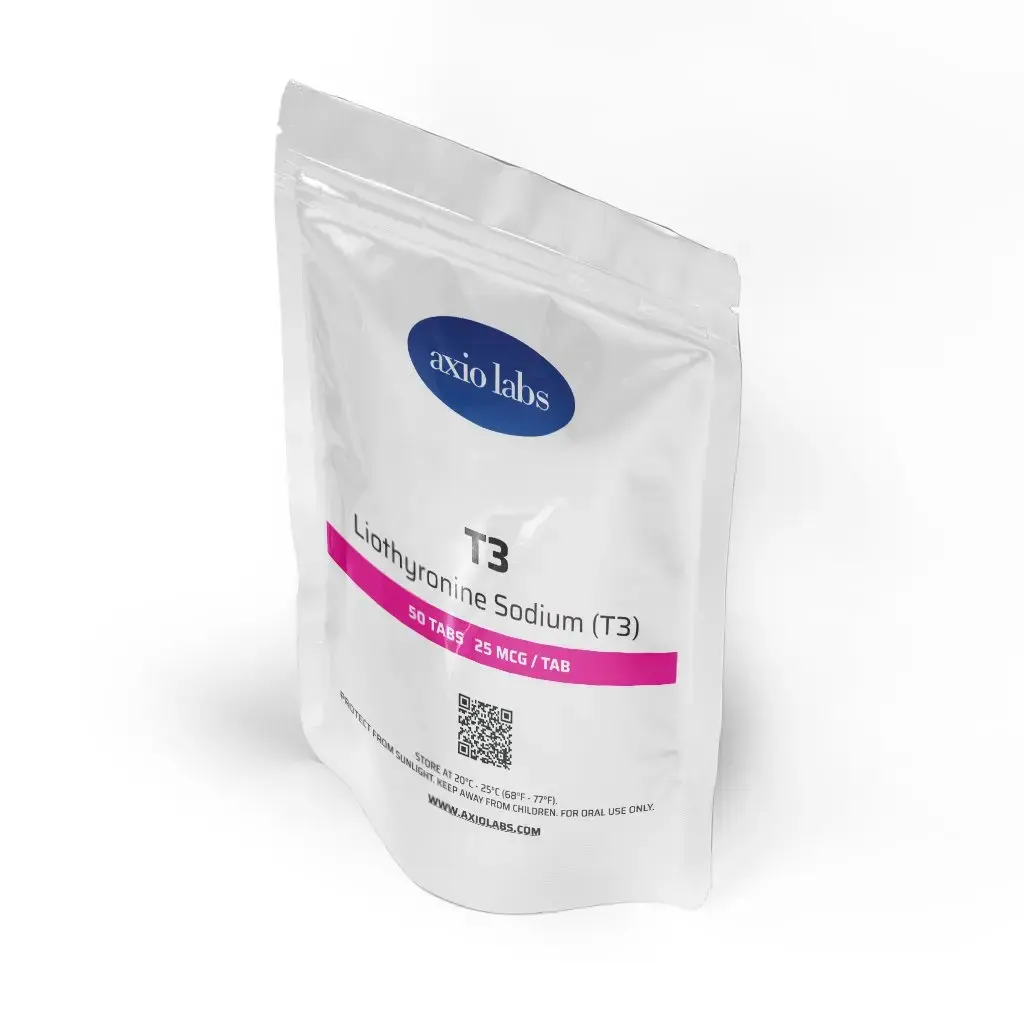
T3 25 mcg is an oral liothyronine sodium product manufactured by Axiolabs and supplied as 25 mcg tablets in 50-tablet or 100-tablet packages.
T3 25 mcg contains liothyronine sodium, a synthetic form of triiodothyronine (T3), the biologically active thyroid hormone. T3 is produced endogenously primarily through peripheral deiodination of thyroxine (T4), with approximately 80% of circulating T3 derived from this conversion process. Liothyronine sodium is FDA-approved for the treatment of hypothyroidism and as a diagnostic agent in thyroid suppression tests.
In clinical medicine, liothyronine sodium is indicated as replacement therapy in primary, secondary, and tertiary hypothyroidism, and for pituitary TSH suppression. The recommended starting dosage for adults with hypothyroidism is 25 mcg orally once daily, with adjustments based on clinical response and laboratory parameters. In bodybuilding and physique-oriented contexts, liothyronine is commonly referenced during cutting phases for its metabolic rate-enhancing effects, though such use falls outside approved medical indications and carries significant risks.
Liothyronine exerts its effects by diffusing into cell nuclei and binding to thyroid receptor proteins attached to DNA, activating gene transcription and synthesis of messenger RNA and cytoplasmic proteins. This mechanism increases basal metabolic rate, oxygen consumption, and the metabolism of carbohydrates, fats, and proteins. Importantly, the FDA labeling explicitly states that thyroid hormones should not be used for the treatment of obesity or for weight loss, and that larger doses may produce serious or life-threatening toxicity.
Liothyronine sodium is the synthetic form of T3, the biologically active thyroid hormone, with a rapid onset and relatively short half-life compared to T4 preparations.
Liothyronine sodium is the sodium salt of synthetic triiodothyronine (T3), which is the physiologically active form of thyroid hormone. While T4 (levothyroxine) is the primary hormone secreted by the thyroid gland, T3 is approximately four times more potent and is responsible for the majority of thyroid hormone activity at the cellular level.
T3 is almost totally absorbed, with approximately 95% absorption within 4 hours of oral administration. Unlike T4, liothyronine is not firmly bound to serum proteins, which contributes to its rapid onset of action and shorter duration of effect. The biological half-life of liothyronine is approximately 2.5 days, compared to the longer half-life of T4 preparations.
This pharmacokinetic profile makes liothyronine useful in clinical settings where rapid dose adjustment is needed, but also contributes to its appeal in non-medical contexts where rapid metabolic effects are sought. Clinical research has demonstrated that T3 increases metabolic rate and oxygen consumption, but also increases protein catabolism—meaning that weight loss from T3 can come at the expense of lean body mass.
Liothyronine's short half-life of approximately 2.5 days and rapid absorption distinguish it from longer-acting T4 preparations. This allows for quick dose adjustments but also requires careful monitoring and tapering.
T3 25 mcg is a thyroid hormone product and is not an anabolic steroid. It should not be confused with compounds used for muscle building or hormone replacement such as Testaplex C 250 or Oxandroplex. In non-medical bodybuilding contexts, T3 is sometimes referenced alongside fat-loss agents such as Clenbutaplex, though such combinations carry significant cardiovascular risks.
Unlike anabolic steroids, T3 does not suppress the hypothalamic-pituitary-gonadal axis and does not require post-cycle therapy for testosterone recovery. However, it does suppress endogenous thyroid hormone production, and abrupt cessation can lead to temporary hypothyroidism.
The information below is provided for educational reference only. Liothyronine sodium is a prescription medication; medical use requires appropriate diagnosis and clinical supervision. Non-medical use falls outside approved indications.
In FDA-approved labeling, the recommended starting dosage for hypothyroidism is 25 mcg once daily, with increases of 25 mcg daily every 1 to 2 weeks as needed, and a usual maintenance dose of 25–75 mcg daily. In non-medical bodybuilding contexts, T3 is commonly referenced at 25–100 mcg per day, with many users starting at 25 mcg and gradually increasing. Doses above 75 mcg are associated with increased risk of cardiac arrhythmias and other serious adverse effects.
| Use Case | Common Reference Range | Frequency |
|---|---|---|
| Hypothyroidism (medical) | 25–75 mcg / day | Once daily |
| Bodybuilding (non-medical) | 25–100 mcg / day | Once or split doses |
| Thyroid suppression test | 75–100 mcg / day for 7 days | Once daily |
In non-medical bodybuilding contexts, T3 is sometimes referenced during cutting phases alongside anabolic steroids to help preserve muscle mass while increasing metabolic rate. This is because T3 accelerates protein catabolism, and without sufficient anabolic support, weight loss may come disproportionately from lean tissue. Common anabolic bases referenced in this context include Testaplex E 250 or Trenaplex A 100.
Non-medical T3 cycles are commonly referenced in the range of 4–8 weeks, with tapering over 1–2 weeks to allow the thyroid axis to recover. Abrupt cessation can result in temporary hypothyroidism characterized by fatigue, cold intolerance, and water retention.
Side effects of liothyronine are generally those of hyperthyroidism and are dose-dependent. Common effects include palpitations, anxiety, tremor, sweating, and heat intolerance. At higher doses, the risk of atrial fibrillation and other cardiac arrhythmias increases significantly. Blood pressure and heart rate should be monitored, and any signs of cardiac distress warrant immediate discontinuation.
T3 accelerates cortisol clearance, which can be problematic in individuals with undiagnosed adrenal insufficiency. Protein catabolism is also a concern, particularly in the absence of anabolic support, and can result in significant muscle loss.
T3 does not suppress the hypothalamic-pituitary-gonadal axis and does not require PCT for testosterone recovery. However, the thyroid axis is suppressed during T3 use, and a gradual taper is recommended to allow endogenous thyroid hormone production to resume. Recovery of normal thyroid function typically occurs within 4–8 weeks after cessation.
Dosing strategies and support protocols should account for individual experience and health status. The information above is for educational reference and does not constitute medical advice.
Liothyronine sodium is a potent thyroid hormone that can affect cardiac function, bone density, and metabolic homeostasis. Medical use requires appropriate diagnosis and ongoing clinical supervision.
FDA labeling explicitly states that thyroid hormones, including liothyronine sodium, should not be used for the treatment of obesity or for weight loss. In euthyroid patients, doses within the range of daily hormonal requirements are ineffective for weight reduction, and larger doses may produce serious or even life-threatening manifestations of toxicity.
Liothyronine has a rapid onset of action, and overdosage can produce signs of hyperthyroidism including tachycardia, arrhythmias, and thyroid storm. Caution is advised in patients with cardiovascular disease, hypertension, or arrhythmias.
Liothyronine is not approved for bodybuilding, weight loss, or athletic performance enhancement. Non-medical use falls outside approved indications and may carry additional health risks beyond those associated with supervised medical use.
Excessive liothyronine produces signs and symptoms of hyperthyroidism. Common effects include palpitations, tachycardia, anxiety, tremor, sweating, heat intolerance, headache, and insomnia. At higher doses, the risk of atrial fibrillation and other cardiac arrhythmias increases substantially.
Prolonged use at supraphysiologic doses can lead to accelerated bone turnover and reduced bone mineral density, though this is primarily a concern with long-term use rather than short cycles. Protein catabolism is a significant concern in non-medical contexts, as T3 can accelerate muscle breakdown, particularly in the absence of adequate anabolic support.
Adrenal crisis can be precipitated in individuals with undiagnosed adrenal insufficiency, as T3 accelerates cortisol clearance. Abrupt discontinuation after prolonged use can cause temporary hypothyroidism.
Liothyronine is contraindicated in patients with untreated adrenal insufficiency, untreated thyrotoxicosis, and in those with hypersensitivity to liothyronine. Caution is advised in patients with cardiovascular disease, including hypertension, angina, and arrhythmias. Medical evaluation is required before any consideration of use.
Medically supervised liothyronine therapy typically involves periodic assessment of serum TSH and T3 levels, along with clinical evaluation of treatment response. For patients on stable replacement doses, monitoring every 6 to 12 months is recommended, with more frequent monitoring after any dose change. Non-medical use lacks this clinical oversight.
Store tablets in a cool, dry place away from direct light and moisture. Keep in original packaging until use. Keep out of reach of children. Do not use if the product appears damaged or compromised.
T3 25 mcg is shipped in original manufacturer packaging with discreet, privacy-focused handling.
Outer packaging remains discreet with no external product details. Products are supplied in original manufacturer presentation.
To verify product authenticity, examine the packaging for manufacturer security features and compare against official Axiolabs presentation. Original packaging and consistent labeling help confirm product legitimacy.
For complete delivery details, please see our Shipping Info page.
Proper storage conditions help preserve product integrity and tablet stability.
Store in a cool, dry place at controlled room temperature. Protect from excessive heat, moisture, and direct light. Keep tablets in their original packaging until use. Do not use if the product appears compromised or if tablets show signs of deterioration.
Keep out of reach of children. Follow proper handling practices.
Answers to common questions about T3 25 mcg, liothyronine sodium, dosing, and product characteristics.
T3 25 mcg contains liothyronine sodium, a synthetic thyroid hormone. In medical practice, it is approved for hypothyroidism and as a diagnostic agent in thyroid suppression tests. In non-medical bodybuilding contexts, it is commonly referenced during cutting phases for metabolic rate enhancement, though such use falls outside approved indications.
In FDA-approved labeling, liothyronine sodium is administered orally once daily for hypothyroidism. In non-medical bodybuilding contexts, it is commonly referenced as being taken once daily or split into smaller doses throughout the day. The biological half-life of approximately 2.5 days supports once-daily dosing for most purposes.
No. T3 does not suppress the hypothalamic-pituitary-gonadal axis and does not require post-cycle therapy for testosterone recovery. However, the thyroid axis is suppressed during T3 use, and a gradual taper over 1–2 weeks is commonly recommended to allow endogenous thyroid hormone production to resume.
Liothyronine is the synthetic form of T3, the biologically active thyroid hormone. It diffuses into cell nuclei and binds to thyroid receptor proteins, activating gene transcription and increasing metabolic rate. T3 affects carbohydrate, fat, and protein metabolism, as well as heart rate, body temperature, and growth.
Liothyronine has a rapid onset of action, with a detectable metabolic response within hours of administration and maximum effect within 2 days. In bodybuilding discussions, users sometimes report subjective effects on body temperature and energy within the first week of use. Individual response varies.
FDA labeling explicitly states that thyroid hormones should not be used for weight loss, as larger doses may produce serious or life-threatening toxicity. While T3 increases metabolic rate and can promote weight loss, clinical research shows that a significant portion of this weight loss comes from lean body mass rather than fat. No thyroid hormone is approved for weight loss.
T3 (liothyronine) is the active form of thyroid hormone, while T4 (levothyroxine) is a prohormone that is converted to T3 in peripheral tissues. Approximately 80% of circulating T3 is derived from T4 conversion. T3 has a more rapid onset and shorter half-life than T4, making it useful when rapid dose adjustment is needed.
T3 and Clenbuterol work through entirely different mechanisms. T3 is a thyroid hormone that increases metabolic rate through nuclear receptor activation, while Clenbuterol is a beta-2 agonist that stimulates the sympathetic nervous system. In non-medical bodybuilding contexts, they are sometimes referenced together, but this combination carries significant cardiovascular risks. Axiolabs offers Clenbutaplex as its Clenbuterol product.
Yes. In medical practice, the usual maintenance dose for hypothyroidism is 25–75 mcg daily. Doses above 75 mcg are associated with increased risk of cardiac arrhythmias and other serious adverse effects. T3 25 mcg contains 25 mcg per tablet, so 100 mcg would equal four tablets daily, which represents a supraphysiologic dose.
T3 25 mcg is supplied as 25 mcg liothyronine sodium tablets in 50-tablet or 100-tablet packages, giving 1,250 mcg or 2,500 mcg of total labeled liothyronine sodium content.
Yes. Clinical research has demonstrated that T3 increases protein catabolism, and that weight loss from T3 can come at the expense of lean body mass rather than fat alone. In non-medical bodybuilding contexts, this is a primary concern, and T3 is often referenced alongside anabolic steroids to help preserve muscle mass.
Yes. T3 increases heart rate and myocardial oxygen demand, and at higher doses can trigger atrial fibrillation and other arrhythmias. Any history of cardiac disease, hypertension, or arrhythmia is a contraindication to non-medical T3 use. Medical supervision is essential when liothyronine is used therapeutically.