
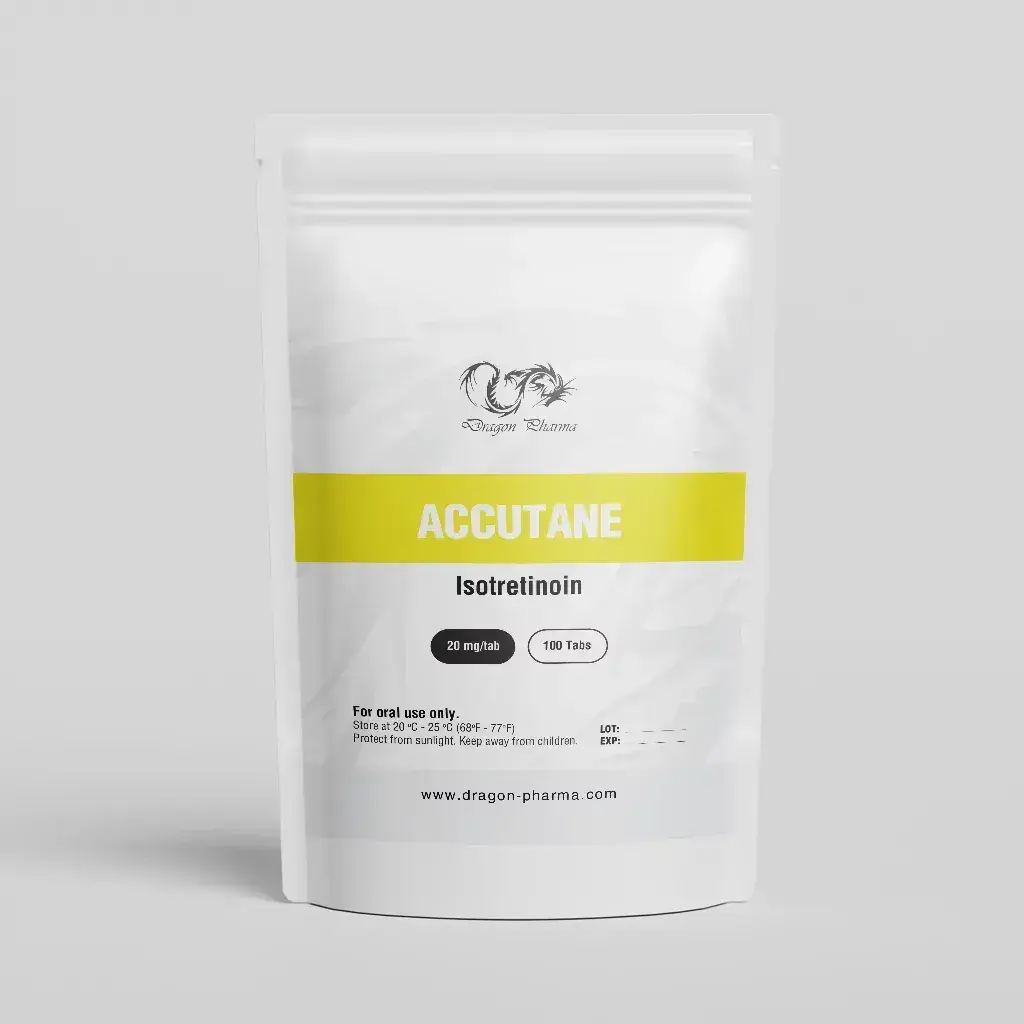
Accutane 20 mg is an oral isotretinoin tablet manufactured by Dragon Pharma and dosed at 20 mg per tablet in a 100-tablet package.
Accutane 20 mg contains isotretinoin, a synthetic oral retinoid and the 13-cis isomer of retinoic acid. Isotretinoin is FDA-approved for the treatment of severe recalcitrant nodular acne that is unresponsive to other therapies, including systemic antibiotics. It is one of the most effective treatments available for severe acne, but it is also one of the most strictly regulated medications due to its teratogenicity.
The mechanism of isotretinoin involves reduction of sebaceous gland size and inhibition of sebum production, normalization of follicular keratinization, and reduction of Cutibacterium acnes colonization. In bodybuilding contexts, isotretinoin is frequently referenced for managing steroid-induced acne, including severe forms such as acne fulminans that can occur during anabolic steroid cycles. However, isotretinoin is not approved for this indication, and self-medication without medical supervision carries substantial risks.
Isotretinoin is a prescription medicine approved for patients 12 years of age and older who are not pregnant, and it is available only through a restricted distribution program called the iPLEDGE Risk Evaluation and Mitigation Strategy (REMS). This program exists because isotretinoin causes severe, life-threatening birth defects if taken during pregnancy. The iPLEDGE REMS requires registration for prescribers, pharmacies, and patients, along with pregnancy testing and counseling requirements. Non-medical use outside this framework is illegal and unsafe.
Isotretinoin is an oral retinoid characterized by predictable linear pharmacokinetics, rapid absorption, high plasma protein binding, and a half-life of 10–20 hours for the parent compound.
Isotretinoin is a retinoid, a class of compounds related to vitamin A. Its pharmacokinetic profile is predictable and can be described using linear pharmacokinetic theory. Following oral administration, isotretinoin is rapidly absorbed, is highly bound to plasma protein, and is metabolized to 4-oxo-isotretinoin, its primary active metabolite.
The apparent half-lives of elimination following oral administration are 10–20 hours for isotretinoin and 24–29 hours for 4-oxo-isotretinoin. Steady-state pharmacokinetic profiles in patients are consistent with single-dose pharmacokinetics in normal subjects, meaning the drug does not accumulate unpredictably. This predictable profile is one reason isotretinoin can be dosed once or twice daily in clinical practice.
Isotretinoin is highly teratogenic, meaning it causes severe birth defects. This is the basis for the iPLEDGE REMS, which requires pregnancy testing before, during, and after treatment, along with two forms of birth control for patients who can become pregnant. The REMS also requires that patients do not donate blood during treatment and for one month after discontinuation, to avoid transfusion to a pregnant patient.
Isotretinoin has predictable linear pharmacokinetics with a half-life of 10–20 hours, but its severe teratogenicity requires the iPLEDGE REMS, a restrictive distribution program that limits access to registered patients, prescribers, and pharmacies.
Dragon Pharma offers multiple compounds discussed in bodybuilding and performance contexts. Isotretinoin is distinct from anabolic steroids such as Anavar 50 or Winstrol 50, which act on androgen receptors to build muscle. It is also distinct from ancillaries such as Finasteride, which addresses hair loss, and Arimidex, which manages estrogen. Isotretinoin is used for its effects on sebaceous glands and is not a performance-enhancing compound.
The distinction between Accutane and these compounds is one of purpose: isotretinoin addresses dermatological consequences of hormonal fluctuations, not muscle growth or hormonal management directly.
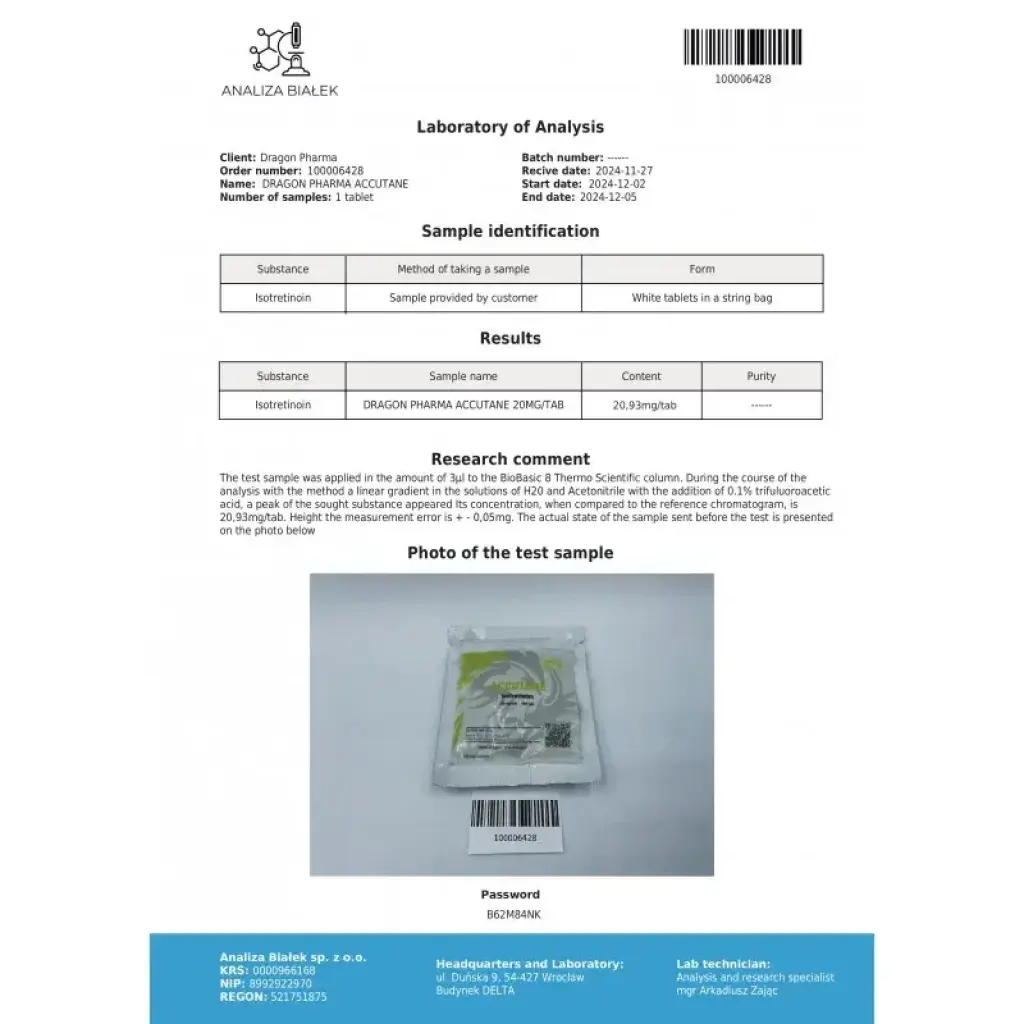
Published laboratory reports for Accutane 20 mg are shown below with the test date, measured isotretinoin content, and percentage of the product's 20 mg label claim.
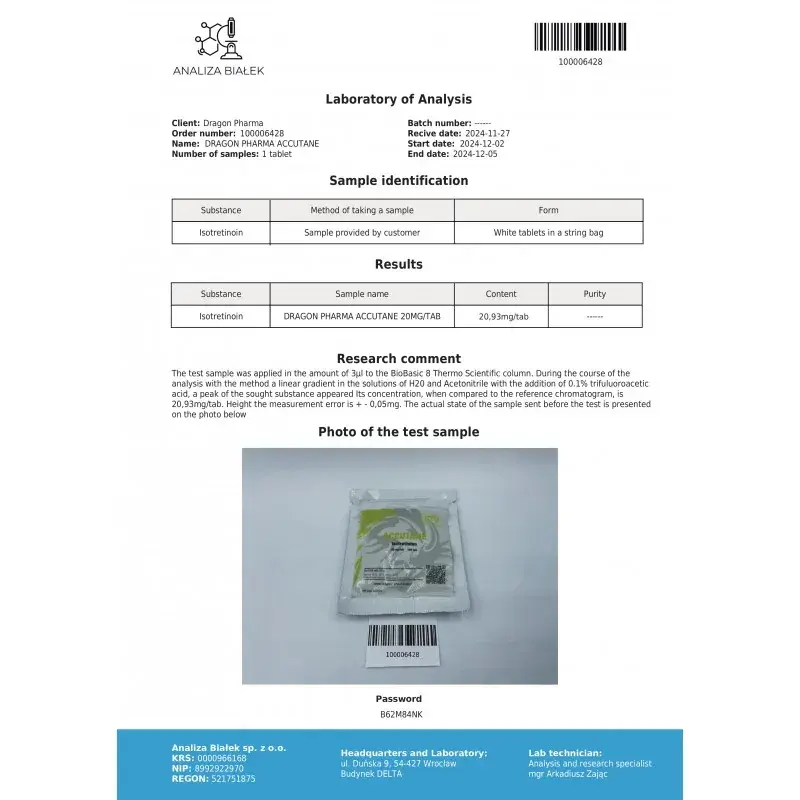 View Report
Laboratory results apply to the specific tested sample represented in each published report and should not be interpreted as a measurement of every tablet or production batch.
The information below is provided for educational reference only. Isotretinoin is a prescription medicine approved for severe recalcitrant nodular acne and is available only through the iPLEDGE REMS. Medical use requires appropriate diagnosis, clinical supervision, and registration in the iPLEDGE program. Non-medical use is illegal and unsafe.
In medically supervised settings, isotretinoin dosing for severe nodular acne is individualized based on patient weight and response. The recommended dosage is typically 0.5 to 1 mg/kg/day, with a cumulative target dose that is often referenced as 120–150 mg/kg to reduce relapse risk. Accutane 20 mg tablets allow for flexible dosing in 20 mg increments.
| Use Case | Common Reference Range | Frequency |
|---|---|---|
| Medical (severe nodular acne) | 0.5–1 mg/kg/day | Once or twice daily with food |
| Low-dose (off-label for rosacea) | 0.5 mg/kg/day or lower | Once daily |
| Cumulative target dose | 120–150 mg/kg | Over 4–6 months |
Isotretinoin causes dose-dependent mucocutaneous side effects that are well recognized and generally manageable, particularly at lower doses. These include dry skin, chapped lips, dry eyes, and photosensitivity. Ocular effects such as dry eye disease and meibomian gland dysfunction have been reported, and a risk-adapted monitoring approach is recommended for patients using isotretinoin.
More serious side effects include increased intracranial pressure, severe skin reactions, and psychiatric symptoms including depression and suicidal ideation. Patients should be observed closely for mood changes, and treatment should be stopped if these occur. Liver function and lipid panels should be monitored during treatment.
Isotretinoin is a prescription medicine with serious risks and is available only through the iPLEDGE REMS. The information above is for educational reference and does not constitute medical advice. Self-medication is illegal and unsafe.
Isotretinoin is a highly teratogenic prescription medicine that can cause severe birth defects, miscarriage, premature birth, and death of the baby if taken during pregnancy. It is available only through the iPLEDGE REMS.
Isotretinoin is approved for the treatment of severe recalcitrant nodular acne in patients 12 years of age and older who are not pregnant. Because of its severe teratogenicity, it has been available only through a restricted distribution program since 2005 and was approved as the iPLEDGE REMS in 2010. All isotretinoin manufacturers, prescribers, pharmacies, and patients must be registered with iPLEDGE.
Patients who can become pregnant must use two forms of birth control or commit to not having sexual contact with a partner that could result in pregnancy for at least one month before treatment, during treatment, and for one month after treatment. Pregnancy tests must be performed before, during, and after treatment, and prescriptions must be obtained within seven days of a pregnancy test.
Isotretinoin is a prescription medicine that should only be taken under the close supervision of a healthcare professional and pharmacist. Buying isotretinoin without a prescription bypasses the iPLEDGE REMS procedures that ensure safe use. Self-medication is illegal and carries severe risks including birth defects, depression, and suicide.
Teratogenicity: Isotretinoin causes severe, life-threatening birth defects. This is the most serious risk and the reason for the iPLEDGE REMS.
Mucocutaneous effects: Dry skin, chapped lips, dry eyes, photosensitivity, and skin fragility are common and dose-dependent.
Ocular effects: Dry eye disease, meibomian gland dysfunction, and rarely retinal alterations have been reported. Risk may be cumulative with long-term use.
Psychiatric effects: Depression, psychosis, suicidal ideation, suicide attempts, and aggressive or violent behavior have been reported. Patients should stop isotretinoin and contact a healthcare provider immediately if these symptoms develop.
Intracranial hypertension: Increased pressure in the brain can occur, leading to permanent vision loss and, in rare cases, death. Symptoms include bad headache, blurred vision, dizziness, nausea, vomiting, and seizures.
Other effects: Night blindness, increased sunburn susceptibility, and changes in vision have been reported. Patients should avoid driving at night until they know how isotretinoin affects their vision.
Isotretinoin should not be used by patients who are pregnant or may become pregnant. It is contraindicated in patients with hypersensitivity to isotretinoin or any of its components. Patients with a history of psychiatric disorders, liver disease, or elevated lipids should be evaluated carefully before treatment.
Medically supervised isotretinoin therapy requires regular follow-up. Blood tests may be performed to check for serious side effects, and treatment may be stopped if certain side effects occur. Patients who can become pregnant must have pregnancy tests before each prescription, when stopping treatment, and one month after stopping. Liver function and lipid levels should be monitored during treatment.
Store at 20° to 25°C (68° to 77°F) with excursions permitted to 15° to 30°C (59° to 86°F). Keep the product in its original packaging and out of the reach of children.
Accutane 20 mg is supplied through the Dragon Pharma distribution chain and shipped in original manufacturer packaging with discreet, privacy-focused handling.
The outer shipping package remains discreet, with privacy-focused handling and no unnecessary external product details. Products are supplied through the Dragon Pharma distribution chain.
To verify your Accutane 20 mg product, cross-check the security features on the packaging against Dragon Pharma's official presentation. Batch-linked lab proof and original packaging help reinforce product legitimacy.
For complete delivery details, tracking policy, and reshipment terms, please see our Shipping Info page.
Proper storage conditions help preserve tablet integrity and overall product stability throughout shelf life.
Store at 20° to 25°C (68° to 77°F) with excursions permitted to 15° to 30°C (59° to 86°F). Keep the product in its original packaging until use.
Keep out of reach of children. Do not use if the packaging appears compromised or if the tablets show signs of degradation.
Answers to common questions about Accutane 20 mg, isotretinoin, its mechanism, dosing, and safety.
Accutane 20 mg contains isotretinoin, an FDA-approved prescription medicine for severe recalcitrant nodular acne that has not responded to other treatments, including systemic antibiotics. In bodybuilding contexts, it is commonly referenced for steroid-induced acne, but this is not an approved indication.
Isotretinoin is typically taken two times a day with food, swallowed whole with a full glass of liquid. The exact dose and duration are determined by a healthcare provider based on body weight and treatment response.
Isotretinoin reduces the size of sebaceous glands and inhibits sebum production, normalizes follicular keratinization, and reduces Cutibacterium acnes colonization. These effects make it highly effective for severe nodular acne.
Acne may get worse when first starting isotretinoin, but this is temporary. Improvement typically occurs over the course of treatment, and acne may continue to improve after treatment is completed. A cumulative target dose is often used to reduce relapse risk.
The apparent half-life of elimination for isotretinoin is 10–20 hours following oral administration. Its active metabolite, 4-oxo-isotretinoin, has a half-life of 24–29 hours.
Isotretinoin is widely regarded as the most effective treatment for severe recalcitrant nodular acne. However, it carries significant risks and is reserved for cases that have not responded to other therapies. The appropriate choice depends on the severity of acne and individual factors.
Antibiotics reduce Cutibacterium acnes populations but do not address sebum production or follicular keratinization. Isotretinoin addresses all four major pathogenic factors of acne and can produce long-term remission. Isotretinoin is reserved for severe cases unresponsive to antibiotics.
Topical retinoids are applied directly to the skin and have local effects. Isotretinoin is taken orally and has systemic effects, including shrinking sebaceous glands throughout the body. Oral isotretinoin is significantly more potent but also carries systemic risks.
Medical isotretinoin dosing is typically 0.5 to 1 mg/kg/day. For a 70 kg adult, that corresponds to 35–70 mg per day. A 20 mg tablet is therefore a moderate dose that may be taken once or twice daily depending on the prescribed regimen. Accutane 20 mg is labeled at 20 mg per tablet.
Accutane 20 mg is labeled at 20 mg of isotretinoin per tablet. It is supplied in a 100-tablet package, giving 2,000 mg of total labeled isotretinoin content.
Yes. A published laboratory report dated December 05, 2024 measured Accutane 20 mg at 20.93 mg per tablet, equivalent to 104.65% of its 20 mg label claim. Complete reports can be viewed in the Lab Reports tab.
Yes. Isotretinoin is FDA-approved for severe recalcitrant nodular acne in patients 12 years and older who are not pregnant. However, it is available only through the iPLEDGE REMS due to its severe teratogenicity.