
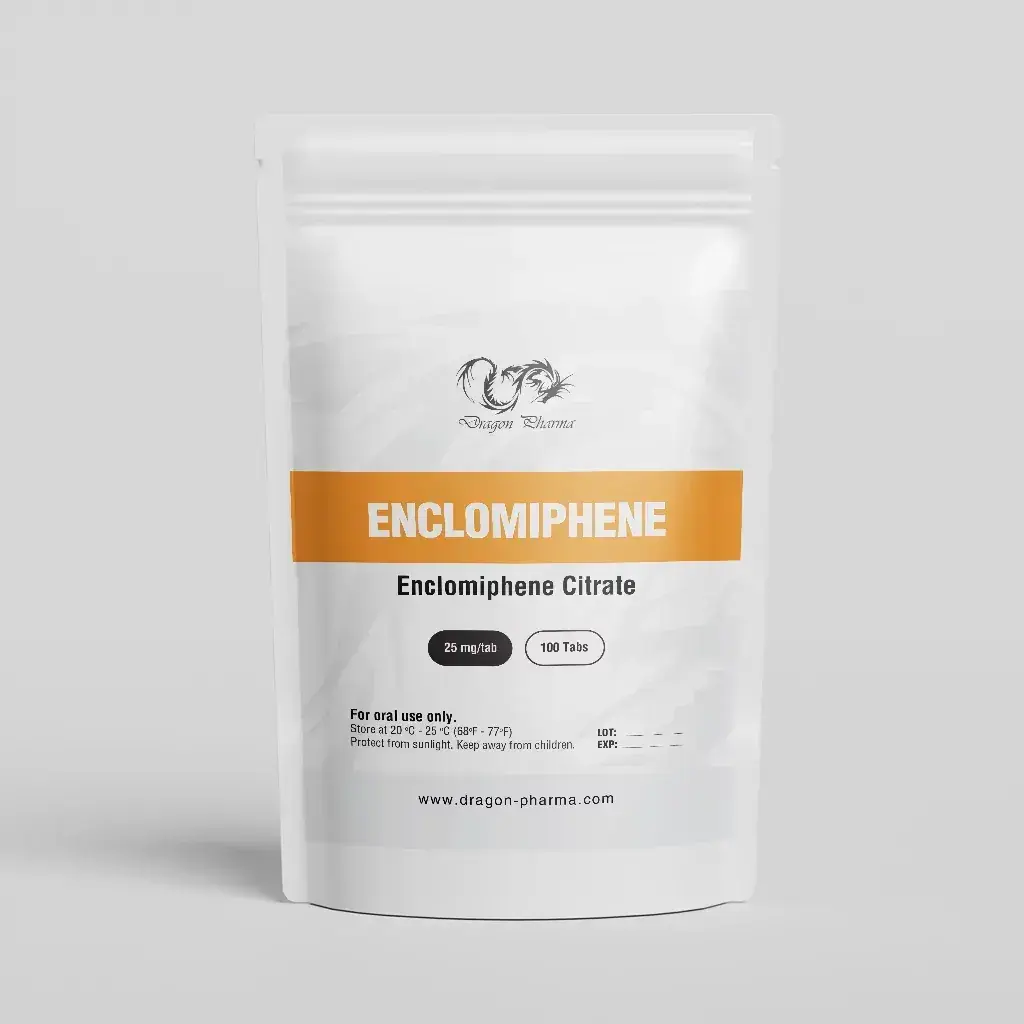
Enclomiphene 25 mg is an oral enclomiphene tablet manufactured by Dragon Pharma, dosed at 25 mg per tablet in a 100-tablet package.
Enclomiphene 25 mg contains enclomiphene, a selective estrogen receptor modulator (SERM) and the trans-isomer of clomiphene citrate. Enclomiphene works by blocking estrogen receptors in the hypothalamus, which disrupts the negative feedback loop that normally suppresses gonadotropin-releasing hormone. This leads to increased release of luteinizing hormone (LH) and follicle-stimulating hormone (FSH), which in turn stimulates the testes to produce more testosterone.
In clinical research, enclomiphene has been investigated for the treatment of secondary hypogonadism in men, where the goal is to restore endogenous testosterone production rather than replace it with exogenous testosterone. This mechanism distinguishes enclomiphene from anabolic steroids and testosterone replacement therapies, which suppress the hypothalamic-pituitary-gonadal axis. Enclomiphene is also studied for its potential to preserve fertility while raising testosterone, as it maintains sperm production rather than suppressing it.
In non-medical bodybuilding contexts, enclomiphene is commonly referenced as a post-cycle therapy (PCT) agent or as a standalone option for testosterone support, though such use falls outside approved medical indications. Its appeal lies in its ability to stimulate natural testosterone production without the suppression associated with exogenous hormones. Enclomiphene has been reported to raise testosterone levels with a lower rate of adverse effects compared to clomiphene, which contains both enclomiphene and zuclomiphene isomers.
Enclomiphene 25 mg is supplied as an oral tablet containing 25 mg of enclomiphene per tablet. Oral administration allows for convenient dosing without the need for injection equipment.
Enclomiphene is a selective estrogen receptor modulator that stimulates the hypothalamic-pituitary-gonadal axis to increase endogenous testosterone production while preserving fertility.
Enclomiphene belongs to the SERM class of compounds, which act as estrogen receptor antagonists in certain tissues while potentially exhibiting agonist activity in others. Unlike clomiphene citrate, which is a mixture of enclomiphene (trans-isomer) and zuclomiphene (cis-isomer), enclomiphene is the pure trans-isomer. This distinction is clinically relevant because zuclomiphene has been associated with more estrogenic side effects, while enclomiphene is considered the more active isomer for stimulating gonadotropin release.
By blocking estrogen receptors in the hypothalamus, enclomiphene disrupts the negative feedback mechanism that normally inhibits gonadotropin-releasing hormone (GnRH) secretion. The resulting increase in GnRH stimulates the pituitary to release more LH and FSH, which signal the testes to increase testosterone production. This mechanism is fundamentally different from exogenous testosterone administration, which suppresses the body's own production.
Clinical studies have demonstrated that enclomiphene increases serum testosterone levels while maintaining or improving sperm parameters, addressing two key limitations of traditional testosterone replacement therapy. Research comparing enclomiphene to clomiphene has found that enclomiphene provides comparable testosterone increases with significantly fewer adverse effects, including lower rates of mood changes, decreased libido, and estradiol elevation.
Enclomiphene blocks estrogen receptors in the hypothalamus, reducing negative feedback and stimulating increased LH and FSH release. This leads to elevated endogenous testosterone production from the testes.
Dragon Pharma offers a range of compounds relevant to hormonal management and post-cycle recovery. Enclomiphene 25 mg is positioned as a SERM option, complementing aromatase inhibitors and other ancillary products.
For estrogen management, Dragon Pharma offers Arimidex and Aromasin. For traditional PCT protocols, Clomid and Nolvadex are commonly referenced. Enclomiphene 25 mg represents a more targeted SERM option, containing only the trans-isomer rather than the mixed isomers found in clomiphene-based products.
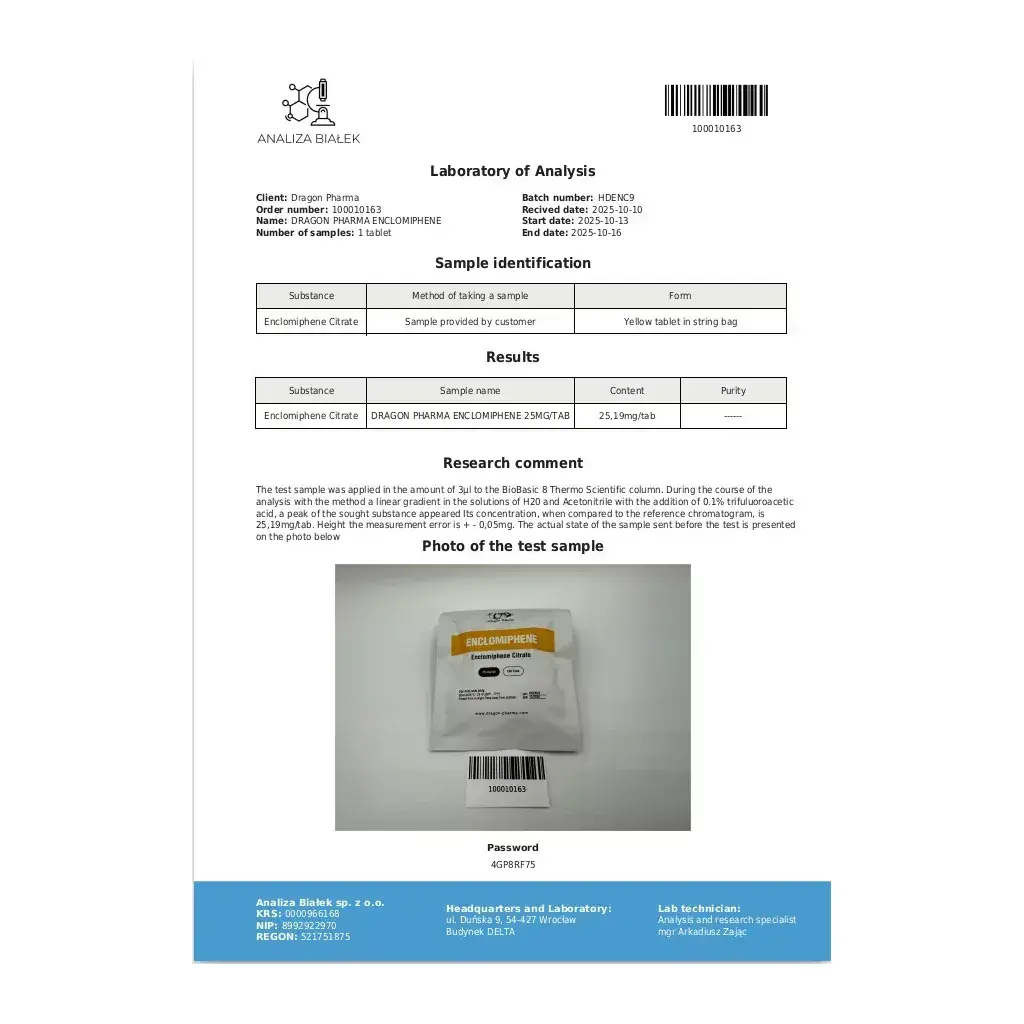
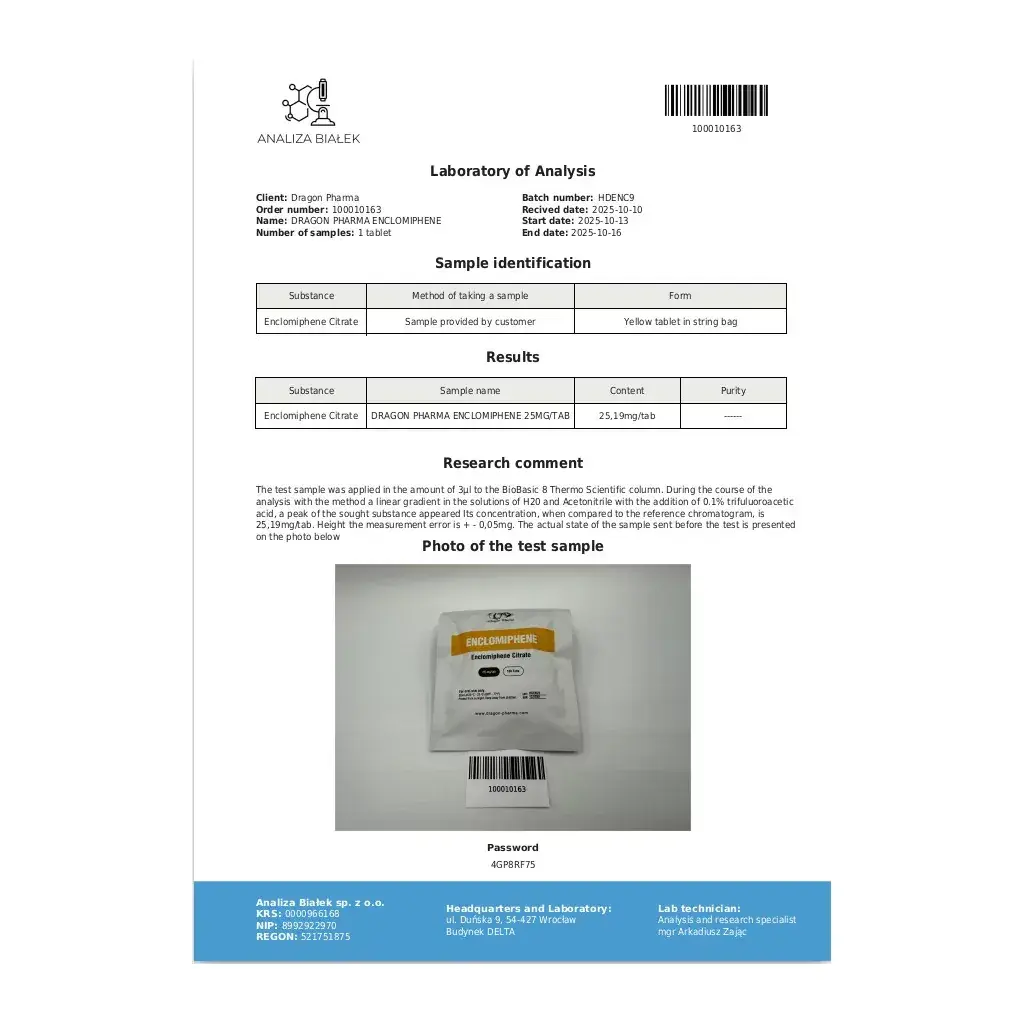
Published laboratory reports for Enclomiphene 25 mg are shown below with the test date, measured content and percentage of the product's 25 mg label claim.
 View Report
Laboratory results apply to the specific tested sample represented in each published report and should not be interpreted as a measurement of every tablet or production batch.
The information below is provided for educational reference only. Enclomiphene is a research compound; medical use requires appropriate diagnosis, clinical supervision and ongoing monitoring. Non-medical use falls outside approved indications.
In clinical research settings, enclomiphene has been studied at doses ranging from 6.25 mg to 25 mg daily for the treatment of secondary hypogonadism. In non-medical bodybuilding contexts, enclomiphene is commonly referenced at 12.5–25 mg daily for post-cycle therapy or testosterone support, though such use falls outside approved medical indications.
| Use Case | Common Reference Range | Frequency |
|---|---|---|
| Clinical research (hypogonadism) | 6.25–25 mg | Once daily |
| Bodybuilding PCT (non-medical) | 12.5–25 mg | Once daily |
| Testosterone support (non-medical) | 12.5–25 mg | Daily or EOD |
Enclomiphene 25 mg tablets may be split to achieve lower doses such as 12.5 mg.
Enclomiphene is not an anabolic compound and is not stacked for muscle-building purposes. It is used as a support ancillary in post-cycle therapy or as a standalone option for stimulating endogenous testosterone production. In PCT contexts, enclomiphene may be used alone or alongside other recovery agents such as Nolvadex or Clomid.
Because enclomiphene stimulates LH and FSH, it is commonly referenced in contexts where preservation of fertility is a consideration. Unlike exogenous testosterone, enclomiphene does not suppress sperm production, which is a distinguishing feature compared to traditional testosterone replacement.
Enclomiphene has been reported to have a lower rate of adverse effects compared to clomiphene citrate, particularly regarding mood changes, decreased libido, and estradiol elevation. Potential side effects may include headache, nausea, and visual disturbances, though these are less common with enclomiphene than with mixed-isomer clomiphene products.
Elevated hematocrit has been observed in clinical studies, with a small percentage of patients experiencing increases to high levels. Monitoring of hematocrit may be considered in non-medical contexts.
Enclomiphene is commonly referenced as a PCT agent in non-medical bodybuilding contexts. After a suppressive cycle, enclomiphene can help stimulate endogenous testosterone production by blocking estrogen feedback at the hypothalamus. Its pure trans-isomer profile may offer advantages over clomiphene in terms of side effect profile.
Dosing strategies and support protocols should be adjusted based on experience level and bloodwork where possible. The information above is for educational reference and does not constitute medical advice.
Enclomiphene is a selective estrogen receptor modulator that can affect hormonal, reproductive, and hematologic function. Medical use requires appropriate diagnosis, clinical supervision and ongoing monitoring.
Enclomiphene is not approved by the FDA for human use as of current knowledge. Clinical research has investigated its use for secondary hypogonadism, but it remains an investigational compound. Non-medical use for bodybuilding or performance enhancement falls outside any approved indications.
Non-medical use of enclomiphene for testosterone support or post-cycle therapy is not approved by regulatory agencies and may carry unknown health risks. Product quality does not establish that non-medical use is safe or appropriate.
Enclomiphene has been associated with increases in hematocrit and hemoglobin in clinical studies. Headache, nausea, and visual disturbances have been reported with clomiphene-class compounds, though enclomiphene appears to have a lower rate of adverse effects compared to clomiphene citrate.
As a SERM, enclomiphene may affect bone density and lipid parameters with long-term use. Mood changes and decreased libido have been reported less frequently with enclomiphene than with clomiphene.
Enclomiphene should be used with caution in individuals with a history of thromboembolic disorders, liver disease, or unexplained uterine bleeding (for female use). Male use should be evaluated in the context of prostate health and hematocrit levels. Pre-existing visual disturbances or a history of visual symptoms with clomiphene should be discussed with a healthcare professional.
Medically supervised use of enclomiphene typically involves monitoring of serum testosterone, LH, FSH, estradiol, and hematocrit levels. In non-medical contexts, bloodwork can help inform whether the compound is producing the desired hormonal response and whether any parameters are moving outside normal ranges.
Keep the product securely stored and protected from conditions that could compromise the tablets or packaging. Inspect the product before use and do not use if it appears damaged or otherwise abnormal. Keep all medications out of the reach of children.
Enclomiphene 25 mg is supplied through the official Dragon Pharma distribution chain and shipped in original manufacturer packaging with discreet, privacy-focused handling.
The outer shipping package remains discreet, with privacy-focused handling and no unnecessary external product details. Products are supplied through the official Dragon Pharma distribution chain.
To verify your Enclomiphene 25 mg product, use the security code on the packaging and cross-check it on the Dragon Pharma official site. Official Dragon Pharma presentation, batch-linked lab proof, and original packaging help reinforce product legitimacy and buyer confidence.
Proper storage conditions help preserve tablet integrity and stability throughout shelf life.
Store in a cool, dry place at controlled room temperature (15–25°C). Protect from excessive heat, moisture, and direct light. Keep the tablets in their original packaging until use.
Do not use if the packaging appears damaged or if the tablets show signs of deterioration. Keep out of reach of children.
Answers to common questions about Enclomiphene 25 mg, enclomiphene, post-cycle therapy, product strength and laboratory testing.
Enclomiphene 25 mg contains enclomiphene, a SERM. In clinical research it has been investigated for secondary hypogonadism. In non-medical bodybuilding contexts, it is commonly referenced as a post-cycle therapy agent or for stimulating endogenous testosterone production. Such use falls outside approved medical indications.
Enclomiphene is typically referenced at once daily dosing. In clinical studies, doses of 6.25–25 mg daily have been investigated. In non-medical bodybuilding contexts, common reference points are 12.5–25 mg daily, though dosing should be individualized.
Enclomiphene itself is commonly used as a PCT agent, so it is not typically followed by additional PCT. After a suppressive cycle, enclomiphene can help stimulate endogenous testosterone production by blocking estrogen feedback. It may be used alongside other recovery agents like Nolvadex if desired.
Enclomiphene blocks estrogen receptors in the hypothalamus, which reduces negative feedback on gonadotropin-releasing hormone. This leads to increased LH and FSH release, stimulating the testes to produce more testosterone. It is the pure trans-isomer of clomiphene citrate.
Enclomiphene begins affecting the hypothalamic-pituitary axis shortly after administration, though full effects on testosterone levels typically develop over days to weeks. Bloodwork can confirm whether LH, FSH, and testosterone levels are responding as expected.
There is no single SERM that is universally best for PCT. Enclomiphene is the pure trans-isomer of clomiphene and has been reported to have a lower rate of adverse effects compared to clomiphene citrate. Other options like Nolvadex and Clomid are also commonly referenced, and the appropriate choice depends on individual response and circumstances.
Clomiphene citrate is a mixture of two isomers: enclomiphene (trans-isomer) and zuclomiphene (cis-isomer). Enclomiphene is the pure trans-isomer, while zuclomiphene has been associated with more estrogenic side effects. Research suggests enclomiphene provides comparable testosterone increases with fewer adverse effects.
Enclomiphene and Nolvadex are both SERMs used in PCT contexts, but they have different tissue selectivity profiles and pharmacokinetics. Enclomiphene is the pure trans-isomer of clomiphene, while Nolvadex is tamoxifen. Both can stimulate LH and FSH, but individual response and side effect profiles may differ.
In clinical research, 25 mg daily has been studied as a standard dose for secondary hypogonadism. In non-medical bodybuilding contexts, common reference points range from 12.5–25 mg daily. The 25 mg strength of Enclomiphene 25 mg allows for splitting to achieve lower doses if desired.
Enclomiphene 25 mg is labeled at 25 mg of enclomiphene per tablet. It is supplied in a 100-tablet package, giving 2,500 mg of total labeled enclomiphene content.
Yes. A published laboratory report dated October 16, 2025 measured Enclomiphene 25 mg at 25.19 mg/tablet, equivalent to 100.76% of its 25 mg label claim. The batch number for this report was #HDENC9. The complete report can be viewed in the Lab Reports tab.
Clinical research has investigated enclomiphene for its ability to stimulate testosterone production while preserving sperm counts, in contrast to exogenous testosterone which suppresses sperm production. This fertility-preserving characteristic is one of the distinguishing features of enclomiphene compared to traditional testosterone replacement.