TB 500 10 mg is a lyophilized research peptide manufactured by Stealth Labs, supplied as 10 mg/vial of the Thymosin Beta 4 fragment (TB-500) in a 2 mL vial.
TB 500 10 mg contains a synthetic fragment of thymosin beta-4, a naturally occurring 43-amino-acid peptide encoded by the TMSB4X gene. The full-length protein functions primarily as an actin-sequestering peptide, binding G-actin monomers with high affinity and regulating cytoskeletal dynamics. The commercial product sold as TB-500 replicates the active LKKTETQ sequence (amino acids 17–23), which researchers believe carries most of the functional activity related to cell migration and wound healing.
TB-500 is not FDA-approved for any human indication and has no completed human efficacy trials for musculoskeletal repair, tendon healing, or sports injury recovery. Full-length thymosin beta-4 has been studied in Phase 2 and Phase 3 trials for ophthalmic applications, but those trials did not result in FDA approval. The subcutaneous protocols commonly referenced for TB-500 in research settings have not been formally characterized in controlled human trials.
TB-500 is banned by the World Anti-Doping Agency (WADA) at all times under Section S2 (Peptide Hormones, Growth Factors, and Related Substances). It is classified as an FDA 503A Category 2 bulk drug substance, meaning it is prohibited for use in compounded medications and is not available through licensed compounding pharmacies. Products sold under the name TB-500 in the United States are research chemicals not regulated by the FDA for purity, sterility, or actual content.
TB 500 10 mg is supplied as a lyophilized (freeze-dried) powder in a 2 mL glass vial. Reconstitution with an appropriate solvent is required before use in research applications.
Thymosin beta-4 is an endogenous actin-sequestering peptide. The TB-500 fragment replicates its active LKKTETQ region but lacks the full-length protein structure.
Full-length thymosin beta-4 is a 43-amino-acid peptide encoded by the TMSB4X gene. Its primary function is the regulation of actin cytoskeleton dynamics: it binds G-actin monomers with high affinity, buffering the intracellular pool of actin subunits available for polymerization into filamentous F-actin. When a cell receives a migration or repair signal, the sequestered actin is released and assembled into the structures that drive cell movement.
TB-500 is a synthetic 17-amino-acid fragment (Ac-LKKTETQ) corresponding to the actin-binding domain of the full protein. It is not established as equivalent to full-length thymosin beta-4, and published research on the full protein does not verify commercial TB-500 effectiveness. The fragment lacks the full-length protein's other domains, which may contribute to biological activity through different mechanisms.
The most commonly referenced non-medical dosage in research settings is a loading phase of 2–2.5 mg administered twice weekly for 4–6 weeks, followed by a maintenance dose of 2–2.5 mg once weekly. However, no human pharmacokinetic data exists for subcutaneous TB-500, and the safety data that does exist comes from intravenous administration of full-length thymosin beta-4 in healthy volunteers, not from the subcutaneous protocols used in research settings.
TB-500 is classified as an FDA 503A Category 2 bulk drug substance, prohibited for use in compounded medications. It is not FDA-approved for any human indication. An FDA advisory committee voted in July 2026 to recommend wider access to several peptides including TB-500, but this vote is a non-binding recommendation and does not constitute FDA approval.
Stealth Labs offers BPC 157 as another research peptide commonly referenced in tissue-healing contexts. Both BPC-157 and TB-500 are classified as doping substances by WADA and are widely sold as research chemicals.
Compared to BPC-157, which is studied for local tendon and gastrointestinal healing, TB-500 is associated with systemic cell migration and inflammation modulation. The two are sometimes referenced together in non-medical research contexts because their proposed mechanisms are complementary rather than redundant. Neither is FDA-approved for human use.
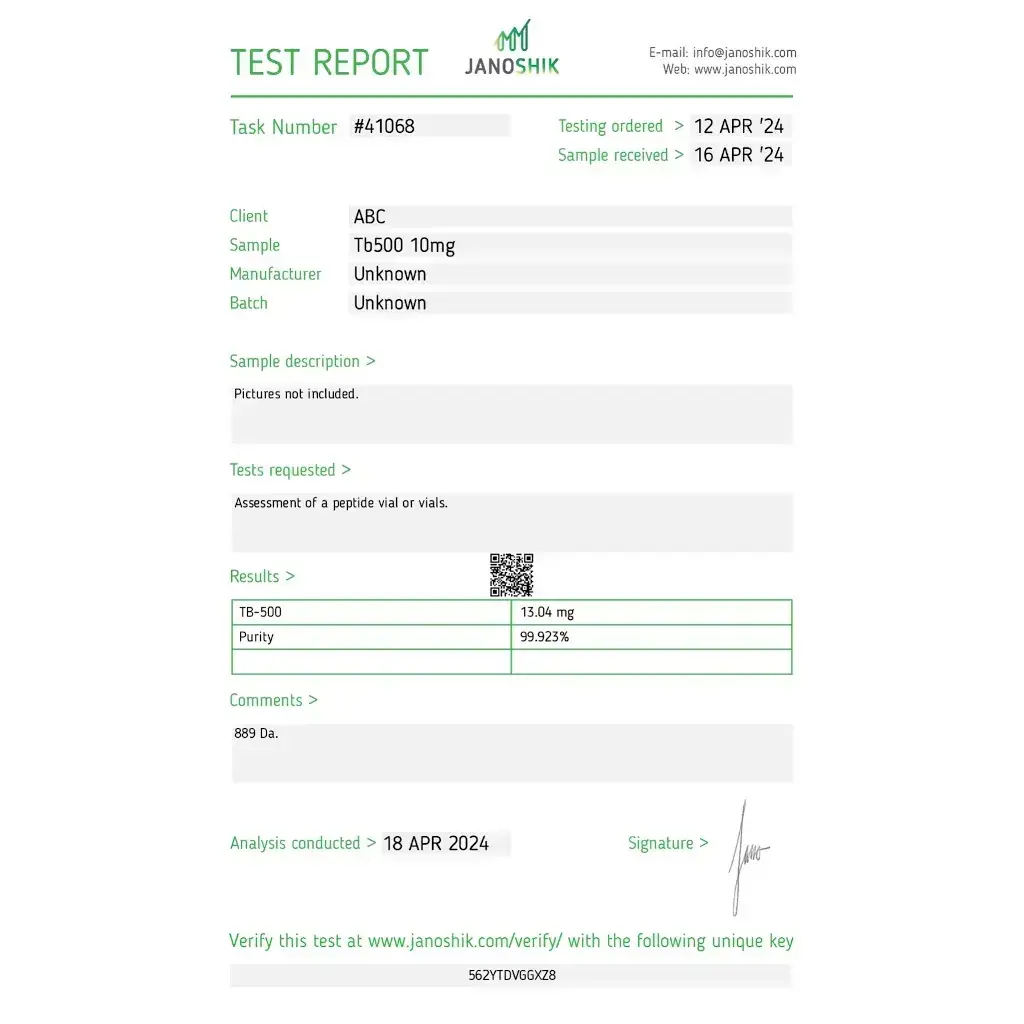
Published laboratory reports for TB 500 10 mg are shown below with the test date, measured concentration and percentage of the product's 10 mg/vial label claim.
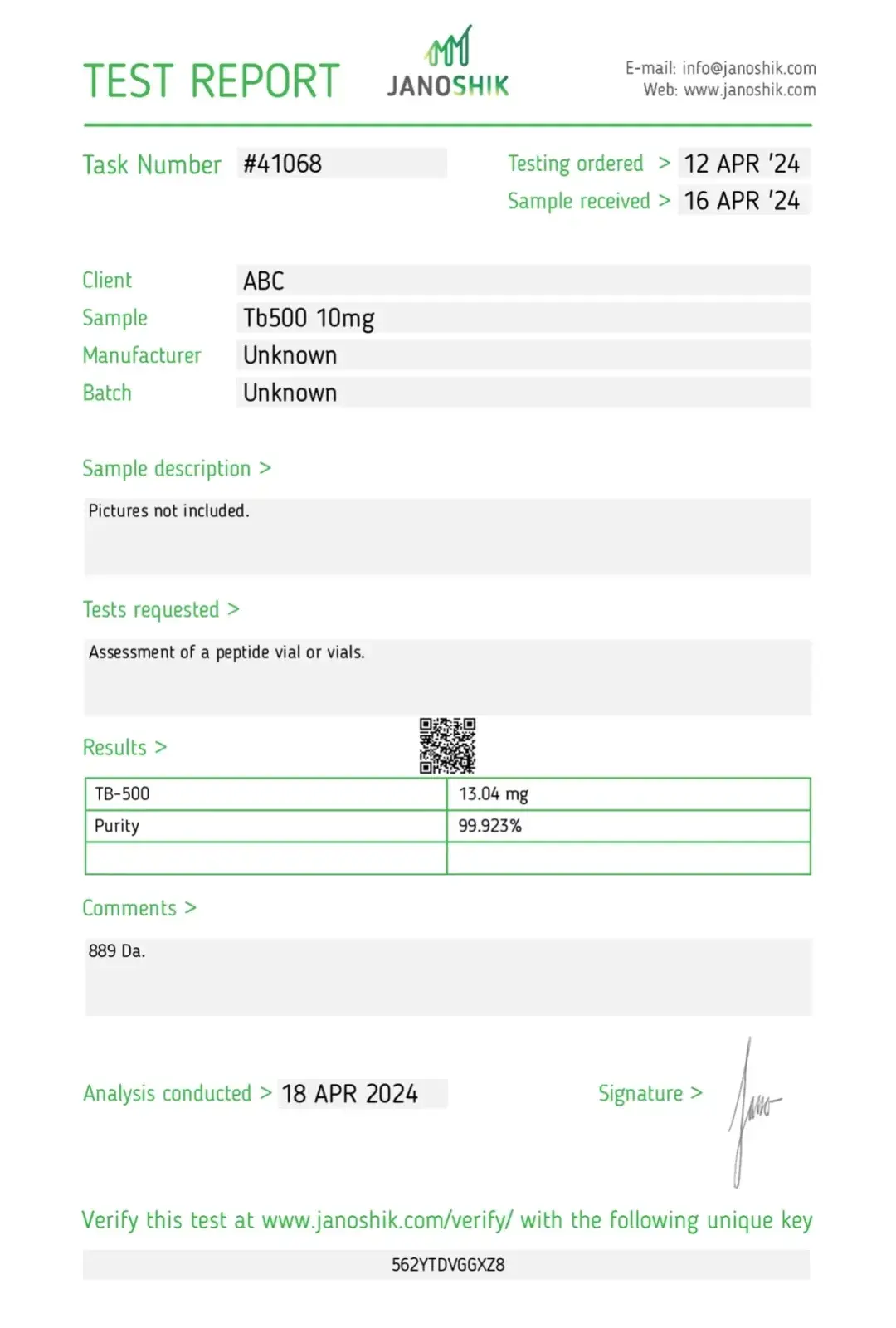 View Report
Laboratory results apply to the specific tested sample represented in each published report and should not be interpreted as a measurement of every vial or production batch.
The information below is provided for educational reference only. TB-500 is not FDA-approved for any indication. No human dosing information is established for non-clinical settings, and non-medical use falls outside any approved indication.
Common reference ranges for TB-500 in non-medical contexts are not well characterized in publicly available bodybuilding resources, and no human pharmacokinetic data exists for subcutaneous TB-500. The most commonly referenced protocol in community settings is a loading phase of 2–2.5 mg twice weekly for 4–6 weeks, followed by a maintenance dose of 2–2.5 mg once weekly. These figures are anecdotal and lack clinical validation.
| Use Case | Research Reference Range | Frequency |
|---|---|---|
| Loading phase (anecdotal) | 2–2.5 mg per injection | Twice weekly for 4–6 weeks |
| Maintenance (anecdotal) | 2–2.5 mg per injection | Once weekly |
| Clinical human data | None established for subcutaneous use | Not applicable |
TB-500 is supplied as a lyophilized powder requiring reconstitution with an appropriate solvent such as bacteriostatic water or sterile saline. Once reconstituted, peptide solutions are more susceptible to degradation and should be stored refrigerated at 2–8°C. Avoid repeated freeze-thaw cycles, which can degrade the peptide and potentially increase immunogenicity risk.
Reconstitution should be performed gently by swirling rather than shaking to prevent denaturation or aggregation. A cloudy solution or visible particles may indicate incomplete dissolution, aggregation, or contamination and should not be used.
Adverse events reported in Phase 1 human trials of full-length thymosin beta-4 (intravenous administration) were infrequent and mild to moderate, with no dose-limiting toxicities observed. Commonly reported side effects in research settings include headache, nausea, lightheadedness, injection site irritation, and temporary fatigue.
Theoretical concerns include cancer risk, because thymosin beta-4 promotes cell migration, angiogenesis, and cell survival—mechanisms that tumor growth can exploit. The existing human safety data did not show cancer signals, but trial durations were short and not designed to detect long-term oncologic outcomes. Individuals with active malignancy or a history of cancer should discuss this concern with an oncologist. TB-500 is banned by WADA at all times for competitive athletes.
TB-500 is a peptide and does not suppress endogenous testosterone production. No post-cycle therapy is applicable or necessary for TB-500 alone. If TB-500 is referenced alongside anabolic compounds in non-medical contexts, any PCT protocol would be determined by the other compounds, not by TB-500.
No human clinical data exists to support any specific dosing strategy for TB-500 in non-clinical settings. The information above is for educational reference only and does not constitute medical advice. TB-500 is not FDA-approved for any indication.
TB-500 is not FDA-approved for any indication and is not approved for human use anywhere in the world. Its safety profile outside clinical trial settings is not characterized.
Thymosin beta-4 is not approved for human use anywhere in the world, including by the FDA and the Australian Therapeutic Goods Administration. It is listed on the WADA Prohibited List under S2.3 (Growth Factors and Growth Factor Modulators) and is banned in sport at all times. A Therapeutic Use Exemption would not be granted for thymosin beta-4 in any medical condition.
As of April 2026, TB-500 is classified as an FDA 503A Category 2 bulk drug substance, meaning it is prohibited for use in compounded medications under Section 503A and 503B. An FDA advisory committee voted in July 2026 to recommend wider access to several peptides including TB-500, but this vote is a non-binding recommendation and does not constitute FDA approval.
TB-500 is sold as a research chemical and is not approved for human use. Products sold online under the name TB-500 through research compound vendors are not FDA-regulated, have no verified manufacturing standards, and carry unknown contamination, dosing, and safety risks.
In Phase 1 human trials of full-length thymosin beta-4 administered intravenously, adverse events were infrequent and mild to moderate, with no dose-limiting toxicities or serious adverse events observed. Commonly reported side effects in research settings include headache, nausea, lightheadedness, injection site irritation, and temporary fatigue.
Theoretical concerns include cancer risk, because thymosin beta-4 promotes cell migration, angiogenesis, and cell survival. Individuals with active malignancy or a history of cancer should discuss this concern with an oncologist. Immune effects from long-term exogenous supplementation have not been characterized in humans.
Because no human pharmacokinetic data exists for subcutaneous TB-500, the risk-benefit profile for the subcutaneous protocols commonly used in research settings has not been formally characterized in controlled human trials.
Precautionary contraindications based on the peptide's known mechanisms include active malignancy or history of cancer, pregnancy or breastfeeding, and concurrent use of anticoagulants or bleeding disorders. No pediatric safety data exists. Individuals with any medical condition should consult a qualified healthcare professional before considering any research peptide.
No monitoring parameters have been established for TB-500 outside clinical trial settings. Laboratory testing of the product itself, such as the published potency report shown in the Lab Reports tab, is separate from any clinical monitoring. Product testing does not assess individual health status or suitability for use.
Lyophilized TB-500 should be stored at -20°C or below for maximal stability, protected from moisture and light. Allow the vial to warm to room temperature before opening to prevent condensation.
Reconstituted TB-500 should be stored refrigerated at 2–8°C and used within a reasonable timeframe. Avoid repeated freeze-thaw cycles, which can degrade the peptide. Keep all research peptides out of the reach of children.
TB 500 10 mg is supplied through the official Stealth Labs distribution chain and shipped in original manufacturer packaging with discreet, privacy-focused handling.
The outer shipping package remains discreet, with privacy-focused handling and no unnecessary external product details. Products are supplied through the official Stealth Labs distribution chain.
To verify your TB 500 10 mg product, use the security code on the vial label and cross-check it on the Stealth Labs official site. Official Stealth Labs presentation, batch-linked lab proof, and original packaging help reinforce product legitimacy and buyer confidence.
For complete delivery details, tracking policy, and reshipment terms, please see our Shipping Info page.
Proper storage conditions help preserve peptide stability and overall product integrity throughout shelf life.
Lyophilized TB-500 should be stored at -20°C or below for maximal stability, protected from moisture and light. Short-term storage at room temperature is relatively stable for weeks, but long-term storage requires freezing. Allow the vial to warm to room temperature before opening to prevent condensation.
Reconstituted TB-500 should be stored refrigerated at 2–8°C and used within a reasonable timeframe. Avoid repeated freeze-thaw cycles, which can degrade the peptide. Inspect the solution before use and do not use if it appears cloudy, discolored, or contains particulate matter.
Answers to common questions about TB 500 10 mg, its research status, clinical data, and laboratory testing.
TB 500 10 mg is a lyophilized research peptide sold for laboratory use only. It contains a synthetic fragment of thymosin beta-4 corresponding to the LKKTETQ region. In preclinical research, thymosin beta-4 has been studied for potential effects on tissue repair, cell migration, and wound healing. TB-500 is not FDA-approved for any human indication and is not approved for human use anywhere in the world.
Common reference ranges for TB-500 in non-medical contexts are not well characterized in publicly available bodybuilding resources, and no human pharmacokinetic data exists for subcutaneous TB-500. The most commonly referenced protocol in community settings is a loading phase of 2–2.5 mg twice weekly for 4–6 weeks, followed by a maintenance dose of 2–2.5 mg once weekly. These figures are anecdotal and lack clinical validation.
TB-500 is a peptide and does not suppress endogenous testosterone production. No post-cycle therapy is applicable or necessary for TB-500 alone. If TB-500 is referenced alongside anabolic compounds in non-medical contexts, any PCT protocol would be determined by the other compounds, not by TB-500.
Full-length thymosin beta-4 is an endogenous peptide that binds G-actin monomers and regulates actin cytoskeleton dynamics. It plays a role in cell migration, tissue repair, and angiogenesis. TB-500 is a synthetic fragment of the full protein and is not established as equivalent to full-length thymosin beta-4.
Community reports suggest most users notice changes in chronic inflammation and pain during the second or third week of a loading phase, with some reporting a 4–6 week window before meaningful improvement. However, no controlled human trials have characterized the onset of effects for subcutaneous TB-500. The time required to notice effects depends on the individual and the specific outcome being evaluated.
There is no clinical evidence to compare TB-500 against other peptides or to establish it as superior for any indication. A scoping review in the Journal of Orthopaedic Experience & Innovation concluded that peptide therapies are increasingly encountered in orthopaedic practice, yet evidence supporting clinical efficacy and perioperative safety remains limited. TB-500 is not FDA-approved, has no established dosage, and creates clear anti-doping risk.
TB-500 and BPC-157 are distinct research peptides with different amino acid sequences and proposed mechanisms. TB-500 is a fragment of thymosin beta-4 associated with systemic cell migration and inflammation modulation, while BPC-157 is a pentadecapeptide studied for local tendon and gastrointestinal healing. Both are sold as research chemicals, are not FDA-approved for human use, and are classified as doping substances by international sports authorities. BPC 157 is available from Stealth Labs as an alternative research peptide.
Full-length thymosin beta-4 is a 43-amino-acid protein encoded by the TMSB4X gene. TB-500 is a synthetic 17-amino-acid fragment corresponding to the actin-binding domain (LKKTETQ). Full-length thymosin beta-4 has human safety data from Phase 1 trials and has been studied in Phase 2 and Phase 3 ophthalmic trials, but TB-500 has none of this: no completed human efficacy trials, no published human pharmacokinetic data, and no independent confirmation that the fragment produces the same downstream biology as the parent protein in human tissue.
A milligram amount cannot be classified as appropriate or excessive because TB-500 is not FDA-approved and no non-clinical dosing information exists. It is also important to distinguish a total vial content from a dose. TB 500 10 mg indicates the total peptide content per vial; that quantity does not by itself specify how much should be used in any research application.
TB 500 10 mg is labeled at 10 mg of Thymosin Beta 4 fragment (TB-500) per vial. It is supplied as a lyophilized powder in a 2 mL vial.
Yes. A published laboratory report dated April 18, 2024 measured TB 500 10 mg at 13.04 mg, equivalent to 130.40% of its 10 mg/vial label claim. The complete report can be viewed in the Lab Reports tab. Laboratory results apply to the tested sample represented by the individual report.
TB-500 is not FDA-approved, and no clinical data exists to support any combination with other compounds outside of clinical trials. In non-medical research contexts, it is sometimes referenced alongside other peptides such as BPC 157, but these combinations lack clinical validation and are not supported by human evidence.