


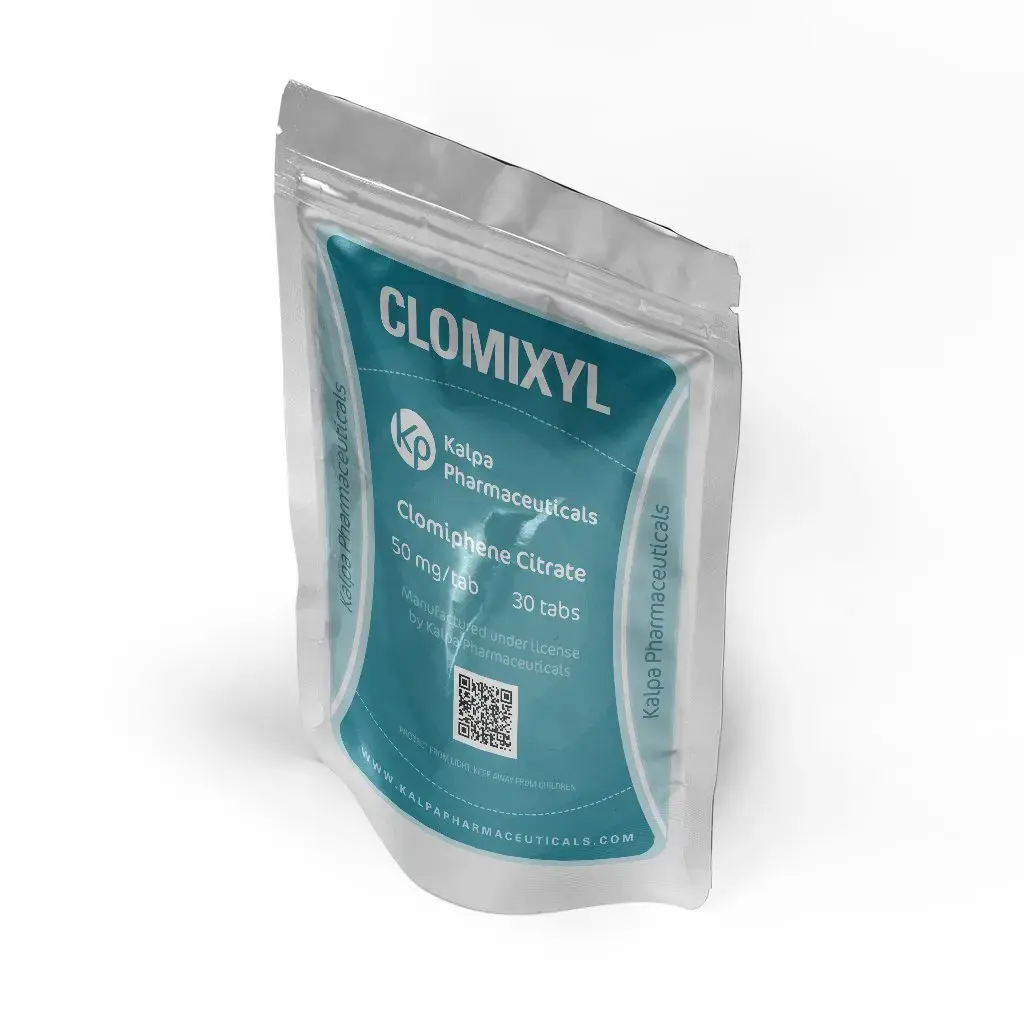
Clomixyl 50 mg is an oral clomiphene citrate tablet manufactured by Kalpa Pharmaceuticals and dosed at 50 mg per tablet, available in packs of 30 or 100 tablets.
Clomixyl 50 mg contains clomiphene citrate, a selective estrogen receptor modulator (SERM) . Clomiphene works by blocking estrogen receptors in the hypothalamus, which reduces the negative feedback normally exerted by circulating estrogens on the hypothalamic-pituitary-gonadal (HPG) axis. This action stimulates the release of gonadotropin-releasing hormone (GnRH) from the hypothalamus, which in turn promotes the secretion of luteinizing hormone (LH) and follicle-stimulating hormone (FSH) from the anterior pituitary.
Clomiphene citrate is FDA-approved for the treatment of ovulatory dysfunction in women desiring pregnancy. For men, clomiphene is sometimes prescribed off-label to treat secondary hypogonadism, a condition that can develop from extended steroid use. In clinical research, clomiphene citrate has been evaluated in post-cycle therapy (PCT) protocols for recreational bodybuilders, with a study using 25 mg/day as monotherapy to stimulate gonadotrophin release.
In non-medical bodybuilding contexts, clomiphene is commonly referenced in PCT protocols after anabolic-androgenic steroid cycles to help restore endogenous testosterone production. The compound is used because it can increase serum testosterone levels without suppressing the HPG axis, preserving testicular function and sperm production. However, non-medical use falls outside approved indications and carries risks including visual disturbances, mood changes, and rare but serious cardiovascular events.
Clomixyl 50 mg is supplied as an oral compressed tablet containing 50 mg of clomiphene citrate per unit, packaged in 30-tablet or 100-tablet formats by Kalpa Pharmaceuticals.
Clomiphene citrate is a selective estrogen receptor modulator characterized by mixed agonist-antagonist activity, a relatively long half-life, and the ability to stimulate gonadotropin release without suppressing the HPG axis.
Clomiphene citrate is a nonsteroidal triphenylethylene derivative that binds to estrogen receptors and acts as a mixed agonist-antagonist . Its primary mechanism involves blocking estrogen receptors in the hypothalamus, which reduces the negative feedback normally exerted by circulating estrogens on the HPG axis. This leads to increased release of GnRH, which in turn promotes secretion of LH and FSH from the anterior pituitary.
The increase in LH enhances testosterone production in the Leydig cells, while FSH supports spermatogenesis through its effect on Sertoli cells within the seminiferous tubules. By enhancing endogenous testosterone production, clomiphene can improve testosterone levels without suppressing the HPG axis, preserving testicular function and sperm production.
Clomiphene citrate is FDA-approved only for the treatment of ovulatory dysfunction in women desiring pregnancy. There are no adequate or well-controlled studies that demonstrate the effectiveness of clomiphene citrate in the treatment of male infertility. Testicular tumors and gynecomastia have been reported in males using clomiphene.
Clomiphene citrate has a relatively long half-life, with effects on gonadotropin release persisting after discontinuation. In clinical practice, each course of clomiphene citrate is typically started on or about the 5th day of the cycle.
Kalpa Pharmaceuticals offers several compounds referenced in non-medical bodybuilding contexts for managing hormonal recovery. The main distinctions involve mechanism of action and clinical profile.
For those comparing PCT options, Nolvaxyl 20 mg (tamoxifen) is another SERM commonly referenced in PCT protocols. For aromatase inhibitors, Arimixyl 1 mg (anastrozole) and Aromaxyl 25 mg (exemestane) work by reducing estrogen production rather than blocking receptors.
The information below is provided for educational reference only. Clomiphene citrate is a prescription medication; medical use requires appropriate diagnosis, clinical supervision, and ongoing monitoring. Non-medical use falls outside approved indications.
In FDA-approved medical use for women, clomiphene citrate is typically dosed at 50 mg daily for 5 days, starting on or about the 5th day of the cycle. In clinical research in male bodybuilders for PCT, clomiphene citrate has been studied at 25 mg/day as monotherapy. In other male studies, clomiphene has been used at 50 mg thrice per week for central hypogonadism. In non-medical bodybuilding contexts, clomiphene is commonly referenced in PCT protocols at 50–100 mg per day for 4 weeks, though such use falls outside approved indications.
| Use Case | Common Reference Range | Frequency |
|---|---|---|
| Medical (ovulatory dysfunction) | 50 mg per day | For 5 days per cycle |
| Clinical (PCT bodybuilders) | 25 mg per day | Daily as monotherapy |
| Clinical (male hypogonadism) | 50 mg thrice per week | Three times weekly |
| Non-medical (PCT) | 50–100 mg per day | Daily for 4 weeks |
In non-medical bodybuilding contexts, clomiphene is commonly referenced as a primary PCT agent after suppressive anabolic steroid cycles. The goal is to stimulate endogenous testosterone production by increasing LH and FSH release. A 2026 study in recreational bodybuilders found that clomiphene citrate monotherapy (25 mg/day) facilitated earlier hormonal normalization compared to no treatment.
The addition of hCG to clomiphene was associated with superior recovery of semen parameters and testicular volume compared to clomiphene alone. PCT protocols vary based on cycle length, compounds used, and individual response.
Clomiphene is generally well-tolerated, with side effects including mild mood changes, headaches, and visual disturbances, which are often reversible upon discontinuation. Common side effects of clomiphene for men include blurred vision or blind spots, breast pain or tenderness, dizziness, flushing, gynecomastia, headache, hypertriglyceridemia, mood swings, nausea, and testicular tumor.
Rare but serious cardiovascular events have been reported with clomiphene misuse in bodybuilders. A case series described a 24-year-old man with tachycardia and elevated blood pressure (183/99 mmHg) and a 30-year-old man with acute myocardial infarction after clomiphene use in a performance-enhancing drug context.
Clomiphene is commonly referenced as a PCT agent. Standard non-medical PCT protocols typically reference clomiphene at 50/50/25/25 mg over 4 weeks. However, the efficacy of PCT is still unproven, and many practices surrounding steroid use are not supported by rigorous clinical evidence. Medical guidance is strongly advised.
For PCT protocols, agents such as Clomixyl 50 mg and Nolvaxyl 20 mg are commonly discussed.
Dosing strategies and support protocols should be adjusted based on experience level, health status, and bloodwork where possible. The information above is for educational reference and does not constitute medical advice.
Clomiphene citrate is a prescription medication with effects on the reproductive system and potential for rare but serious adverse events. Medical use requires appropriate diagnosis, clinical supervision, and ongoing monitoring.
Clomiphene citrate is indicated for the treatment of ovulatory dysfunction in women desiring pregnancy. There are no adequate or well-controlled studies that demonstrate the effectiveness of clomiphene citrate in the treatment of male infertility. In addition, testicular tumors and gynecomastia have been reported in males using clomiphene.
Non-medical use of clomiphene citrate falls outside approved indications and can expose individuals to risks including visual disturbances, mood changes, and rare cardiovascular events.
Clomiphene citrate is a prescription medication. Non-medical use for PCT or performance enhancement is not approved by the FDA and is associated with risks including cardiovascular events.
Common side effects of clomiphene for men include blurred vision or blind spots, breast pain or tenderness, dizziness, flushing or hot flashes, gynecomastia, headache, hypertriglyceridemia, mood swings, nausea, pelvic pain, testicular tumor, upset stomach, and vomiting.
Visual disturbances are a known adverse effect of clomiphene and are generally reversible upon discontinuation. Rare but serious cardiovascular events have been reported in men using clomiphene in a performance-enhancing drug context. A case series described a 24-year-old man with tachycardia and elevated blood pressure (183/99 mmHg) and a 30-year-old man with acute myocardial infarction.
Clomiphene citrate reduces IGF-1 by approximately 32% to 35% in women with PCOS and by approximately 20% in controls. In men with hypogonadism, a study found that clomiphene (50 mg thrice per week for ≥3 months) decreased IGF-1 levels by −0.60 SDs in 75% of participants. This has led to recommendations for IGF-1 monitoring in hypogonadal patients treated with clomiphene citrate.
Clomiphene citrate is contraindicated in patients with known hypersensitivity or allergy to clomiphene citrate or any of its ingredients, and in pregnant women.
Pre-existing liver disease, visual disturbances, and cardiovascular conditions require careful evaluation before any consideration of clomiphene use. IGF-1 levels may warrant monitoring in men treated with clomiphene citrate.
Medically supervised clomiphene therapy should include monitoring for visual disturbances, mood changes, and cardiovascular symptoms. In men with hypogonadism, IGF-1 monitoring has been recommended due to the potential for significant reductions.
Any use of clomiphene citrate should be accompanied by appropriate monitoring and medical supervision where possible.
Store in a cool, dry place away from direct light and moisture. Keep tablets in the original packaging until use. Keep out of reach of children.
Clomixyl 50 mg is supplied through the official Kalpa Pharmaceuticals distribution chain and shipped in original manufacturer packaging with discreet, privacy-focused handling.
The outer shipping package remains discreet, with privacy-focused handling and no unnecessary external product details. Products are supplied through the official Kalpa Pharmaceuticals distribution chain.
To verify your Clomixyl 50 mg product, use the security code on the packaging and cross-check it on the Kalpa official site. Original Kalpa Pharmaceuticals presentation and packaging help reinforce product legitimacy and buyer confidence.
For complete delivery details, tracking policy, and reshipment terms, please see our Shipping Info page.
Proper storage conditions help preserve tablet integrity and stability throughout shelf life.
Store Clomixyl 50 mg in a cool, dry place away from excessive heat, moisture, and direct light. Maintaining stable conditions helps preserve the integrity of the tablets.
Keep the tablets in their original packaging until use. Do not use if the packaging is damaged or if the tablets appear abnormal in color or texture.
Keep out of reach of children. Follow proper handling practices for oral medications.
Answers to common questions about Clomixyl 50 mg, clomiphene citrate, dosing, side effects, and product specifications.
Clomixyl 50 mg contains clomiphene citrate, which is FDA-approved for the treatment of ovulatory dysfunction in women desiring pregnancy. In non-medical bodybuilding contexts, clomiphene is commonly referenced in PCT protocols after anabolic steroid cycles to help restore endogenous testosterone production, though such use falls outside approved indications.
In FDA-approved medical use for women, clomiphene citrate is typically dosed at 50 mg daily for 5 days, starting on or about the 5th day of the cycle. In clinical research in male bodybuilders for PCT, clomiphene has been studied at 25 mg/day as monotherapy. Non-medical PCT protocols commonly reference 50/50/25/25 mg over 4 weeks.
Clomiphene is itself commonly used as a PCT agent. It does not suppress the HPG axis and is used to stimulate endogenous testosterone production after suppressive anabolic steroid cycles. Standard non-medical PCT protocols reference clomiphene at 50/50/25/25 mg over 4 weeks. The efficacy of PCT is still unproven, and medical guidance is advised.
Clomiphene citrate blocks estrogen receptors in the hypothalamus, reducing the negative feedback normally exerted by circulating estrogens on the HPG axis. This stimulates GnRH release, which promotes LH and FSH secretion from the anterior pituitary. The increase in LH enhances testosterone production in the Leydig cells, while FSH supports spermatogenesis.
Clomiphene stimulates gonadotropin release relatively quickly, but effects on testosterone levels and recovery of the HPG axis may take weeks to manifest. In a 2026 study in recreational bodybuilders, clomiphene citrate monotherapy (25 mg/day) facilitated earlier hormonal normalization compared to no treatment.
There is no single PCT agent that is universally best. Clomiphene is commonly referenced in PCT protocols, as is Nolvaxyl 20 mg (tamoxifen). A 2026 study found that adding hCG to clomiphene was associated with superior recovery of semen parameters and testicular volume compared to clomiphene alone. The appropriate approach depends on individual factors and medical guidance.
Both clomiphene and tamoxifen are selective estrogen receptor modulators (SERMs) commonly referenced in PCT protocols. Clomiphene blocks estrogen receptors in the hypothalamus to stimulate gonadotropin release. Tamoxifen is also used for this purpose. The choice between them depends on individual response and medical guidance.
Clomiphene is a SERM that blocks estrogen receptors, while anastrozole is an aromatase inhibitor that reduces estrogen production by blocking the aromatase enzyme. Clomiphene is commonly referenced for PCT, while anastrozole is sometimes referenced for managing estrogenic side effects during cycles. Anastrozole is available as Arimixyl 1 mg.
A 50 mg tablet represents the standard FDA-approved daily dose for women with ovulatory dysfunction. In clinical research in male bodybuilders for PCT, clomiphene has been studied at 25 mg/day. Non-medical PCT protocols commonly reference starting at 50 mg and tapering down.
Clomixyl 50 mg is labeled at 50 mg of clomiphene citrate per tablet. It is supplied in packs of 30 or 100 tablets.
Clomiphene citrate stimulates FSH release, which supports spermatogenesis through its effect on Sertoli cells. A 2026 study in recreational bodybuilders found that adding hCG to clomiphene was associated with superior recovery of semen parameters compared to clomiphene alone. However, the FDA notes there are no adequate studies demonstrating effectiveness in male infertility.
Laboratory testing information for Clomixyl 50 mg is not currently available in this product listing. Kalpa Pharmaceuticals products are manufactured under pharmaceutical-grade conditions, but independent lab reports are not published for this specific product at this time.

April 22, 2019
Clomixyl tested good on labmax but have not used yet so don't know if dose is correct