


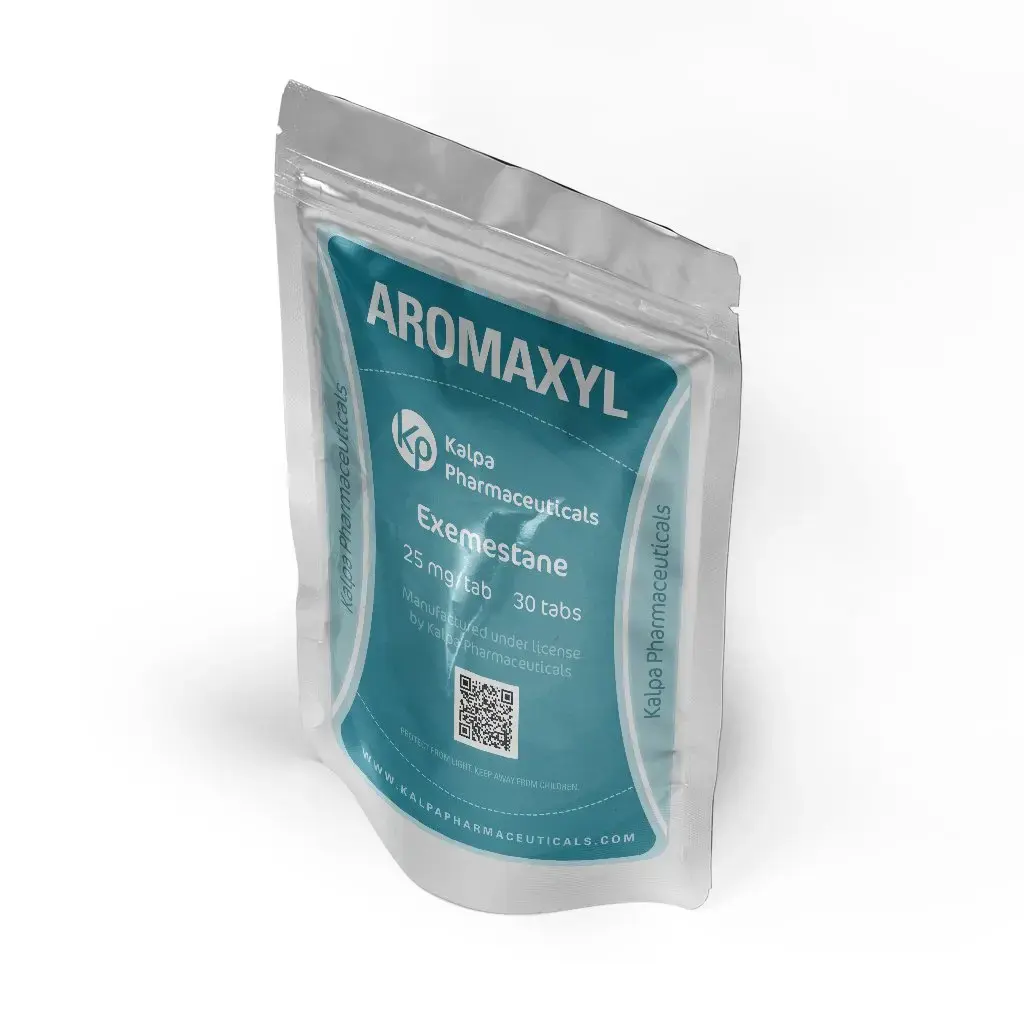
Aromaxyl 25 mg is an oral exemestane tablet manufactured by Kalpa Pharmaceuticals and dosed at 25 mg per tablet, supplied in packs of 30 tablets.
Aromaxyl 25 mg contains exemestane, an irreversible, steroidal aromatase inactivator structurally related to the natural substrate androstenedione . Exemestane binds irreversibly to the aromatase enzyme, blocking the conversion of androgens into estrogens . This mechanism results in profound suppression of circulating estrogen levels, with a maximum suppression of at least 85% to 95% achieved at the 25 mg dose .
Exemestane is FDA-approved for the treatment of advanced breast cancer in postmenopausal women whose disease has progressed following tamoxifen therapy, and as adjuvant treatment for postmenopausal women with estrogen-receptor positive early breast cancer . In clinical research in males, exemestane has been studied for its effects on estrogen suppression and testosterone elevation. A study in young males found that exemestane 25 mg daily suppressed plasma estradiol by 38% and produced a reciprocal increase in testosterone concentrations of 60% .
In non-medical bodybuilding contexts, exemestane is sometimes referenced to manage estrogenic side effects associated with aromatizable anabolic steroids . However, the FDA has not approved exemestane for this purpose, and approved indications in male athletes do not exist . Non-medical use falls outside approved indications and carries risks including marked bone mineral density loss, arthralgia, and cardiovascular events .
Aromaxyl 25 mg is supplied as an oral compressed tablet containing 25 mg of exemestane per unit, packaged in a 30-tablet format by Kalpa Pharmaceuticals.
Exemestane is a steroidal aromatase inhibitor characterized by irreversible enzyme binding, potent estrogen suppression, and a distinct pharmacological profile compared to non-steroidal inhibitors such as anastrozole and letrozole.
Exemestane is an irreversible, steroidal aromatase inactivator structurally related to the natural substrate androstenedione . Unlike non-steroidal inhibitors (anastrozole, letrozole) which bind reversibly, exemestane binds irreversibly to the aromatase enzyme, leading to sustained enzyme inactivation . This mechanism is sometimes referred to as "suicide inhibition" because the enzyme is permanently inactivated .
Exemestane is extensively metabolized, with levels of unchanged drug in plasma accounting for less than 10% of total radioactivity . The metabolites are inactive or inhibit aromatase with decreased potency compared with the parent drug . One metabolite may have androgenic activity . The principal isoenzyme involved in oxidation is CYP 3A4 .
Following oral administration, exemestane is absorbed with a mean tmax of 1.2 hours in women with breast cancer and 2.9 hours in healthy women . A high-fat breakfast increases AUC and Cmax by 59% and 39%, respectively . The drug is 90% bound to plasma proteins .
Exemestane has a terminal half-life of approximately 24 hours in clinical populations . After a single 25 mg dose, maximal suppression of circulating estrogens occurs 2 to 3 days after dosing and persists for 4 to 5 days .
Kalpa Pharmaceuticals offers several compounds referenced in non-medical bodybuilding contexts for managing hormonal side effects. The main distinctions involve mechanism of action and clinical profile.
For those comparing aromatase inhibitors, Arimixyl 1 mg (anastrozole) is a non-steroidal, reversible inhibitor. Letroxyl (letrozole) is another non-steroidal inhibitor with a different potency profile. For selective estrogen receptor modulators, Nolvaxyl 20 mg (tamoxifen) and Clomixyl 50 mg (clomiphene) work by blocking estrogen receptors rather than inhibiting estrogen production.
The information below is provided for educational reference only. Exemestane is a prescription medication; medical use requires appropriate diagnosis, clinical supervision, and ongoing monitoring. The FDA has only approved exemestane for breast cancer treatment . Non-medical use falls outside approved indications.
In FDA-approved medical use, the recommended dose of exemestane is one 25 mg tablet once daily after a meal . For patients receiving exemestane with a strong CYP 3A4 inducer such as rifampicin or phenytoin, the recommended dose is 50 mg once daily . In clinical research in young males, exemestane 25 mg daily was administered for 10 days, suppressing estradiol by 38% and increasing testosterone by 60% . In non-medical bodybuilding contexts, exemestane has been referenced at a mean dose of 10 mg per day in forum analyses, though such use falls outside approved indications .
| Use Case | Common Reference Range | Frequency |
|---|---|---|
| Medical (breast cancer) | 25 mg per day | Once daily after a meal |
| Medical (with CYP 3A4 inducer) | 50 mg per day | Once daily after a meal |
| Clinical research (young males) | 25 mg per day | Once daily for 10 days |
| Non-medical (bodybuilding) | 10 mg per day (mean) | Once daily |
In non-medical bodybuilding contexts, exemestane is sometimes referenced alongside aromatizable anabolic steroids to manage estrogenic side effects. The rationale involves reducing the conversion of testosterone to estrogen, which can help prevent gynecomastia and water retention associated with high estrogen levels .
However, the FDA has not approved exemestane for this purpose, and approved indications in male athletes do not exist . Forum analyses of aromatase inhibitor use in steroid users found a median treatment duration of 84 days for exemestane, with a mean dose of 10 mg per day . Excessive estrogen suppression can lead to its own side effects, including joint pain and negative effects on lipid profiles and bone density .
Exemestane is associated with significant reductions in bone mineral density over time. In clinical trials, mean decreases in lumbar spine BMD were -3.1% and femoral neck BMD were -4.2% at 24 months . During adjuvant treatment, women with osteoporosis or at risk of osteoporosis should have bone mineral density formally assessed by bone densitometry at the commencement of treatment .
Common adverse reactions occurring in ≥10% of patients include hot flushes, fatigue, arthralgia, headache, insomnia, and increased sweating . Cardiovascular effects include cardiac ischemic events (1.6% vs 0.6% for tamoxifen) . Lipid profile monitoring every 6 months is recommended .
Exemestane is not a selective estrogen receptor modulator (SERM) and is not typically used as a primary PCT agent. In non-medical bodybuilding contexts, PCT protocols commonly reference SERMs such as Nolvaxyl 20 mg (tamoxifen) or Clomixyl 50 mg (clomiphene) to support recovery of endogenous testosterone production. Exemestane may be referenced in some protocols for managing estrogen rebound, but medical guidance is strongly advised.
Dosing strategies and support protocols should be adjusted based on experience level, health status, and bloodwork where possible. The information above is for educational reference and does not constitute medical advice.
Exemestane is a prescription medication with significant effects on estrogen biosynthesis, bone mineral density, and cardiovascular risk markers. Medical use requires appropriate diagnosis, clinical supervision, and ongoing monitoring.
Exemestane is indicated for the treatment of advanced breast cancer in postmenopausal women whose disease has progressed following tamoxifen therapy, and for adjuvant treatment of postmenopausal women with estrogen-receptor positive early breast cancer . It is contraindicated in patients with known hypersensitivity to the drug or to any excipients .
Non-medical use of exemestane falls outside approved indications and can expose individuals to risks including marked bone mineral density loss, arthralgia, hypertension, and psychiatric effects .
Exemestane is a prescription medication. Non-medical use for bodybuilding or performance enhancement is not approved by the FDA and is associated with serious health risks including bone loss, cardiovascular events, and arthralgia.
Reductions in bone mineral density over time are seen with exemestane use. In clinical trials, mean decreases in lumbar spine BMD were -3.1% and femoral neck BMD were -4.2% at 24 months . During adjuvant treatment, bone mineral density should be formally assessed by bone densitometry at commencement, and patients should be monitored for bone mineral density loss .
Adverse reactions occurring in ≥10% of patients in any treatment group include hot flushes (21%), fatigue (16%), arthralgia (15%), headache (13%), insomnia (12%), and increased sweating (12%) . Incidences of cardiac ischemic events were 1.6% for exemestane vs 0.6% for tamoxifen . Incidence of cardiac failure was 0.7% vs 0.3% for placebo .
In non-medical contexts, exemestane use causes marked bone mineral density loss, arthralgia, hypertension, and psychiatric effects . Lipid profile changes including decreased total and HDL cholesterol have been observed .
Exemestane is contraindicated in patients with known hypersensitivity to the drug or to any excipients . Women with osteoporosis or at risk of osteoporosis should have bone mineral density formally assessed by bone densitometry at the commencement of treatment .
Pre-existing cardiovascular disease, high cholesterol levels, and liver problems require careful evaluation and monitoring before and during exemestane use .
Medically supervised exemestane therapy should include monitoring of bone mineral density due to the risk of decreases . Lipid profile monitoring every 6 months is recommended . During adjuvant treatment, women with osteoporosis or at risk should have bone mineral density formally assessed at commencement .
Any use of exemestane should be accompanied by appropriate monitoring and medical supervision where possible.
Store in a cool, dry place away from direct light and moisture. Keep tablets in the original packaging until use. Keep out of reach of children.
Aromaxyl 25 mg is supplied through the official Kalpa Pharmaceuticals distribution chain and shipped in original manufacturer packaging with discreet, privacy-focused handling.
The outer shipping package remains discreet, with privacy-focused handling and no unnecessary external product details. Products are supplied through the official Kalpa Pharmaceuticals distribution chain.
To verify your Aromaxyl 25 mg product, use the security code on the packaging and cross-check it on the Kalpa official site. Original Kalpa Pharmaceuticals presentation and packaging help reinforce product legitimacy and buyer confidence.
For complete delivery details, tracking policy, and reshipment terms, please see our Shipping Info page.
Proper storage conditions help preserve tablet integrity and stability throughout shelf life.
Store Aromaxyl 25 mg in a cool, dry place away from excessive heat, moisture, and direct light. Maintaining stable conditions helps preserve the integrity of the tablets.
Keep the tablets in their original packaging until use. Do not use if the packaging is damaged or if the tablets appear abnormal in color or texture.
Keep out of reach of children. Follow proper handling practices for oral medications.
Answers to common questions about Aromaxyl 25 mg, exemestane, dosing, side effects, and product specifications.
Aromaxyl 25 mg contains exemestane, which is FDA-approved for the treatment of advanced breast cancer in postmenopausal women whose disease has progressed following tamoxifen therapy, and for adjuvant treatment of postmenopausal women with estrogen-receptor positive early breast cancer . In non-medical bodybuilding contexts, it is sometimes referenced to manage estrogenic side effects of aromatizable anabolic steroids, though such use falls outside approved indications .
In FDA-approved medical use, exemestane is taken as one 25 mg tablet once daily after a meal . For patients receiving strong CYP 3A4 inducers, the recommended dose is 50 mg once daily . In non-medical bodybuilding contexts, forum analyses have referenced a mean dose of 10 mg per day, though such use falls outside approved indications .
Exemestane is not a selective estrogen receptor modulator (SERM) and is not typically used as a primary PCT agent. In non-medical bodybuilding contexts, PCT protocols commonly reference SERMs such as Nolvaxyl 20 mg or Clomixyl 50 mg to support recovery. Exemestane may be referenced in some protocols for managing estrogen rebound, but medical guidance is strongly advised.
Exemestane (brand name Aromasin) binds irreversibly to the aromatase enzyme, blocking the conversion of androgens into estrogens . This results in profound suppression of circulating estrogen levels, with a maximum suppression of at least 85% to 95% achieved at the 25 mg dose . In clinical research, exemestane 25 mg daily suppressed plasma estradiol by 38% in young males and produced a reciprocal increase in testosterone concentrations of 60% .
Following oral administration, exemestane is rapidly absorbed with a mean tmax of 1.2 hours in women with breast cancer . After a single 25 mg dose, maximal suppression of circulating estrogens occurs 2 to 3 days after dosing and persists for 4 to 5 days . The terminal half-life is approximately 24 hours .
There is no single aromatase inhibitor that is universally best. Exemestane is unique as an irreversible steroidal inhibitor . Other aromatase inhibitors such as Arimixyl 1 mg (anastrozole) and Letroxyl (letrozole) are non-steroidal and bind reversibly. The appropriate choice depends on the clinical context and individual factors.
Exemestane is a steroidal aromatase inhibitor that binds irreversibly to the enzyme . Anastrozole is a non-steroidal inhibitor that binds reversibly. Both are used for estrogen suppression, but their mechanisms and side effect profiles differ. Exemestane is available as Aromaxyl 25 mg while anastrozole is available as Arimixyl 1 mg.
Exemestane is an aromatase inhibitor that reduces estrogen production by blocking the aromatase enzyme . Tamoxifen is a selective estrogen receptor modulator (SERM) that blocks estrogen receptors rather than reducing estrogen production. In clinical trials, exemestane was associated with a higher incidence of arthralgia (15% vs 9%) and cardiac ischemic events (1.6% vs 0.6%) compared to tamoxifen .
A 25 mg tablet represents the standard FDA-approved daily dose for breast cancer treatment . In non-medical bodybuilding contexts, doses as low as 10 mg per day are referenced . Even at lower doses, exemestane can significantly suppress estrogen levels and carries risks including marked bone mineral density loss and arthralgia .
Aromaxyl 25 mg is labeled at 25 mg of exemestane per tablet. It is supplied in packs of 30 tablets, giving 750 mg of total labeled exemestane content per pack.
Yes, clinical research in young males found that exemestane 25 mg daily produced a reciprocal increase in testosterone concentrations of 60% . This occurs because suppressing estrogen removes negative feedback on the hypothalamic-pituitary-gonadal axis, leading to increased luteinizing hormone and testosterone production.
Laboratory testing information for Aromaxyl 25 mg is not currently available in this product listing. Kalpa Pharmaceuticals products are manufactured under pharmaceutical-grade conditions, but independent lab reports are not published for this specific product at this time.
April 22, 2019
Aromaxyl helped keep estro in check at 10mg and when it crept up too high near end of cycle and I doubled the dose it dropped me back into range