


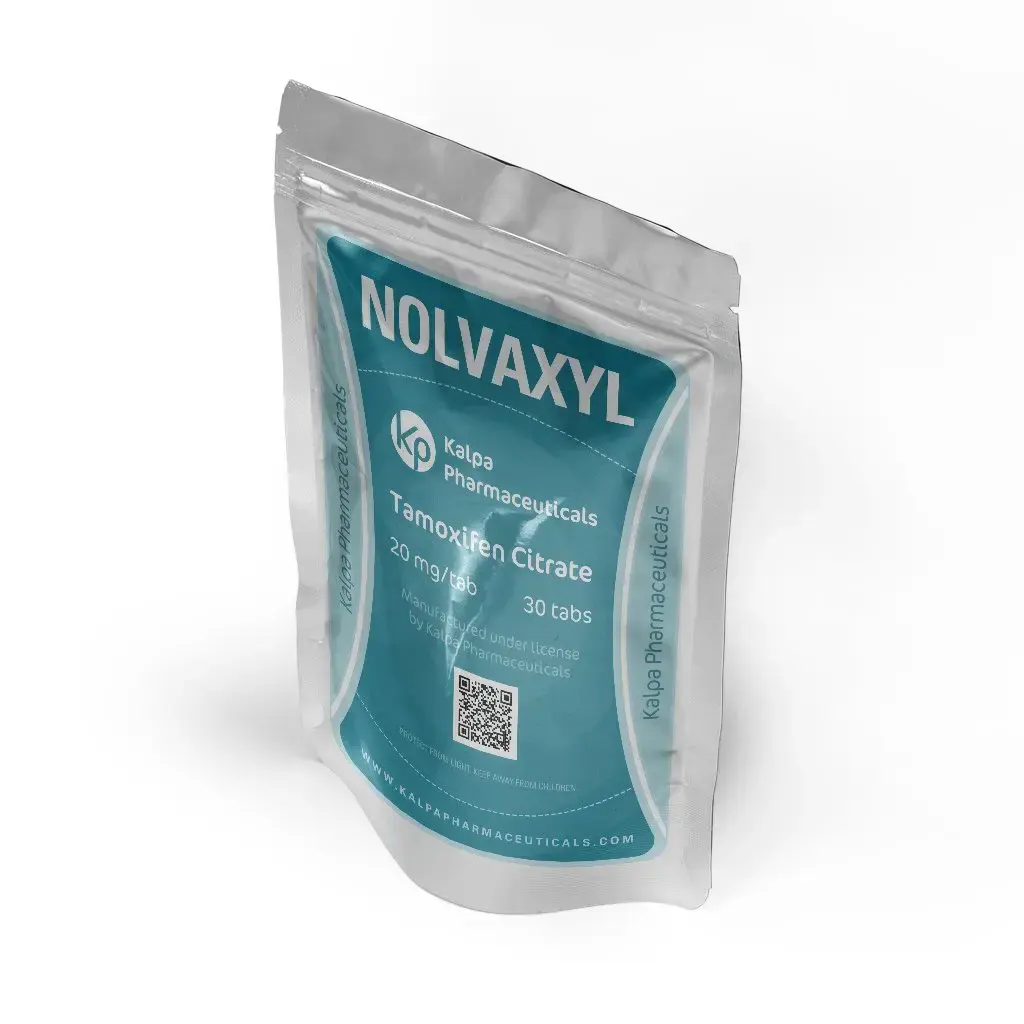
Nolvaxyl 20 mg is an oral tamoxifen citrate tablet manufactured by Kalpa Pharmaceuticals and dosed at 20 mg per tablet, available in packs of 30 or 100 tablets.
Nolvaxyl 20 mg contains tamoxifen citrate, a selective estrogen receptor modulator (SERM) . Tamoxifen works by competitively binding to estrogen receptors in target tissues, thereby blocking the effects of endogenous estrogens . In the hypothalamus and pituitary, this blockade reduces the negative feedback normally exerted by circulating estrogens on the hypothalamic-pituitary-gonadal (HPG) axis, leading to increased secretion of gonadotropin-releasing hormone (GnRH), which in turn stimulates the release of luteinizing hormone (LH) and follicle-stimulating hormone (FSH) from the anterior pituitary.
Tamoxifen citrate is FDA-approved for the treatment of metastatic breast cancer in women and men, adjuvant treatment of breast cancer, treatment of ductal carcinoma in situ (DCIS), and reduction of breast cancer incidence in women at high risk. In clinical research, tamoxifen has been studied for the treatment of gynecomastia and male infertility, though these are not FDA-approved indications.
In non-medical bodybuilding contexts, tamoxifen is commonly referenced in post-cycle therapy (PCT) protocols after anabolic-androgenic steroid cycles to help restore endogenous testosterone production and manage estrogenic side effects such as gynecomastia. The compound is used because it can increase serum testosterone levels by stimulating the HPG axis, without suppressing testicular function. However, non-medical use falls outside approved indications and carries risks including thromboembolic events and visual disturbances.
Nolvaxyl 20 mg is supplied as an oral compressed tablet containing 20 mg of tamoxifen citrate per unit, packaged in 30-tablet or 100-tablet formats by Kalpa Pharmaceuticals.
Tamoxifen citrate is a selective estrogen receptor modulator characterized by mixed agonist-antagonist activity, a long half-life, and the ability to stimulate gonadotropin release without suppressing the HPG axis.
Tamoxifen citrate is a nonsteroidal triphenylethylene derivative that binds to estrogen receptors and acts as a mixed agonist-antagonist depending on the target tissue . In the breast, it acts as an antagonist, blocking estrogen's proliferative effects. In the hypothalamus and pituitary, its antagonistic action reduces estrogen-mediated negative feedback, leading to increased GnRH, LH, and FSH secretion.
The increase in LH enhances testosterone production in the Leydig cells, while FSH supports spermatogenesis through its effect on Sertoli cells . By enhancing endogenous testosterone production, tamoxifen can improve testosterone levels without suppressing the HPG axis, preserving testicular function and sperm production.
Tamoxifen is extensively metabolized in the liver via CYP3A, 2C9, and 2D6 enzymes into active metabolites including 4-hydroxytamoxifen and endoxifen. The major metabolite, N-desmethyl tamoxifen, has similar biological activity to the parent drug. Steady-state concentrations are achieved in approximately 4 weeks, with a terminal elimination half-life of about 5 to 7 days.
Tamoxifen has a terminal elimination half-life of approximately 5 to 7 days, with its major metabolite N-desmethyl tamoxifen having a half-life of approximately 14 days. This long half-life allows for once-daily dosing and sustained receptor blockade.
Kalpa Pharmaceuticals offers several compounds referenced in non-medical bodybuilding contexts for managing hormonal recovery and estrogenic side effects. The main distinctions involve mechanism of action and clinical profile.
For those comparing PCT options, Clomixyl 50 mg (clomiphene citrate) is another SERM commonly referenced in PCT protocols. For aromatase inhibitors, Arimixyl 1 mg (anastrozole) and Aromaxyl 25 mg (exemestane) work by reducing estrogen production rather than blocking receptors.
The information below is provided for educational reference only. Tamoxifen citrate is a prescription medication; medical use requires appropriate diagnosis, clinical supervision, and ongoing monitoring. Non-medical use falls outside approved indications.
In FDA-approved medical use, the recommended daily dose of tamoxifen for metastatic breast cancer is 20 to 40 mg, given as a single dose or in divided doses (morning and evening) . For adjuvant treatment of breast cancer, the recommended dose is 20 mg daily for 5 to 10 years. For gynecomastia prophylaxis in men receiving antiandrogen therapy for prostate cancer, the recommended dose is 20 mg once daily. In clinical research for pubertal gynecomastia, tamoxifen has been studied at 20-40 mg/d orally for 2-12 months. In non-medical bodybuilding contexts, tamoxifen is commonly referenced in PCT protocols at 20 mg per day for 4-6 weeks, sometimes starting at 40 mg for the first 2 weeks.
| Use Case | Common Reference Range | Frequency |
|---|---|---|
| Medical (metastatic breast cancer) | 20–40 mg per day | Once daily or divided |
| Medical (adjuvant breast cancer) | 20 mg per day | Once daily for 5–10 years |
| Medical (gynecomastia prophylaxis) | 20 mg per day | Once daily |
| Clinical research (pubertal gynecomastia) | 20–40 mg per day | Once daily for 2–12 months |
| Non-medical (PCT) | 20 mg per day (40 mg start) | Daily for 4–6 weeks |
In non-medical bodybuilding contexts, tamoxifen is commonly referenced as a primary PCT agent after suppressive anabolic steroid cycles. The goal is to stimulate endogenous testosterone production by increasing LH and FSH release. Clinical data from Pirard et al. (2005) and Kaminetsky et al. show tamoxifen raises testosterone comparably or better than clomiphene at lower milligram doses with a more favorable side-effect profile.
Combination use with clomiphene is common in bodybuilding protocols, but controlled data supporting additive benefit over tamoxifen alone are lacking. PCT duration should reflect the suppressive depth of the anabolic cycle used, with most protocols running 4 to 6 weeks.
Tamoxifen is associated with several potential side effects. Common adverse reactions include hot flashes, mood disturbances, vaginal discharge, vaginal bleeding, nausea, and fluid retention. Serious risks include uterine malignancies, stroke, and pulmonary embolism, as highlighted in the boxed warning.
Ocular changes including corneal changes, cataracts, and retinopathy have been reported. Periodic ophthalmologic examinations are recommended, and patients experiencing visual changes should seek immediate evaluation. Tamoxifen may also increase the risk of thromboembolic events, particularly in women with a history of deep vein thrombosis or pulmonary embolism.
Tamoxifen is commonly referenced as a PCT agent in non-medical bodybuilding contexts. Standard PCT protocols typically reference tamoxifen at 20 mg per day for 4 to 6 weeks, sometimes starting at 40 mg for the first 2 weeks. The goal is to stimulate endogenous testosterone production by blocking estrogen receptors in the hypothalamus and pituitary, which increases GnRH, LH, and FSH release.
Agents such as Nolvaxyl 20 mg and Clomixyl 50 mg are commonly discussed for this purpose. The efficacy of PCT is still unproven in rigorous clinical trials, and medical guidance is strongly advised.
Dosing strategies and support protocols should be adjusted based on experience level, health status, and bloodwork where possible. The information above is for educational reference and does not constitute medical advice.
Tamoxifen citrate is a prescription medication with significant effects on estrogen signaling, coagulation, and endometrial tissue. Medical use requires appropriate diagnosis, clinical supervision, and ongoing monitoring.
Tamoxifen citrate carries a boxed warning for uterine malignancies and thromboembolic events. Serious and life-threatening events including uterine malignancies (endometrial adenocarcinoma and uterine sarcoma), stroke, and pulmonary embolism have occurred, with some fatal cases. The incidence rates per 1000 women-years in the NSABP P-1 trial were: endometrial adenocarcinoma 2.20 for tamoxifen vs 0.71 for placebo; uterine sarcoma 0.17 vs 0.04; stroke 1.43 vs 1.00; pulmonary embolism 0.75 vs 0.25.
Tamoxifen is indicated for metastatic breast cancer in women and men, adjuvant treatment of breast cancer, DCIS, and reduction of breast cancer incidence in high-risk women. Non-medical use falls outside approved indications and carries these same serious risks.
Tamoxifen citrate is a prescription medication. Non-medical use for PCT or performance enhancement is not approved by the FDA and is associated with serious health risks including thromboembolic events and uterine malignancies.
The most common adverse reactions (occurring in >10% of patients) include hot flashes, mood disturbances, vaginal discharge, vaginal bleeding, nausea, and fluid retention. Other reported effects include fatigue, dizziness, headache, and skin changes.
Serious adverse effects include increased incidence of uterine malignancies (endometrial adenocarcinoma and uterine sarcoma), thromboembolic events (deep vein thrombosis, pulmonary embolism, stroke), and ocular changes including corneal changes, cataracts, and retinopathy. Hypercalcemia has been reported in breast cancer patients with bone metastases within a few weeks of starting treatment .
Tamoxifen is a substrate of CYP3A, 2C9, and 2D6 enzymes. Concomitant use with strong CYP2D6 inhibitors (e.g., paroxetine, fluoxetine, quinidine) should be avoided as it may reduce levels of active metabolites. Tamoxifen reduces plasma concentration of letrozole by 37% when coadministered.
Tamoxifen is contraindicated in patients with known hypersensitivity to the drug or any of its ingredients. It is contraindicated in women who require concomitant coumarin-type anticoagulant therapy or in women with a history of deep-vein thrombosis or pulmonary embolus if used for risk reduction or DCIS.
Pre-existing coagulation disorders, history of thromboembolic events, liver disease, and ocular conditions require careful evaluation before tamoxifen use. Periodic blood counts are advisable in patients with persistent leukopenia or thrombocytopenia.
Medically supervised tamoxifen therapy should include periodic monitoring for thromboembolic events, uterine changes, and ocular effects. Patients should be instructed to report symptoms of stroke, pulmonary embolism, or abnormal vaginal bleeding immediately.
Any use of tamoxifen citrate should be accompanied by appropriate monitoring and medical supervision where possible.
Store in a cool, dry place away from direct light and moisture. Keep tablets in the original packaging until use. Keep out of reach of children.
Nolvaxyl 20 mg is supplied through the official Kalpa Pharmaceuticals distribution chain and shipped in original manufacturer packaging with discreet, privacy-focused handling.
The outer shipping package remains discreet, with privacy-focused handling and no unnecessary external product details. Products are supplied through the official Kalpa Pharmaceuticals distribution chain.
To verify your Nolvaxyl 20 mg product, use the security code on the packaging and cross-check it on the Kalpa official site. Original Kalpa Pharmaceuticals presentation and packaging help reinforce product legitimacy and buyer confidence.
For complete delivery details, tracking policy, and reshipment terms, please see our Shipping Info page.
Proper storage conditions help preserve tablet integrity and stability throughout shelf life.
Store Nolvaxyl 20 mg in a cool, dry place away from excessive heat, moisture, and direct light. Maintaining stable conditions helps preserve the integrity of the tablets.
Keep the tablets in their original packaging until use. Do not use if the packaging is damaged or if the tablets appear abnormal in color or texture.
Keep out of reach of children. Follow proper handling practices for oral medications.
Answers to common questions about Nolvaxyl 20 mg, tamoxifen citrate, dosing, side effects, and product specifications.
Nolvaxyl 20 mg contains tamoxifen citrate, which is FDA-approved for the treatment of metastatic breast cancer in women and men, adjuvant treatment of breast cancer, treatment of ductal carcinoma in situ (DCIS), and reduction of breast cancer incidence in women at high risk. In non-medical bodybuilding contexts, tamoxifen is commonly referenced in PCT protocols after anabolic steroid cycles to help restore endogenous testosterone production, though such use falls outside approved indications.
In FDA-approved medical use, tamoxifen for metastatic breast cancer is dosed at 20 to 40 mg daily, given as a single dose or in divided doses . For adjuvant treatment, the recommended dose is 20 mg daily for 5 to 10 years. In non-medical PCT protocols, tamoxifen is commonly referenced at 20 mg per day for 4 to 6 weeks, sometimes starting at 40 mg for the first 2 weeks.
Tamoxifen is itself commonly used as a PCT agent. It does not suppress the HPG axis and is used to stimulate endogenous testosterone production after suppressive anabolic steroid cycles. Standard non-medical PCT protocols reference tamoxifen at 20 mg per day for 4 to 6 weeks. The efficacy of PCT is still unproven, and medical guidance is advised.
Tamoxifen (brand name Nolvadex) competitively binds to estrogen receptors, blocking the effects of endogenous estrogens in target tissues . In the hypothalamus and pituitary, this blockade reduces estrogen-mediated negative feedback on the HPG axis, leading to increased GnRH, LH, and FSH secretion. The increase in LH enhances testosterone production in the Leydig cells . In clinical research, tamoxifen 20 mg daily for 6 weeks significantly increased LH (211%), FSH (215%), and total testosterone (157%) levels in men.
Tamoxifen is extensively metabolized in the liver, with steady-state concentrations achieved in approximately 4 weeks. In clinical research, significant increases in LH, FSH, and testosterone levels were observed after 6 weeks of daily 20 mg dosing. For gynecomastia, clinical studies have used treatment courses of 2 to 12 months.
There is no single PCT agent that is universally best. Human data show tamoxifen raises testosterone comparably or better than clomiphene at lower milligram doses with a more favorable side-effect profile. Tamoxifen is commonly referenced in PCT protocols, as is Clomixyl 50 mg. The appropriate choice depends on individual factors and medical guidance.
Both tamoxifen and clomiphene are selective estrogen receptor modulators (SERMs) commonly referenced in PCT protocols. Human data show tamoxifen produces a comparable or larger gonadotropin response at lower doses than clomiphene. Clomiphene carries a higher rate of visual disturbances and mood changes attributed to its estrogen-agonist activity. Tamoxifen is available as Nolvaxyl 20 mg while clomiphene is available as Clomixyl 50 mg.
Tamoxifen is a SERM that blocks estrogen receptors, while anastrozole is an aromatase inhibitor that reduces estrogen production by blocking the aromatase enzyme. Tamoxifen is commonly referenced for PCT, while anastrozole is sometimes referenced for managing estrogenic side effects during cycles. Anastrozole is available as Arimixyl 1 mg.
A 20 mg tablet represents the standard FDA-approved daily dose for adjuvant breast cancer treatment, DCIS, and breast cancer risk reduction. In clinical research for gynecomastia, tamoxifen has been studied at 20-40 mg/day. In non-medical PCT protocols, 20 mg per day is the standard dose.
Nolvaxyl 20 mg is labeled at 20 mg of tamoxifen citrate per tablet. It is supplied in packs of 30 or 100 tablets.
Yes, tamoxifen has been studied for the treatment of gynecomastia. Clinical research in boys with pubertal gynecomastia found that tamoxifen at 20-40 mg/day for 2-12 months resulted in complete resolution in most cases. A retrospective study of 38 patients with persistent pubertal gynecomastia found that tamoxifen treatment resulted in a mean reduction in breast nodule diameter of 2.1 cm, with improvement seen in 86% of patients. In a comparison study, complete resolution was recorded in 78.2% of patients treated with tamoxifen (20 mg/d) for idiopathic gynecomastia.
Laboratory testing information for Nolvaxyl 20 mg is not currently available in this product listing. Kalpa Pharmaceuticals products are manufactured under pharmaceutical-grade conditions, but independent lab reports are not published for this specific product at this time.
Nolvaxyl was effective in keeping nip symptoms down right when I started to feel them leading me to believe it is accurately dosed
Please log in to write Nolvaxyl 20 mg review.




July 23, 2022
I am taking 20 mg nolva every day since I got it. It works really well. the gyno stopped to grow! But people said it is just prevention so I now need to order some Letrozole to reduce the puffy nipple. highly recommend this supplier