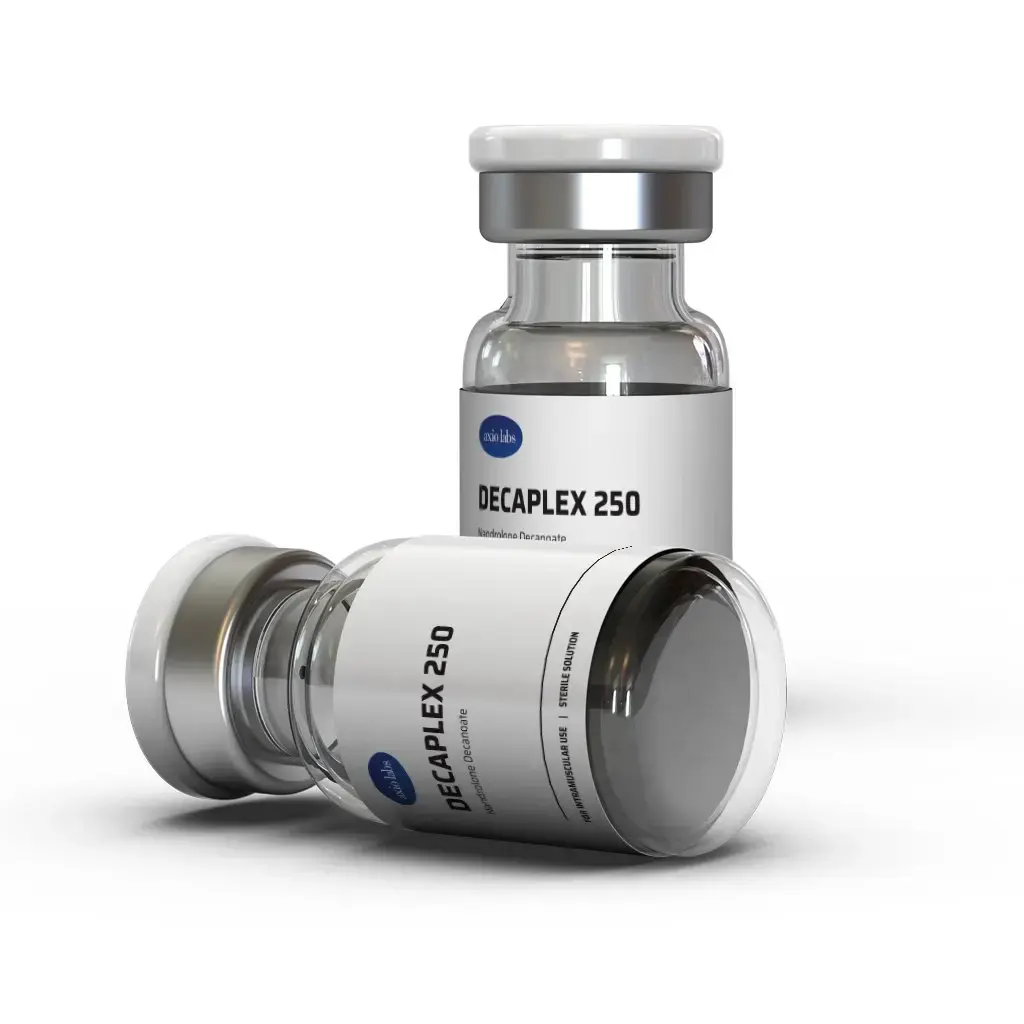
Decaplex 250 mg is an oil-based nandrolone decanoate injectable manufactured by Axiolabs and dosed at 250 mg/mL in a 10 mL vial.
Decaplex 250 mg is an injectable anabolic-androgenic steroid containing nandrolone decanoate, a long-acting 19-nor testosterone derivative. Nandrolone decanoate is FDA-approved for the management of anemia of renal insufficiency and has been shown to increase hemoglobin and red cell mass. Its extended release profile, driven by the decanoate ester, makes it one of the most widely referenced injectable anabolic steroids in non-medical bodybuilding contexts for mass-building and joint support.
In clinical practice, nandrolone decanoate is indicated for the management of anemia associated with renal insufficiency, with surgically induced anephric patients reported to be less responsive. Anabolic steroids, including nandrolone decanoate, suppress the gonadotropic functions of the pituitary and may exert a direct effect upon the testis. In bodybuilding and performance-enhancement settings, nandrolone decanoate is commonly referenced as a foundational compound in bulking cycles due to its anabolic activity and reputation for joint comfort, though such use falls outside approved medical indications.
Nandrolone supports muscle protein synthesis and nitrogen retention through androgen receptor binding, but its 19-nor structure produces a distinct pharmacological profile compared to testosterone. Nandrolone decanoate has been reported to increase low-density lipoproteins and decrease high-density lipoproteins, with these changes reverting to normal upon discontinuation of treatment. Non-medical use at supraphysiologic doses increases exposure to adverse effects including suppression of endogenous testosterone production, lipid profile disruption, and potential hepatic complications.
Decaplex 250 mg uses MCT oil as its carrier oil, providing the oil base for the nandrolone decanoate formulation.
Nandrolone decanoate is a long-acting 19-nor anabolic steroid with a distinct pharmacological profile, characterized by its decanoate ester and FDA approval for a specific clinical indication.
Nandrolone decanoate is the decanoic acid ester of nandrolone (19-nortestosterone). The decanoate ester slows the release of nandrolone from the injection site, producing a prolonged duration of activity. The compound is supplied as a sterile oleaginous solution containing nandrolone decanoate with benzyl alcohol as a solubilizer/preservative in sesame oil or other suitable carrier oils.
As a 19-nor compound, nandrolone lacks the 19-methyl group present in testosterone, which alters its interaction with enzymes and receptors. This structural difference contributes to nandrolone's relatively lower androgenic activity compared to testosterone and its different metabolic fate. Anabolic steroids are synthetic derivatives of testosterone, and complete dissociation of anabolic and androgenic effects has not been achieved.
Nandrolone decanoate is a Schedule III controlled substance in the United States with accepted medical uses. Clinical use is limited to specific indications, and the drug has not been shown to be safe and effective for the enhancement of athletic performance.
The decanoate ester provides nandrolone with an extended release profile, supporting less frequent administration compared to shorter-acting esters. This characteristic is central to its practical application in both clinical and non-medical contexts.
Axiolabs produces several injectable anabolic products referenced in different contexts. Decaplex 250 mg is a nandrolone decanoate product, placing it among the long-acting injectable options alongside Testaplex C 250 (testosterone cypionate) and Testaplex E 250 (testosterone enanthate).
For bodybuilders considering shorter-acting alternatives, Duraplex 100 (nandrolone phenylpropionate) offers a faster-release nandrolone ester. For cutting phases, Mastaplex 100 (drostanolone propionate) is commonly discussed. The choice between these compounds depends on individual goals, cycle structure, and tolerance for suppression of endogenous testosterone production.
The information below is provided for educational reference only. Nandrolone decanoate is a prescription anabolic steroid; medical use requires appropriate diagnosis and clinical supervision. Non-medical use falls outside approved indications and is illegal in many jurisdictions.
In medical practice, nandrolone decanoate dosing is individualized based on the specific indication, with clinical use limited to conditions such as anemia of renal insufficiency. In non-medical bodybuilding contexts, nandrolone decanoate is commonly referenced in the range of 200–400 mg per week for beginner-to-intermediate users, with more experienced users sometimes referencing 400–600 mg per week. Doses are typically administered via intramuscular injection once weekly due to the long-acting decanoate ester.
| Use Case | Common Reference Range | Injection Frequency |
|---|---|---|
| Medical (anemia, supervised) | Individualized by clinician | Per clinical protocol |
| Bodybuilding (non-medical, beginner) | 200–400 mg / week | Once weekly |
| Bodybuilding (non-medical, advanced) | 400–600 mg / week | Once weekly or split |
In non-medical bodybuilding contexts, nandrolone decanoate is frequently referenced as a base compound in bulking cycles and is often stacked with testosterone to mitigate libido-related side effects associated with 19-nor compounds. It may also be combined with oral compounds such as Methanoplex during the initial weeks of a mass-building protocol. Cycle duration in non-medical discussions is commonly referenced in the range of 8–12 weeks.
Nandrolone decanoate is known to be suppressive to the hypothalamic-pituitary-gonadal axis, and appropriate cycle support and recovery protocols should be considered in the context of individual experience and health status.
Nandrolone decanoate can cause significant suppression of endogenous testosterone production, which may result in libido changes, mood alterations, and erectile dysfunction. It also has a reputation for causing water retention and elevated blood pressure in some users. Lipid profile monitoring is relevant as anabolic steroids have been reported to decrease high-density lipoprotein and sometimes increase low-density lipoprotein, with changes that may be marked and could impact atherosclerosis risk.
Because nandrolone is a 19-nor compound, it is not aromatized to estrogen to the same extent as testosterone, but it can still contribute to estrogenic side effects through other pathways. Managing these effects requires attention to cycle composition and individual response.
Nandrolone decanoate is suppressive to the hypothalamic-pituitary-gonadal axis, and post-cycle therapy is commonly recommended after a cycle to support recovery of endogenous testosterone production. Agents such as Clomiplex and Tamoxiplex are frequently referenced for this purpose. PCT protocols vary based on cycle length, compounds used, and individual factors. The long-acting decanoate ester should be considered when timing PCT initiation.
Dosing strategies and support protocols should account for individual experience and health status. The information above is for educational reference and does not constitute medical advice.
Nandrolone decanoate is a prescription anabolic steroid that can affect hepatic, cardiovascular, and endocrine function. Medical use requires appropriate diagnosis and ongoing clinical supervision.
Nandrolone decanoate carries boxed warnings for serious hepatic and cardiovascular risks. Peliosis hepatis, a condition in which liver and sometimes splenic tissue is replaced with blood-filled cysts, has been reported in patients receiving androgenic anabolic steroid therapy. These cysts are sometimes present with minimal hepatic dysfunction but at other times have been associated with liver failure, and are often not recognized until life-threatening liver failure or intra-abdominal hemorrhage develops.
Liver cell tumors have also been reported. Most often these tumors are benign and androgen-dependent, but fatal malignant tumors have been reported. Blood lipid changes associated with increased risk of atherosclerosis are seen in patients treated with androgens and anabolic steroids, including decreased high-density lipoprotein and sometimes increased low-density lipoprotein.
Nandrolone decanoate has not been shown to be safe and effective for the enhancement of athletic performance, and the FDA labeling explicitly states that the drug should not be used for such purpose because of the potential risk of serious adverse health effects. Non-medical use falls outside approved indications and is illegal in many jurisdictions.
Hepatic effects are a primary concern with anabolic steroid therapy. Cholestatic jaundice is associated with therapeutic use of anabolic and androgenic steroids, and edema may occur occasionally with or without congestive heart failure.
In men, postpubertal adverse effects can include inhibition of testicular function, testicular atrophy and oligospermia, impotence, and chronic priapism. Women should be observed for signs of virilization including deepening of the voice, hirsutism, acne, clitorimegaly, and menstrual irregularities. Discontinuation of drug therapy at the time of evidence of mild virilism is necessary to prevent irreversible virilization.
Anabolic steroids suppress the gonadotropic functions of the pituitary and may exert a direct effect upon the testis. Lipid profile changes, including decreased HDL and sometimes increased LDL, have been reported and may have a serious impact on the risk of atherosclerosis and coronary artery disease.
Nandrolone decanoate is contraindicated in male patients with carcinoma of the breast or with known or suspected carcinoma of the prostate, in females with carcinoma of the breast with hypercalcemia, in pregnancy because of masculinization of the fetus, and in nephrosis or the nephrotic phase of nephritis. Caution is required in administering these agents to patients with cardiac, renal, or hepatic disease.
Medically supervised anabolic steroid therapy typically involves periodic hemoglobin and hematocrit checks for polycythemia, serum lipid and HDL cholesterol determination, and liver function tests. These monitoring practices are relevant to medical use; non-medical use lacks the same clinical oversight.
Preserve in a tight, light-resistant container under refrigeration. Keep the vial securely stored and protected from conditions that could compromise the product or container. Inspect the vial and solution before use and do not use a product that appears damaged, contaminated, or otherwise abnormal. Keep out of reach of children.
Decaplex 250 mg is shipped in original manufacturer packaging with discreet, privacy-focused handling.
Outer packaging remains discreet with no external product details. Products are supplied in original manufacturer presentation.
To verify product authenticity, examine the packaging for manufacturer security features and compare against official Axiolabs presentation. Original packaging and consistent labeling help confirm product legitimacy.
For complete delivery details, please see our Shipping Info page.
Proper storage conditions help preserve formulation stability and overall product integrity throughout shelf life.
Preserve in a tight, light-resistant container under refrigeration. Store at controlled refrigerated temperature and protect from excessive heat, moisture, and direct light. Keep the vial in its original packaging until use. Do not use if the product appears compromised or if the solution appears cloudy, discolored, or contains particulate matter.
Keep out of reach of children. Follow proper handling and sterile injection practices when administering the product.
Answers to common questions about Decaplex 250 mg, nandrolone decanoate, dosing, and product characteristics.
Decaplex 250 mg contains nandrolone decanoate, an injectable anabolic steroid. In medical practice, it is approved for the management of anemia of renal insufficiency. In non-medical bodybuilding contexts, it is commonly referenced for mass-building and joint support, though such use falls outside approved indications and the drug has not been shown to be safe or effective for athletic performance enhancement.
Because of its long-acting decanoate ester, nandrolone decanoate is typically referenced as being administered once weekly via intramuscular injection. Some users split the weekly dose into two injections to manage injection volume and site rotation.
Yes. Nandrolone decanoate suppresses the hypothalamic-pituitary-gonadal axis, and post-cycle therapy is commonly recommended after a cycle to support recovery of endogenous testosterone production. Agents such as Clomiplex or Tamoxiplex are commonly referenced for this purpose.
Nandrolone decanoate is an anabolic steroid that binds to androgen receptors and promotes nitrogen retention and protein synthesis. Anabolic steroids suppress the gonadotropic functions of the pituitary and may exert a direct effect upon the testis. Its 19-nor structure gives it a different pharmacological profile compared to testosterone.
The decanoate ester provides an extended release profile, with effects building gradually over the course of a cycle. In bodybuilding discussions, users sometimes report noticeable effects on muscle fullness and joint comfort within the first 2–4 weeks, though individual response varies considerably.
There is no universally "best" injectable for bulking. Nandrolone decanoate is commonly referenced as a foundational compound for mass-building, but Testaplex C 250 and Testaplex E 250 are also widely used. The appropriate choice depends on individual goals, tolerance for suppression, and cycle structure.
Both are nandrolone esters, but they differ in release rate. Nandrolone decanoate has a longer ester chain and slower release, supporting less frequent administration. Nandrolone phenylpropionate (NPP) has a shorter ester and is typically referenced for more frequent injections. Axiolabs offers Duraplex 100 as its NPP product.
Nandrolone decanoate is a 19-nor compound, while testosterone is the primary male sex hormone. Nandrolone has a different structural profile that affects its interaction with enzymes and receptors, and it is known to be more suppressive to endogenous testosterone production. Testosterone is commonly used as a base compound alongside nandrolone in non-medical cycles.
In non-medical bodybuilding contexts, 400 mg per week is within the commonly referenced range of 200–400 mg per week for beginner-to-intermediate users. Decaplex 250 mg contains 250 mg/mL, so 400 mg would equal 1.6 mL per week. Dosage appropriateness depends on individual factors and the overall cycle context.
Decaplex 250 mg is labeled at 250 mg of nandrolone decanoate per mL. It is supplied in a 10 mL vial, giving 2,500 mg of total labeled nandrolone decanoate content per vial.
Lab testing information for Decaplex 250 mg is not available on this page. For product-specific testing inquiries, please contact customer support.
Nandrolone decanoate is commonly referenced in non-medical bodybuilding contexts for its reputation for joint comfort, though this effect is not an approved medical indication and the mechanism is not fully established in clinical literature. Individual response varies, and any perceived joint benefits should be weighed against the significant risks associated with anabolic steroid use.