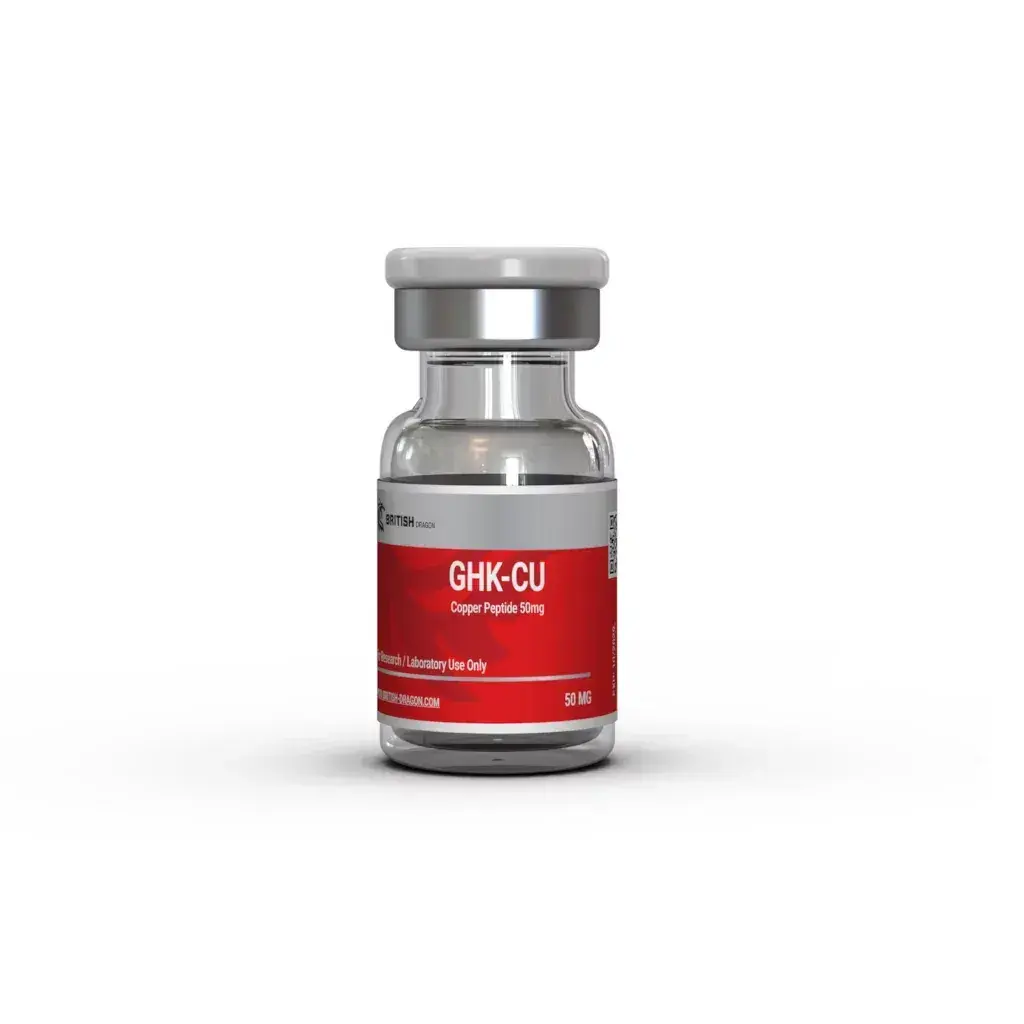
GHK-CU 50 mg is a lyophilized copper peptide research product manufactured by British Dragon and supplied as a 50 mg/vial powder in a 2 mL vial.
GHK-CU 50 mg contains the copper-binding tripeptide glycyl-L-histidyl-L-lysine complexed with copper(II), commonly known as Copper Tripeptide-1. This naturally occurring peptide is found in human plasma, saliva, and urine, with concentrations that decline with age. It has been studied extensively in dermatological and tissue-remodeling research contexts.
In research settings, GHK-CU has been investigated for its role in collagen synthesis, angiogenesis, and anti-inflammatory responses. These properties have generated interest in both academic dermatological research and non-medical bodybuilding communities, where it is commonly referenced for skin quality, connective tissue support, and recovery applications. However, injectable GHK-CU is not an FDA-approved drug, and its non-medical use falls outside approved indications.
Preclinical studies suggest GHK-CU may modulate gene expression related to tissue remodeling and stimulate fibroblast proliferation. Human clinical evidence for injectable use remains limited, though topical formulations have been more extensively studied for cosmetic applications.
GHK-CU 50 mg is supplied as a lyophilized (freeze-dried) powder in a 2 mL vial. Reconstitution with an appropriate solvent is required before use in research or non-medical contexts.
GHK-CU is a copper-binding tripeptide with a molecular weight of approximately 403.9 g/mol. Its amino acid sequence is glycyl-L-histidyl-L-lysine, complexed with a copper(II) ion.
GHK-CU belongs to a class of copper-binding peptides investigated for tissue-remodeling and regenerative properties. The peptide portion delivers copper to cells, where it serves as a cofactor for enzymes involved in collagen cross-linking and antioxidant defense. Unlike anabolic steroids or growth hormone secretagogues, GHK-CU does not act through androgen or growth hormone pathways.
Research has demonstrated that GHK-CU can stimulate collagen, elastin, and glycosaminoglycan synthesis in fibroblast cultures. It has also been shown to promote angiogenesis and modulate inflammatory responses in animal models. These mechanisms are the basis for its investigation in wound-healing and skin-remodeling research.
In non-medical bodybuilding contexts, GHK-CU is commonly referenced for skin quality, connective tissue integrity, and recovery support, though such use lacks rigorous clinical validation for injectable administration.
GHK-CU is distinguished by its ability to form a stable complex with copper(II). This copper-binding property is central to its proposed mechanisms, as the copper ion serves as a cofactor for lysyl oxidase and other enzymes involved in extracellular matrix remodeling.
British Dragon offers several research peptides targeting different aspects of recovery and tissue health. Within this lineup, BPC 157 is commonly discussed alongside GHK-CU for its tissue-repair properties, though the two peptides operate through distinct mechanisms—BPC-157 primarily through angiogenic and cytoprotective pathways, and GHK-CU through copper-mediated collagen synthesis.
For research focused on soft-tissue recovery, TB 500 represents another peptide commonly referenced in this context, with a different amino acid sequence and mechanism of action. These peptides are not interchangeable and address different aspects of tissue biology.
The information below is provided for educational reference only. GHK-CU is not an FDA-approved human drug for injectable use. Its use for any non-medical purpose falls outside approved indications, and no established human dosing regimen exists.
Because injectable GHK-CU lacks FDA approval and published human dose-finding trials, there is no medically established dosage range. In non-medical bodybuilding and research communities, reference ranges are derived from animal studies and community convention, with substantial uncertainty. Commonly referenced ranges are 1–2 mg administered subcutaneously twice weekly, with some protocols referencing up to 2 mg three times weekly for more aggressive approaches.
| Use Case | Common Reference Range | Frequency |
|---|---|---|
| General skin/connective tissue support (non-medical) | 1–2 mg | Twice weekly |
| Recovery-focused protocol (non-medical) | 2 mg | Two to three times weekly |
| Combined with BPC-157 (non-medical) | 1–2 mg GHK-CU + BPC-157 | Per individual protocol |
These ranges are community conventions, not evidence-based medical recommendations. No human dose-response relationship has been established for injectable GHK-CU, and individual response is unpredictable.
GHK-CU 50 mg is supplied as a lyophilized powder and requires reconstitution before use. In non-medical contexts, bacteriostatic water is commonly used as the solvent. A 50 mg vial reconstituted with 2 mL of solvent yields a concentration of 25 mg/mL, meaning a 1 mg dose would require drawing 0.04 mL (4 units on a U-100 insulin syringe).
Reconstituted peptide is typically stored refrigerated and used within a limited timeframe. Unreconstituted powder is more stable and should be kept under appropriate conditions.
In non-medical bodybuilding contexts, GHK-CU is sometimes combined with BPC 157 for recovery-focused protocols, as the two peptides are believed to address complementary aspects of tissue repair. Cycle lengths commonly referenced range from 4 to 12 weeks, though no pharmacokinetic basis supports any specific cycle duration.
The resolution trajectory of any underlying concern, rather than a fixed calendar, likely matters more in determining appropriate use duration. Continued use after resolution of a specific issue offers no established benefit.
No human pharmacokinetic or dose-response data exists for injectable GHK-CU. All dosage information is derived from animal research or community convention and should not be interpreted as medical guidance.
GHK-CU is not FDA-approved for injectable human use. Safety data in humans for injectable administration is extremely limited, and non-medical use carries unknown risks.
Injectable GHK-CU has not undergone the clinical trials required for FDA approval as a human drug. While topical copper peptides have a more established safety profile in cosmetic applications, injectable use bypasses the skin barrier and introduces systemic exposure with uncharacterized risks.
Dermatology ethics literature has raised concerns about the marketing of unapproved injectable peptides, noting insufficient evidence to understand benefit-risk profiles and risks of contamination or mislabeling from unregulated sourcing.
Injectable GHK-CU is marketed in some contexts as a research peptide or through compounding channels, but it is not FDA-approved for any human indication. Non-medical use falls outside approved indications and should be approached with caution.
Human safety data for injectable GHK-CU is minimal. Injection site reactions are commonly reported in community discussions. Copper-related toxicity is a theoretical concern with excessive dosing, as copper is an essential trace mineral with a Tolerable Upper Intake Level of 10 mg per day for oral intake.
As a peptide administered parenterally, GHK-CU may pose immunogenicity risks. Individuals with Wilson's disease or other copper metabolism disorders should exercise particular caution.
Given the absence of human safety data for injectable use, any consideration of GHK-CU should involve consultation with a qualified healthcare professional. Individuals with copper metabolism disorders, liver disease, or known sensitivity to copper should exercise particular caution.
No established monitoring protocol exists for injectable GHK-CU. In research contexts, any adverse reactions should be documented and reported to appropriate authorities.
Lyophilized powder should be stored under conditions that preserve peptide stability. Protect from heat, moisture, and light. Keep out of reach of children.
GHK-CU 50 mg is supplied through the official British Dragon distribution chain and shipped in original manufacturer packaging with discreet handling.
The outer shipping package remains discreet, with privacy-focused handling. Products are supplied through the official British Dragon distribution chain.
To verify your GHK-CU 50 mg product, use the security code on the vial label and cross-check it on the British Dragon official site. Original packaging and manufacturer presentation help reinforce product legitimacy.
For complete delivery details, tracking policy, and reshipment terms, please see our Shipping Info page.
Proper storage conditions help preserve peptide stability and integrity throughout shelf life.
Store lyophilized powder in a cool, dry place protected from heat, moisture, and direct light. For longer-term storage, refrigeration or freezing of the unreconstituted powder may be appropriate, though specific stability data for this product is limited.
Once reconstituted, store refrigerated and use within the timeframe recommended for peptide solutions. Avoid repeated temperature fluctuations.
Keep out of reach of children. Follow proper handling practices.
Answers to common questions about GHK-CU 50 mg, Copper Tripeptide-1, and research peptide handling.
GHK-CU 50 mg is a copper peptide studied in preclinical settings for its potential effects on collagen synthesis, tissue remodeling, and skin repair. In non-medical bodybuilding contexts, it is commonly referenced for skin quality and connective tissue support, though injectable use falls outside approved indications.
No established human dosing schedule exists for injectable GHK-CU. Community protocols commonly reference twice-weekly subcutaneous administration, but this is based on anecdotal convention rather than pharmacokinetic data.
GHK-CU does not suppress endogenous testosterone production and does not require post-cycle therapy in the way anabolic steroids do. However, any non-medical peptide use should be approached with caution given the absence of human safety data for injectable administration.
Copper Tripeptide-1 (GHK-CU) is a naturally occurring peptide that binds copper and delivers it to cells. Research suggests it may stimulate collagen and elastin synthesis, promote angiogenesis, and modulate inflammatory responses in tissue-remodeling contexts.
No human data establishes a timeline for injectable GHK-CU effects. Preclinical research and topical cosmetic studies suggest effects on skin quality may appear over weeks to months, but translation to injectable use is speculative.
GHK-CU is the most extensively studied copper peptide, but there is no universally "best" copper peptide. Comparative human data for injectable administration is absent, and individual response to any peptide is unpredictable.
GHK-CU is a copper-binding tripeptide studied for collagen synthesis and skin remodeling, while BPC 157 is a larger peptide studied for angiogenesis and cytoprotection. They operate through different mechanisms and are not interchangeable.
GHK-CU is a copper tripeptide focused on collagen and skin-related pathways, while TB 500 is a thymosin beta-4 fragment studied for cell migration and tissue repair. They have different amino acid sequences and proposed mechanisms.
Without human dose-response data for injectable GHK-CU, it is impossible to characterize any amount as appropriate or excessive. Community protocols commonly reference 1–2 mg per injection, but this is convention, not evidence.
GHK-CU 50 mg is labeled at 50 mg of GHK-CU per vial. It is supplied as a lyophilized powder in a 2 mL vial.
Store the lyophilized powder in a cool, dry place protected from heat, moisture, and light. Once reconstituted, refrigerate and use within the recommended timeframe for peptide solutions.