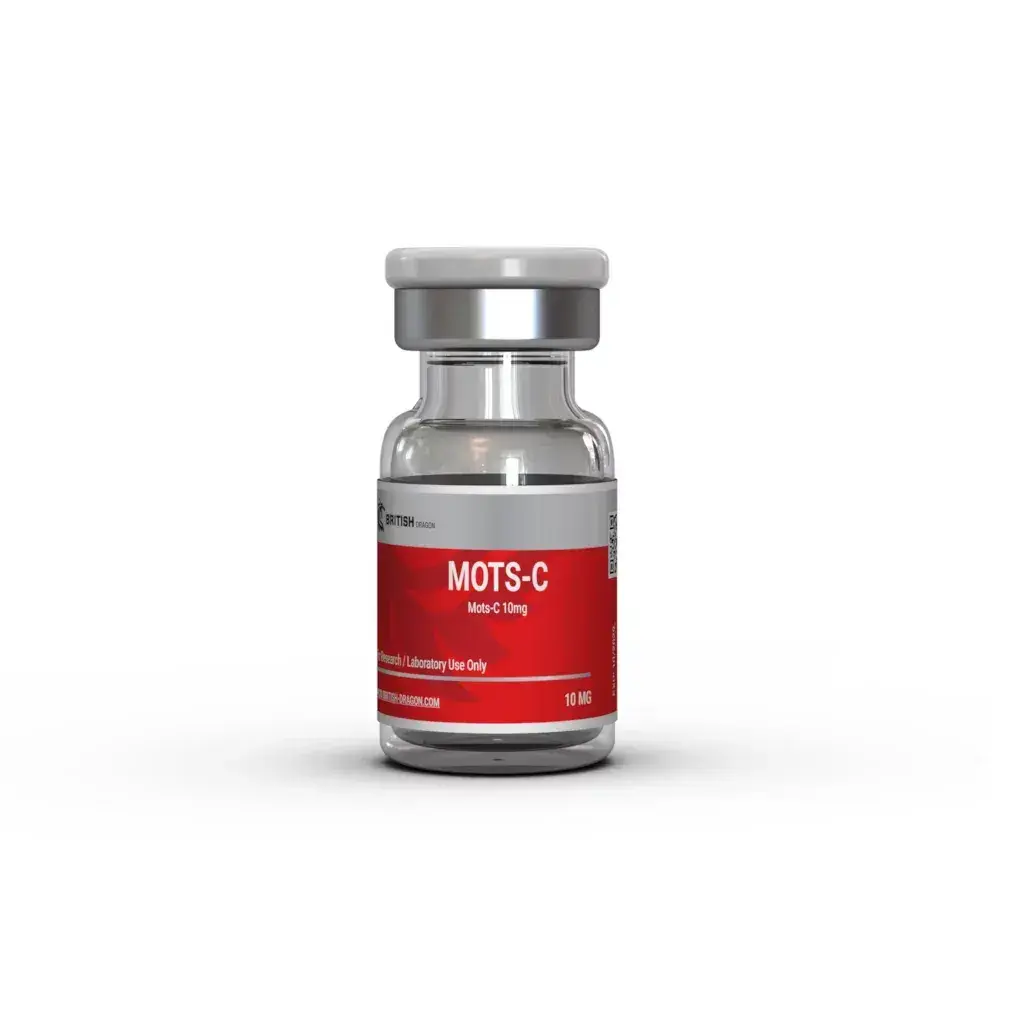
MOTS-c 10 mg is a lyophilized mitochondrial-derived peptide research product manufactured by British Dragon and supplied as a 10 mg/vial powder in a 2 mL vial.
MOTS-c 10 mg contains MOTS-c (Mitochondrial Open Reading Frame of the 12S rRNA Type-c), a 16-amino-acid peptide encoded within the mitochondrial genome. This endogenous peptide is expressed in response to metabolic stress and has been studied extensively in preclinical models for its role in regulating insulin sensitivity, metabolic homeostasis, and cellular stress responses.
In research settings, MOTS-c has been investigated for its ability to activate AMPK, inhibit the folate cycle, and translocate to the nucleus under metabolic stress to regulate antioxidant gene expression. These mechanisms have generated interest in non-medical bodybuilding communities for potential effects on metabolic efficiency, exercise performance, and body composition. However, MOTS-c is not FDA-approved for any human indication, and a Phase 2a clinical trial in prediabetes and obesity is currently ongoing.
Preclinical studies in mice have demonstrated that MOTS-c treatment can improve treadmill performance, increase grip strength, and reduce age-dependent insulin resistance. Human data remains limited, though observational research has shown that acute exercise significantly increases endogenous MOTS-c expression in skeletal muscle.
MOTS-c 10 mg is supplied as a lyophilized (freeze-dried) powder in a 2 mL vial. Reconstitution with an appropriate solvent is required before use in research or non-medical contexts.
MOTS-c is a 16-amino-acid peptide with the sequence MRWQEMGYIFYPRKLR and a molecular weight of approximately 2,174.59 g/mol.
MOTS-c belongs to the class of mitochondrial-derived peptides (MDPs), which are encoded by short open reading frames within the mitochondrial genome. Unlike nuclear-encoded peptides, MOTS-c is translated in the cytoplasm from a transcript exported from mitochondria, and it functions as a retrograde signaling molecule that communicates metabolic status from mitochondria to the nucleus.
The peptide acts through several interconnected pathways. It inhibits the folate cycle, leading to accumulation of AICAR and activation of AMPK, a master regulator of cellular energy homeostasis. Under metabolic stress, MOTS-c translocates to the nucleus where it binds to antioxidant response elements and regulates gene expression in an NRF2-dependent manner. Preclinical research has also identified a MOTS-c/CK2 pathway and effects on the mTORC2/AKT/FOXO1 axis relevant to skeletal muscle growth.
In non-medical bodybuilding contexts, MOTS-c is commonly referenced for its potential to enhance metabolic efficiency and exercise performance, though injectable use falls outside approved indications and human data remains preliminary.
MOTS-c is distinguished by its mitochondrial origin and its role as a retrograde stress-responsive signal. Unlike exercise-mimetic compounds that act on a single pathway, MOTS-c coordinates AMPK activation, antioxidant gene expression, and metabolic gene regulation in response to cellular stress.
British Dragon offers several peptide products targeting different aspects of endocrine and metabolic biology. Within this lineup, Ipamorelin is commonly discussed alongside MOTS-c for its effects on growth hormone release, though ipamorelin acts through the ghrelin receptor rather than mitochondrial pathways. The two peptides address fundamentally different aspects of metabolism—ipamorelin for pulsatile GH stimulation, MOTS-c for cellular energy regulation.
For research focused on tissue recovery rather than metabolic function, BPC 157 represents a different approach entirely, operating through angiogenic and cytoprotective mechanisms. Similarly, TB 500 addresses soft-tissue repair through a thymosin beta-4 fragment mechanism. These peptides are not interchangeable and target distinct biological pathways.
The information below is provided for educational reference only. MOTS-c is not an FDA-approved human drug. Its use for any non-medical purpose falls outside approved indications, and no established human dosing regimen exists.
Because MOTS-c lacks FDA approval and completed human clinical trials, there is no medically established dosage range. In non-medical bodybuilding and research communities, reference ranges are derived from animal studies and community convention, with substantial uncertainty. Community protocols most commonly reference 5 mg once weekly for beginners or general metabolic support, and 10 mg per week split into two injections for performance or body recomposition goals.
| Use Case | Common Reference Range | Injection Frequency |
|---|---|---|
| First-time trial (non-medical) | 5 mg | Once weekly |
| Fat loss / recomposition (non-medical) | 10 mg | Split into two 5 mg doses weekly |
| Athletic performance (non-medical) | 10 mg | Split, injected 30–60 min pre-training |
These ranges are community conventions. The peptide is believed to work through a saturable pathway, meaning higher doses do not necessarily produce proportionally greater effects.
MOTS-c 10 mg is supplied as a lyophilized powder and requires reconstitution before use. In non-medical contexts, bacteriostatic water is commonly used as the solvent. A 10 mg vial reconstituted with 2 mL of solvent yields a concentration of 5 mg/mL, meaning a 5 mg dose would require drawing 1 mL.
Reconstituted peptide is typically stored refrigerated and used within a limited timeframe. Unreconstituted powder is more stable and should be kept desiccated and protected from light.
In non-medical bodybuilding contexts, MOTS-c is sometimes combined with other metabolic or performance compounds, though there is limited information on synergistic protocols. Standard community cycles typically run 8 to 12 weeks followed by a 4-week washout period to prevent AMPK pathway tolerance.
Some users combine MOTS-c with Ipamorelin for a combined metabolic and growth hormone protocol, though this represents a combination of different mechanisms rather than a well-characterized synergistic stack. Cycle structure and duration should be considered in the context of individual experience and goals.
No human dose-response data for therapeutic outcomes exists for MOTS-c. All dosage information is derived from animal research or community convention and should not be interpreted as medical guidance.
MOTS-c is not FDA-approved for any human use. Safety data in humans is extremely limited, and non-medical use carries unknown risks.
MOTS-c has not undergone the large controlled clinical trials required for FDA approval. A Phase 2a study evaluating MOTS-c for insulin sensitivity in adults with prediabetes and overweight/obesity began in 2026, but results are not yet available. Until such data are published, the safety profile of exogenous MOTS-c in humans remains largely unknown.
“Research use only” vials marketed online are not intended or tested for human injection, and their purity and sterility are not guaranteed to pharmaceutical standards.
MOTS-c is used in humans only through physician prescription and pharmacy compounding, or in research settings. Non-medical use falls outside approved indications and should be approached with caution.
Human safety data for MOTS-c is minimal. Because the peptide activates AMPK and modulates metabolic pathways, theoretical concerns include effects on glucose metabolism and potential interactions with diabetes medications. Injection site reactions are commonly reported in community discussions.
As a peptide administered parenterally, MOTS-c may pose immunogenicity risks. Individuals with pre-existing metabolic conditions or those taking glucose-lowering medications should exercise particular caution.
Given the absence of human safety data, any consideration of MOTS-c use should involve consultation with a qualified healthcare professional. Individuals with diabetes, pre-diabetes, or other metabolic disorders should be particularly cautious given the peptide’s proposed effects on insulin sensitivity.
No established monitoring protocol exists for MOTS-c. In research contexts, any adverse reactions should be documented and reported to appropriate authorities. Blood glucose monitoring may be relevant given the peptide’s proposed effects on metabolic pathways.
Lyophilized powder should be stored sealed, away from moisture, at -80°C for long-term storage or -20°C for up to one year. Keep out of reach of children.
MOTS-c 10 mg is supplied through the official British Dragon distribution chain and shipped in original manufacturer packaging with discreet handling.
The outer shipping package remains discreet, with privacy-focused handling. Products are supplied through the official British Dragon distribution chain.
To verify your MOTS-c 10 mg product, use the security code on the vial label and cross-check it on the British Dragon official site. Original packaging and manufacturer presentation help reinforce product legitimacy.
For complete delivery details, tracking policy, and reshipment terms, please see our Shipping Info page.
Proper storage conditions help preserve peptide stability and integrity throughout shelf life.
Store lyophilized powder sealed, away from moisture, at -80°C for long-term storage or -20°C for up to one year. Protect from light.
Once reconstituted, store refrigerated and use within the timeframe recommended for peptide solutions. Avoid repeated freeze-thaw cycles.
Keep out of reach of children. Follow proper handling practices.
Answers to common questions about MOTS-c 10 mg, mitochondrial-derived peptides, and research peptide handling.
MOTS-c 10 mg is a research peptide studied for its role in regulating metabolic homeostasis and insulin sensitivity. In non-medical bodybuilding contexts, it is commonly referenced for metabolic efficiency, fat loss, and exercise performance support, though such use falls outside approved indications.
No established human dosing schedule exists for MOTS-c. Community protocols commonly reference once-weekly administration for beginner protocols or split into two injections per week for performance goals, but this is based on convention rather than clinical outcome data.
MOTS-c does not suppress endogenous testosterone production and does not require post-cycle therapy in the way anabolic steroids do. However, any non-medical peptide use should be approached with caution given the absence of human safety data.
MOTS-c is a mitochondrial-derived peptide that activates AMPK, inhibits the folate cycle, and translocates to the nucleus under metabolic stress to regulate antioxidant gene expression. It functions as a retrograde signaling molecule communicating metabolic status from mitochondria to the nucleus.
No human data establishes a timeline for injectable MOTS-c effects. Preclinical studies in mice have shown improvements in treadmill performance and grip strength with intermittent dosing over weeks, but translation to human timelines is speculative.
MOTS-c is one of the most extensively studied mitochondrial-derived peptides, alongside humanin and SHLPs. There is no universally “best” mitochondrial peptide, and comparative human data for injectable use is absent.
MOTS-c is a mitochondrial-derived peptide focused on metabolic regulation and AMPK activation, while Ipamorelin is a growth hormone secretagogue that stimulates GH release through the ghrelin receptor. They operate through entirely different mechanisms and address different biological goals.
MOTS-c targets metabolic and mitochondrial pathways, while BPC 157 is a tissue-repair peptide studied for angiogenic and cytoprotective effects. They have different amino acid sequences and proposed mechanisms.
Without human dose-response data for injectable MOTS-c, it is impossible to characterize any amount as appropriate or excessive. Community protocols commonly reference 5–10 mg per week, but this is convention, not evidence.
MOTS-c 10 mg is labeled at 10 mg of MOTS-c per vial. It is supplied as a lyophilized powder in a 2 mL vial.
Store the lyophilized powder sealed, away from moisture, at -80°C for long-term storage or -20°C for up to one year. Once reconstituted, refrigerate and use within the recommended timeframe for peptide solutions.