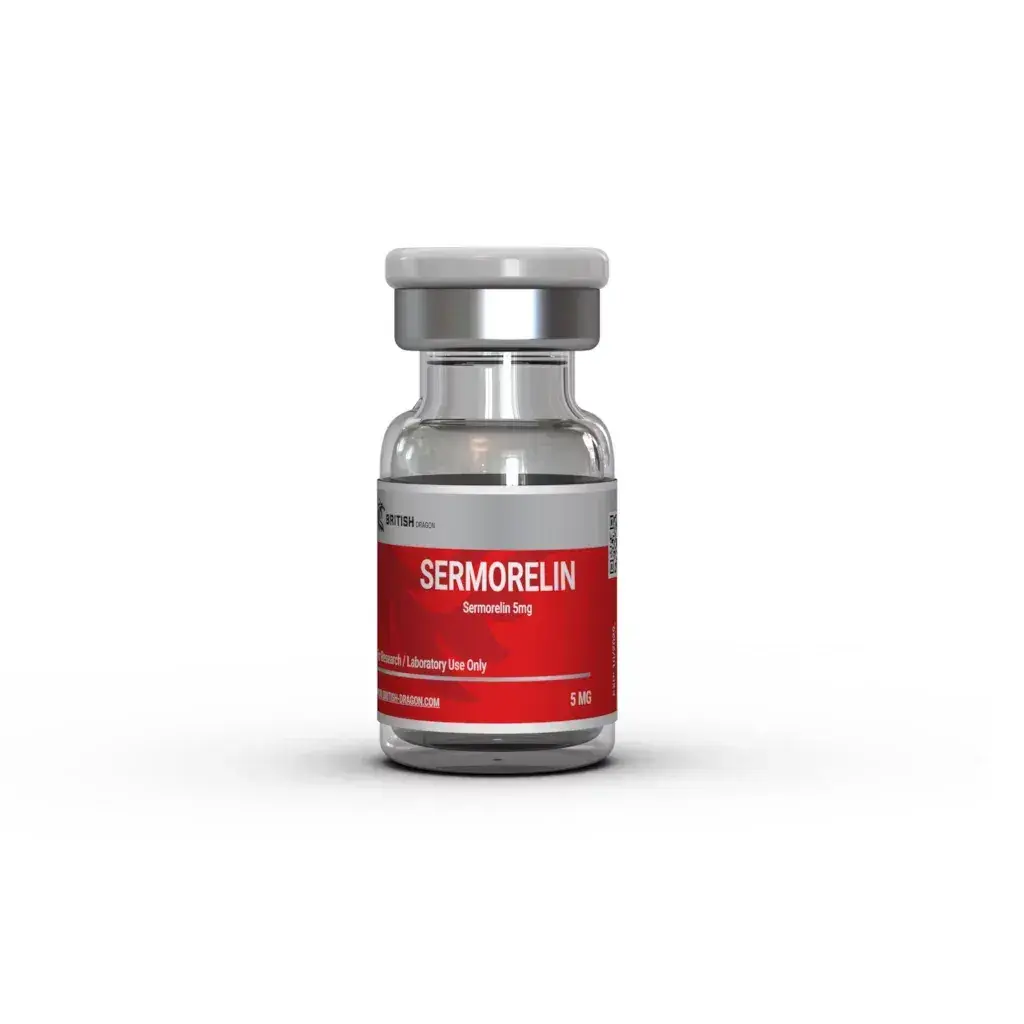
Sermorelin 5 mg is a lyophilized growth hormone-releasing hormone (GHRH) analog research product manufactured by British Dragon and supplied as a 5 mg/vial powder in a 2 mL vial.
Sermorelin 5 mg contains sermorelin acetate, a synthetic 29-amino-acid peptide corresponding to the amino-terminal segment of endogenous human growth hormone-releasing hormone (GHRH). Sermorelin was developed as a diagnostic agent and therapeutic option for growth hormone deficiency, receiving FDA approval in 1990 under the brand name Geref.
Sermorelin works by binding to GHRH receptors on the anterior pituitary, stimulating the secretion of endogenous growth hormone. Unlike exogenous growth hormone administration, sermorelin relies on the body's own pituitary function, potentially allowing natural feedback mechanisms to regulate GH levels. This mechanism has made it a subject of interest in non-medical bodybuilding contexts for its potential effects on recovery, sleep quality, and body composition, though such use falls outside approved indications.
The FDA-approved indication for sermorelin was for the diagnosis and treatment of idiopathic growth hormone deficiency in children with growth failure. Geref was discontinued from the market, and sermorelin is no longer available as an FDA-approved commercial product in the United States.
Sermorelin 5 mg is supplied as a lyophilized (freeze-dried) powder in a 2 mL vial. Reconstitution with an appropriate solvent is required before use in research or non-medical contexts.
Sermorelin is a 29-amino-acid peptide with a molecular weight of approximately 3,358 Da. Its sequence corresponds to the first 29 amino acids of endogenous human GHRH, which contains the full biological activity of the native hormone.
Sermorelin belongs to the class of growth hormone-releasing hormone (GHRH) analogs, which stimulate GH secretion through direct activation of pituitary GHRH receptors. This mechanism is distinct from ghrelin receptor agonists such as ipamorelin, which act through a different receptor pathway.
Unlike exogenous recombinant human growth hormone, which directly introduces GH into circulation, sermorelin stimulates the pituitary to release its own GH. This reliance on endogenous synthesis may allow natural IGF-1 feedback inhibition to limit excessive GH elevation. Sermorelin has a short half-life of approximately 10–20 minutes, producing a discrete GH pulse after administration.
In non-medical bodybuilding contexts, sermorelin is commonly referenced for its potential to stimulate pulsatile GH release, with users typically seeking improvements in recovery, sleep quality, and lean mass. However, sermorelin is not FDA-approved for any currently marketed human use in the United States.
Sermorelin is distinguished by its short half-life and rapid clearance, which produces a discrete GH pulse rather than sustained elevation. This pulsatile profile is often described as more physiologic than longer-acting GHRH analogs such as CJC-1295.
British Dragon offers several peptide products targeting different aspects of endocrine and recovery biology. Within this lineup, Ipamorelin is commonly discussed alongside sermorelin for its growth hormone-stimulating properties, though ipamorelin acts through the ghrelin receptor rather than the GHRH receptor. The two peptides are sometimes combined in non-medical protocols for potential synergistic GH release.
For research focused on tissue recovery rather than GH stimulation, BPC 157 represents a different approach entirely, operating through angiogenic and cytoprotective mechanisms. Similarly, TB 500 addresses soft-tissue repair through a thymosin beta-4 fragment mechanism. These peptides are not interchangeable and target distinct biological pathways.
The information below is provided for educational reference only. Sermorelin is not currently marketed as an FDA-approved human drug. Its use for any non-medical purpose falls outside approved indications, and no established human dosing regimen exists for non-clinical contexts.
Because sermorelin lacks a current FDA-approved commercial product and published dose-finding trials for non-medical use, there is no medically established dosage range for bodybuilding contexts. In non-medical bodybuilding and research communities, reference ranges are derived from historical clinical studies and community convention. The most commonly referenced range is 200–300 mcg per injection, administered before bedtime.
| Use Case | Common Reference Range | Injection Frequency |
|---|---|---|
| Recovery/sleep focus (non-medical) | 200 mcg | Once daily, bedtime |
| Standard protocol (non-medical) | 300 mcg | Once daily, bedtime |
| Upper range (non-medical) | 400–500 mcg | Once daily, bedtime |
These ranges are community conventions informed by historical clinical data. The GH response to sermorelin is described as near-maximal at 300 mcg, with higher doses producing diminishing returns and increased side-effect incidence.
Sermorelin 5 mg is supplied as a lyophilized powder and requires reconstitution before use. In non-medical contexts, bacteriostatic water is commonly used as the solvent. A 5 mg vial reconstituted with 2 mL of solvent yields a concentration of 2,500 mcg/mL, meaning a 300 mcg dose would require drawing 12 units on a U-100 insulin syringe.
Reconstituted peptide is typically stored refrigerated and used within 30 days. Unreconstituted powder is more stable and should be kept refrigerated or frozen and protected from light.
In non-medical bodybuilding contexts, sermorelin is frequently combined with Ipamorelin for potential synergistic GH release, as the two peptides target different receptors—the GHRH receptor and the ghrelin receptor, respectively. Some community protocols reference continuous use for 6 to 12 months without cycling.
For recovery-focused protocols, some users combine sermorelin with BPC 157, though this represents a combination of GH-stimulating and tissue-repair mechanisms rather than a synergistic GH protocol.
No human dose-response data for therapeutic outcomes exists for sermorelin in non-medical contexts. All dosage information is derived from historical clinical data or community convention and should not be interpreted as medical guidance.
Sermorelin is not currently available as an FDA-approved commercial product. Safety data in humans is limited to historical clinical use and is not applicable to non-medical contexts.
Sermorelin was previously FDA-approved under the brand name Geref for diagnostic and therapeutic use in growth hormone deficiency. The product has been discontinued, and sermorelin is no longer available as an FDA-approved commercial drug in the United States.
Historical clinical use was limited to diagnosed growth hormone deficiency under medical supervision. Non-medical use for bodybuilding or performance enhancement falls outside any approved indication and is not supported by safety or efficacy data.
Sermorelin is marketed in some contexts as a research peptide, but it is not FDA-approved for any currently marketed human indication. Non-medical use falls outside approved indications.
Historical clinical data on sermorelin reports generally mild and transient adverse effects. Commonly referenced effects in community discussions include injection-site reactions such as redness and irritation, transient flushing, and occasional headache, particularly at higher doses.
As a peptide administered parenterally, sermorelin may pose immunogenicity risks. Antibodies to GHRH have been reported to develop in some patients during extended therapy, which may impair the drug's potency.
Given the absence of current clinical safety data and the discontinued status of approved sermorelin products, any consideration of sermorelin use should involve consultation with a qualified healthcare professional. Individuals with pre-existing endocrine conditions, those taking medications affecting hormone levels, or those considering use during pregnancy or breastfeeding should exercise particular caution.
No established monitoring protocol exists for non-medical sermorelin use. In research contexts, any adverse reactions should be documented and reported to appropriate authorities. Historical clinical monitoring included assessment of growth hormone and IGF-1 levels, but such monitoring is not standardized for non-medical contexts.
Lyophilized powder should be stored refrigerated or frozen and protected from light. Once reconstituted, store refrigerated and use within 30 days. Keep out of reach of children.
Sermorelin 5 mg is supplied through the official British Dragon distribution chain and shipped in original manufacturer packaging with discreet handling.
The outer shipping package remains discreet, with privacy-focused handling. Products are supplied through the official British Dragon distribution chain.
To verify your Sermorelin 5 mg product, use the security code on the vial label and cross-check it on the British Dragon official site. Original packaging and manufacturer presentation help reinforce product legitimacy.
For complete delivery details, tracking policy, and reshipment terms, please see our Shipping Info page.
Proper storage conditions help preserve peptide stability and integrity throughout shelf life.
Store lyophilized powder refrigerated or frozen and protected from light. For longer-term storage, freezing of the unreconstituted powder may be appropriate, though specific stability data for this product is limited.
Once reconstituted, store refrigerated and use within 30 days. Avoid repeated temperature fluctuations.
Keep out of reach of children. Follow proper handling practices.
Answers to common questions about Sermorelin 5 mg, GHRH analogs, and research peptide handling.
Sermorelin 5 mg contains sermorelin acetate, a GHRH analog that stimulates endogenous growth hormone release. It was historically used for diagnosing and treating growth hormone deficiency. In non-medical bodybuilding contexts, it is commonly referenced for recovery, sleep quality, and body composition support, though such use falls outside approved indications.
No established human dosing schedule exists for sermorelin in non-medical contexts. Community protocols commonly reference once-daily administration before bedtime, with dosing 5–7 nights per week, but this is based on convention rather than clinical outcome data.
Sermorelin does not suppress endogenous testosterone production and does not require post-cycle therapy in the way anabolic steroids do. However, any non-medical peptide use should be approached with caution given the absence of current human safety data.
Sermorelin is a synthetic GHRH analog that binds to GHRH receptors on the anterior pituitary, stimulating the secretion of endogenous growth hormone. Unlike exogenous GH, sermorelin relies on the body's own pituitary function, potentially allowing natural feedback mechanisms to regulate GH levels.
Pharmacokinetically, sermorelin has a short half-life of approximately 10–20 minutes, with peak GH levels occurring shortly after administration. Community reports suggest sleep quality improvements may appear within 1–2 weeks, while body composition changes typically require 8–12 weeks of consistent use.
There is no universally “best” GHRH analog. Sermorelin produces a discrete GH pulse due to its short half-life, which some describe as more physiologic, while longer-acting analogs such as CJC-1295 produce sustained elevation. The appropriate choice depends on individual goals and circumstances.
Sermorelin acts through the GHRH receptor, while Ipamorelin acts through the ghrelin receptor. They target different pathways and are sometimes combined for synergistic GH release in non-medical protocols, but they are not interchangeable.
Sermorelin is a GHRH analog focused on growth hormone release, while BPC 157 is a tissue-repair peptide studied for angiogenic and cytoprotective effects. They operate through entirely different mechanisms and address different biological goals.
300 mcg is commonly referenced as the standard dose for near-maximal GH response with minimal side effects. Higher doses are not necessarily more effective; the dose-response curve is described as flattening beyond this level, with increased side-effect incidence.
Sermorelin 5 mg is labeled at 5 mg of sermorelin acetate per vial. It is supplied as a lyophilized powder in a 2 mL vial.
Store the lyophilized powder refrigerated or frozen and protected from light. Once reconstituted, refrigerate and use within 30 days.