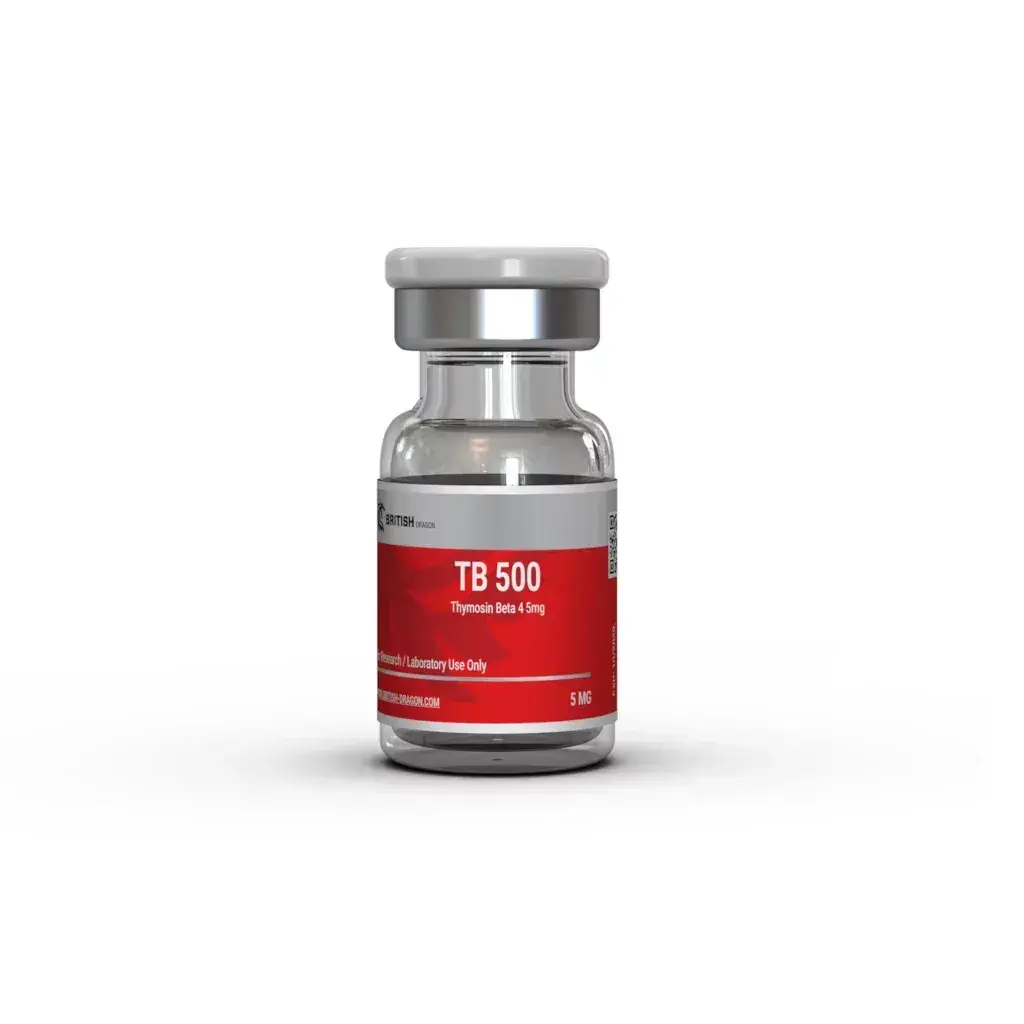
TB 500 5 mg is a lyophilized Thymosin Beta 4 research product manufactured by British Dragon and supplied as a 5 mg/vial powder in a 2 mL vial.
TB 500 5 mg contains a synthetic fragment of Thymosin Beta 4, a naturally occurring actin-binding protein found in virtually all human cells. The TB-500 fragment corresponds to the active actin-binding domain (LKKTETQ) of the full-length 43-amino-acid Thymosin Beta 4 molecule. This peptide is studied extensively in preclinical models for its roles in cell migration, tissue repair, and angiogenesis.
Thymosin Beta 4's primary mechanism involves binding to globular actin (G-actin) monomers, preventing their polymerization into filaments. This action maintains a pool of actin monomers essential for cell motility, allowing repair cells to migrate efficiently to sites of injury. Unlike anabolic steroids or growth hormone secretagogues, TB-500 does not act through androgen or GH receptor pathways; its effects are mediated through actin regulation and downstream cellular signaling.
In non-medical bodybuilding contexts, TB-500 is commonly referenced for systemic recovery support, joint protection during caloric deficits, and soft-tissue repair. However, TB-500 is not FDA-approved for any human indication, and the FDA has noted a lack of clinical and nonclinical safety information for the substance.
TB 500 5 mg is supplied as a lyophilized (freeze-dried) powder in a 2 mL vial. Reconstitution with an appropriate solvent is required before use in research or non-medical contexts.
Thymosin Beta 4 is a 43-amino-acid peptide with a molecular weight of approximately 4,963 Da. The TB-500 fragment corresponds to the actin-binding domain, with the sequence LKKTETQ.
Thymosin Beta 4 belongs to a family of actin-sequestering peptides that regulate cytoskeletal dynamics. The peptide binds G-actin at a 1:1 ratio, inhibiting its polymerization into F-actin filaments. This mechanism is fundamental to cell motility, allowing cells to migrate efficiently to sites of tissue damage.
Beyond actin regulation, Thymosin Beta 4 has been studied for its roles in angiogenesis, anti-inflammatory signaling, and cell survival. Preclinical research in animal models has explored its potential to promote dermal wound repair, corneal healing, and tissue remodeling following injury. The TB-500 fragment retains the actin-binding domain and is studied for similar reparative properties.
In non-medical bodybuilding contexts, TB-500 is commonly referenced for systemic recovery support, flexibility, and joint protection, particularly during caloric deficits when recovery resources are limited. These uses fall outside approved indications and lack controlled human trial validation.
TB-500 is distinguished by its capacity to sequester G-actin, creating a ready pool of actin monomers that facilitates cell motility. This mechanism is central to its proposed role in directing repair cells to injury sites.
British Dragon offers several research peptides targeting different aspects of recovery and tissue health. Within this lineup, BPC 157 is commonly discussed alongside TB-500 for its tissue-repair properties, though the two peptides operate through distinct mechanisms—BPC-157 primarily through angiogenic and cytoprotective pathways, and TB-500 through actin-mediated cell migration.
For research focused on growth hormone stimulation rather than tissue repair, Sermorelin represents a different approach entirely, operating through the GHRH receptor rather than actin-binding pathways. These peptides are not interchangeable and address different biological goals.
The information below is provided for educational reference only. TB-500 is not an FDA-approved human drug. Its use for any non-medical purpose falls outside approved indications, and no established human dosing regimen exists.
Because TB-500 lacks FDA approval and published human dose-finding trials for musculoskeletal indications, there is no medically established dosage range. In non-medical bodybuilding and research communities, reference ranges are derived from animal studies and community convention. The most commonly referenced protocol uses a loading phase of 2–5 mg administered subcutaneously twice weekly for 4–6 weeks, followed by a maintenance phase of 2–2.5 mg once weekly for 4–8 weeks.
| Use Case | Common Reference Range | Injection Frequency |
|---|---|---|
| Loading phase (non-medical) | 2–5 mg | Twice weekly, 4–6 weeks |
| Maintenance phase (non-medical) | 2–2.5 mg | Once weekly, 4–8 weeks |
| Systemic repair support (non-medical) | 2.5 mg | Once weekly |
These ranges are community conventions, not evidence-based medical recommendations. No human pharmacokinetic data exists for subcutaneous TB-500 in musculoskeletal indications, and individual response is unpredictable.
TB 500 5 mg is supplied as a lyophilized powder and requires reconstitution before use. In non-medical contexts, bacteriostatic water is commonly used as the solvent. A 5 mg vial reconstituted with 2 mL of solvent yields a concentration of 2.5 mg/mL, meaning a 2.5 mg dose would require drawing 1 mL (100 units on a U-100 insulin syringe).
Reconstituted peptide is typically stored refrigerated and used within a limited timeframe. Unreconstituted powder is more stable and should be kept sealed and protected from light.
In non-medical bodybuilding contexts, TB-500 is frequently combined with BPC 157 for recovery-focused protocols, as the two peptides are believed to address complementary aspects of tissue repair—BPC-157 through angiogenesis and TB-500 through cell migration. Cycle lengths commonly referenced range from 4 to 12 weeks, followed by a rest period of 4 to 12 weeks.
For research focused on growth hormone rather than tissue repair, some users combine TB-500 with Sermorelin, though this represents a combination of different mechanisms rather than a synergistic repair protocol.
No human dose-response data for therapeutic outcomes exists for TB-500. All dosage information is derived from animal research or community convention and should not be interpreted as medical guidance.
TB-500 is not FDA-approved for any human use. The FDA has noted a lack of clinical and nonclinical safety information for the substance.
Thymosin Beta 4 has been studied in Phase 1 clinical trials via intravenous administration in healthy volunteers, with no dose-limiting toxicities observed. However, these trials did not evaluate subcutaneous administration, the route commonly referenced in non-medical contexts, and were not designed to assess long-term safety.
TB-500 is on the World Anti-Doping Agency (WADA) Prohibited List under S2 (Peptide Hormones, Growth Factors, Related Substances) and is banned in tested sport.
TB-500 is marketed in some contexts as a research peptide, but it is not FDA-approved for any human indication. Non-medical use falls outside approved indications and should be approached with caution.
Human safety data for subcutaneous TB-500 is limited. Community-reported side effects include headache, nausea, lightheadedness, injection site irritation, and fatigue. These reports are anecdotal and not from controlled trials.
Because Thymosin Beta 4 promotes angiogenesis and cell migration, there is a theoretical concern that it could support tumor growth or spread. Individuals with active malignancy or a history of cancer should exercise particular caution.
Given the absence of comprehensive human safety data for subcutaneous use, any consideration of TB-500 should involve consultation with a qualified healthcare professional. Individuals with cancer history, bleeding disorders, or those taking anticoagulants should exercise particular caution.
No established monitoring protocol exists for TB-500. In research contexts, any adverse reactions should be documented and reported to appropriate authorities.
Lyophilized powder should be stored sealed and protected from light and moisture. Once reconstituted, store refrigerated and use within the recommended timeframe. Keep out of reach of children.
TB 500 5 mg is supplied through the official British Dragon distribution chain and shipped in original manufacturer packaging with discreet handling.
The outer shipping package remains discreet, with privacy-focused handling. Products are supplied through the official British Dragon distribution chain.
To verify your TB 500 5 mg product, use the security code on the vial label and cross-check it on the British Dragon official site. Original packaging and manufacturer presentation help reinforce product legitimacy.
For complete delivery details, tracking policy, and reshipment terms, please see our Shipping Info page.
Proper storage conditions help preserve peptide stability and integrity throughout shelf life.
Store lyophilized powder sealed and protected from light and moisture. For longer-term storage, refrigeration or freezing of the unreconstituted powder may be appropriate, though specific stability data for this product is limited.
Once reconstituted, store refrigerated and use within the timeframe recommended for peptide solutions. Avoid repeated temperature fluctuations.
Keep out of reach of children. Follow proper handling practices.
Answers to common questions about TB 500 5 mg, Thymosin Beta 4, and research peptide handling.
TB 500 5 mg contains a Thymosin Beta 4 fragment studied in preclinical models for cell migration and tissue repair. In non-medical bodybuilding contexts, it is commonly referenced for systemic recovery support and joint protection, though such use falls outside approved indications.
No established human dosing schedule exists for TB-500. Community protocols commonly reference a loading phase of twice-weekly subcutaneous injections followed by once-weekly maintenance, but this is based on convention rather than pharmacokinetic data.
TB-500 does not suppress endogenous testosterone production and does not require post-cycle therapy in the way anabolic steroids do. However, any non-medical peptide use should be approached with caution given the absence of human safety data for subcutaneous administration.
Thymosin Beta 4 binds to G-actin monomers, preventing their polymerization and maintaining a pool of actin essential for cell motility. This mechanism allows repair cells to migrate efficiently to sites of tissue damage. The peptide has also been studied for angiogenesis and anti-inflammatory effects in preclinical models.
No human data establishes a timeline for subcutaneous TB-500 effects. Preclinical research and community reports suggest effects may appear over weeks, but translation to human timelines is speculative.
There is no universally “best” recovery peptide. TB-500 is commonly referenced for systemic recovery through actin-mediated cell migration, while BPC 157 is studied for localized tissue repair through angiogenic mechanisms. The two are often discussed together but address different aspects of tissue biology.
TB-500 is a Thymosin Beta 4 fragment that regulates actin and promotes cell migration for systemic repair, while BPC 157 is a pentadecapeptide studied for angiogenesis and cytoprotection. They operate through different mechanisms and are sometimes combined in non-medical protocols for complementary effects.
TB-500 targets tissue repair through actin regulation and cell migration, while Sermorelin is a GHRH analog that stimulates growth hormone release. They address entirely different biological goals.
5 mg represents a full vial of TB 500 5 mg, not necessarily a single dose. Community protocols reference loading doses of 2–5 mg per injection, meaning a single 5 mg vial would provide one or two loading doses depending on the protocol.
TB 500 5 mg is labeled at 5 mg of Thymosin Beta 4 fragment per vial. It is supplied as a lyophilized powder in a 2 mL vial.
Store the lyophilized powder sealed and protected from light and moisture. Once reconstituted, refrigerate and use within the recommended timeframe for peptide solutions.