

BPC 157 5 mg is a lyophilized research peptide manufactured by Dragon Pharma, supplied as 5 mg per vial for laboratory research purposes.
BPC 157 5 mg contains BPC 157 (Body Protection Compound 157), a synthetic pentadecapeptide composed of 15 amino acids. Its sequence is derived from a partial sequence of a human gastric juice protein, and it is also known by its IUPAC condensed formula GEPPPGKPADDAGLV. BPC 157 has been studied extensively in preclinical models for its regenerative properties across various tissue types, particularly musculoskeletal soft tissue healing.
The proposed mechanisms of BPC 157 center on angiogenesis (new blood vessel formation), fibroblast activity, and modulation of the nitric oxide system. Research indicates that BPC 157 activates the Akt-eNOS signaling axis to promote angiogenesis and upregulates growth hormone receptor expression in fibroblasts, which are crucial for cell proliferation and collagen production. It also interacts with the nitric oxide system, which plays a significant role in muscle repair and blood flow.
BPC 157 has been investigated in numerous animal studies demonstrating accelerated healing of tendon, ligament, muscle, and gastrointestinal tissues. However, BPC 157 is not approved by the FDA for human use, has no completed human clinical trials for musculoskeletal applications, and is classified as a non-approved substance under WADA regulations. It is sold strictly for laboratory research purposes. In non-medical bodybuilding contexts, BPC 157 is commonly referenced for injury recovery support, with community protocols describing subcutaneous doses of 250-500 mcg daily.
BPC 157 5 mg is supplied as a lyophilized powder in a 2 mL vial. The powder requires reconstitution with bacteriostatic water or another appropriate solvent before laboratory use. Once reconstituted, the solution should be refrigerated and used within approximately 30 days.
BPC 157 is a synthetic pentadecapeptide derived from human gastric juice protein, studied for its regenerative and cytoprotective properties in preclinical models.
BPC 157 belongs to the class of research peptides. Its structure is a 15-amino acid sequence (GEPPPGKPADDAGLV) with a molecular weight of approximately 1,419.5 Da. The peptide is stable in human gastric juice, which is unusual for peptides and is part of the rationale for proposed oral activity.
The proposed mechanisms of BPC 157 involve multiple pathways. It promotes angiogenesis by activating the Akt-eNOS signaling axis. It enhances fibroblast activity and upregulates growth hormone receptor expression, which supports cell proliferation and collagen production. It also modulates inflammation and interacts with the nitric oxide system, which is significant for muscle repair and blood flow. At a cellular level, BPC 157 has been found to upregulate paxillin and vinculin expression, proteins essential for cell migration.
Preclinical studies have demonstrated consistently positive healing effects for various injury types across multiple tissue types. However, human clinical trial data is scarce to non-existent, and no published human pharmacokinetic studies exist that measure BPC 157 plasma concentrations over time. The half-life in humans is unknown, and tissue distribution is uncharacterized.
BPC 157 is not approved by the FDA for any human indication. It was placed in FDA Category 2 in 2023, meaning it does not meet current safety criteria for pharmacy compounding. Human safety and efficacy data for musculoskeletal applications are limited to a small case series and anecdotal reports.
Dragon Pharma offers a range of research peptides relevant to tissue repair and recovery. BPC 157 5 mg is positioned as a tissue repair peptide, complementing other recovery-focused compounds.
For systemic recovery support, Dragon Pharma offers TB 500, which works through actin sequestration and cell motility mechanisms. For combined tissue repair and systemic recovery, TB 500/BPC 157 provides both compounds in a single vial. For general research peptides, GHK-CU is also available.
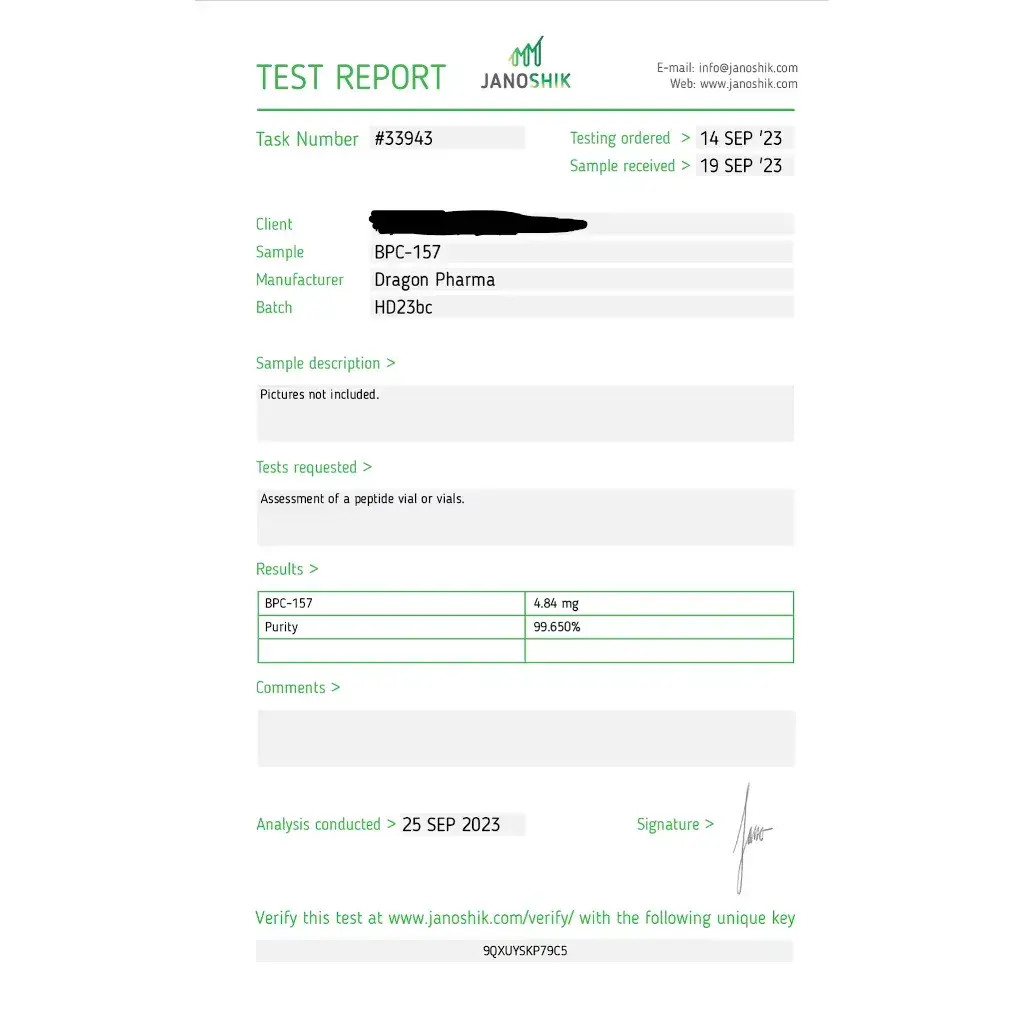
Published laboratory reports for BPC 157 5 mg are shown below with the test date, measured content and percentage of the product's 5 mg label claim.
 View Report
 View Report
Laboratory results apply to the specific tested sample represented in each published report and should not be interpreted as a measurement of every vial or production batch.
The information below is provided for educational reference only. BPC 157 is a research compound that has not been approved for human use. No human pharmacokinetic studies exist to guide dosing, and human efficacy data is limited to a small case series. Non-medical use falls outside any approved indications.
No established human dosage exists for BPC 157 based on clinical trials. In non-medical bodybuilding and research contexts, community protocols commonly reference subcutaneous doses of 250–500 mcg daily. Some protocols describe twice-daily dosing during acute recovery phases, while a maintenance dose of 250 mcg daily is sufficient for injury prevention. The dose-response relationship in humans is unknown.
| Use Case | Common Reference Range | Frequency |
|---|---|---|
| Preclinical research (rodent) | 10 μg/kg – 10 ng/kg | Daily |
| Maintenance (non-medical) | 250 mcg | Once daily |
| Active injury recovery (non-medical) | 500 mcg | Once or twice daily |
| Combined with TB-500 | 250–500 mcg BPC + 2–2.5 mg TB | Per protocol |
For a 5 mg vial reconstituted with 2 mL of bacteriostatic water, the concentration is 2,500 mcg/mL. At this concentration, 10 units on a U-100 insulin syringe equals 250 mcg.
BPC 157 is not an anabolic compound and is not stacked for muscle-building purposes. In non-medical contexts, it is most commonly referenced alongside TB 500 for a combined tissue repair and systemic recovery approach. Dragon Pharma offers TB 500/BPC 157 as a pre-combined formulation. For general recovery research, GHK-CU 50 mg is also available.
Cycle patterns commonly referenced in non-medical contexts are 4–8 weeks of daily use followed by 4–8 weeks off. These cycle conventions are adopted from broader peptide culture rather than derived from BPC 157 pharmacokinetic data.
BPC 157 has shown a favorable safety profile in preclinical research, with no lethal dose established in animal toxicology studies. Community-reported side effects are mild and infrequent, including occasional headache, dizziness, and nausea. Rare reports of transient blood pressure changes have been noted.
Injection site reactions are the most common practical consideration. A small, temporary wheal at the injection site is normal with subcutaneous injections and resolves within 15 to 60 minutes. Signs of infection requiring medical attention include redness spreading beyond 2 cm, warmth, increasing swelling over 24–48 hours, pus, or fever.
Dosing errors are a significant risk with any injectable peptide. The most common mistakes include confusing units with milliliters, miscalculating concentration after reconstitution, and drawing from the wrong vial. Always verify the vial label and calculate concentration before drawing a dose.
BPC 157 is not part of standard post-cycle therapy protocols, which focus on restoring endogenous testosterone production. PCT compounds such as Clomid and Nolvadex address the hypothalamic-pituitary-gonadal axis rather than tissue repair mechanisms. BPC 157's role is generally limited to injury recovery support during or between cycles.
BPC 157 has never been approved for human use. No human pharmacokinetic studies exist to guide dosing. The information above is for educational reference and does not constitute medical advice.
BPC 157 is an experimental research compound that has never been approved for human use. Human safety and efficacy data for musculoskeletal applications are limited to a small case series and anecdotal reports.
BPC 157 is not FDA-approved for any indication. It has no approved label and no legitimate prescription pathway for injury recovery or any other purpose. It was placed in FDA Category 2 in 2023, meaning it does not meet current safety criteria for pharmacy compounding. BPC 157 is classified as a non-approved substance under WADA regulations and is banned in competitive sport.
BPC 157 is sold strictly for research purposes. It is not a dietary supplement, medication, or approved therapeutic agent. Human consumption for injury recovery or any other purpose is not recommended and may pose unknown health risks. Product quality does not establish that human use is safe or appropriate.
BPC 157 has shown a favorable safety profile in preclinical research, with no lethal dose established in animal toxicology studies. Community-reported side effects are mild and infrequent, including occasional headache, dizziness, and nausea. Rare reports of transient blood pressure changes have been noted.
The most significant risk associated with BPC 157 use is related to product quality and sterility. Products sold as research chemicals are manufactured without pharmaceutical oversight, and independent testing has documented contamination with unintended compounds, inaccurate dosing, and degraded peptide chains. A vial labeled "5mg BPC-157" may contain 2mg, 0mg, or an entirely different compound.
Injection-site infection is a risk if sterile technique is not followed. Reconstituting with sterile water instead of bacteriostatic water can lead to bacterial contamination of the vial, potentially causing subcutaneous abscesses requiring medical treatment.
BPC 157 has no approved indications and no established contraindications because no human use is supported. However, given the lack of human safety data, individuals with active cancer or malignancy, pregnant or breastfeeding persons, and those with compromised immune systems should be particularly cautious. No human reproductive or developmental toxicology data exists.
No monitoring protocols exist for BPC 157 because it has no approved human use. No published human pharmacokinetic studies exist that measure BPC 157 plasma concentrations over time, and the half-life in humans is unknown. For research settings, standard laboratory safety monitoring would apply.
Store lyophilized powder refrigerated or frozen for long-term stability. Once reconstituted with bacteriostatic water, refrigerate at 2-8°C and use within approximately 30 days. Do not freeze the reconstituted solution, as freezing damages peptide structure. Keep all research compounds out of the reach of children. BPC 157 is prohibited by WADA under Section S0 (non-approved substances) and is banned in sport.
BPC 157 5 mg is supplied through the official Dragon Pharma distribution chain and shipped in original manufacturer packaging with discreet, privacy-focused handling.
The outer shipping package remains discreet, with privacy-focused handling and no unnecessary external product details. Products are supplied through the official Dragon Pharma distribution chain.
To verify your BPC 157 5 mg product, use the security code on the packaging and cross-check it on the Dragon Pharma official site. Official Dragon Pharma presentation, batch-linked lab proof, and original packaging help reinforce product legitimacy and buyer confidence.
Proper storage conditions help preserve peptide integrity and stability throughout shelf life.
Store lyophilized powder refrigerated or frozen for long-term stability. Keep the vial in its original packaging until use. Let frozen vials warm to room temperature before opening so condensation won't form.
Once reconstituted with bacteriostatic water, refrigerate at 2-8°C and use within approximately 30 days. Do not freeze the reconstituted solution, as freezing damages peptide structure. If the solution turns cloudy, changes color, or develops floaters, discard it. Keep out of reach of children.
Answers to common questions about BPC 157 5 mg, its research status, mechanism of action, and safety considerations.
BPC 157 5 mg is a research peptide studied for its regenerative properties in preclinical models, particularly musculoskeletal soft tissue healing. It has been investigated for tendon, ligament, muscle, and gastrointestinal tissue repair. It has never been approved for human use and is sold strictly for laboratory research purposes.
No established human dosage exists based on clinical trials. In non-medical community contexts, subcutaneous doses of 250-500 mcg daily are commonly referenced. Some protocols describe twice-daily dosing during acute recovery phases, while a maintenance dose of 250 mcg daily is sufficient for injury prevention. The dose-response relationship in humans is unknown.
BPC 157 has no relationship to the hypothalamic-pituitary-gonadal axis and is not part of any post-cycle therapy protocol. Its research focus has been on tissue repair, angiogenesis, and inflammation modulation, not hormonal recovery. PCT compounds such as Clomid and Nolvadex address entirely different biological systems.
BPC 157 is a synthetic pentadecapeptide derived from human gastric juice protein. Its proposed mechanisms center on angiogenesis (new blood vessel formation), fibroblast activity, and modulation of the nitric oxide system. It activates the Akt-eNOS signaling axis to promote angiogenesis and upregulates growth hormone receptor expression in fibroblasts. It also upregulates paxillin and vinculin expression, proteins essential for cell migration.
No human data exists on the time course of BPC 157 effects for musculoskeletal applications. In animal studies, improvements in healing, reduction in inflammation, and earlier functional recovery have been observed over days to weeks. Anecdotal human reports sometimes describe reduced pain and improved mobility within a few days to weeks, though full regeneration of tendons or ligaments often takes longer. No controlled human trials define how fast, or whether, it produces recovery effects in people.
There is no single peptide that is universally best for recovery. BPC 157 is one of the most studied peptides for tissue repair in preclinical models. TB 500 is often referenced alongside it for systemic recovery support through different mechanisms. The appropriate choice depends on individual research goals and circumstances.
BPC 157 and TB 500 have different mechanisms. BPC 157's proposed mechanisms center on nitric oxide pathways, VEGFR2-Akt-eNOS signaling, and FAK-paxillin-mediated fibroblast migration. TB-500's proposed mechanism centers on actin sequestration, cell motility, and angiogenesis through the actin-binding domain. BPC 157 is often described as more local and targeted, while TB-500 is described as more systemic.
BPC 157 and GHK-CU 50 mg target different aspects of tissue repair. BPC 157 is studied for angiogenesis, fibroblast activity, and tendon/ligament healing. GHK-Cu is a copper peptide studied for collagen synthesis, skin remodeling, and connective tissue support. They are sometimes referenced together in recovery research contexts.
No human dosing standards exist for BPC 157. The 5 mg vial strength is a research quantity. When reconstituted with 2 mL of bacteriostatic water, it produces a concentration of 2,500 mcg/mL, which allows for multiple 250-500 mcg doses. For a 4-8 week protocol at 250 mcg daily, a 5 mg vial provides approximately 20 doses.
BPC 157 5 mg is labeled at 5 mg of BPC 157 per vial. It is supplied as a lyophilized powder in a 2 mL vial, requiring reconstitution before laboratory use.
Yes. Published laboratory reports include one dated March 22, 2024 measuring BPC 157 5 mg at 4.99 mg/vial (99.8% of label claim), and another dated September 25, 2023 measuring 4.84 mg/vial (96.8% of label claim). The batch number for both reports was #HD23BC. Complete reports can be viewed in the Lab Reports tab.
Yes. BPC 157 5 mg is supplied as a lyophilized powder and requires reconstitution before use. Bacteriostatic water (water with 0.9% benzyl alcohol) is the preferred solvent because the preservative allows the multi-dose vial to be used for multiple withdrawals over up to 30 days. A common choice is 2 mL of bacteriostatic water added to a 5 mg vial, producing a concentration of 2,500 mcg/mL.