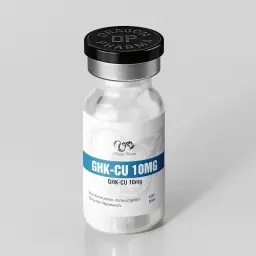


TB 500 5 mg is a lyophilized powder research peptide manufactured by Dragon Pharma, containing 5 mg of Thymosin Beta-4 (TB-500 fragment) per 2 mL vial.
TB-500 is a synthetic fragment of the naturally occurring protein thymosin beta-4, a 43-amino-acid peptide found in virtually all human and animal cells . The TB-500 fragment corresponds to the active region of thymosin beta-4 responsible for its primary biological activity: binding to actin, the protein that forms the cellular cytoskeleton . This actin-binding property is central to thymosin beta-4's role in cell migration, differentiation, and tissue repair .
Thymosin beta-4 is a naturally occurring peptide that regulates actin polymerization and plays a critical role in cellular repair and regeneration . It is not FDA-approved for any human use in the United States, and no product containing thymosin beta-4 as an active ingredient is approved by the FDA for any indication. In non-medical bodybuilding and performance contexts, TB-500 is commonly referenced for its potential to support recovery from soft tissue injuries, reduce inflammation, and enhance flexibility, though such use falls outside approved indications.
Unlike peptides that act through cell surface receptors, TB-500 works intracellularly by sequestering actin monomers and promoting actin filament dynamics. This mechanism is hypothesized to support cell migration to injury sites, reduce scar tissue formation, and improve tissue remodeling. However, no controlled human clinical trials have evaluated TB-500 for musculoskeletal or performance applications, and the evidence base is limited to preclinical research and community anecdotal reports.
TB 500 5 mg is supplied as a lyophilized (freeze-dried) powder in a 2 mL vial. This form requires reconstitution with a suitable solvent such as bacteriostatic water before use.
TB-500 is a synthetic fragment of thymosin beta-4 that binds actin and promotes cell migration, with research interests focused on tissue repair and recovery.
TB-500 corresponds to the active actin-binding region of thymosin beta-4 (Tβ4), a naturally occurring 43-amino-acid peptide. The fragment comprises the LKKTETQ region, which is responsible for the protein's primary actin-binding activity . Thymosin beta-4 is the most abundant of the beta-thymosins and is found in high concentrations in platelets, neutrophils, and macrophages — cell types involved in tissue repair .
The primary mechanism of TB-500 involves sequestration of actin monomers (G-actin), which regulates actin polymerization and depolymerization dynamics . This actin-binding activity is essential for cell motility, allowing cells to migrate to sites of injury and initiate repair processes. In animal models, thymosin beta-4 has been shown to promote wound healing, reduce inflammation, and enhance collagen deposition in various tissues .
The full-length thymosin beta-4 protein also contains a C-terminal domain (ages) associated with its anti-inflammatory and anti-apoptotic effects. The TB-500 fragment (LKKTETQ) does not include this C-terminal domain, meaning some of the full protein's broader effects may not be present in the fragment. Community protocols for TB-500 are anecdotal and not supported by controlled human trial data.
No controlled human clinical trials have evaluated TB-500 for musculoskeletal recovery, performance, or any other indication. The evidence base consists of preclinical research on full-length thymosin beta-4 and community anecdotal reports specific to the fragment. No FDA-approved product contains thymosin beta-4 as an active ingredient.
Dragon Pharma offers several research peptides that are commonly referenced alongside TB 500 5 mg in recovery and tissue-repair contexts. BPC 157 is a research peptide studied for angiogenesis and collagen synthesis through a different mechanism. TB 500/BPC 157 is a pre-combined blend of both peptides. GHK-CU is a copper peptide studied for extracellular matrix remodeling and collagen production. Glow 60 mg combines BPC-157, TB-500, and GHK-Cu in a single formulation. These compounds act through distinct but potentially complementary pathways.
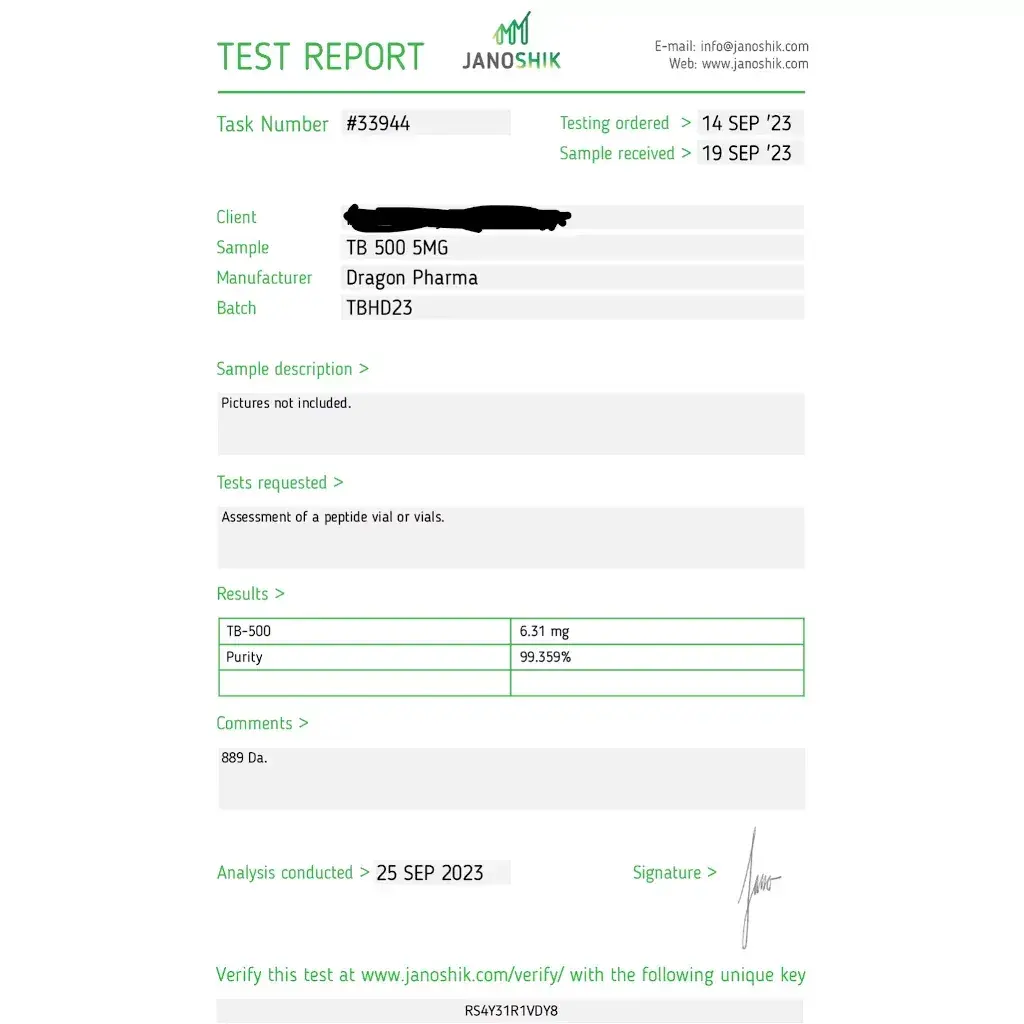
Published laboratory reports for TB 500 5 mg are shown below with the test date, measured concentration, and percentage of the product's 5 mg label claim.
 View Report
 View Report
Laboratory results apply to the specific tested sample represented in each published report and should not be interpreted as a measurement of every vial or production batch.
The information below is provided for educational reference only. TB-500 is not FDA-approved for any human use in the United States. All use in non-medical contexts falls outside approved indications.
No human clinical trials have established a safe or effective dose of TB-500. Community protocols for the TB-500 fragment are anecdotal and vary widely, with commonly referenced doses ranging from 2 mg to 5 mg per week during loading phases, followed by lower maintenance doses. Some users report a conservative starting dose of 2 mg twice weekly for 2–4 weeks, then 2 mg once weekly thereafter.
| Use Case | Common Reference Range | Injection Frequency |
|---|---|---|
| Community standard (loading) | 2–5 mg per week | Split into 2 injections weekly |
| Community standard (maintenance) | 2 mg per week | Once weekly |
| Community conservative start | 2 mg | Twice weekly for 2–4 weeks |
Common reference ranges for TB-500 in non-medical contexts are not well characterized in publicly available bodybuilding resources. The table above reflects community self-reports rather than validated clinical protocols.
TB-500 is frequently stacked with BPC 157 in community recovery protocols. The two peptides are hypothesized to act through complementary mechanisms, with BPC-157 studied for angiogenesis and collagen synthesis and TB-500 investigated for actin binding and cell migration. Pre-combined products such as TB 500/BPC 157 and Glow 60 mg are also available for those who prefer a fixed-ratio blend.
Community protocols typically reference cycles of 4–6 weeks followed by a break. Bacteriostatic Water is commonly referenced for reconstitution.
No human safety data exist for TB-500 in controlled trials. Community reports commonly reference injection-site reactions including redness, swelling, and mild discomfort. Less commonly, users report temporary increases in inflammation or flu-like symptoms shortly after initiation.
The full-length thymosin beta-4 protein has been associated with potential effects on cell proliferation and migration. The fragment lacks the C-terminal domain that contributes to some of the full protein's anti-inflammatory and anti-apoptotic effects, and the long-term effects of TB-500 use have not been established.
TB-500 acts on actin dynamics and tissue remodeling rather than the hypothalamic-pituitary-gonadal axis. It does not suppress endogenous testosterone production, and post-cycle therapy in the context of testosterone recovery is not applicable.
Dosing strategies for TB-500 are not established in clinical settings. The information above is for educational reference and does not constitute medical advice.
TB-500 is not FDA-approved for any human use in the United States. No product containing thymosin beta-4 as an active ingredient is approved by the FDA for any indication.
TB-500 is a synthetic fragment of thymosin beta-4, a naturally occurring protein. It is not approved for therapeutic use in the United States, and no controlled human clinical trials have evaluated its safety or efficacy for any indication. WADA prohibits TB-500 as a peptide hormone .
The full-length thymosin beta-4 protein has been studied in clinical trials for wound healing and corneal repair, but the TB-500 fragment is structurally distinct and has not been the subject of equivalent clinical research. Safety and efficacy data for the full protein do not directly transfer to the fragment.
TB-500 is not FDA-approved for human use. Any use outside of approved research applications falls outside approved indications. Product concentration and laboratory verification do not establish that non-medical use is safe or appropriate for an individual.
No human adverse event data exist for TB-500 in controlled trials. Community reports commonly reference injection-site reactions including redness, swelling, and mild discomfort. Less commonly, users report temporary increases in inflammation or flu-like symptoms shortly after initiation.
Because TB-500 promotes cell migration and actin dynamics, theoretical concerns include potential effects on cell proliferation. The long-term effects of TB-500 use have not been established.
Individuals with active malignancy or a history of cancer should exercise particular caution, as the peptide's effects on cell migration and proliferation are not fully characterized. Because TB-500 has not been studied in humans, the full range of contraindications and potential drug interactions is unknown.
No safety data exist for TB-500 in pregnancy, lactation, or pediatric populations. WADA prohibits TB-500 for competing athletes.
No established monitoring protocol exists for TB-500 in non-medical contexts. In research settings where thymosin beta-4 has been studied, endpoints have focused on wound healing and tissue repair rather than standardized safety parameters.
No published laboratory reports are available for this specific product beyond the potency verification shown in the Lab Reports tab. That testing applies to the tested sample only and is separate from any clinical monitoring of the individual.
Lyophilized TB-500 should be stored tightly sealed in its original container, protected from light, and desiccated at -20°C for long-term storage. After reconstitution, store refrigerated at 2–8°C and use within 2–4 weeks. Avoid repeated freeze-thaw cycles.
Keep all peptides and injectable products out of the reach of children. Follow the storage instructions provided with the product packaging.
TB 500 5 mg by Dragon Pharma is supplied through the official distribution chain and shipped in original manufacturer packaging with discreet, privacy-focused handling.
The outer shipping package remains discreet, with privacy-focused handling and no unnecessary external product details. Products are supplied through the official Dragon Pharma distribution chain.
To verify your TB 500 5 mg product, use the security code on the vial label and cross-check it on the Dragon Pharma official site. Official presentation, batch-linked lab proof, and original packaging help reinforce product legitimacy and buyer confidence.
For complete delivery details, tracking policy, and reshipment terms, please see our Shipping Info page.
Proper storage conditions help preserve peptide stability and overall product integrity throughout shelf life.
Store the lyophilized (dry) powder tightly sealed in its original container, protected from light, and desiccated at -20°C for long-term storage. Brief handling at refrigerated or ambient conditions is acceptable provided the container is allowed to equilibrate to room temperature before opening to prevent moisture uptake.
TB-500 is a peptide fragment susceptible to degradation once reconstituted. After reconstitution, store refrigerated at 2–8°C and use within 2–4 weeks. Avoid repeated freeze-thaw cycles.
Keep out of reach of children. Follow proper handling and sterile technique when administering the product.
Answers to common questions about TB 500 5 mg, its mechanism, product strength, and laboratory testing.
TB 500 5 mg contains a synthetic fragment of thymosin beta-4. In research settings, it is studied for its actin-binding properties and potential role in cell migration and tissue remodeling. In non-medical bodybuilding contexts, it is commonly referenced for recovery support, though such use falls outside approved indications.
Community protocols commonly reference 2–5 mg per week during a loading phase, split into two injections weekly, followed by 2 mg per week for maintenance. These protocols are anecdotal and not supported by controlled human trial data.
No. TB-500 acts on actin dynamics and tissue remodeling rather than the hypothalamic-pituitary-gonadal axis. It does not suppress endogenous testosterone production, and post-cycle therapy in the context of testosterone recovery is not applicable.
Thymosin beta-4 is a naturally occurring protein that binds actin monomers, regulating actin polymerization and cell motility. This mechanism is central to cell migration and tissue repair. TB-500 is a fragment of this protein corresponding to its actin-binding region (LKKTETQ).
The time course for TB-500 is not established in humans because no controlled clinical trials have been conducted. Community reports vary widely, with some users describing effects within days and others reporting gradual changes over weeks. Individual response cannot be predicted from available data.
There is no evidence-based “best” recovery peptide. TB-500 is studied for actin binding and cell migration, while BPC 157 is investigated for angiogenesis and collagen synthesis. The two are often stacked for potentially complementary effects. The appropriate choice depends on individual goals.
TB-500 is a fragment of thymosin beta-4 that binds actin and promotes cell migration. BPC 157 is a pentadecapeptide studied for angiogenesis and collagen synthesis through a different mechanism. The two are commonly stacked in community recovery protocols, and a pre-combined product is available as TB 500/BPC 157.
TB-500 acts on actin dynamics and cell migration, while GHK-CU is a copper peptide studied for extracellular matrix remodeling and collagen production. The two are sometimes referenced together in broader recovery protocols, and both are included in Glow 60 mg.
2 mg is a commonly referenced maintenance dose in community protocols. A conservative starting protocol often involves 2 mg twice weekly for 2–4 weeks before transitioning to 2 mg once weekly. These figures are anecdotal and not clinically established.
TB 500 5 mg is labeled at 5 mg of Thymosin Beta-4 (TB-500 fragment) per vial. It is supplied as a lyophilized powder in a 2 mL vial, requiring reconstitution before use.
Yes. Published laboratory reports are available. The most recent report dated March 22, 2024 measured TB 500 5 mg at 6.15 mg, equivalent to 123% of its 5 mg label claim. An earlier report dated September 25, 2023 measured 6.31 mg (126.2% of label claim). Complete reports can be viewed in the Lab Reports tab.
Lyophilized TB-500 is typically reconstituted with a suitable solvent such as Bacteriostatic Water or sterile water. The volume of solvent added determines the concentration of the resulting solution. Proper sterile technique should be used during reconstitution.