
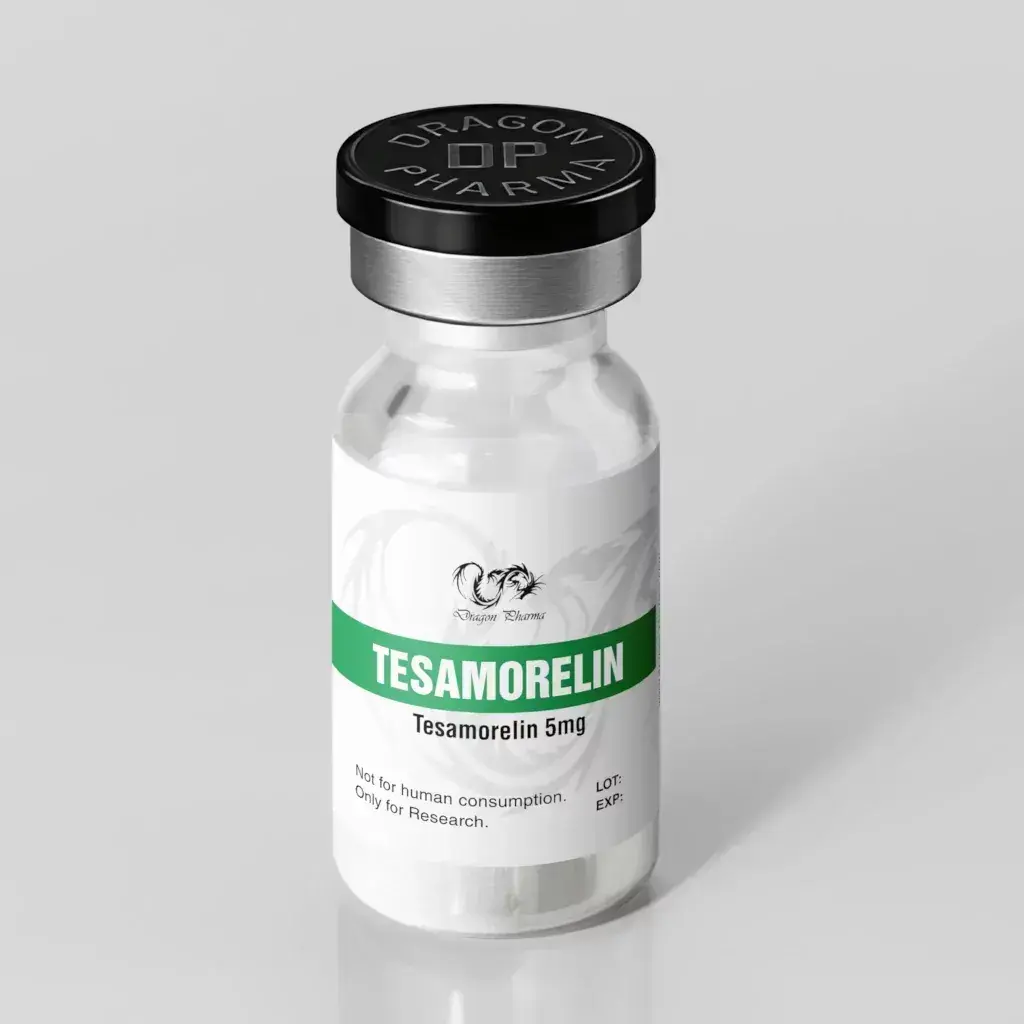
Tesamorelin 5 mg is a lyophilized powder research peptide manufactured by Dragon Pharma and supplied as 5 mg of tesamorelin per 2 mL vial.
Tesamorelin is a synthetic analogue of growth hormone-releasing hormone (GHRH), also known as growth hormone-releasing factor (GRF). It consists of the 44-amino-acid sequence of human GHRH and binds to GHRH receptors on pituitary somatotroph cells to stimulate the synthesis and pulsatile release of endogenous growth hormone. Unlike exogenous HGH administration, tesamorelin works through the body's own pituitary signalling pathways, which preserves the natural pulsatile pattern of growth hormone secretion.
In medical practice, tesamorelin is FDA-approved under the brand name Egrifta for the reduction of excess abdominal fat in HIV-infected patients with lipodystrophy. Clinical trials demonstrated significant reductions in visceral adipose tissue over 26 to 52 weeks of treatment. In bodybuilding and fitness contexts, tesamorelin is referenced for its potential effects on body composition, particularly visceral fat reduction and improvements in lean mass, though such use falls outside approved medical indications.
The peptide's mechanism centres on stimulating the pituitary to produce more of the body's own growth hormone. This leads to downstream increases in IGF-1 production, which mediates many of the anabolic and lipolytic effects associated with growth hormone. Because tesamorelin acts upstream of growth hormone production, its effects are subject to the body's own feedback mechanisms, which may influence both its efficacy profile and side effect characteristics compared to direct HGH administration.
Tesamorelin 5 mg is supplied as a lyophilized powder requiring reconstitution with a suitable diluent before use. The 2 mL vial size provides adequate capacity for the reconstituted solution. Store the lyophilized powder under recommended conditions to maintain peptide integrity.
Tesamorelin is a synthetic GHRH analogue peptide that stimulates pituitary growth hormone release. Its clinical development focused on visceral adiposity reduction, and it remains the only FDA-approved therapy for HIV-associated lipodystrophy.
Tesamorelin belongs to the class of growth hormone-releasing hormone (GHRH) analogues. These peptides mimic the action of endogenous GHRH, a hypothalamic hormone that signals the pituitary gland to release growth hormone. Tesamorelin binds GHRH receptors with similar potency to natural GHRH, stimulating both the synthesis and pulsatile release of growth hormone.
The peptide's pharmacokinetic profile shows a median peak plasma concentration at approximately 0.15 hours after subcutaneous administration, with an elimination half-life of 26 to 38 minutes. Despite the short half-life, the downstream effects on growth hormone and IGF-1 levels persist for considerably longer, reflecting the cascade nature of the GH/IGF-1 axis.
In clinical trials, 2 mg daily subcutaneous tesamorelin significantly increased serum growth hormone levels, with mean overnight GH secretion increasing by approximately 70% and IGF-1 more than doubling in some studies. These effects on the GH/IGF-1 axis are the basis for both its clinical applications and its interest in bodybuilding research contexts.
Unlike exogenous growth hormone which provides a continuous supply, tesamorelin stimulates the pituitary to release the body's own GH in a pulsatile pattern. This distinction may influence both the physiological effects and the side effect profile compared to direct HGH administration.
Dragon Pharma offers several peptide and hormone-related products that are referenced in bodybuilding research contexts. The primary distinction between these preparations lies in their mechanism of action and their position within the GH/IGF-1 axis.
Tesamorelin acts upstream by stimulating endogenous GH production, while Dragontropin HGH provides exogenous growth hormone directly. For researchers examining related peptides, Sermorelin is a shorter GHRH analogue with a different pharmacokinetic profile, while Ipamorelin works through ghrelin receptor pathways rather than GHRH receptors. A combined preparation containing both Ipamorelin 5 mg and Tesamorelin 5 mg is also available for researchers studying complementary mechanisms.
The information below is provided for educational reference only. Tesamorelin is a prescription peptide; medical use requires appropriate diagnosis and clinical supervision. Non-medical use falls outside approved indications.
In medically supervised settings, tesamorelin is dosed at 2 mg subcutaneously once daily, as used in the clinical trials that supported its FDA approval. In non-medical bodybuilding contexts, tesamorelin is commonly referenced in the range of 1–2 mg per day, with some users preferring the lower end for cost management and reduced side effect potential. Reference ranges vary widely in non-clinical literature.
| Use Case | Common Reference Range | Injection Frequency |
|---|---|---|
| Medical (clinical trials) | 2 mg / day | Once daily, subcutaneous |
| Bodybuilding (non-medical) | 1–2 mg / day | Once daily, typically fasted |
| Cycling protocol (non-medical) | 5 days on / 2 days off | Per individual protocol |
Tesamorelin 5 mg is supplied as a lyophilized powder requiring reconstitution before use. Bacteriostatic Water is commonly referenced for reconstituting research peptides. The reconstituted solution should be handled according to standard peptide handling practices.
In clinical settings, tesamorelin is administered subcutaneously in the abdominal area, with rotation of injection sites to reduce local reactions. The timing of administration may influence results, with some protocols favouring evening injections to align with natural nocturnal GH secretion patterns.
In non-medical bodybuilding contexts, tesamorelin is sometimes referenced alongside other compounds targeting the GH/IGF-1 axis. The combined Ipamorelin 5 mg and Tesamorelin 5 mg product is designed for researchers examining complementary GHRH and ghrelin receptor pathways. CJC-1295 No DAC / Ipamorelin represents another combination approach to GH stimulation.
Cycle length is an important consideration for tesamorelin research. Clinical data spans 26 to 52 weeks of continuous treatment, but non-medical users often reference shorter cycles with time off between them. Individual response to GHRH analogue peptides varies considerably.
Tesamorelin's side effect profile in clinical trials included injection site reactions, fluid retention, and potential effects on glucose metabolism. Monitoring IGF-1 levels during tesamorelin research is referenced to assess the magnitude of GH axis stimulation.
Fluid retention, manifesting as edema, joint pain, or carpal tunnel-like symptoms, is thought to be related to growth hormone induction. These effects were generally transient or resolved upon discontinuation in clinical studies.
Dosing strategies and cycle protocols should account for individual factors. The information above is for educational reference and does not constitute medical advice.
Tesamorelin stimulates growth hormone production and can affect multiple physiological systems. Medical use requires clinical supervision and monitoring.
Tesamorelin is FDA-approved for a specific medical indication—reduction of excess abdominal fat in HIV-infected patients with lipodystrophy. Use outside this indication, including bodybuilding and performance enhancement, falls outside approved labelling and may carry additional risks that have not been characterised in clinical trials.
Growth hormone-releasing hormone analogues stimulate the GH/IGF-1 axis, which influences growth, metabolism, and cellular proliferation. Monitoring of IGF-1 levels is recommended during clinical tesamorelin therapy to assess the degree of axis stimulation and guide treatment decisions.
Non-medical use of tesamorelin falls outside approved indications. Product purity and laboratory verification do not establish that non-medical use is safe or appropriate for an individual.
In clinical trials, tesamorelin was associated with injection site reactions (25% incidence in treated patients vs 14% placebo), fluid retention including edema and arthralgia, and potential effects on glucose metabolism. Hypersensitivity reactions occurred in 4% of treated patients.
Increased IGF-1 levels were observed in a substantial proportion of treated patients. Among those receiving tesamorelin for 26 weeks, 47% had IGF-1 levels greater than 2 standard deviation scores above normal, and 36% had levels greater than 3 SDS. The long-term consequences of sustained IGF-1 elevation are not fully characterised.
Glucose intolerance or diabetes mellitus risk may increase with tesamorelin treatment. In clinical trials, patients receiving tesamorelin had a higher rate of elevated HbA1c (≥6.5%) compared to placebo. Evaluation of glucose status before and during treatment is recommended in clinical practice.
Tesamorelin is contraindicated in patients with active cancer or a history of cancer that is not inactive, and in those with known hypersensitivity to tesamorelin or product components. Pregnancy and breastfeeding are additional contraindications.
Patients with diabetes or glucose metabolism disorders require careful monitoring during tesamorelin therapy due to the potential for worsening glucose control. Those with breathing problems or scheduled surgery should discuss tesamorelin use with a healthcare provider.
Clinical tesamorelin therapy involves monitoring of IGF-1 levels to assess treatment response and guide decisions about continuation. Periodic evaluation of glucose status, including HbA1c, is recommended to detect potential effects on glycemic control.
Laboratory testing of the product itself is separate from clinical monitoring of the individual using tesamorelin. Product testing provides information about the vial's contents, not about the physiological response of the person using it.
Store the lyophilized powder under recommended conditions and protect from conditions that could compromise peptide integrity. Follow standard practices for handling lyophilized peptide products and inspect the vial before reconstitution.
Keep all research peptides and injectable products out of the reach of children.
Tesamorelin 5 mg by Dragon Pharma is supplied through the official distribution chain and shipped with discreet, privacy-focused handling.
The outer shipping package remains discreet, with no external product details. Products are supplied through the official Dragon Pharma distribution chain.
To verify your Tesamorelin 5 mg product, use the security code on the vial label and cross-check it on the official Dragon Pharma site. Original packaging and batch-linked documentation help reinforce product legitimacy.
For complete delivery details, tracking policy, and reshipment terms, please see our Shipping Info page.
Proper storage conditions help preserve peptide integrity and maintain product stability throughout shelf life.
Store the lyophilized powder in a cool, dry place protected from light and moisture. The unopened vial should be kept under conditions that preserve the peptide's structural integrity until reconstitution.
Once reconstituted, tesamorelin solution should be handled according to standard peptide practices. The reconstituted solution is typically less stable than the lyophilized powder and should be used within the timeframe appropriate for the specific diluent and storage conditions.
Keep out of reach of children. Follow proper handling practices for research peptides and use appropriate sterile technique during reconstitution and administration.
Answers to common questions about Tesamorelin 5 mg, GHRH analogue peptides, dosage considerations, and product details.
Tesamorelin 5 mg is a research peptide supplied as a lyophilized powder. In medical practice, tesamorelin is FDA-approved for reducing excess abdominal fat in HIV-infected patients with lipodystrophy. In bodybuilding research contexts, it is referenced for its effects on the GH/IGF-1 axis and body composition, though such use falls outside approved indications.
In clinical trials, tesamorelin was administered as 2 mg subcutaneously once daily. Non-medical bodybuilding protocols often reference daily administration, sometimes with a 5-days-on, 2-days-off schedule. Administration frequency should align with the specific research protocol and individual factors.
Tesamorelin is not an anabolic steroid and does not suppress endogenous testosterone production in the same way. Post-cycle therapy designed for steroid cycles is not typically referenced in the context of tesamorelin research. However, the GH/IGF-1 axis does have its own feedback mechanisms that researchers may consider.
Tesamorelin is a GHRH analogue that binds to growth hormone-releasing hormone receptors on the pituitary gland, stimulating the synthesis and pulsatile release of endogenous growth hormone. This leads to downstream increases in IGF-1 and effects on metabolism and body composition. It is distinct from exogenous HGH because it works through the body's own pituitary signalling.
Clinical studies measured effects on visceral adipose tissue over 26 to 52 weeks of treatment. Growth hormone and IGF-1 levels increase relatively quickly after administration, but changes in body composition develop over longer periods. Individual response timelines vary based on multiple factors.
Tesamorelin is the only GHRH analogue with FDA approval for a specific indication—HIV-associated lipodystrophy. Other GHRH analogues such as Sermorelin have different pharmacokinetic profiles and approval histories. The "best" choice depends on the specific research or clinical context.
Both tesamorelin and sermorelin are GHRH analogues, but they differ in their amino acid sequences and pharmacokinetic profiles. Tesamorelin contains the full 44-amino-acid sequence of human GHRH, while sermorelin is a shorter fragment. Tesamorelin has been more extensively studied in clinical trials for visceral fat reduction.
Tesamorelin and Ipamorelin work through different mechanisms. Tesamorelin activates GHRH receptors, while ipamorelin is a ghrelin receptor agonist that stimulates GH release through a separate pathway. A combined Ipamorelin and Tesamorelin product is available for researchers examining both pathways.
2 mg once daily is the dose used in the clinical trials that supported tesamorelin's FDA approval. In non-medical contexts, some users reference lower doses for cost management or side effect considerations. As with any peptide, individual response and tolerance vary.
Tesamorelin 5 mg by Dragon Pharma contains 5 mg of tesamorelin per vial as a lyophilized powder. The vial size is 2 mL. This is a research-strength presentation that allows for flexible dosing depending on the reconstitution volume used.
No laboratory report is currently published for this specific Tesamorelin 5 mg product listing. Dragon Pharma products are generally subject to quality control, but no third-party laboratory report is available for this batch at this time. Researchers should verify product authenticity through the manufacturer's security features.
Tesamorelin is sometimes referenced alongside other GH-related peptides in research contexts. CJC-1295 No DAC / Ipamorelin represents another approach to GH axis stimulation. The combined Ipamorelin and Tesamorelin product exists specifically for researchers examining complementary mechanisms.