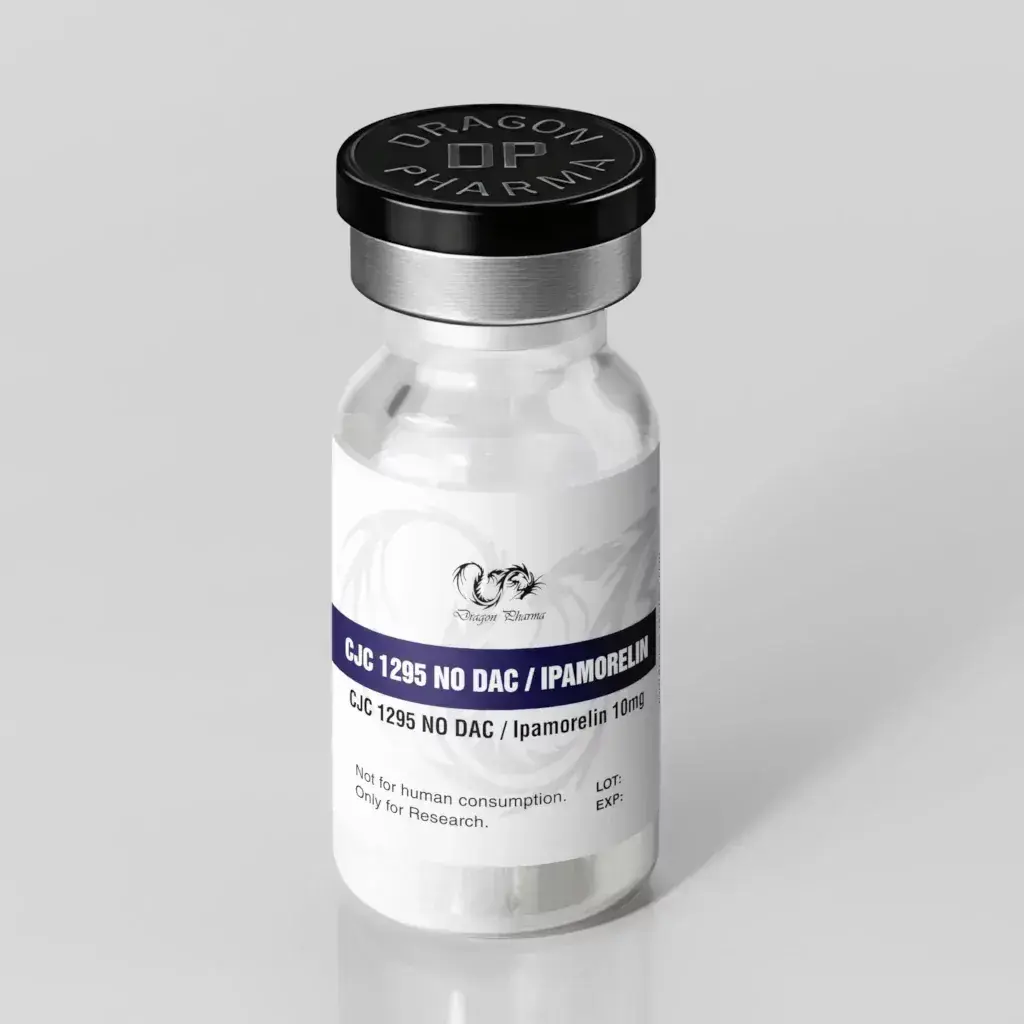
CJC 1295 No DAC 5 mg/Ipamorelin 5 mg is a lyophilized research peptide blend manufactured by Dragon Pharma, supplied as 5 mg of CJC-1295 No DAC and 5 mg of Ipamorelin per 2 mL vial for laboratory research purposes.
CJC 1295 No DAC 5 mg/Ipamorelin 5 mg combines two growth hormone secretagogues in a single lyophilized vial. CJC-1295 No DAC (also known as Mod GRF 1-29 or tetrasubstituted GRF 1-29) is a synthetic analog of growth hormone-releasing hormone (GHRH) with four amino acid substitutions that increase its resistance to enzymatic degradation and extend its half-life to approximately 30 minutes. Ipamorelin is a selective pentapeptide growth hormone secretagogue that binds to the ghrelin receptor (GHS-R1a) and stimulates growth hormone release without significantly affecting cortisol, prolactin, or appetite at standard doses.
The two peptides work synergistically through independent pituitary pathways. CJC-1295 No DAC provides the GHRH signal that primes pituitary somatotroph cells to produce growth hormone, while Ipamorelin triggers its release via ghrelin receptor activation. This dual-pathway approach is commonly referenced in non-medical research contexts as producing a more pronounced growth hormone pulse than either compound alone. In clinical research, CJC-1295 with the Drug Affinity Complex (DAC) has been studied in healthy adults, demonstrating dose-dependent increases in growth hormone and IGF-1 levels. The No DAC version provides a shorter, more pulsatile profile that more closely mimics the body's natural GH rhythm.
Neither CJC-1295 nor Ipamorelin is FDA-approved for any indication. Both are classified as research peptides and are prohibited by WADA under category S2.4 (growth hormone secretagogues). The blend is sold strictly for laboratory research purposes and is not intended for human use.
CJC 1295 No DAC 5 mg/Ipamorelin 5 mg is supplied as a lyophilized powder in a 2 mL vial. The powder requires reconstitution with bacteriostatic water or another appropriate solvent before laboratory use. Once reconstituted, the solution should be refrigerated and handled according to standard research peptide protocols.
CJC-1295 No DAC and Ipamorelin are complementary growth hormone secretagogues that activate independent pituitary receptors to produce synergistic GH release.
CJC-1295 No DAC (Mod GRF 1-29) is a synthetic GHRH analog with four amino acid substitutions designed to resist proteolytic inactivation by dipeptidyl peptidase IV (DPP-IV). These substitutions include D-alanine at position 2, glutamine at position 8, and leucine at position 27. The half-life of approximately 30 minutes is significantly longer than native GHRH but much shorter than the DAC version of CJC-1295, which binds to albumin and has a half-life of 5.8 to 8.1 days.
Ipamorelin is a pentapeptide ghrelin mimetic that selectively activates the growth hormone secretagogue receptor (GHS-R1a). In preclinical and healthy volunteer studies, Ipamorelin has demonstrated a clean off-target profile, with no meaningful elevation of cortisol, ACTH, or prolactin. Its plasma half-life is approximately 2 hours after subcutaneous administration.
When combined, the two peptides activate GHRH receptors and ghrelin receptors on pituitary somatotrophs, producing a synergistic GH pulse that exceeds what either achieves alone. This co-administration approach is well-characterized in research literature and is the standard pairing in non-medical GH peptide protocols.
CJC-1295 No DAC has a half-life of approximately 30 minutes, while Ipamorelin has a half-life of approximately 2 hours. The shorter CJC-1295 profile creates discrete GH pulses, while Ipamorelin provides a slightly more sustained signal. Both are cleared rapidly compared to the DAC version of CJC-1295.
Dragon Pharma offers a range of research peptides relevant to growth hormone and recovery research. This blend is positioned as a dual-pathway GH secretagogue combination, complementing other peptide products.
For a longer-acting GHRH analog, Dragon Pharma offers CJC-DAC, which provides sustained growth hormone elevation with less frequent dosing. For standalone Ipamorelin research, Ipamorelin is available separately. For a different GHRP with more pronounced appetite stimulation, GHRP-6 is also offered.
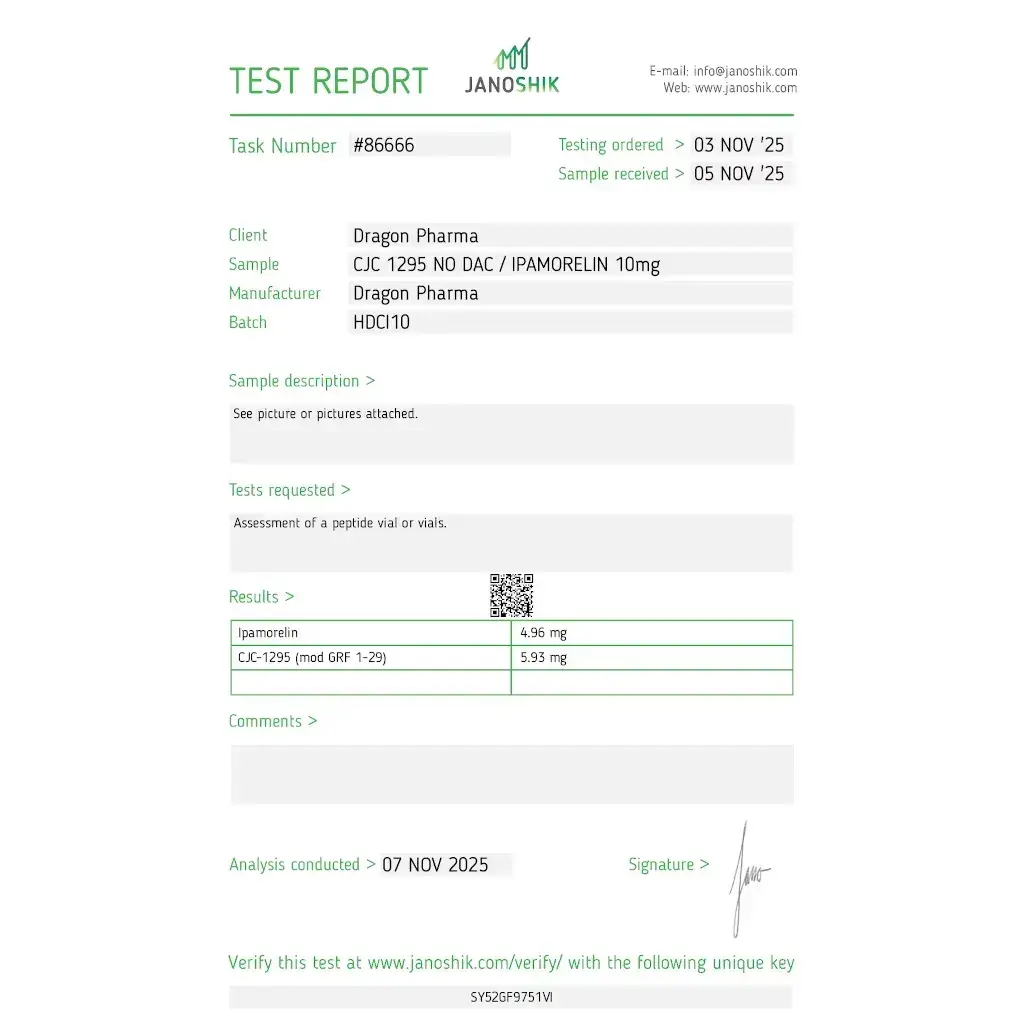
Published laboratory reports for CJC 1295 No DAC 5 mg/Ipamorelin 5 mg are shown below with the test date, measured content and percentage of the product's label claim.
 View Report
Laboratory results apply to the specific tested sample represented in each published report and should not be interpreted as a measurement of every vial or production batch.
The information below is provided for educational reference only. CJC-1295 and Ipamorelin are research compounds that have not been approved for human use. No established human dosing exists outside of clinical trial protocols. Non-medical use falls outside any approved indications and carries unknown health risks.
In non-medical research contexts, CJC-1295 No DAC and Ipamorelin are commonly referenced at a combined dose of 100–200 mcg of CJC-1295 No DAC and 200 mcg of Ipamorelin per injection, administered once or twice daily. The bedtime dose is prioritized to coincide with the natural nocturnal GH surge, with an optional second dose upon waking in a fasted state. In clinical research, CJC-1295 with DAC has been studied at doses of 30 or 60 mcg/kg in healthy adults. The No DAC version has not been studied in human clinical trials at comparable scale.
| Use Case | Common Reference Range | Frequency |
|---|---|---|
| CJC-1295 No DAC (research) | 100–200 mcg | 1–2x daily |
| Ipamorelin (research) | 200 mcg | 1–2x daily |
| Combined protocol | 100–200 mcg CJC + 200 mcg Ipamorelin | Once or twice daily |
Doses are administered subcutaneously in a fasted state, ideally at least 2 hours after the last meal and 30 minutes before eating. The CJC-1295 No DAC content in this 5 mg/5 mg blend provides approximately 25–50 doses at 100–200 mcg per injection.
CJC-1295 No DAC and Ipamorelin are designed to be used together, and this pre-combined vial provides both peptides in a single formulation. Community protocols commonly reference an 8 to 12 week cycle followed by a 4-week break to allow receptor resensitization. Some users prefer a 5 days on, 2 days off weekly pattern to provide partial receptor recovery.
For a longer-acting GHRH option, Dragon Pharma offers CJC-DAC, which requires less frequent dosing but produces sustained rather than pulsatile GH elevation. For standalone Ipamorelin research, Ipamorelin is available separately.
Common side effects reported in non-medical contexts include injection site reactions (redness, mild swelling), transient flushing, water retention, and headache. Water retention typically resolves by week 3–4. Carpal tunnel-like tingling or numbness in the hands may indicate elevated GH levels and typically resolves with dose reduction.
Fasting glucose should be monitored, as GH promotes gluconeogenesis and can mildly increase fasting glucose. Individuals with pre-diabetes or type 2 diabetes should monitor fasting glucose and HbA1c every 8–12 weeks. Ipamorelin is notably clean in its side effect profile, with no meaningful cortisol, prolactin, or appetite effects at standard doses.
CJC-1295 and Ipamorelin are not part of standard post-cycle therapy protocols, which focus on restoring endogenous testosterone production. PCT compounds such as Clomid and Nolvadex address the hypothalamic-pituitary-gonadal axis rather than growth hormone secretion. The role of GH secretagogues is generally separate from testosterone recovery protocols.
CJC-1295 and Ipamorelin have not been approved for human use. The information above is for educational reference and does not constitute medical advice. Human use is not supported by evidence for non-medical applications and is prohibited by WADA.
CJC-1295 and Ipamorelin are experimental research peptides that have not been approved for human use. No long-term human safety data exists for non-medical applications.
Neither CJC-1295 nor Ipamorelin is FDA-approved for any indication. Both are classified as research peptides and are prohibited by WADA under category S2.4 (growth hormone secretagogues). Products sold online as research chemicals are not FDA-regulated, have no verified manufacturing standards, and carry unknown contamination, dosing, and safety risks. A 2026 analysis of peptide products found that many samples did not contain the stated peptide.
CJC 1295 No DAC 5 mg/Ipamorelin 5 mg is sold strictly for research purposes. It is not a dietary supplement, medication, or approved therapeutic agent. Human consumption for growth hormone optimization or any other purpose is not recommended and may pose unknown health risks.
In non-medical community reports, the most common side effects are injection site reactions, transient flushing, water retention, and headache. Water retention typically resolves within 3–4 weeks. Carpal tunnel-like tingling or numbness in the hands may occur with elevated GH levels and typically resolves with dose reduction.
Growth hormone and IGF-1 are growth factors, and elevating them in someone with active malignancy could promote tumor proliferation. This is a hard contraindication for all GH-stimulating compounds. Individuals with pituitary damage may not respond to secretagogues and may require direct GH replacement.
Blood glucose changes may occur because GH promotes gluconeogenesis. Fasting glucose should be monitored, particularly in individuals with pre-diabetes or type 2 diabetes.
CJC-1295 and Ipamorelin have no approved indications and no established contraindications because no human use is supported. However, given the mechanism of action, individuals with active cancer or malignancy, pituitary damage, or pre-existing glucose intolerance should be particularly cautious. No human reproductive or developmental toxicology data exists for these compounds.
No monitoring protocols exist for CJC-1295 No DAC or Ipamorelin because they have no approved human use. In non-medical research contexts, IGF-1 levels are commonly referenced as a practical proxy for GH axis activity, along with fasting glucose and insulin. Baseline and mid-cycle bloodwork including IGF-1, fasting glucose, and a complete metabolic panel is sometimes referenced in community protocols.
Store lyophilized powder refrigerated or frozen for long-term stability. Once reconstituted with bacteriostatic water, refrigerate at 2-8°C and use according to standard research peptide protocols. Do not freeze the reconstituted solution, as freezing can damage peptide structure. Keep all research compounds out of the reach of children. Both compounds are prohibited by WADA under S2.4.
CJC 1295 No DAC 5 mg/Ipamorelin 5 mg is supplied through the official Dragon Pharma distribution chain and shipped in original manufacturer packaging with discreet, privacy-focused handling.
The outer shipping package remains discreet, with privacy-focused handling and no unnecessary external product details. Products are supplied through the official Dragon Pharma distribution chain.
To verify your CJC 1295 No DAC 5 mg/Ipamorelin 5 mg product, use the security code on the packaging and cross-check it on the Dragon Pharma official site. Official Dragon Pharma presentation, batch-linked lab proof, and original packaging help reinforce product legitimacy and buyer confidence.
Proper storage conditions help preserve peptide integrity and stability throughout shelf life.
Store lyophilized powder refrigerated or frozen for long-term stability. Keep the vial in its original packaging until use. Let frozen vials warm to room temperature before opening so condensation won't form.
Once reconstituted with bacteriostatic water, refrigerate at 2-8°C and use according to standard research peptide protocols. Do not freeze the reconstituted solution, as freezing can damage peptide structure. If the solution turns cloudy, changes color, or develops floaters, discard it. Keep out of reach of children.
Answers to common questions about CJC 1295 No DAC 5 mg/Ipamorelin 5 mg, its research status, mechanism of action, and safety considerations.
CJC 1295 No DAC 5 mg/Ipamorelin 5 mg is a research peptide blend studied for its effects on growth hormone secretion. CJC-1295 No DAC is a GHRH analog that primes pituitary somatotroph cells, while Ipamorelin is a ghrelin receptor agonist that triggers GH release. Both are research compounds that have not been approved for human use.
In non-medical research contexts, the blend is commonly referenced at a combined dose of 100–200 mcg CJC-1295 No DAC and 200 mcg Ipamorelin, administered once or twice daily. The bedtime dose is prioritized to coincide with the natural nocturnal GH surge. Doses are administered subcutaneously in a fasted state.
CJC-1295 and Ipamorelin have no relationship to the hypothalamic-pituitary-gonadal axis and are not part of any post-cycle therapy protocol. Their research focus has been on growth hormone secretion, not testosterone recovery. PCT compounds such as Clomid and Nolvadex address entirely different biological systems.
CJC-1295 No DAC is a GHRH analog that binds to GHRH receptors on pituitary somatotrophs, priming them to produce growth hormone. Ipamorelin is a ghrelin mimetic that binds to the GHS-R1a receptor and triggers GH release. Together, they activate two independent pathways to produce a synergistic GH pulse.
CJC-1295 No DAC has a half-life of approximately 30 minutes, and Ipamorelin has a half-life of approximately 2 hours. In community protocols, improved sleep quality is often reported within 1–2 weeks, while body composition changes typically become visible after 4–6 weeks.
There is no single GH secretagogue combination that is universally best. The CJC-1295 No DAC and Ipamorelin pairing is one of the most commonly referenced in non-medical contexts because they activate complementary pathways and Ipamorelin has a clean side effect profile. Other options include CJC-DAC for longer-acting GHRH signaling, or GHRP-6 for a different GHRP profile.
CJC-1295 No DAC (Mod GRF 1-29) has a half-life of approximately 30 minutes and creates discrete, pulsatile GH spikes. CJC-1295 with DAC binds to albumin and has a half-life of 5.8 to 8.1 days, producing sustained GH elevation with less frequent dosing. Dragon Pharma offers CJC-DAC as the longer-acting version.
Ipamorelin and GHRP-6 are both ghrelin receptor agonists, but they differ in selectivity. Ipamorelin is described as a selective GH secretagogue with no meaningful elevation of cortisol, prolactin, or appetite at standard doses. GHRP-6 may produce more pronounced appetite stimulation and can affect other hormones. Dragon Pharma offers GHRP-6 separately.
The 5 mg/5 mg vial strength is a research quantity. At a combined protocol of 100–200 mcg CJC-1295 No DAC and 200 mcg Ipamorelin per injection, the vial provides approximately 25–50 doses. This is a standard research vial size for lyophilized peptides.
CJC 1295 No DAC 5 mg/Ipamorelin 5 mg is labeled at 5 mg of CJC-1295 No DAC and 5 mg of Ipamorelin per vial, for a total of 10 mg per vial. It is supplied as a lyophilized powder in a 2 mL vial, requiring reconstitution before laboratory use.
Yes. A published laboratory report dated November 7, 2025 measured CJC 1295 No DAC 5 mg/Ipamorelin 5 mg at 5.93 mg CJC-1295 and 4.96 mg Ipamorelin, equivalent to 118.6% and 99.2% of label claim respectively. The batch number for this report was #HDCI10. The complete report can be viewed in the Lab Reports tab.
Yes. Elevated blood glucose and insulin blunt pituitary GH release, reducing the effectiveness of both peptides. The optimal windows are before bed (at least 2 hours after the last meal) and upon waking in a fasted state (at least 30 minutes before eating). This is one of the most commonly cited protocol considerations in non-medical research contexts.