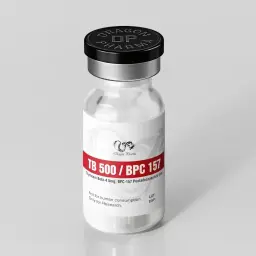


Ipamorelin 5 mg is a lyophilized powder research peptide manufactured by Dragon Pharma, containing 5 mg of Ipamorelin per 2 mL vial.
Ipamorelin is a synthetic pentapeptide growth hormone secretagogue that acts as a selective agonist at the ghrelin receptor (GHS-R1a), stimulating pituitary GH release with minimal effect on other hormones. It was originally developed by Novo Nordisk and investigated in Phase 2 clinical trials for postoperative ileus, though development was discontinued for lack of efficacy.
In research settings, ipamorelin has been studied for its GH-releasing properties, which are notably selective compared to earlier GHRPs. A 1998 preclinical paper demonstrated that ipamorelin released GH at levels comparable to GHRP-6 but without the cortisol, prolactin, or ACTH release that earlier secretagogues produced. It is not FDA-approved for any human use in the United States, and in 2024 the FDA recommended against permitting ipamorelin in compounded drug products.
Compared to other GHRPs, ipamorelin is commonly referenced as the most selective option, producing clean GH release with minimal cortisol, prolactin, and appetite effects. Its half-life is approximately 2 hours, requiring multiple daily dosing to maintain GH pulsatility. In non-medical bodybuilding contexts, ipamorelin is commonly referenced for its GH-stimulating properties and favorable side effect profile, though such use falls outside approved indications.
Ipamorelin 5 mg is supplied as a lyophilized (freeze-dried) powder in a 2 mL vial. This form requires reconstitution with a suitable solvent such as bacteriostatic water before use.
Ipamorelin is a selective growth hormone secretagogue that stimulates GH release through ghrelin receptor activation. Its profile is characterized by high selectivity for the GH axis, minimal effects on cortisol and prolactin, and a short half-life supporting pulsatile dosing.
Ipamorelin binds to and activates the growth hormone secretagogue receptor (GHS-R1a), the same receptor targeted by ghrelin, in the pituitary and hypothalamus. This activation triggers GH release through mechanisms that are additive with GHRH analogs. Ipamorelin was derived from GHRP-1 and has a unique selectivity profile that distinguishes it from earlier GHRPs.
The defining characteristic of ipamorelin is its selectivity. Unlike GHRP-2 and GHRP-6, ipamorelin does not stimulate the secretion of adrenocorticotropic hormone (ACTH) or cortisol, and is highly selective for inducing the secretion only of GH. This selectivity profile makes it the most commonly studied ghrelin-mimetic in combination research contexts.
In animal studies, ipamorelin has demonstrated GH-mediated effects including longitudinal bone growth in hypophysectomized rats and increased bone mineral content in adult female rats. However, no completed human trials have examined ipamorelin’s effects on body composition, lean mass, bone density, or recovery in humans.
Ipamorelin has a terminal half-life of approximately 2 hours after IV administration in humans. This short half-life supports multiple daily dosing to create multiple GH pulses, mimicking the body’s natural pulsatile secretion pattern more closely than continuous GH exposure.
Dragon Pharma offers several growth hormone secretagogue peptides that are commonly referenced alongside Ipamorelin 5 mg. GHRP-2 produces stronger GH stimulation but with more pronounced cortisol and prolactin elevation, making it a more potent but less selective option. GHRP-6 produces significant appetite stimulation and moderate cortisol effects, which ipamorelin largely avoids. Hexarelin produces the strongest GH pulse but desensitizes rapidly and elevates cortisol and prolactin significantly, making ipamorelin the preferred choice for longer protocols. CJC 1295 No DAC/Ipamorelin is a pre-mixed combination option for those seeking synergistic GH release.
Published laboratory reports for Ipamorelin 5 mg are shown below with the test date, measured concentration, and percentage of the product's 5 mg label claim.
 View Report
Laboratory results apply to the specific tested sample represented in each published report and should not be interpreted as a measurement of every vial or production batch.
The information below is provided for educational reference only. Ipamorelin is not FDA-approved for any human use in the United States. All use in non-medical contexts falls outside approved indications.
In research and community settings, ipamorelin is commonly referenced at microgram-level doses due to its selectivity and short half-life. Community protocols most often cite 200–300 mcg per injection, administered one to three times daily, with bedtime administration preferred to amplify the natural nocturnal GH pulse.
| Use Case | Common Reference Range | Injection Frequency |
|---|---|---|
| Research/Community (non-medical) | 200–300 mcg per injection | 1–3 times daily |
| Standard GH Pulse Protocol | 200–300 mcg | Once daily before bed |
| Combined with GHRH analog | 200–300 mcg + 100–300 mcg Mod GRF 1-29 | Once daily before bed |
| Advanced protocol | 200–300 mcg | 2–3 times daily, fasting |
Ipamorelin is most commonly stacked with GHRH analogs such as CJC 1295 No DAC/Ipamorelin or Mod GRF 1-29 to produce synergistic GH release. The combination of a GHRP and a GHRH analog stimulates GH through complementary mechanisms, producing a larger pulse than either alone. This is the dominant protocol in anti-aging and bodybuilding contexts.
Community protocols typically reference cycles of 8–12 weeks followed by a 4-week break, though this practice is based on community experience rather than validated clinical protocols. Bedtime administration is strongly preferred for at least one daily dose, as GH secretagogues administered at night amplify the natural GH pulse during early slow-wave sleep.
Ipamorelin is consistently identified as the most tolerable GHRP, with the near-absence of cortisol elevation and minimal hunger stimulation being the most valued features compared to GHRP-2 and GHRP-6. Commonly referenced side effects include mild transient hunger increase shortly after injection, headache, water retention, and tingling in extremities at higher doses.
Doses are typically timed away from food, as elevated blood glucose and insulin can blunt the GH response. A minimum 2-hour fast before injection is widely recommended in community protocols. Food intake, particularly carbohydrates and fats, can reduce the GH pulse by 50% or more.
Ipamorelin does not suppress endogenous testosterone production and therefore does not typically require post-cycle therapy in the way anabolic steroids do. Because it works through the ghrelin receptor rather than directly affecting the hypothalamic-pituitary-gonadal axis, PCT is generally not considered necessary after ipamorelin use alone.
Dosing strategies and cycle protocols should be adjusted based on individual factors. The information above is for educational reference and does not constitute medical advice.
Ipamorelin is not FDA-approved for any human use in the United States. In 2024, the FDA recommended against permitting ipamorelin-related bulk drug substances to be used in compounded drug products.
Ipamorelin is a synthetic pentapeptide that stimulates GH release through selective GHS-R1a receptor activation. It is not approved for therapeutic use in the United States. An FDA briefing document concluded that based on available clinical data, ipamorelin-related substances may raise safety concerns, including potential immunogenicity risk when given subcutaneously due to potential for aggregation and impurities.
The FDA review noted a lack of nonclinical and clinical safety data and clinical effectiveness data for ipamorelin delivered via subcutaneous route for growth hormone deficiency or postoperative ileus.
Ipamorelin is not FDA-approved for human use. Any use outside of approved research applications falls outside approved indications. Product concentration and laboratory verification do not establish that non-medical use is safe or appropriate for an individual.
An FDA review of available clinical data reported the following adverse effects associated with ipamorelin: hypokalemia, insomnia, hyperglycemia, glucose intolerance, diabetes, nausea, vomiting, and abdominal distention. Two fatality cases were described, though it is unclear whether they were related to ipamorelin.
Administering the drug by injection may carry a heightened risk of triggering an immune response. Potential adverse effects on reproductive health are also mentioned in the FDA review. Ipamorelin obtained through unregulated markets is known to pose contamination risks.
Community experience consistently identifies ipamorelin as the most tolerable GHRP, with fewer mood disruptions and less water retention compared to GHRP-2 and GHRP-6.
Individuals with diabetes or insulin resistance should monitor blood glucose closely and consult an endocrinologist before using ipamorelin, as GH secretagogues may affect insulin sensitivity. The long-term effects of chronic ipamorelin use have not been established.
There are currently FDA-approved drugs for the diagnosis and treatment of growth hormone deficiency, which are the appropriate options for those conditions.
In research settings where ipamorelin has been studied, monitoring has focused on GH response and safety parameters. In non-medical contexts, individuals commonly reference periodic IGF-1 blood testing to confirm the protocol is working, as IGF-1 is the standard marker for GH axis activation.
Laboratory testing of the product itself, such as the published potency report shown in the Lab Reports tab, is separate from any clinical monitoring of the individual.
Lyophilized ipamorelin should be stored desiccated below -18°C, protected from light and moisture. After reconstitution, store refrigerated at 4°C and use within 2–7 days, or below -18°C for longer storage. Avoid repeated freeze-thaw cycles.
Keep all peptides and injectable products out of the reach of children. Follow the storage instructions provided with the product packaging.
Ipamorelin 5 mg by Dragon Pharma is supplied through the official distribution chain and shipped in original manufacturer packaging with discreet, privacy-focused handling.
The outer shipping package remains discreet, with privacy-focused handling and no unnecessary external product details. Products are supplied through the official Dragon Pharma distribution chain.
To verify your Ipamorelin 5 mg product, use the security code on the vial label and cross-check it on the Dragon Pharma official site. Official presentation, batch-linked lab proof, and original packaging help reinforce product legitimacy and buyer confidence.
For complete delivery details, tracking policy, and reshipment terms, please see our Shipping Info page.
Proper storage conditions help preserve peptide stability and overall product integrity throughout shelf life.
Store the lyophilized (dry) powder tightly sealed in its original container, protected from light, and kept desiccated at -20°C for long-term storage. Brief handling at refrigerated or ambient conditions is acceptable provided the container is allowed to equilibrate to room temperature before opening to prevent moisture uptake.
Ipamorelin is hygroscopic and susceptible to degradation. After reconstitution, store refrigerated at 4°C and use within 2–7 days, or below -18°C for longer storage. Avoid repeated freeze-thaw cycles.
Keep out of reach of children. Follow proper handling and sterile technique when administering the product.
Answers to common questions about Ipamorelin 5 mg, its mechanism, product strength, and laboratory testing.
Ipamorelin 5 mg contains a selective growth hormone secretagogue peptide. In research settings it is used to stimulate GH release via GHS-R1a receptor activation. In non-medical bodybuilding contexts, ipamorelin is commonly referenced for its GH-stimulating properties and favorable side effect profile, though such use falls outside approved indications.
Community protocols commonly reference ipamorelin being injected 1–3 times daily at doses of 200–300 mcg per injection, with bedtime administration strongly preferred to amplify the natural GH pulse during slow-wave sleep. Doses are typically timed on an empty stomach to maximize the GH response.
Ipamorelin does not suppress endogenous testosterone production because it acts on the GHS-R1a receptor rather than the hypothalamic-pituitary-gonadal axis. Post-cycle therapy is therefore generally not considered necessary after ipamorelin use alone. Community protocols typically reference 8–12 weeks on followed by a 4-week break.
Ipamorelin stimulates growth hormone release by selectively activating the GHS-R1a receptor in the pituitary and hypothalamus. Unlike earlier GHRPs, ipamorelin does not stimulate ACTH or cortisol secretion and is highly selective for GH. This selectivity profile distinguishes it from GHRP-2 and GHRP-6.
Ipamorelin has a terminal half-life of approximately 2 hours, meaning each injection produces a short, pulsatile GH release. Community reports typically describe sleep quality improvements within 1–2 weeks, with recovery and body composition changes emerging over 8–12 weeks of consistent use.
There is no single GH secretagogue that is universally best. Ipamorelin is the most selective, producing clean GH release with minimal cortisol, prolactin, and appetite effects. GHRP-2 produces stronger GH stimulation but with more side effects, while Hexarelin produces the strongest GH pulse but desensitizes rapidly. The appropriate choice depends on individual goals.
Ipamorelin is more selective than GHRP-2, producing clean GH release without significant cortisol or prolactin elevation. GHRP-2 produces stronger GH stimulation but with more pronounced side effects. Ipamorelin is also more tolerable, with minimal appetite stimulation compared to GHRP-2.
Ipamorelin is significantly more selective than GHRP-6, which produces pronounced appetite stimulation and moderate cortisol elevation. GHRP-6 is often referenced for bulking contexts where increased caloric intake is desired, while ipamorelin is preferred for its clean side effect profile and suitability for longer protocols.
200 mcg is a standard starting dose in community protocols, with 200–300 mcg per injection being the most commonly referenced range. The 5 mg vial contains 5,000 mcg total, providing 16–25 doses at these levels. Doses are typically administered 1–3 times daily depending on the protocol.
Ipamorelin 5 mg is labeled at 5 mg of ipamorelin per vial. It is supplied as a lyophilized powder in a 2 mL vial, requiring reconstitution before use.
Yes. A published laboratory report dated November 20, 2023 measured Ipamorelin 5 mg at 5.60 mg, equivalent to 112% of its 5 mg label claim. The batch number for this report is #HDIPM923.
The complete report can be viewed in the Lab Reports tab. Laboratory results apply to the tested sample represented by the individual report and should not be interpreted as a measurement of every vial.
Lyophilized ipamorelin is typically reconstituted with a suitable solvent such as Bacteriostatic Water or sterile water. The volume of solvent added determines the concentration of the resulting solution. Proper sterile technique should be used during reconstitution, directing the solvent against the vial wall rather than onto the powder.