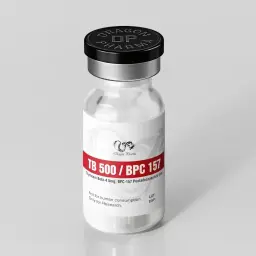
Hexarelin 5 mg is a lyophilized powder research peptide manufactured by Dragon Pharma, containing 5 mg of Examorelin (Hexarelin) per 2 mL vial.
Hexarelin is a synthetic hexapeptide growth hormone secretagogue that acts as a potent agonist at the growth hormone secretagogue receptor (GHS-R1a), stimulating pituitary GH release through a mechanism distinct from growth hormone-releasing hormone (GHRH). It is considered the most potent member of the growth hormone-releasing peptide (GHRP) family, producing the strongest GH pulse among all GHRPs.
In research settings, hexarelin has been studied for its GH-releasing activity and, uniquely among GHRPs, for direct cardiovascular actions mediated through the CD36 receptor that are independent of GH release. It is not FDA-approved for any human use in the United States. In non-medical bodybuilding contexts, hexarelin is commonly referenced for its potent GH-stimulating properties, though such use falls outside approved indications.
Compared to other GHRPs, hexarelin produces the highest GH peak but also the most pronounced cortisol and prolactin elevation, and exhibits the fastest receptor desensitization of any GHRP-class compound. These characteristics position hexarelin as a short-cycle compound in community protocols rather than a long-term maintenance option.
Hexarelin 5 mg is supplied as a lyophilized (freeze-dried) powder in a 2 mL vial. This form requires reconstitution with a suitable solvent such as bacteriostatic water before use.
Hexarelin is a synthetic hexapeptide growth hormone secretagogue that stimulates GH release through GHS-R1a receptor activation. Its profile is characterized by the highest GH potency among GHRPs, rapid receptor desensitization, and unique cardiovascular research activity.
Hexarelin binds to and activates the growth hormone secretagogue receptor (GHS-R1a), the same receptor targeted by ghrelin, in the pituitary and hypothalamus. This activation triggers GH release through mechanisms that are additive with GHRH analogs. Hexarelin was developed through structural modification of GHRP-6, with a 2-methyl-Trp substitution that enhances its potency and oral activity.
Beyond its GH-releasing effects, hexarelin also binds to the scavenger receptor CD36 in cardiac tissue, mediating cardioprotective effects that are independent of GH release. This dual-receptor activity is unique among GHRPs and has been the subject of cardiovascular research interest.
Hexarelin also causes significant elevations in prolactin, ACTH, and cortisol, particularly at higher doses. These effects are dose-dependent and occur through GHS-R1a activation on pituitary lactotrophs and adrenocortical cells.
Hexarelin produces a rapid, short-lived GH pulse after administration, but GH response attenuation begins within 2–4 weeks of continuous use, limiting effective cycle length to 4–8 weeks. This rapid desensitization is the fastest among all GHRPs and is a defining characteristic of the compound.
Dragon Pharma offers several growth hormone secretagogue peptides that are commonly referenced alongside Hexarelin 5 mg. GHRP-2 produces strong GH stimulation with moderate cortisol and prolactin elevation and slower desensitization, making it a better choice for longer cycles. GHRP-6 occupies a similar side effect burden but with less raw GH potency and more pronounced appetite stimulation. Ipamorelin is the most selective GHRP, producing cleaner GH release with negligible cortisol and prolactin changes and no desensitization concerns, making it suitable for longer protocols.
Published laboratory reports for Hexarelin 5 mg are shown below with the test date, measured concentration, and percentage of the product's 5 mg label claim.
 View Report
Laboratory results apply to the specific tested sample represented in each published report and should not be interpreted as a measurement of every vial or production batch.
The information below is provided for educational reference only. Hexarelin is not FDA-approved for any human use in the United States. All use in non-medical contexts falls outside approved indications.
In research and community settings, hexarelin is commonly referenced at microgram-level doses. Research studies have used 1–2 mcg/kg body weight intravenously for diagnostic applications. In non-medical bodybuilding contexts, hexarelin is commonly referenced at 100–200 mcg per injection, administered once or twice daily. Due to its rapid desensitization profile, cycle lengths are typically limited to 4–6 weeks.
| Use Case | Common Reference Range | Injection Frequency |
|---|---|---|
| Research/Community (non-medical) | 100–200 mcg per injection | 1–2 times daily |
| Beginner protocol reference | 100 mcg | Once daily, morning fasted |
| Standard protocol reference | 100–150 mcg | Twice daily |
| Combined with GHRH analog | 100 mcg Hexarelin + 100 mcg Mod GRF 1-29 | 1–2 times daily |
Hexarelin is commonly stacked with GHRH analogs such as CJC-DAC or Mod GRF 1-29 to produce synergistic GH release. The combination of a GHRP and a GHRH analog stimulates GH through complementary mechanisms, producing a larger pulse than either alone.
Due to hexarelin's rapid receptor desensitization, community protocols typically reference a 4–6 week cycle followed by a transition to a less desensitizing GHRP such as Ipamorelin for continued maintenance. This "blast and transition" approach allows receptor recovery while maintaining GH support.
Hexarelin produces significant cortisol and prolactin elevation at standard doses, more pronounced than any other GHRP. This is a primary reason community protocols limit cycle length. Prolactin elevation may increase gynecomastia risk in men with sustained high-dose use.
Appetite stimulation is moderate and predictable, more manageable than GHRP-6 but more noticeable than ipamorelin. Doses are typically timed on an empty stomach to avoid insulin-driven blunting of the GH response. Injection-site reactions are similar to other GHRPs.
Hexarelin does not suppress endogenous testosterone production and therefore does not typically require post-cycle therapy in the way anabolic steroids do. However, the cortisol and prolactin effects may warrant supportive measures in some individuals.
After completing a hexarelin cycle, a 4-week break is commonly referenced to allow GHS-R1a receptor resensitization before the next cycle begins.
Dosing strategies and cycle protocols should be adjusted based on individual factors. The information above is for educational reference and does not constitute medical advice.
Hexarelin is not FDA-approved for any human use in the United States. It is a synthetic peptide that stimulates growth hormone release through GHS-R1a receptor activation.
Hexarelin is a synthetic hexapeptide that stimulates GH release and also causes significant elevations in prolactin, ACTH, and cortisol. It is not approved for therapeutic use in the United States. While hexarelin has been studied in human clinical research, repeated daily use for performance or physique enhancement falls outside any approved framework.
Because hexarelin affects cortisol and prolactin in addition to GH, its effects extend beyond GH release alone. Long-term safety data for non-medical use is not available.
Hexarelin is not FDA-approved for human use. Any use outside of approved research applications falls outside approved indications. Product concentration and laboratory verification do not establish that non-medical use is safe or appropriate for an individual.
Hexarelin produces the most pronounced cortisol elevation of any GHRP at equivalent doses, through direct GHS-R1a activation in adrenocortical cells. Prolactin also rises substantially with each injection, which may increase gynecomastia risk in men with sustained use.
Water retention is commonly referenced due to high-amplitude GH pulses. Other potential effects include appetite stimulation beginning 15–30 minutes post-injection, injection-site reactions, and rapid receptor desensitization requiring cycling.
Individuals with existing endocrine disorders, pituitary conditions, or hormone-sensitive conditions should consult a qualified healthcare professional before considering hexarelin. Because hexarelin can affect cortisol and prolactin levels, individuals with conditions sensitive to these hormones should exercise particular caution.
The long-term effects of chronic hexarelin use have not been established. WADA prohibits hexarelin for competing athletes.
In research settings where hexarelin has been studied, monitoring has focused on GH response, cortisol, prolactin, and ACTH levels. In non-medical contexts, individuals commonly reference periodic bloodwork to monitor hormonal markers.
Laboratory testing of the product itself, such as the published potency report shown in the Lab Reports tab, is separate from any clinical monitoring of the individual.
Lyophilized hexarelin should be stored tightly sealed in its original container, protected from light, and kept desiccated at -20°C for long-term storage. The peptide should be allowed to equilibrate to room temperature before opening to prevent moisture uptake.
Keep all peptides and injectable products out of the reach of children. Follow the storage instructions provided with the product packaging.
Hexarelin 5 mg by Dragon Pharma is supplied through the official distribution chain and shipped in original manufacturer packaging with discreet, privacy-focused handling.
The outer shipping package remains discreet, with privacy-focused handling and no unnecessary external product details. Products are supplied through the official Dragon Pharma distribution chain.
To verify your Hexarelin 5 mg product, use the security code on the vial label and cross-check it on the Dragon Pharma official site. Official presentation, batch-linked lab proof, and original packaging help reinforce product legitimacy and buyer confidence.
For complete delivery details, tracking policy, and reshipment terms, please see our Shipping Info page.
Proper storage conditions help preserve peptide stability and overall product integrity throughout shelf life.
Store the lyophilized (dry) powder tightly sealed in its original container, protected from light, and desiccated at -20°C for long-term storage. Brief handling at refrigerated or ambient conditions is acceptable provided the container is allowed to equilibrate to room temperature before opening to prevent moisture uptake.
Hexarelin is hygroscopic and susceptible to oxidation, so it must be kept dry and away from air and light to limit degradation. After reconstitution, store aliquots refrigerated at 2–8°C and use within 2–4 weeks. Avoid repeated freeze-thaw cycles.
Keep out of reach of children. Follow proper handling and sterile technique when administering the product.
Answers to common questions about Hexarelin 5 mg, examorelin, GH release, product strength and laboratory testing.
Hexarelin 5 mg contains examorelin, a potent growth hormone secretagogue peptide. In research settings it is used to stimulate GH release via GHS-R1a receptor activation. In non-medical bodybuilding contexts, hexarelin is commonly referenced for its GH-stimulating properties, though such use falls outside approved indications.
Community protocols commonly reference hexarelin being injected 1–2 times daily at doses of 100–200 mcg per injection. Due to rapid receptor desensitization, cycle lengths are typically limited to 4–6 weeks followed by a break. Doses are typically timed on an empty stomach to maximize the GH response.
Hexarelin does not suppress endogenous testosterone production because it acts on the GHS-R1a receptor rather than the hypothalamic-pituitary-gonadal axis. Post-cycle therapy is therefore generally not considered necessary after hexarelin use alone. However, a 4-week break between cycles is commonly referenced to allow receptor resensitization.
Examorelin stimulates growth hormone release by activating the GHS-R1a receptor in the pituitary and hypothalamus. It also binds to the CD36 receptor in cardiac tissue, mediating cardioprotective effects independent of GH. Hexarelin additionally causes significant elevations in prolactin, ACTH, and cortisol.
The GH pulse from a single hexarelin injection typically peaks within 15–30 minutes and returns to baseline within a few hours. However, GH response attenuation begins within 2–4 weeks of continuous use, which is why cycle lengths are typically limited. After a 4-week break, receptor sensitivity is generally restored.
There is no single GH secretagogue that is universally best. Hexarelin produces the strongest GH pulse but also the most pronounced cortisol and prolactin elevation and the fastest desensitization. Ipamorelin is more selective with minimal side effects and no desensitization, making it better for long-term use. The appropriate choice depends on individual goals and cycle strategy.
Hexarelin produces 2–3 times the GH peak of GHRP-2 but desensitizes within weeks and elevates cortisol and prolactin more significantly. GHRP-2 produces strong GH stimulation with moderate cortisol and prolactin elevation and slower desensitization, making it a better choice for 10–12 week cycles.
Hexarelin produces the strongest GH pulse but with significant cortisol and prolactin elevation and rapid desensitization. Ipamorelin produces cleaner, more selective GH release with virtually no side effects and no desensitization, making it the better choice for long-term use. The proven strategy is to use hexarelin for a 4–6 week blast, then switch to ipamorelin for months of maintenance.
100 mcg is commonly referenced as a conservative starting dose for hexarelin, producing roughly 70–90% of the maximal GH response while keeping cortisol and prolactin moderate. Doses of 100–200 mcg per injection are typical in community protocols. The 5 mg vial contains 5,000 mcg total, providing 25–50 doses at these levels.
Hexarelin 5 mg is labeled at 5 mg of examorelin per vial. It is supplied as a lyophilized powder in a 2 mL vial, requiring reconstitution before use.
Yes. A published laboratory report dated September 12, 2025 measured Hexarelin 5 mg at 5.34 mg, equivalent to 106.8% of its 5 mg label claim. The batch number for this report is #HEXAHD6.
The complete report can be viewed in the Lab Reports tab. Laboratory results apply to the tested sample represented by the individual report and should not be interpreted as a measurement of every vial.
Lyophilized hexarelin is typically reconstituted with a suitable solvent such as Bacteriostatic Water or sterile water. The volume of solvent added determines the concentration of the resulting solution. Proper sterile technique should be used during reconstitution.