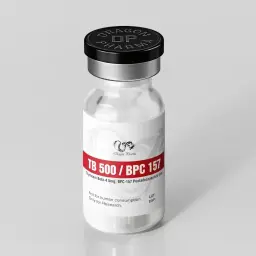
CJC-1295 DAC 5 mg is a lyophilized research peptide manufactured by Dragon Pharma, supplied as 5 mg per 2 mL vial for laboratory research purposes.
CJC-1295 DAC 5 mg contains CJC-1295 with Drug Affinity Complex (DAC), a synthetic analog of growth hormone-releasing hormone (GHRH). It is a 30-amino acid peptide designed with four amino acid substitutions in the GHRH(1-29) sequence (D-Ala at position 2, Gln at position 8, Ala at position 15, and Leu at position 27) that increase resistance to enzymatic degradation. The DAC moiety is a maleimidopropionic acid group covalently attached to the lysine at position 30, which enables the peptide to bind reversibly to albumin in the bloodstream, dramatically extending its half-life.
In clinical research, CJC-1295 DAC has been studied in healthy adults. A randomized, placebo-controlled trial published in the Journal of Clinical Endocrinology & Metabolism reported that a single subcutaneous injection produced dose-dependent increases in mean plasma GH concentrations by 2- to 10-fold for 6 days or more, and mean plasma IGF-1 concentrations by 1.5- to 3-fold for 9 to 11 days. The estimated half-life of CJC-1295 DAC was 5.8 to 8.1 days. After multiple doses, mean IGF-1 levels remained above baseline for up to 28 days.
CJC-1295 DAC is not FDA-approved for any indication. The FDA has evaluated CJC-1295-related bulk drug substances and concluded that they should not be placed on the 503A Bulks List for compounding, citing concerns about characterization, impurity profiles, and potential immunogenicity. The FDA also noted that CJC-1295 DAC is associated with known risks of elevated GH and IGF-1 levels, and that a phase 2 clinical trial in HIV lipodystrophy subjects was terminated after a subject experienced an acute myocardial infarction. CJC-1295 DAC is prohibited by WADA under Section S2 (peptide hormones, growth factors).
CJC-1295 DAC 5 mg is supplied as a lyophilized powder in a 2 mL vial. The powder requires reconstitution with an appropriate solvent before laboratory use. Once reconstituted, the solution should be refrigerated and handled according to standard research peptide protocols.
CJC-1295 DAC is a long-acting GHRH analog that uses Drug Affinity Complex technology to bind to albumin, extending its half-life to approximately one week.
CJC-1295 DAC belongs to the class of growth hormone-releasing hormone (GHRH) analogs. Its core structure is GHRH(1-29), the fully functional N-terminal fragment of the naturally occurring 44-amino acid GHRH. Four amino acid substitutions (D-Ala2, Gln8, Ala15, Leu27) stabilize the peptide against enzymatic degradation, particularly by DPP-IV. The DAC moiety, a maleimidopropionic acid group attached to Lys30, forms a covalent bond with free thiols on albumin, creating a circulating depot that gradually releases active peptide.
The pharmacokinetic profile of CJC-1295 DAC is distinguished by its extended half-life. In healthy adults, the estimated half-life was 5.8 to 8.1 days, and drug concentration was measurable for 10 to 13 days after administration. Maximum drug concentrations were reached between 1 and 1.5 hours. After multiple doses, IGF-1 levels remained above baseline for up to 28 days, indicating a cumulative effect. This sustained profile allows for less frequent dosing compared to the non-DAC version of CJC-1295 (Mod GRF 1-29), which has a half-life of approximately 30 minutes.
The FDA has evaluated CJC-1295 DAC and related substances and identified significant safety concerns. In a phase 2 clinical trial of CJC-1295 DAC in subjects with HIV lipodystrophy, one subject experienced an acute myocardial infarction approximately 2 hours after receiving an 11th weekly dose, and the study was terminated. The FDA also noted that CJC-1295 DAC is not well-characterized from a physicochemical perspective, with concerns about impurities, aggregates, and potential immunogenicity when administered subcutaneously.
CJC-1295 DAC has an estimated half-life of 5.8 to 8.1 days in healthy adults, achieved through covalent binding to albumin via the Drug Affinity Complex. This supports once or twice weekly dosing in clinical research settings.
Dragon Pharma offers a range of research peptides relevant to growth hormone research. CJC-1295 DAC 5 mg is positioned as a long-acting GHRH analog, complementing other GH-related research compounds.
For a shorter-acting GHRH analog that produces more pulsatile GH release, Dragon Pharma offers CJC 1295 No DAC/Ipamorelin, a combined vial containing both Mod GRF 1-29 and Ipamorelin. For standalone Ipamorelin research, Ipamorelin is also available. For direct GH research, Dragontropin HGH is offered as a lyophilized somatropin product.
The information below is provided for educational reference only. CJC-1295 DAC is a research compound that has not been approved for human use. No established human dosing exists outside of clinical trial protocols. Non-medical use falls outside any approved indications and carries unknown health risks.
In clinical trials, CJC-1295 DAC was administered subcutaneously at single doses of 30, 60, 125, and 250 mcg/kg in healthy adults. In the terminated phase 2 trial, subjects received weekly injections of an escalating low or high dose. In non-medical research contexts, community references suggest 1–2 mg administered subcutaneously once or twice weekly. One community protocol describes starting at 1 mg weekly for the first week, then increasing to 2 mg weekly. A typical research cycle is 8 to 12 weeks followed by a 2 to 4 week break.
| Use Case | Common Reference Range | Frequency |
|---|---|---|
| Clinical trial (single dose) | 30–250 mcg/kg | Single injection |
| Clinical trial (multiple dose) | Escalating doses | Weekly or biweekly |
| Non-medical (community reference) | 1–2 mg | Once or twice weekly |
Community doses are extrapolated from clinical trial data but are not supported by published human safety or efficacy data for non-medical use. CJC-1295 DAC has not been approved for any indication.
CJC-1295 DAC is often referenced alongside a ghrelin receptor agonist such as Ipamorelin in non-medical research contexts. The combination activates both GHRH and ghrelin receptor pathways, potentially producing a synergistic GH pulse. Dragon Pharma offers CJC 1295 No DAC/Ipamorelin as a pre-combined vial for researchers interested in the shorter-acting GHRH variant. For standalone Ipamorelin research, Ipamorelin is available separately.
Because CJC-1295 DAC has an extended half-life, some researchers prefer the non-DAC version for protocols designed to mimic pulsatile GH release. The DAC version is more commonly referenced for once or twice weekly dosing schedules.
In clinical trials of CJC-1295 DAC, injection site reactions were the most common adverse event, occurring in approximately 70% of subjects receiving a single injection and in all subjects receiving multiple doses. Other reported adverse events included headache, diarrhea, flushing, nausea, abdominal pain, transient involuntary leg muscle contractions, dizziness, and hypotension.
A phase 2 clinical trial in HIV lipodystrophy subjects was terminated after one subject experienced an acute myocardial infarction approximately 2 hours after receiving an 11th weekly dose. The FDA has noted that elevated GH and IGF-1 levels are associated with known risks, and there is no data to suggest CJC-1295 DAC would not present similar risks.
Blood glucose should be monitored, as GH promotes gluconeogenesis and can mildly increase fasting glucose. One community report noted that CJC-1295 DAC can "blunt my glucose control and cause insulin resistance".
CJC-1295 DAC is not part of any post-cycle therapy protocol. It has no relationship to the hypothalamic-pituitary-gonadal axis and its research focus has been on growth hormone secretion. PCT compounds such as Clomid and Nolvadex address entirely different biological systems.
CJC-1295 DAC has not been approved for human use. The FDA has evaluated CJC-1295-related substances and concluded they should not be placed on the 503A Bulks List for compounding due to safety concerns. The information above is for educational reference and does not constitute medical advice.
CJC-1295 DAC is an experimental research peptide that has not been approved for human use. The FDA has identified significant safety concerns regarding its characterization, impurity profile, and clinical adverse events.
CJC-1295 DAC is not FDA-approved for any indication. The FDA has evaluated CJC-1295-related bulk drug substances and concluded that they should not be placed on the list of bulk drug substances that can be used in compounding under section 503A of the FD&C Act, citing concerns about characterization, impurities, and potential immunogenicity. CJC-1295 DAC is prohibited by WADA under Section S2 (peptide hormones, growth factors, and related substances).
CJC-1295 DAC 5 mg is sold strictly for research purposes. It is not a dietary supplement, medication, or approved therapeutic agent. Human consumption for growth hormone optimization or any other purpose is not recommended and may pose unknown health risks.
In clinical trials, injection site reactions occurred in approximately 70% of subjects receiving a single injection and in all subjects receiving multiple doses of CJC-1295 DAC. Other reported adverse events included headache, diarrhea, flushing, nausea, abdominal pain, transient involuntary leg muscle contractions, loss of coordination, dizziness, and hypotension.
A phase 2 clinical trial in HIV lipodystrophy subjects was terminated after one subject experienced an acute myocardial infarction approximately 2 hours after receiving an 11th weekly dose. The FDA has noted that elevated GH and IGF-1 levels are associated with known risks, including potential cardiovascular effects, and there is no data to suggest CJC-1295 DAC would not present similar risks.
The FDA also noted that CJC-1295 DAC is not well-characterized from a physicochemical perspective, with concerns about potential peptide-related impurities, aggregates, and immunogenicity when administered by subcutaneous injection.
CJC-1295 DAC has no approved indications and no established contraindications because no human use is supported. However, given the mechanism of action (elevated GH and IGF-1) and the clinical adverse events observed, individuals with active malignancy, cardiovascular disease, or pre-existing glucose intolerance should be particularly cautious. No human reproductive or developmental toxicology data exists for this compound.
No monitoring protocols exist for CJC-1295 DAC because it has no approved human use. In clinical research settings, monitoring included assessment of serum GH and IGF-1 levels, injection site reactions, and cardiovascular parameters. The FDA has noted that there is a lack of long-term safety data.
Store lyophilized powder at -20°C or below, protected from light and moisture. Once reconstituted, store at 2-8°C and use within approximately 20 days. Do not freeze the reconstituted solution. Keep all research compounds out of the reach of children. CJC-1295 DAC is prohibited by WADA under Section S2.
CJC-1295 DAC 5 mg is supplied through the official Dragon Pharma distribution chain and shipped in original manufacturer packaging with discreet, privacy-focused handling.
The outer shipping package remains discreet, with privacy-focused handling and no unnecessary external product details. Products are supplied through the official Dragon Pharma distribution chain.
To verify your CJC-1295 DAC 5 mg product, use the security code on the packaging and cross-check it on the Dragon Pharma official site. Official Dragon Pharma presentation and original packaging help reinforce product legitimacy and buyer confidence.
Proper storage conditions help preserve peptide integrity and stability throughout shelf life.
Store lyophilized powder at -20°C or below, protected from light and moisture. Keep the vial in its original packaging until use. Let frozen vials warm to room temperature before opening so condensation won't form.
Once reconstituted, store at 2-8°C and use within approximately 20 days. Do not freeze the reconstituted solution, as freezing can damage peptide structure. If the solution turns cloudy, changes color, or develops floaters, discard it. Keep out of reach of children.
Answers to common questions about CJC-1295 DAC 5 mg, its research status, mechanism of action, and safety considerations.
CJC-1295 DAC 5 mg is a research peptide studied for its ability to stimulate growth hormone release. It is a long-acting GHRH analog that binds to albumin and has a half-life of 5.8 to 8.1 days. It has not been approved for human use and is sold strictly for laboratory research purposes.
In clinical trials, CJC-1295 DAC was administered as a single injection or weekly/biweekly doses. In non-medical community contexts, 1-2 mg administered subcutaneously once or twice weekly is commonly referenced. A typical research cycle is 8 to 12 weeks followed by a 2 to 4 week break.
CJC-1295 DAC has no relationship to the hypothalamic-pituitary-gonadal axis and is not part of any post-cycle therapy protocol. Its research focus has been on growth hormone secretion, not testosterone recovery. PCT compounds such as Clomid and Nolvadex address entirely different biological systems.
CJC-1295 DAC is a GHRH analog that binds to GHRH receptors on pituitary somatotroph cells, stimulating the production and release of growth hormone. The DAC moiety enables the peptide to bind to albumin, extending its half-life to 5.8 to 8.1 days. This results in sustained elevation of both GH and IGF-1 levels.
In clinical trials, a single injection of CJC-1295 DAC produced increases in mean plasma GH concentrations by 2- to 10-fold for 6 days or more, and increases in mean plasma IGF-1 concentrations by 1.5- to 3-fold for 9 to 11 days. After multiple doses, mean IGF-1 levels remained above baseline for up to 28 days.
There is no single GHRH analog that is universally best. CJC-1295 DAC is distinguished by its extended half-life, which supports less frequent dosing. The non-DAC version (Mod GRF 1-29) has a half-life of approximately 30 minutes and is used for more pulsatile GH release. The appropriate choice depends on research goals and protocol design.
CJC-1295 DAC has a half-life of 5.8 to 8.1 days due to albumin binding, while CJC-1295 No DAC (Mod GRF 1-29) has a half-life of approximately 30 minutes. The DAC version produces sustained GH elevation, while the No DAC version produces more pulsatile release. Dragon Pharma offers CJC 1295 No DAC/Ipamorelin as a combined vial.
CJC-1295 DAC and Ipamorelin work through different mechanisms. CJC-1295 DAC is a GHRH analog that primes pituitary somatotrophs, while Ipamorelin is a ghrelin receptor agonist that triggers GH release. The two are often combined in non-medical research contexts for a synergistic effect.
No human dosing standards exist for CJC-1295 DAC. The 5 mg vial strength is a research quantity. At a community-referenced dose of 1-2 mg per week, the vial provides approximately 2.5 to 5 doses. This is a standard research vial size for lyophilized peptides.
CJC-1295 DAC 5 mg is labeled at 5 mg of CJC-1295 DAC per vial. It is supplied as a lyophilized powder in a 2 mL vial, requiring reconstitution before laboratory use.
This product page does not include a published laboratory report for the current batch. For researchers requiring batch-specific testing documentation, please contact customer support. The manufacturer's general quality standards apply to all Dragon Pharma products.
No. CJC-1295 DAC has never been approved by the FDA or any regulatory authority for human use. The FDA has evaluated CJC-1295-related bulk drug substances and concluded they should not be placed on the 503A Bulks List for compounding due to safety concerns. CJC-1295 DAC is prohibited by WADA under Section S2.