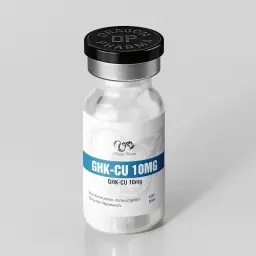
AOD 9604 5 mg is a lyophilized research peptide manufactured by Dragon Pharma, supplied as 5 mg per 2 mL vial for laboratory research purposes.
AOD 9604 5 mg contains AOD 9604, a synthetic peptide fragment corresponding to the C-terminal region of human growth hormone (hGH), specifically amino acids 177-191 with an added tyrosine residue at the N-terminus. This fragment was isolated and studied because it appeared to retain the lipolytic (fat-metabolizing) properties of full-length growth hormone while lacking the growth-promoting and diabetogenic effects that make hGH unsuitable as a weight-loss therapy.
The peptide was originally developed by Metabolic Pharmaceuticals Ltd., an Australian biotechnology company, in collaboration with Monash University researchers. In preclinical models, chronic subcutaneous administration of AOD 9604 increased fat oxidation and markers of lipolysis and attenuated weight gain in obese mice, without inducing hyperglycaemia or binding to the GH receptor. Human evidence, however, is limited and largely short-term. In a 24-week oral study involving 502 randomized patients, AOD 9604 failed to demonstrate a significant benefit on the primary weight-loss endpoint compared to placebo.
Despite the failed obesity trial, AOD 9604 has continued to circulate in the peptide therapy and anti-aging medicine space. It has been explored for cartilage repair applications, receiving FDA Investigational New Drug (IND) approval for osteoarthritis research. It holds Generally Recognized as Safe (GRAS) status as a food additive under a specific oral formulation, which is sometimes misrepresented as evidence of therapeutic approval. Injectable AOD 9604 is not approved for any indication, and no human exposure data exists for subcutaneous or transdermal routes of administration.
AOD 9604 5 mg is supplied as a lyophilized powder in a 2 mL vial. The powder requires reconstitution with an appropriate solvent before laboratory use. Once reconstituted, the solution should be refrigerated and used within approximately 30 days.
AOD 9604 is a modified C-terminal fragment of human growth hormone that retains lipolytic activity without GH receptor binding or IGF-1 elevation.
AOD 9604 belongs to the class of growth hormone-derived peptides. Its structure corresponds to amino acids 177-191 of human growth hormone, with an additional tyrosine residue at the N-terminus for stabilization. The molecular formula is C78H123N23O23S2 with a molecular weight of approximately 1,817 Da. The peptide was designed to retain the fat-reducing effects of GH while avoiding the growth-promoting and insulin-resistance effects associated with full-length growth hormone.
Preclinical research established that AOD 9604 reduces body weight gain and increases fat oxidation in obese mice without interacting with the GH receptor or inducing cell proliferation. Importantly, unlike full-length GH, AOD 9604 did not induce hyperglycaemia or reduce insulin secretion in animal models. The lipolytic actions of AOD 9604 are not mediated directly through beta-3 adrenergic receptors, although the peptide does increase beta-3-AR expression, which may subsequently contribute to enhanced lipolytic sensitivity.
Human clinical data on AOD 9604 is limited. Six randomized, double-blind, placebo-controlled trials were conducted by the original developer, but these primarily assessed oral formulations. The most comprehensive safety summary reported that AOD 9604 had no effect on serum IGF-1 levels, no negative effect on carbohydrate metabolism, and no anti-AOD 9604 antibodies detected in any patients selected for antibody assay. However, the FDA has noted that no human exposure data exists for subcutaneous or transdermal routes of administration.
AOD 9604 has no FDA approval for any therapeutic indication. Its Phase 2B obesity trial failed to meet its primary endpoint, with treated subjects not losing significantly more weight than placebo controls. Injectable AOD 9604 is a research or compounded peptide, not an approved drug.
Dragon Pharma offers a range of research peptides and compounds. AOD 9604 5 mg is positioned as a research peptide with a distinct mechanism targeting lipolysis, complementing other metabolic research compounds.
For GLP-1 receptor agonist research, Dragon Pharma offers Survodutide and Cagrilintide, which have demonstrated more substantial weight reduction in clinical trials. For mitochondrial research compounds, MOTS-C and SS-31 target different aspects of mitochondrial function. AOD 9604's HGH-fragment mechanism represents a distinct research approach.
The information below is provided for educational reference only. AOD 9604 is a research compound that has never been approved for human use. No human safety or efficacy data exists for injectable routes of administration, and the original obesity trial failed to meet its primary endpoint. Non-medical use falls outside any approved indications and carries unknown health risks.
No established human dosage exists for AOD 9604 in injectable form. In clinical trials, AOD 9604 was administered orally (capsules or tablets) at doses ranging from 0.25 mg to 30 mg daily for up to 24 weeks, and intravenously at single doses of 25-400 mcg/kg. In non-medical bodybuilding and peptide therapy contexts, community references suggest subcutaneous doses ranging from 200 mcg to 500 mcg daily, with some users reporting doses as high as 1.5 mg daily. A typical protocol is 0.5 mg (500 mcg) subcutaneously daily, Monday through Friday, for 8-10 weeks, with a 6-8 week break between cycles. These doses are extrapolated from animal studies and community anecdote, not from human clinical data for injectable use.
| Use Case | Research Reference | Frequency |
|---|---|---|
| Preclinical research (mouse) | Doses titrated to effect | Daily (ip administration) |
| Clinical trial (oral) | 0.25–30 mg | Daily for up to 24 weeks |
| Clinical trial (IV) | 25–400 mcg/kg | Single dose |
| Non-medical (community reference) | 200–500 mcg | Daily (5 days on, 2 off) |
Community doses for injectable use are not supported by published human RCT data. The original obesity trial used oral formulations and failed to demonstrate significant weight loss benefit.
AOD 9604 is not an anabolic compound and is not stacked for muscle-building purposes. In non-medical contexts, it is sometimes referenced alongside other metabolic research compounds. Dragon Pharma offers MOTS-C as a mitochondrial-derived peptide and SS-31 for mitochondrial research. For GLP-1-based weight reduction research, Survodutide is also available.
Community discussions reference combining AOD 9604 with fasted cardio and a 2-3 hour fasting window after injection to maximize lipolytic effects. No clinical data exists on such protocols.
In the oral clinical trials, adverse events were generally mild and comparable to placebo groups, with nausea and gastrointestinal complaints being the most commonly reported symptoms. The safety summary reported that AOD 9604 had no effect on serum IGF-1 levels, no negative effect on carbohydrate metabolism, and no anti-AOD 9604 antibodies detected in any patients selected for antibody assay.
For injectable use, formally documented adverse events from controlled studies do not exist. The FDA has noted that serious adverse events reported in oral studies included diarrhea, chest tightness, and various types of cancers. Nonclinical studies identified safety signals suggestive of negative effects on bone health in rats treated orally for 13 weeks and potential liver toxicity in Cynomolgus monkeys treated orally for 9 months. The long-term consequences of chronic injectable use in healthy individuals are unknown.
AOD 9604 is not part of any post-cycle therapy protocol. It has no relationship to the hypothalamic-pituitary-gonadal axis. Its research focus has been on lipolysis and fat metabolism, not hormonal recovery. PCT compounds such as Clomid and Nolvadex address entirely different biological systems.
AOD 9604 has never been approved for human use. Its obesity trial failed to meet its primary endpoint. No human exposure data exists for subcutaneous or transdermal routes of administration. The information above is for educational reference and does not constitute medical advice.
AOD 9604 is an experimental research compound that has never been approved for human use. Its obesity trial failed to meet its primary endpoint, and no human exposure data exists for injectable routes of administration.
AOD 9604 is not FDA-approved for any therapeutic indication. It has no approved label and no legitimate prescription pathway for weight loss or body composition purposes. The FDA has concluded that the use of AOD 9604-related bulk drug substances in compounding may raise safety concerns, citing limited clinical safety information, lack of evidence of effectiveness, and insufficient data on physicochemical characterization. Injectable routes of administration may present a particular risk for immunogenicity.
AOD 9604 is sold strictly for research purposes. It is not a dietary supplement, medication, or approved therapeutic agent. Human consumption for weight loss or performance is not recommended and may pose unknown health risks. Product quality does not establish that human use is safe or appropriate.
In oral clinical trials, adverse events were generally mild and comparable to placebo groups. The most common adverse events included headache, diarrhea, flatulence, increased appetite, and nausea. Three adverse events were reported as severe, including one case of "feeling of chest tightness" in the 50 mcg/kg IV AOD 9604 group deemed possibly related to the study drug. The FDA has reported that serious adverse events in oral studies included diarrhea, chest tightness, and various types of cancers.
Nonclinical studies identified safety signals suggestive of negative effects on bone health in rats treated orally for 13 weeks and potential liver toxicity in Cynomolgus monkeys treated orally for 9 months. AOD 9604 also induced equivocal mutagenic signals in in-vitro and in-vivo genotoxicity assays. Nonclinical studies were too limited in scope to inform safety considerations for injectable routes of administration.
For injectable use, formally documented adverse events from controlled studies do not exist. Anecdotally reported reactions include injection-site redness, mild swelling, and transient flushing. The more significant unknown is long-term safety at supraphysiologic injectable doses. No study has run injectable AOD 9604 in humans for longer than a few weeks with systematic adverse event tracking.
AOD 9604 has no approved indications and no established contraindications because no human use is supported. However, the FDA has noted that there is insufficient information to support patient safety for the long-term use of AOD 9604 in patients with obesity. Individuals with pre-existing bone disease, liver disease, or a history of cancer should be particularly cautious given the safety signals identified in nonclinical studies.
No monitoring protocols exist for AOD 9604 because it has no approved human use. The FDA has noted that there is no information to assess the pharmacokinetic or pharmacodynamic effects of AOD 9604 in humans. For research settings, standard laboratory safety monitoring would apply.
Store lyophilized powder at -20°C in dry, dark conditions and limit moisture exposure. Once reconstituted in bacteriostatic water, refrigerate and use within approximately 30 days. Do not freeze the mixed solution, as freezing can denature peptides. Avoid repeated freeze-thaw cycles, which degrade the peptide through aggregation and oxidation. Keep all research compounds out of the reach of children. AOD 9604 is prohibited by WADA under category S0 (non-approved substances) and S2 (peptide hormones).
AOD 9604 5 mg is supplied through the official Dragon Pharma distribution chain and shipped in original manufacturer packaging with discreet, privacy-focused handling.
The outer shipping package remains discreet, with privacy-focused handling and no unnecessary external product details. Products are supplied through the official Dragon Pharma distribution chain.
To verify your AOD 9604 5 mg product, use the security code on the packaging and cross-check it on the Dragon Pharma official site. Official Dragon Pharma presentation and original packaging help reinforce product legitimacy and buyer confidence.
Proper storage conditions help preserve peptide integrity and stability throughout shelf life.
Store lyophilized powder at -20°C in dry, dark conditions and limit moisture exposure. Keep the vial in its original packaging until use. Let frozen vials warm to room temperature before opening so condensation won't form.
Once reconstituted in bacteriostatic water, refrigerate at 2-8°C and use within approximately 30 days. Do not freeze the mixed solution, as freezing can denature peptides. Avoid repeated freeze-thaw cycles, which degrade the peptide through aggregation and oxidation. Keep out of reach of children.
Answers to common questions about AOD 9604 5 mg, its research status, mechanism of action, and safety considerations.
AOD 9604 5 mg is a research peptide studied for its lipolytic (fat-metabolizing) activity. It was originally developed as an anti-obesity drug candidate but failed to demonstrate significant weight loss benefit in Phase 2 clinical trials. It has no approved human use and is sold strictly for laboratory research purposes.
No established human dosage exists for AOD 9604 in injectable form. In clinical trials, it was administered orally at doses ranging from 0.25 mg to 30 mg daily for up to 24 weeks. In non-medical community contexts, subcutaneous doses of 200-500 mcg daily are referenced, with some users reporting doses up to 1.5 mg daily. A typical community protocol is 0.5 mg subcutaneously daily, Monday through Friday, for 8-10 weeks. These doses are not supported by human clinical data for injectable use.
AOD 9604 is a modified C-terminal fragment of human growth hormone (amino acids 177-191) that retains lipolytic activity without GH receptor binding or IGF-1 elevation. Preclinical research demonstrated that it increases fat oxidation and markers of lipolysis while attenuating weight gain in obese mice, without inducing hyperglycaemia. Human efficacy data for injectable use do not exist.
No human data exists on the time course of AOD 9604 effects for injectable use. In animal studies, metabolic effects were observed over 14 days of chronic treatment. In the oral clinical trial, the study ran 12 weeks before detecting statistically significant weight differences. Injectable protocols in clinical settings have not been formally evaluated in a published RCT, so a reliable timeline for injectable use cannot be stated from evidence.
AOD 9604 is not a viable fat loss agent based on available human evidence. Its Phase 2B obesity trial failed to meet its primary endpoint, with treated subjects not losing significantly more weight than placebo controls. GLP-1 receptor agonists like semaglutide have demonstrated 10-15% body weight reduction in large Phase III human RCTs, clearly outperforming AOD 9604 on available evidence.
AOD 9604 is a 15-amino-acid fragment of human growth hormone (amino acids 177-191), while HGH is the full-length 191-amino-acid hormone. AOD 9604 retains the lipolytic action of HGH but lacks the growth-promoting and glucose-modulating effects of full HGH. Unlike HGH, AOD 9604 does not bind to the GH receptor, does not elevate IGF-1, and does not induce hyperglycaemia in animal studies.
AOD 9604 and MOTS-C have different mechanisms. AOD 9604 is an HGH fragment that acts on lipolysis, while MOTS-C is a mitochondrial-derived peptide that activates AMPK signaling. Both are research compounds with distinct biological targets and different levels of clinical evidence.
No human dosing standards exist for AOD 9604 in injectable form. The 5 mg vial strength is a research quantity. In clinical trials, oral doses ranged from 0.25 mg to 30 mg daily. In non-medical community contexts, subcutaneous doses of 200-500 mcg daily are referenced. The 5 mg vial provides enough material for multiple doses at these community-referenced levels.
AOD 9604 5 mg is labeled at 5 mg of AOD 9604 per vial. It is supplied as a lyophilized powder in a 2 mL vial, requiring reconstitution before laboratory use.
No. Clinical trials reported that AOD 9604 had no effect on serum IGF-1 levels, confirming the hypothesis that AOD 9604 does not act via IGF-1. Unlike full-length growth hormone, AOD 9604 does not bind to the GH receptor and does not stimulate IGF-1 production. This is the key mechanistic distinction from full HGH.
No. AOD 9604 has never been approved by the FDA or any regulatory authority for human use. Its obesity trial failed to meet its primary endpoint. It holds Generally Recognized as Safe (GRAS) status as a food additive under a specific oral formulation, which is sometimes misrepresented as evidence of therapeutic approval. Injectable AOD 9604 is a research or compounded peptide, not an approved drug.