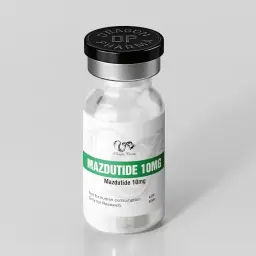


Cagrilintide Acetate 10 mg is a lyophilized research peptide manufactured by Dragon Pharma, supplied as 10 mg per 2 mL vial for laboratory research purposes.
Cagrilintide Acetate 10 mg contains cagrilintide, a long-acting acylated analogue of human amylin. Amylin is a 37-amino acid peptide co-secreted with insulin from pancreatic beta cells that plays a role in appetite regulation, gastric emptying, and satiety signaling. Cagrilintide is a non-selective agonist at both amylin and calcitonin receptors, with structural modifications designed to prolong its duration of action and prevent amyloid fibril formation.
In clinical research, cagrilintide has been studied extensively as both a monotherapy and in combination with semaglutide (a GLP-1 receptor agonist) under the name CagriSema. A phase 2 dose-finding trial in adults with overweight or obesity demonstrated that cagrilintide 2.4 mg monotherapy produced a 10.8% reduction in body weight over 26 weeks, compared to 3% with placebo. When combined with semaglutide 2.4 mg, cagrilintide 2.4 mg achieved a 17.1% weight reduction at 20 weeks, significantly greater than semaglutide alone. The REDEFINE 1 phase 3 trial reported 22.7% weight loss at 68 weeks with CagriSema 2.4 mg/2.4 mg, compared to 16.1% with semaglutide alone and 11.8% with cagrilintide alone.
Cagrilintide is not FDA-approved for any indication as of April 2026. Novo Nordisk has submitted a regulatory filing for CagriSema, with approval anticipated in 2026, but no approval date can be confirmed. Cagrilintide as a standalone peptide is not available as a prescription medication in the United States and has no legal compounding pathway. In non-medical bodybuilding contexts, cagrilintide is sometimes referenced for appetite suppression and weight management research, though such use falls outside approved indications and carries unknown risks.
Cagrilintide Acetate 10 mg is supplied as a lyophilized powder in a 2 mL vial. The powder requires reconstitution with an appropriate solvent before laboratory use. Once reconstituted, the solution should be refrigerated and handled according to standard research peptide protocols.
Cagrilintide is a long-acting acylated amylin analogue that acts as a non-selective agonist at amylin and calcitonin receptors, studied for its effects on appetite regulation and weight management.
Cagrilintide belongs to the class of amylin analogues, peptide hormones that mimic the actions of endogenous amylin. Its structure includes several modifications compared to pramlintide (an earlier amylin analogue). Proline substitutions at positions 25, 28, and 29 inhibit the formation of amyloid fibrils, addressing a key safety concern with amylin-based therapeutics. The Tyr37 Pro replacement enhances receptor potency, while Asn14 Glu prevents deamination, and Val17 Arg improves solubility at physiological pH by forming a helix-stabilizing salt bridge with Glu14.
The pharmacokinetic profile of cagrilintide is characterized by a long half-life of 159 to 195 hours, achieved through the incorporation of a C-20 fatty diacid via an α-glutamyl spacer that promotes reversible binding to albumin. This extended half-life supports once-weekly subcutaneous dosing. In a Phase 1 study, the area under the curve (AUC), maximum concentration (Cmax), time to maximum concentration (tmax), and half-life (t1/2) of cagrilintide were determined. A decrease in heart rate of −2.9 to −3.7 beats per minute was observed with cagrilintide compared to placebo, which was not considered clinically relevant.
The mechanism of action involves activation of amylin receptors in the area postrema of the brainstem, which modulates satiety signaling and gastric emptying. By mimicking amylin's effects, cagrilintide reduces food intake and slows stomach emptying, leading to reduced caloric consumption and weight loss. Its effects appear complementary to GLP-1 receptor agonists, with the combination producing greater weight loss than either agent alone.
Cagrilintide has an extended half-life of 159 to 195 hours, achieved through fatty acid acylation and albumin binding. This supports once-weekly dosing in clinical research settings.
Dragon Pharma offers a range of research peptides and metabolic compounds. Cagrilintide Acetate 10 mg is positioned as a long-acting amylin analogue, complementing other metabolic research compounds.
For GLP-1 receptor agonist research, Dragon Pharma offers Survodutide, a dual GLP-1/glucagon receptor agonist studied for metabolic effects. For amylin-related research, cagrilintide represents a distinct mechanism targeting the amylin pathway. For mitochondrial research compounds, MOTS-C and SS-31 target different aspects of cellular metabolism.
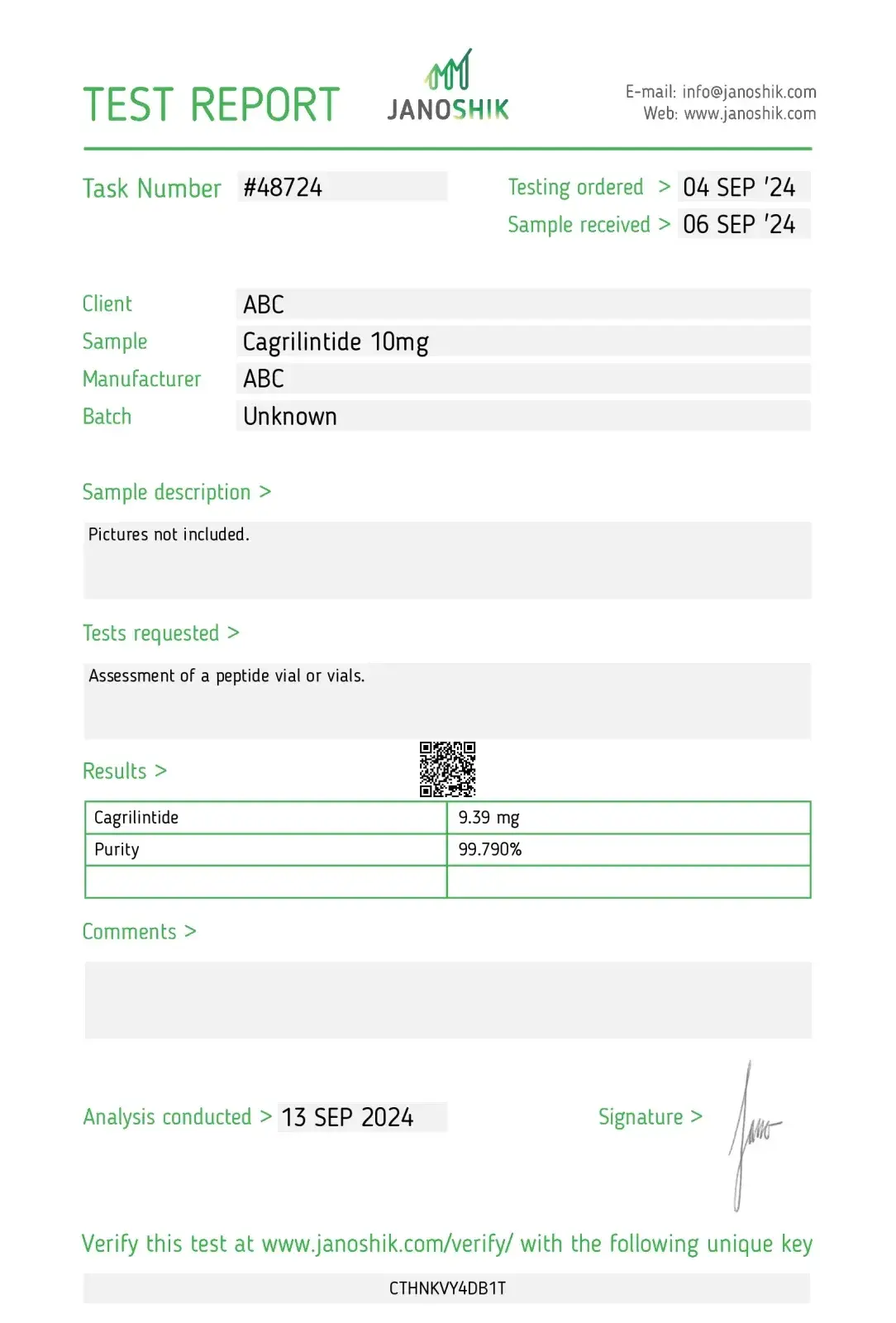
Published laboratory reports for Cagrilintide Acetate 10 mg are shown below with the test date, measured content and percentage of the product's 10 mg label claim.
 View Report
Laboratory results apply to the specific tested sample represented in each published report and should not be interpreted as a measurement of every vial or production batch.
The information below is provided for educational reference only. Cagrilintide is a research compound that has not been approved for human use. No established human dosing exists outside of clinical trial protocols. Non-medical use falls outside any approved indications and carries unknown health risks.
No established human dosage exists for cagrilintide outside of clinical trial settings. In clinical trials, cagrilintide has been studied as a monotherapy at doses of 0.6 mg to 4.5 mg administered once weekly, with dose escalation every 2 weeks. In combination with semaglutide, cagrilintide has been studied at doses of 1.0 mg and 2.4 mg once weekly. In non-medical bodybuilding contexts, community references suggest starting doses of 0.25 mg to 0.5 mg weekly, with some users titrating up to 1.0 mg weekly or higher. A common warning in community discussions is that starting doses above 0.5 mg can cause severe appetite suppression and difficulty eating.
| Use Case | Research Reference | Frequency |
|---|---|---|
| Clinical trial (monotherapy) | 0.6–4.5 mg | Once weekly, titrated |
| Clinical trial (with semaglutide) | 1.0–2.4 mg | Once weekly |
| Non-medical (community reference) | 0.25–1.0 mg | Once weekly |
Community doses are extrapolated from clinical trial data but are not supported by published human safety or efficacy data for non-medical use. Cagrilintide has not been approved for any indication.
Cagrilintide is not an anabolic compound and is not stacked for muscle-building purposes. In non-medical research contexts, it is sometimes referenced alongside GLP-1 receptor agonists such as semaglutide or tirzepatide, based on the complementary mechanisms of amylin and GLP-1 pathways. Dragon Pharma offers Survodutide as a dual GLP-1/glucagon receptor agonist for metabolic research. Community discussions describe combining cagrilintide with GLP-1 agonists at lower doses than either agent alone, though this approach remains experimental and unsupported by clinical data for non-medical use.
Because cagrilintide's human safety profile for non-medical use is not established, cycle structure and support compounds remain speculative. Any use should be considered experimental.
The most commonly reported side effects in clinical trials are gastrointestinal, including nausea, vomiting, diarrhea, and constipation. These events were generally mild and transient, occurring most frequently during dose escalation. Decreased appetite and early satiety were reported more frequently with higher doses of cagrilintide (2.4 mg and 4.5 mg) than with placebo. In a clinical trial of cagrilintide-semaglutide, 100% of participants on cagrilintide 2.4 mg plus semaglutide reported decreased appetite.
Community reports describe that cagrilintide can cause a pronounced drop in blood pressure, potentially leading to reflex tachycardia. One user reported a heart rate of 144 bpm and blood pressure of 89/62 mmHg after administration, with symptoms resolving over several hours. This effect may be exacerbated when combined with other compounds that lower blood pressure. Cagrilintide also appears to have a heart rate-lowering effect of −2.9 to −3.7 beats per minute compared to placebo, which was not considered clinically relevant.
Cagrilintide is not part of any post-cycle therapy protocol. It has no relationship to the hypothalamic-pituitary-gonadal axis and its research focus has been on metabolic and appetite-related endpoints. PCT compounds such as Clomid and Nolvadex address entirely different biological systems.
Cagrilintide has not been approved for human use. CagriSema (cagrilintide plus semaglutide) is under FDA review with approval anticipated in 2026, but no approval date can be confirmed. The information above is for educational reference and does not constitute medical advice. Human use outside of clinical trials is not supported by evidence.
Cagrilintide Acetate is an experimental research compound that has not been approved for human use as a standalone product. CagriSema (the combination of cagrilintide and semaglutide) is under FDA review, but approval is not confirmed.
Cagrilintide is not FDA-approved as a standalone product for any indication. CagriSema (cagrilintide plus semaglutide) has been submitted for FDA review, with approval anticipated in 2026, but no approval date can be confirmed. As of April 2026, cagrilintide is not available as a prescription medication in the United States and has no legal compounding pathway. Products sold online as research chemicals are not FDA-regulated, have no verified manufacturing standards, and carry unknown contamination, dosing, and safety risks.
Cagrilintide Acetate is sold strictly for research purposes. It is not a dietary supplement, medication, or approved therapeutic agent. Human consumption for appetite suppression or weight management is not recommended and may pose unknown health risks. Product quality does not establish that human use is safe or appropriate.
The most commonly reported adverse effects in clinical trials are gastrointestinal events, including nausea, vomiting, diarrhea, and constipation. These were generally mild and transient, occurring most frequently during dose escalation. A meta-analysis of CagriSema trials found that gastrointestinal events were more frequent than with semaglutide alone (RR 1.09) and more frequent than with placebo (RR 2.02), but serious adverse events were rare and similar across groups.
Decreased appetite and early satiety are expected pharmacological effects. In clinical trials, decreased appetite was reported by 100% of participants on cagrilintide 2.4 mg plus semaglutide. Community reports describe that starting doses above 0.5 mg can cause severe appetite suppression and difficulty eating.
Blood pressure effects have been observed. Community reports describe a pronounced drop in blood pressure that may trigger reflex tachycardia, with one user reporting a heart rate of 144 bpm and blood pressure of 89/62 mmHg. A Phase 1 study found a decrease in heart rate of −2.9 to −3.7 beats per minute compared to placebo, which was not considered clinically relevant.
Cagrilintide has no approved indications and no established contraindications because no human use is supported. However, given the gastrointestinal and cardiovascular effects observed in clinical trials, individuals with pre-existing gastrointestinal conditions (such as gastroparesis), cardiovascular disease, or a history of arrhythmias should be particularly cautious. No human reproductive or developmental toxicology data exists for cagrilintide as a standalone product.
No monitoring protocols exist for cagrilintide because it has no approved human use as a standalone product. In clinical trials, safety monitoring included assessment of gastrointestinal symptoms, cardiovascular parameters (including ECG), and standard laboratory safety measures. For research settings, standard laboratory safety monitoring would apply.
Store lyophilized powder refrigerated or frozen for long-term stability. Once reconstituted, refrigerate at 2-8°C and use according to standard research peptide protocols. Do not freeze the reconstituted solution, as freezing can damage peptide structure. Keep all research compounds out of the reach of children. Cagrilintide is not approved for human use and is not available through legal prescription pathways as a standalone product.
Cagrilintide Acetate 10 mg is supplied through the official Dragon Pharma distribution chain and shipped in original manufacturer packaging with discreet, privacy-focused handling.
The outer shipping package remains discreet, with privacy-focused handling and no unnecessary external product details. Products are supplied through the official Dragon Pharma distribution chain.
To verify your Cagrilintide Acetate 10 mg product, use the security code on the packaging and cross-check it on the Dragon Pharma official site. Official Dragon Pharma presentation, batch-linked lab proof, and original packaging help reinforce product legitimacy and buyer confidence.
Proper storage conditions help preserve peptide integrity and stability throughout shelf life.
Store lyophilized powder refrigerated or frozen for long-term stability. Keep the vial in its original packaging until use. Let frozen vials warm to room temperature before opening so condensation won't form.
Once reconstituted, refrigerate at 2-8°C and use according to standard research peptide protocols. Do not freeze the reconstituted solution, as freezing can damage peptide structure. If the solution turns cloudy, changes color, or develops floaters, discard it. Keep out of reach of children.
Answers to common questions about Cagrilintide Acetate 10 mg, its research status, mechanism of action, and safety considerations.
Cagrilintide Acetate 10 mg is a research peptide studied for its effects on appetite regulation and weight management. It is a long-acting amylin analogue that has been investigated in clinical trials both as a monotherapy and in combination with semaglutide (CagriSema). It has not been approved for human use as a standalone product and is sold strictly for laboratory research purposes.
In clinical trials, cagrilintide has been administered as a once-weekly subcutaneous injection. Doses studied range from 0.6 mg to 4.5 mg as monotherapy, and 1.0 mg to 2.4 mg in combination with semaglutide. In non-medical community contexts, starting doses of 0.25 mg to 0.5 mg weekly are referenced, with titration upward based on response. No established human dosing exists outside of clinical trial protocols.
Cagrilintide is a long-acting acylated analogue of human amylin. It acts as a non-selective agonist at amylin and calcitonin receptors, mimicking amylin's effects on satiety signaling and gastric emptying. By activating these receptors in the brainstem, it reduces food intake and slows stomach emptying, leading to reduced caloric consumption and weight loss. Its effects appear complementary to GLP-1 receptor agonists.
Cagrilintide has a half-life of 159 to 195 hours, which supports once-weekly dosing and means steady-state levels accumulate over several weeks. In clinical trials, significant weight loss was observed over 20 to 68 weeks of treatment. Appetite suppression effects are typically reported within days to weeks of starting treatment, though full weight loss effects develop over months.
Cagrilintide is the most advanced amylin analogue in clinical development for weight management, having completed phase 3 trials as part of CagriSema. Pramlintide is an earlier amylin analogue approved for diabetes but not for weight management. Cagrilintide has structural modifications designed to prevent amyloid fibril formation and extend its half-life. No other amylin analogue has progressed as far in clinical development for obesity.
Cagrilintide and semaglutide work through different mechanisms. Cagrilintide is an amylin analogue that targets amylin and calcitonin receptors, while semaglutide is a GLP-1 receptor agonist. Their mechanisms are complementary, and combining them (as CagriSema) produces greater weight loss than either alone. The REDEFINE 1 trial reported 22.7% weight loss with CagriSema versus 16.1% with semaglutide alone at 68 weeks.
Cagrilintide and tirzepatide have different mechanisms. Tirzepatide is a dual GIP/GLP-1 receptor agonist, while cagrilintide is an amylin analogue. In the REDEFINE 4 trial, CagriSema (cagrilintide plus semaglutide) did not meet the primary endpoint of non-inferiority on weight loss compared to tirzepatide 15 mg at 84 weeks. Both represent advanced approaches to weight management through different hormonal pathways.
No human dosing standards exist for cagrilintide as a standalone research product. The 10 mg vial strength is a research quantity. In clinical trials, the highest dose studied was 4.5 mg weekly. A 10 mg vial, when reconstituted, provides enough material for multiple doses at the doses studied in clinical trials or referenced in non-medical contexts.
Cagrilintide Acetate 10 mg is labeled at 10 mg of cagrilintide acetate per vial. It is supplied as a lyophilized powder in a 2 mL vial, requiring reconstitution before laboratory use.
Yes. A published laboratory report dated September 13, 2024 measured Cagrilintide Acetate 10 mg at 9.39 mg/vial, equivalent to 93.9% of its 10 mg label claim. The batch number for this report was #CGDHD7. The complete report can be viewed in the Lab Reports tab.
No. CagriSema (cagrilintide plus semaglutide) is not FDA-approved for any indication as of April 2026. Novo Nordisk has submitted a regulatory filing, with approval anticipated in 2026, but no approval date can be confirmed. Cagrilintide as a standalone product is not available as a prescription medication and has no legal compounding pathway.