
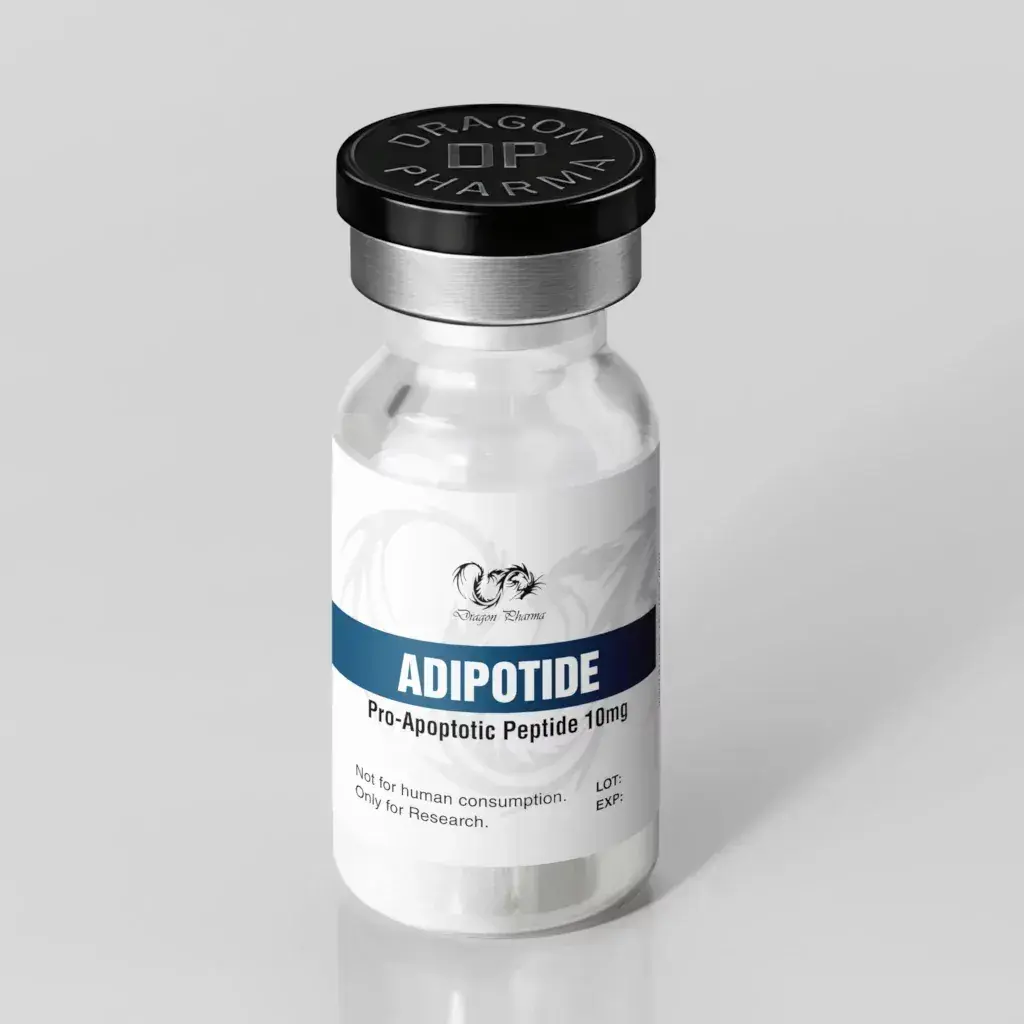
Adipotide 10 mg is a lyophilized research peptide manufactured by Dragon Pharma, supplied as 10 mg per 2 mL vial for laboratory research purposes.
Adipotide 10 mg contains adipotide, a synthetic peptidomimetic also known as FTPP (prohibitin-targeting peptide) or CKGGRAKDC-GG-D(KLAKLAK)₂. Adipotide is a chimeric molecule composed of two functional domains: a homing sequence (CKGGRAKDC) that binds to prohibitin on the surface of blood vessels supplying white adipose tissue, and a proapoptotic sequence (D(KLAKLAK)₂) that triggers programmed cell death once internalized. The design intent is to selectively destroy the vasculature feeding white fat tissue, causing fat cells to be starved of nutrients and reabsorbed.
In preclinical research, adipotide has been studied extensively in animal models. In obese rhesus monkeys, daily subcutaneous injections over 28 days produced an average 11% reduction in body weight, a 27% decrease in abdominal fat, and marked improvements in insulin resistance. Obese mice lost up to 30% of body weight in earlier studies. Lean animals did not lose weight, suggesting the compound's effects may be selective for obese subjects with expanded white adipose tissue vasculature.
Adipotide has never been approved for human use. A Phase 1 clinical trial was initiated in 2012 in obese patients with castrate-resistant prostate cancer, but the trial was terminated due to dose-limiting nephrotoxicity. The primary safety signal in both primate and human studies was renal tubular toxicity, which was characterized as dose-dependent and reversible in animals but proved unacceptable in humans at therapeutic doses. Adipotide is not FDA-approved, has no legal compounding pathway, and is sold strictly for research purposes.
Adipotide 10 mg is supplied as a lyophilized powder in a 2 mL vial. The powder requires reconstitution with an appropriate solvent before laboratory use. Once reconstituted, the solution should be handled according to standard research peptide protocols.
Adipotide is a chimeric peptidomimetic that combines a prohibitin-binding homing sequence with a proapoptotic effector domain, designed to selectively ablate the vasculature supporting white adipose tissue.
Adipotide belongs to the class of ligand-directed peptidomimetics. Its structure consists of the sequence CKGGRAKDC-GG-D(KLAKLAK)₂. The CKGGRAKDC domain functions as a homing peptide that binds with high specificity to prohibitin (PHB), a protein expressed on the surface of vascular endothelial cells in white adipose tissue. The D(KLAKLAK)₂ domain is a cationic, amphipathic peptide that disrupts mitochondrial membranes, triggering apoptosis in cells that internalize the compound.
The mechanism of action is fundamentally distinct from other weight-management agents. Rather than modulating appetite or metabolism through receptor signaling, adipotide physically destroys the blood vessels that supply white fat tissue. When the vascular supply is ablated, fat cells are starved of nutrients and undergo reabsorption and metabolism. This approach has been described as a "new class of candidate drugs" for obesity treatment.
Preclinical research demonstrated that adipotide's effects were selective for white adipose tissue vasculature. In lean monkeys, no weight loss was observed, suggesting the drug's targeting was specific to the expanded vasculature associated with obesity. However, the selectivity was not absolute: prohibitin is also expressed in renal tissue, and the compound's clearance through the kidney led to dose-dependent renal tubular changes.
Adipotide's Phase 1 clinical trial was terminated due to dose-limiting nephrotoxicity. The therapeutic window between effective fat-reducing doses and kidney-damaging doses proved too narrow for acceptable clinical use. Adipotide has never received marketing authorization in any jurisdiction.
Dragon Pharma offers a range of research peptides and compounds. Adipotide 10 mg is positioned as a research peptide with a unique mechanism targeting adipose vasculature, distinct from other metabolic research compounds.
For mitochondrial research compounds, Dragon Pharma offers MOTS-C and SS-31, which target different aspects of mitochondrial function. For fat loss research, AOD 9604 is a peptide fragment studied for lipolytic activity. Adipotide's vascular-targeting mechanism represents a fundamentally different research approach.
The information below is provided for educational reference only. Adipotide is a research compound that has never been approved for human use. No human safety or efficacy data exists, and the compound has been associated with significant renal toxicity in both animal studies and a terminated human clinical trial. Non-medical use is not supported by evidence and carries serious health risks.
No established human dosage exists for adipotide. In the terminated Phase 1 clinical trial, patients received daily subcutaneous injections for a single 28-day cycle, with dose escalation across up to five cohorts. The trial was terminated due to dose-limiting nephrotoxicity before a maximum tolerated dose was established. In preclinical primate studies, doses that produced meaningful fat loss also produced renal tubular changes. Common reference ranges for human use of this compound are not well characterized because no human use is supported by clinical evidence.
| Use Case | Research Reference | Frequency |
|---|---|---|
| Preclinical research (primate) | Doses titrated to effect | Daily for 28 days |
| Terminated Phase 1 trial | Escalating doses, up to 5 levels | Daily for 28 days |
| Human use | No established dosage | Not applicable |
Adipotide has no approved human dosing. The Phase 1 trial was terminated due to nephrotoxicity before a safe human dose could be established.
Adipotide is not an anabolic compound and is not stacked for muscle-building purposes. Its proposed mechanism of targeting adipose vasculature is unrelated to anabolic pathways. Because adipotide's safety profile is characterized by renal toxicity, combining it with other compounds that impose renal stress would be expected to compound risks. No clinical data exists on combining adipotide with any other compound.
For researchers interested in metabolic and mitochondrial compounds, Dragon Pharma offers MOTS-C and SS-31 as research peptides with different mechanisms of action and more favorable preclinical safety profiles.
The primary safety signal for adipotide is renal toxicity. In primate studies, dose-dependent changes in renal proximal tubule function were observed, including decreased serum phosphorus and potassium, glucosuria, proteinuria, and increased transitional/renal epithelial cells in urine. These changes were generally characterized as mild and reversible in animals. In the human Phase 1 trial, nephrotoxicity proved to be dose-limiting and led to trial termination.
Given the mechanism of action, off-target effects from the proapoptotic domain are a theoretical concern if the compound fails to home specifically to adipose vasculature. The D(KLAKLAK)₂ domain disrupts mitochondrial membranes in any cell that internalizes it in sufficient quantity. Renal uptake and clearance of the compound likely contributed to the observed kidney toxicity.
Adipotide is not part of any post-cycle therapy protocol. It has no relationship to the hypothalamic-pituitary-gonadal axis. Its research focus has been on adipose tissue vasculature and metabolic endpoints, not hormonal recovery. PCT compounds such as Clomid and Nolvadex address different biological systems entirely.
Adipotide has never been approved for human use. Its clinical development was discontinued due to unacceptable kidney toxicity. The information above is for educational reference and does not constitute medical advice. Human use is not supported by evidence and is not recommended.
Adipotide is an experimental research compound that has never been approved for human use. Its clinical development was discontinued due to dose-limiting nephrotoxicity. No human safety data exists to support any human use.
Adipotide is not FDA-approved for any indication. It has no FDA drug application on file, no approved label, and no classification as a compoundable bulk drug substance under 503A or 503B. There is no legal pathway to obtain pharmaceutical-grade adipotide for human use in the United States. Products sold under this name through online vendors exist outside any regulatory framework and carry the additional risks of unverified identity, purity, and concentration.
Adipotide is sold strictly for research purposes. It is not a dietary supplement, medication, or approved therapeutic agent. Human consumption is not recommended and may pose serious health risks. Product quality does not establish that human use is safe or appropriate.
The primary adverse effect identified for adipotide is renal toxicity. In primate studies, dose-dependent changes in renal proximal tubule function were observed, including decreased serum phosphorus and potassium, urinary changes such as glucosuria and proteinuria, and increased transitional/renal epithelial cells. These changes were characterized as generally mild and reversible in animals, resolving during the recovery period.
In the Phase 1 human clinical trial, nephrotoxicity proved to be dose-limiting and led to trial termination. The therapeutic window between effective doses and kidney-damaging doses was too narrow for acceptable clinical use. The nephrotoxicity likely stems from the kidney's role in filtering and clearing the peptide, with the proapoptotic domain causing collateral damage to renal tubular epithelial cells during excretion.
Because the D(KLAKLAK)₂ domain disrupts mitochondrial membranes in any cell that internalizes it, off-target effects are a theoretical concern if the compound fails to home specifically to adipose vasculature. The compound's safety in primate models depended on the targeting selectivity of the CKGGRAKDC homing peptide.
Adipotide has no approved indications and no established contraindications because no human use is supported. However, the documented renal toxicity profile raises particular concerns for individuals with pre-existing kidney disease or reduced renal function. Given that adipotide is not approved for any use, there are no populations for whom use is medically appropriate.
No monitoring protocols exist for adipotide because it has no approved human use. In the terminated Phase 1 trial, safety monitoring included assessment of renal function, but specific monitoring guidelines have not been published in peer-reviewed form. For research settings, standard laboratory safety monitoring would apply.
Store lyophilized powder according to standard research peptide protocols. Keep the vial securely stored and protected from conditions that could compromise the product. Inspect the product before use and do not use if it appears damaged or otherwise abnormal. Keep all research compounds out of the reach of children. Adipotide is classified as a non-approved substance under WADA category S0 and is prohibited in sport.
Adipotide 10 mg is supplied through the official Dragon Pharma distribution chain and shipped in original manufacturer packaging with discreet, privacy-focused handling.
The outer shipping package remains discreet, with privacy-focused handling and no unnecessary external product details. Products are supplied through the official Dragon Pharma distribution chain.
To verify your Adipotide 10 mg product, use the security code on the packaging and cross-check it on the Dragon Pharma official site. Official Dragon Pharma presentation and original packaging help reinforce product legitimacy and buyer confidence.
Proper storage conditions help preserve peptide integrity and stability throughout shelf life.
Store lyophilized powder in a cool, dry place at controlled room temperature or refrigerated conditions (2–8°C) as appropriate for research peptides. Protect from excessive heat, moisture, and direct light. Keep the vial in its original packaging until use.
Once reconstituted, follow standard research peptide handling protocols for solution stability and storage. Do not use if the packaging appears damaged or if the powder shows signs of deterioration. Keep out of reach of children.
Answers to common questions about Adipotide 10 mg, its research status, mechanism of action, and safety considerations.
Adipotide 10 mg is a research peptide studied for its ability to target and destroy the blood vessels supplying white adipose tissue. It has never been approved for human use, and its clinical development was discontinued due to kidney toxicity. It is sold strictly for laboratory research purposes.
No established human dosage exists for adipotide. In the terminated Phase 1 clinical trial, patients received daily subcutaneous injections for a single 28-day cycle, but the trial was stopped due to dose-limiting nephrotoxicity. Human use is not supported by evidence.
Adipotide is a chimeric peptidomimetic with two functional domains. The CKGGRAKDC domain binds to prohibitin on the surface of blood vessels supplying white adipose tissue. The D(KLAKLAK)₂ domain then triggers apoptosis, destroying those blood vessels and starving fat cells of nutrients. This causes fat tissue to be reabsorbed and metabolized.
In preclinical research, adipotide's effects were observed over a 28-day treatment period. Obese rhesus monkeys lost an average of 11% of body weight after 28 days of daily injections. Improvements in insulin resistance were noted during treatment. No human efficacy data exists.
Adipotide is not a viable fat loss agent for human use. Its clinical development was discontinued due to kidney toxicity. The research community generally regards its risk-benefit ratio as unacceptable, especially with safer alternatives available for weight management research.
Adipotide and GLP-1 agonists work through fundamentally different mechanisms. GLP-1 agonists modulate appetite and metabolism through receptor signaling and have completed Phase 3 trials and received FDA approval for specific indications. Adipotide physically destroys blood vessels supplying fat tissue, has never been approved for human use, and carries documented renal toxicity.
Adipotide and AOD 9604 have different mechanisms. AOD 9604 is a peptide fragment studied for lipolytic activity through growth hormone-related pathways. Adipotide targets prohibitin on adipose vasculature and induces apoptosis of blood vessels. Adipotide's mechanism is more aggressive and carries documented renal toxicity.
No human dosing standards exist for adipotide. The 10 mg vial strength is a research quantity, not a human dose. In the terminated Phase 1 trial, doses were escalated across up to five levels, but the trial was stopped before a safe dose was established. The 10 mg vial is intended for laboratory research use only.
Adipotide 10 mg is labeled at 10 mg of adipotide per vial. It is supplied as a lyophilized powder in a 2 mL vial, requiring reconstitution before laboratory use.
Yes. Renal toxicity is the primary safety signal for adipotide. In primate studies, dose-dependent changes in renal proximal tubule function were observed, including glucosuria, proteinuria, and increased renal epithelial cells. In the human Phase 1 trial, nephrotoxicity was dose-limiting and led to trial termination. The kidney's role in filtering and clearing the peptide is believed to contribute to this toxicity.
No. Adipotide has never been approved by the FDA or any regulatory authority for human use. It has no FDA drug application, no approved label, and no legal compounding pathway. Its clinical development was discontinued after the Phase 1 trial was terminated due to nephrotoxicity.