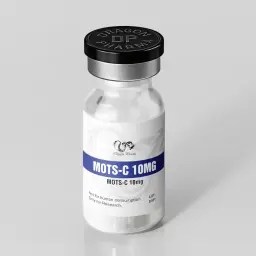


Klow 80 mg is a lyophilized powder research peptide blend manufactured by Dragon Pharma, containing 10 mg of BPC-157, 10 mg of TB-500, 10 mg of KPV, and 50 mg of GHK-Cu per 2 mL vial for a total strength of 80 mg/vial.
Klow 80 mg combines four synthetic peptides commonly referenced in regenerative research contexts: BPC-157, TB-500, KPV, and GHK-Cu. Each component acts through distinct pathways involved in tissue repair, cellular migration, inflammation resolution, and extracellular matrix remodeling, though no human clinical trials have evaluated this specific combination.
BPC-157 is a synthetic pentadecapeptide derived from human gastric juice that has been studied primarily in animal models for its effects on angiogenesis, collagen synthesis, and gastrointestinal protection. TB-500 is a synthetic fragment of thymosin beta-4 that binds actin and has been investigated for cell migration and tissue repair mechanisms in preclinical research. KPV is a tripeptide fragment of alpha-melanocyte-stimulating hormone (α-MSH) studied for its anti-inflammatory properties through inhibition of IL-1β signaling. GHK-Cu is a naturally occurring copper-binding tripeptide that has been studied for its role in collagen production, elastin synthesis, and skin remodeling.
The rationale for combining these peptides is mechanistic: BPC-157 is proposed to act primarily through angiogenesis and collagen synthesis pathways, TB-500 acts through cellular migration and actin polymerization, KPV provides an inflammation-resolution component through NF-κB inhibition, and GHK-Cu supports extracellular matrix remodeling and collagen deposition. This combination is based on the hypothesis that these complementary mechanisms could produce additive effects on tissue repair. That hypothesis has not been evaluated in controlled human studies, and no human clinical trial data exists for any individual component in injectable form or for the combined formulation.
Klow 80 mg is supplied as a lyophilized (freeze-dried) powder in a 2 mL vial. This form requires reconstitution with a suitable solvent such as bacteriostatic water before use.
Klow 80 mg is a multi-component peptide formulation that combines four compounds with distinct but potentially complementary mechanisms of action in tissue repair, inflammation resolution, and regeneration research.
Each component of Klow 80 mg acts through a different primary pathway. BPC-157 has been studied primarily through angiogenesis and collagen synthesis mechanisms in animal models, with a systematic review identifying only three human studies since 1993, including a pharmacokinetic study in two subjects and two small uncontrolled pilot studies. TB-500, a fragment of thymosin beta-4, binds actin and has been investigated for cell migration and survival signaling, though the cardiac-repair biology that produced the strongest Tβ4 animal findings may not transfer to the TB-500 fragment because it lacks the C-terminal AGES domain. KPV is a tripeptide fragment of α-MSH studied for its anti-inflammatory effects through inhibition of IL-1β functions and NF-κB pathway modulation. GHK-Cu is a copper-binding tripeptide that has been studied for its effects on collagen production, elastin synthesis, and inflammatory modulation, with clinical evidence primarily from topical application rather than injectable use.
The distinction between these mechanisms is the rationale for stacking: BPC-157 and TB-500 are sometimes combined in community protocols, with KPV added for its anti-inflammatory effects and GHK-Cu for its proposed extracellular matrix effects. However, the four components have never been tested together in any study, human or animal, and the combined safety profile has not been independently evaluated.
Human evidence for BPC-157 is limited to three uncontrolled pilot studies with a combined sample size of 30 participants. TB-500 has no human RCT data for musculoskeletal indications. KPV has no published human dosing trial. GHK-Cu research is primarily in topical formulations and skin-related applications. All four are sold as research chemicals and are not FDA-approved for human use.
None of the four components in Klow 80 mg are FDA-approved for any indication. No human clinical trial data exists for any individual component in injectable form or for the combined formulation. The TB-500 component is listed on the WADA prohibited list under S2 Peptide Hormones.
Dragon Pharma offers individual peptide products and simpler combinations as alternatives to this quadruple formulation. BPC 157 is available as a standalone product, as is TB 500. GHK-CU and GHK-Cu Basic provide the copper peptide separately, and KPV 5 mg provides the anti-inflammatory tripeptide alone. For a three-component blend without KPV, Glow 60 mg contains BPC-157, TB-500, and GHK-Cu. For a two-component BPC-157 and TB-500 combination, TB 500/BPC 157 is an alternative option.
The information below is provided for educational reference only. BPC-157, TB-500, KPV, and GHK-Cu are not FDA-approved for any human use in the United States. All use in non-medical contexts falls outside approved indications.
Because Klow 80 mg is a combined formulation with a fixed ratio of four components, dose calculations must account for the proportion of each peptide within the blend. The 80 mg vial contains 50 mg GHK-Cu (62.5% of total mass), 10 mg BPC-157 (12.5%), 10 mg TB-500 (12.5%), and 10 mg KPV (12.5%). Published research on BPC-157 most often references single-dose protocols in the 50–100 mcg range in animal studies, while GHK-Cu clinical protocols typically reference 0.5–3 mg administered monthly via subcutaneous injection. Because Klow 80 mg is a combined formulation, dose calculations must account for the ratio of each component within the blend, and GHK-Cu is generally the limiting component for dose tiering.
| Use Case | Common Reference Range | Administration Frequency |
|---|---|---|
| Research/Community (non-medical) | Varies by protocol and component | Protocol-dependent |
| BPC-157 component reference | 50–100 mcg per administration | Subcutaneous, protocol-dependent |
| TB-500 component reference | 2–5 mg per week (community references) | Split or single weekly dose |
| GHK-Cu component reference | 1–2 mg per day (subcutaneous tier) | Subcutaneous, daily to every other day |
| KPV component reference | 200–400 mcg per administration | Protocol-dependent |
Common reference ranges for this specific four-peptide combination are not well characterized in publicly available bodybuilding resources. The table above reflects individual component research rather than validated combination protocols.
Klow 80 mg is itself a pre-combined stack and is not typically referenced as a base for additional peptide stacking. In community contexts, the four components are sometimes referenced together based on mechanistic hypotheses, but the combination has not been evaluated in any published study.
Community protocols for peptide blends typically reference cycles of 4–8 weeks, though this practice is based on community experience rather than validated clinical protocols. Bacteriostatic Water is commonly referenced for reconstitution. Reconstituting an 80 mg vial with 2.5 mL of bacteriostatic water yields a 32 mg/mL concentration, and a 10-unit draw on a U-100 syringe would deliver 2 mg GHK-Cu and 400 mcg each of BPC-157, TB-500, and KPV.
Because Klow 80 mg contains four distinct peptides, the side effect profile is less predictable than for single-compound products. No acute toxicity has been observed for BPC-157, TB-500, KPV, or GHK-Cu individually in preclinical animal models, but the four-component combination safety profile has not been independently evaluated.
Injection-site reactions are commonly referenced for all four peptides. The BPC-157 component carries theoretical angiogenesis concerns, as it promotes neovascularization in preclinical models. The TB-500 component is prohibited by WADA under S2 Peptide Hormones. The GHK-Cu component contains copper and is contraindicated in copper metabolism disorders including Wilson disease.
Klow 80 mg contains peptides that act on tissue repair and inflammation pathways rather than the hypothalamic-pituitary-gonadal axis. Post-cycle therapy is therefore not applicable in the context of testosterone suppression, as these peptides do not affect endogenous testosterone production.
Dosing strategies for this combination are not well established. The information above is for educational reference and does not constitute medical advice.
BPC-157, TB-500, KPV, and GHK-Cu are not FDA-approved for any human use in the United States. None are on the formal 503A Bulks List.
BPC-157 carries a Category 2 bulk drug substance designation reflecting FDA-identified risks including immunogenicity, peptide-related impurities, and insufficient safety evidence for suggested administration routes. TB-500 is prohibited by the World Anti-Doping Agency (WADA) under S2 Peptide Hormones, Growth Factors, Related Substances and Mimetics. KPV has no published human dosing trial. GHK-Cu injectable has never had clear FDA authorization for routine compounding, and its clinical evidence is primarily from topical application.
The four-component combination safety profile has not been independently evaluated in any published study. No chronic toxicity data exists for the combination.
This product is not FDA-approved for human use. Any use outside of research applications falls outside approved indications. Product concentration and laboratory verification do not establish that non-medical use is safe or appropriate for an individual.
Because Klow 80 mg contains four distinct peptides, the combined safety profile is essentially unknown. Adverse event profile reflects combined pharmacology of all four components, and combination safety has not been independently evaluated in any published study. Combining under-studied peptides compounds the uncertainty rather than reducing it.
The BPC-157 component carries theoretical angiogenesis concerns, as enhanced blood supply may support tumor growth; this potential risk has not been evaluated in clinical studies. The TB-500 component is prohibited by WADA and renders this blend prohibited for competing athletes. The GHK-Cu component contains copper and is contraindicated in copper metabolism disorders including Wilson disease.
Klow 80 mg is contraindicated in active malignancy due to the theoretical angiogenesis concern from BPC-157 and TB-500 components, in pregnancy or breastfeeding as no component has been studied in pregnancy, in WADA-tested athletes due to the TB-500 component, and in known copper sensitivity or Wilson disease due to the GHK-Cu component.
No component is FDA-approved for any indication. The long-term effects of chronic use of any of these peptides have not been established.
In research settings where individual peptides have been studied, monitoring has focused on condition-specific endpoints rather than standardized protocols. In non-medical contexts, individuals commonly reference periodic bloodwork, though the appropriate markers for this combination are not established.
No published laboratory reports are available for this specific product. Laboratory testing would apply to the tested sample only and should not be interpreted as a measurement of every vial or production batch.
Lyophilized peptide blends should be stored tightly sealed in the original container, protected from light, and kept at -20°C for long-term storage. Allow the vial to equilibrate to room temperature before opening to prevent moisture uptake. After reconstitution with bacteriostatic water, store refrigerated at 2–8°C and use within 30 days. Avoid repeated freeze-thaw cycles.
Keep all peptides and injectable products out of the reach of children. Follow the storage instructions provided with the product packaging.
Klow 80 mg by Dragon Pharma is supplied through the official distribution chain and shipped in original manufacturer packaging with discreet, privacy-focused handling.
The outer shipping package remains discreet, with privacy-focused handling and no unnecessary external product details. Products are supplied through the official Dragon Pharma distribution chain.
To verify your Klow 80 mg product, use the security code on the vial label and cross-check it on the Dragon Pharma official site. Official presentation, batch-linked lab proof when available, and original packaging help reinforce product legitimacy and buyer confidence.
For complete delivery details, tracking policy, and reshipment terms, please see our Shipping Info page.
Proper storage conditions help preserve peptide stability and overall product integrity throughout shelf life.
Store the lyophilized (dry) powder tightly sealed in its original container, protected from light, and desiccated at -20°C for long-term storage. Brief handling at refrigerated or ambient conditions is acceptable provided the container is allowed to equilibrate to room temperature before opening to prevent moisture uptake.
Peptide blends are hygroscopic and susceptible to oxidation, so they must be kept dry and away from air and light to limit degradation. After reconstitution with bacteriostatic water, store refrigerated at 2–8°C and use within 30 days. Avoid repeated freeze-thaw cycles.
Keep out of reach of children. Follow proper handling and sterile technique when administering the product.
Answers to common questions about Klow 80 mg, its peptide components, product strength, and regulatory considerations.
Klow 80 mg is a research peptide blend containing BPC-157, TB-500, KPV, and GHK-Cu. In research contexts, these peptides have been studied individually for mechanisms related to tissue repair, angiogenesis, inflammation resolution, and extracellular matrix remodeling. No human clinical trials have evaluated this specific combination for any indication, and all use outside research applications falls outside approved indications.
Dosing schedules for this specific combination are not well characterized. Individual component research references vary: BPC-157 in the 50–100 mcg range, TB-500 at 2–5 mg weekly in community references, GHK-Cu at 1–2 mg daily, and KPV at 200–400 mcg per administration. Any combined protocol would require calculations based on the blend ratio, and such protocols are not validated in human studies.
No. Klow 80 mg contains peptides that act on tissue repair and inflammation pathways rather than the hypothalamic-pituitary-gonadal axis. These peptides do not suppress endogenous testosterone production, so post-cycle therapy is not applicable in the context of testosterone recovery.
BPC-157 is a synthetic pentadecapeptide studied primarily in animal models for angiogenesis and collagen synthesis. TB-500 is a fragment of thymosin beta-4 that binds actin and has been investigated for cell migration. KPV is a tripeptide fragment of α-MSH studied for its anti-inflammatory effects through IL-1β inhibition. GHK-Cu is a copper-binding tripeptide studied for collagen production and extracellular matrix remodeling. Each has distinct mechanisms, but human clinical evidence for musculoskeletal or performance applications is minimal for all four.
The time course for this combination is not established. Published animal research on individual components describes effects building over a course of administration rather than a single dose producing an instant change. Timeframes in the animal literature vary by condition and protocol, which is why individual response cannot be predicted from a fixed schedule.
There is no evidence-based “best” approach for regenerative peptides. Klow 80 mg is a four-component blend based on mechanistic hypotheses rather than demonstrated clinical outcomes. No human clinical trials have evaluated these combinations for any indication, and the combined safety profile is essentially unknown.
Glow 60 mg is a three-component blend containing BPC-157, TB-500, and GHK-Cu. Klow 80 mg adds KPV as a fourth component, bringing the total to 80 mg. The addition of KPV introduces an anti-inflammatory signaling component through IL-1β inhibition that the GLOW formulation lacks.
Individual products such as BPC 157 or TB 500 allow for independent dosing of each peptide. Klow 80 mg combines them in a fixed ratio, which does not allow for adjusting the amount of one component without affecting the others. The combined product also includes KPV and GHK-Cu, which are available separately as KPV 5 mg and GHK-CU.
The 80 mg total content is distributed across four peptides: 50 mg GHK-Cu, 10 mg BPC-157, 10 mg TB-500, and 10 mg KPV. The GHK-Cu component accounts for the majority of the mass at 62.5%. Each component’s absolute amount must be considered individually rather than the total vial weight, as the dosing for each peptide is different.
Klow 80 mg is labeled at 80 mg total peptide content per vial. This consists of 50 mg GHK-Cu, 10 mg BPC-157, 10 mg TB-500, and 10 mg KPV. It is supplied as a lyophilized powder in a 2 mL vial.
No published laboratory report is currently available for this specific product. Product potency and purity verification would apply to tested samples only and should not be interpreted as a measurement of every vial or production batch.
Lyophilized Klow 80 mg is typically reconstituted with a suitable solvent such as Bacteriostatic Water or sterile water. Reconstituting with 2.5 mL yields a 32 mg/mL concentration, and a 10-unit draw delivers 2 mg GHK-Cu and 400 mcg each of BPC-157, TB-500, and KPV. Proper sterile technique should be used during reconstitution.