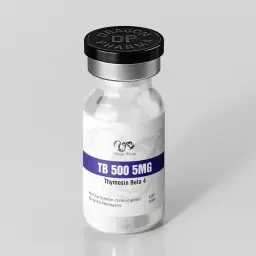
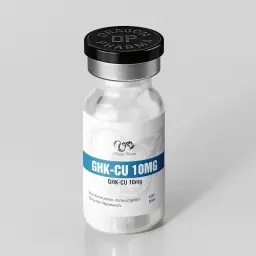
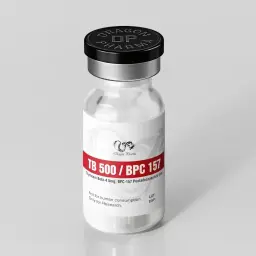
KPV 5 mg is a lyophilized powder research peptide manufactured by Dragon Pharma, containing 5 mg of Ac-KPV-NH2 (KPV tripeptide) per 2 mL vial.
KPV is a synthetic tripeptide corresponding to the C-terminal fragment of alpha-melanocyte-stimulating hormone (α-MSH), consisting of the amino acid sequence Lysine-Proline-Valine . It acts as a melanocortin receptor agonist fragment with anti-inflammatory properties, primarily studied for its ability to modulate inflammatory signaling pathways .
In research settings, KPV has been investigated for its anti-inflammatory effects through inhibition of nuclear factor kappa B (NF-κB) activation and reduction of pro-inflammatory cytokine production . It is not FDA-approved for any human use in the United States, and no published human dosing trial exists for KPV in injectable form . In non-medical bodybuilding contexts, KPV is sometimes referenced as a component of peptide blends or as a standalone research peptide for its anti-inflammatory properties, though such use falls outside approved indications.
Unlike BPC-157, which is studied primarily for angiogenesis and tissue repair mechanisms, KPV's primary research focus is on inflammation resolution. Its mechanism involves modulation of the NF-κB pathway and inhibition of IL-1β signaling, which distinguishes it from other regenerative peptides that primarily target tissue remodeling rather than inflammatory signaling .
KPV 5 mg is supplied as a lyophilized (freeze-dried) powder in a 2 mL vial. This form requires reconstitution with a suitable solvent such as bacteriostatic water before use.
Ac-KPV-NH2 is a tripeptide fragment of alpha-melanocyte-stimulating hormone studied for its anti-inflammatory signaling properties through modulation of the NF-κB pathway.
KPV is the C-terminal tripeptide of α-MSH, corresponding to amino acids 11-13 of the full hormone. It retains the anti-inflammatory activity of the parent molecule while being significantly smaller and potentially more amenable to tissue penetration . The tripeptide acts through inhibition of NF-κB activation, which reduces transcription of pro-inflammatory cytokines including IL-1β, TNF-α, and IL-6 .
Research has investigated KPV’s effects on inflammatory bowel disease models, where it has been shown to reduce intestinal inflammation and mucosal damage . Unlike full-length α-MSH, KPV does not appear to produce significant melanotropic effects such as skin darkening, which is attributed to the core sequence rather than the C-terminal fragment .
No published human clinical trial has evaluated KPV as a therapeutic agent. All available evidence comes from in vitro studies and animal models. The long-term safety profile of KPV in humans has not been established, and no published human dosing trial exists for injectable KPV .
As a tripeptide, KPV has a short half-life in circulation and is likely subject to rapid enzymatic degradation. Its small size and amphipathic character suggest it may have enhanced tissue penetration compared to larger peptides, though pharmacokinetic data in humans are not available .
Dragon Pharma offers several peptide products that are commonly referenced alongside KPV 5 mg. BPC 157 is studied primarily for angiogenesis and tissue repair mechanisms, while KPV focuses on inflammation resolution . TB 500 is investigated for cell migration and actin binding, a different mechanism from KPV’s NF-κB modulation. For combined formulations, KLOW 80 mg contains KPV alongside BPC-157, TB-500, and GHK-Cu, and GLOW 60 mg contains a three-component blend without KPV. GHK-CU is available separately for extracellular matrix support.
The information below is provided for educational reference only. KPV is not FDA-approved for any human use in the United States. All use in non-medical contexts falls outside approved indications.
Common reference ranges for KPV in non-medical contexts are not well characterized in publicly available bodybuilding resources. No published human dosing trial exists for KPV, and all available data come from in vitro studies and animal models . Community references to KPV dosing are anecdotal and not supported by clinical evidence.
| Use Case | Common Reference Range | Administration Frequency |
|---|---|---|
| Research/Community (non-medical) | Not well characterized | Protocol-dependent |
| Community reference (blend component) | 200–400 mcg per administration | Protocol-dependent |
| Animal study reference (IBD models) | Varies by study | Varies by study |
Because KPV is commonly used as a component in peptide blends, the dose delivered depends on the blend ratio and total peptide content. In a four-component blend such as KLOW 80 mg, KPV represents 12.5% of total peptide mass .
KPV is commonly referenced as a component of multi-peptide blends rather than as a standalone product. In KLOW 80 mg, KPV is combined with BPC-157, TB-500, and GHK-Cu, where it is intended to provide an anti-inflammatory signaling component alongside tissue repair peptides .
Community protocols for peptide blends typically reference cycles of 4–8 weeks, though this practice is based on community experience rather than validated clinical protocols. Bacteriostatic Water is commonly referenced for reconstitution.
No human safety data exist for KPV. As a fragment of α-MSH, KPV would be expected to share some of the parent molecule’s properties, but the C-terminal tripeptide does not appear to produce significant melanotropic effects . Injection-site reactions would be expected for any injectable peptide, though no clinical data are available to characterize the actual incidence.
Because KPV modulates inflammatory signaling, individuals with conditions involving immune dysregulation should exercise particular caution. The long-term effects of KPV use have not been established.
KPV acts on inflammatory signaling pathways rather than the hypothalamic-pituitary-gonadal axis. Post-cycle therapy in the context of testosterone recovery is not applicable, as KPV does not affect endogenous testosterone production.
Dosing strategies for KPV are not established in non-medical contexts. The information above is for educational reference and does not constitute medical advice.
KPV is not FDA-approved for any human use in the United States. It has been evaluated as a bulk drug substance for compounding but is not on the 503A Bulks List.
KPV is a synthetic tripeptide fragment of α-MSH. It is not approved for therapeutic use in the United States. No published human clinical trial has evaluated KPV for any indication, and all available safety data come from in vitro studies and animal models .
Because KPV is not on the 503A Bulks List and is not a component of an FDA-approved drug, compounded KPV products are not eligible for the exemptions that apply to certain bulk drug substances used in traditional compounding .
KPV is not FDA-approved for human use. Any use outside of approved research applications falls outside approved indications. Product concentration and laboratory verification do not establish that non-medical use is safe or appropriate for an individual.
No human adverse event data exist for KPV. As a tripeptide fragment, KPV would be expected to have a short half-life and be subject to rapid degradation, but no pharmacokinetic or safety data in humans are available .
Because KPV is a fragment of α-MSH, potential effects on pigmentation would be expected to be minimal based on its structure, but this has not been formally evaluated in clinical studies. Injection-site reactions are a theoretical concern for any injectable peptide.
Individuals with conditions involving immune dysregulation should exercise particular caution, as KPV modulates inflammatory signaling. The long-term effects of KPV use have not been established, and no safety data exist for use in pregnancy, lactation, or pediatric populations.
Because KPV has not been studied in humans, the full range of contraindications and potential drug interactions is unknown.
No established monitoring protocol exists for KPV. In research settings where KPV has been studied, endpoints have been related to inflammatory markers rather than standardized safety parameters .
No published laboratory reports are available for this specific product. Product potency verification would apply to tested samples only and is separate from any clinical monitoring of the individual.
Lyophilized KPV should be stored tightly sealed in its original container, protected from light, and kept desiccated at -20°C for long-term storage. After reconstitution, store refrigerated at 2–8°C and use within 2–4 weeks. Avoid repeated freeze-thaw cycles.
Keep all peptides and injectable products out of the reach of children. Follow the storage instructions provided with the product packaging.
KPV 5 mg by Dragon Pharma is supplied through the official distribution chain and shipped in original manufacturer packaging with discreet, privacy-focused handling.
The outer shipping package remains discreet, with privacy-focused handling and no unnecessary external product details. Products are supplied through the official Dragon Pharma distribution chain.
To verify your KPV 5 mg product, use the security code on the vial label and cross-check it on the Dragon Pharma official site. Official presentation, batch-linked lab proof when available, and original packaging help reinforce product legitimacy and buyer confidence.
For complete delivery details, tracking policy, and reshipment terms, please see our Shipping Info page.
Proper storage conditions help preserve peptide stability and overall product integrity throughout shelf life.
Store the lyophilized (dry) powder tightly sealed in its original container, protected from light, and desiccated at -20°C for long-term storage. Brief handling at refrigerated or ambient conditions is acceptable provided the container is allowed to equilibrate to room temperature before opening to prevent moisture uptake.
KPV is a tripeptide susceptible to enzymatic degradation once reconstituted. After reconstitution, store refrigerated at 2–8°C and use within 2–4 weeks. Avoid repeated freeze-thaw cycles.
Keep out of reach of children. Follow proper handling and sterile technique when administering the product.
Answers to common questions about KPV 5 mg, its mechanism, product strength, and research status.
KPV 5 mg contains Ac-KPV-NH2, a tripeptide fragment of α-MSH studied for its anti-inflammatory properties through NF-κB pathway modulation . In research settings it is used to investigate inflammatory signaling. No human clinical trials have evaluated KPV for any indication, and all use outside research applications falls outside approved indications.
Dosing schedules for KPV are not well characterized in publicly available resources. Community references to KPV dosing are anecdotal and not supported by clinical evidence . No published human dosing trial exists for KPV, so any dosing protocol would be experimental.
No. KPV acts on inflammatory signaling pathways rather than the hypothalamic-pituitary-gonadal axis. It does not suppress endogenous testosterone production, so post-cycle therapy in the context of testosterone recovery is not applicable.
Ac-KPV-NH2 is a tripeptide fragment of α-MSH that acts through inhibition of NF-κB activation, reducing transcription of pro-inflammatory cytokines including IL-1β, TNF-α, and IL-6 . Unlike full-length α-MSH, KPV does not appear to produce significant melanotropic effects . Its primary research focus is on inflammation resolution rather than tissue remodeling.
The time course for KPV is not established in humans. As a tripeptide, KPV has a short half-life in circulation and is likely subject to rapid enzymatic degradation . Published animal research describes effects on inflammatory markers over the course of administration, but no human data exist to characterize onset of action.
There is no evidence-based “best” anti-inflammatory peptide. KPV is studied for its NF-κB pathway modulation, while BPC 157 is studied for angiogenesis and tissue repair . The two have different mechanisms and are sometimes referenced together in research blends such as KLOW 80 mg.
KPV is a tripeptide fragment of α-MSH studied primarily for anti-inflammatory effects through NF-κB inhibition . BPC 157 is a pentadecapeptide studied primarily for angiogenesis and collagen synthesis in animal models . The two have distinct mechanisms: KPV targets inflammatory signaling, while BPC-157 targets tissue remodeling pathways.
KPV is a tripeptide studied for anti-inflammatory signaling . TB 500 is a fragment of thymosin beta-4 that binds actin and has been investigated for cell migration and tissue repair . Their mechanisms are complementary: KPV addresses inflammation, while TB-500 addresses cellular repair processes.
The 5 mg vial strength is a standard presentation for research peptides. Dosing references for KPV are not well characterized in humans, and community protocols often use KPV as a component of blends where the dose delivered depends on the blend ratio . In a four-component blend such as KLOW 80 mg, KPV represents 12.5% of total peptide mass .
KPV 5 mg is labeled at 5 mg of Ac-KPV-NH2 per vial. It is supplied as a lyophilized powder in a 2 mL vial, requiring reconstitution before use.
No published laboratory report is currently available for this specific product. Product potency and purity verification would apply to tested samples only and should not be interpreted as a measurement of every vial or production batch.
Lyophilized KPV is typically reconstituted with a suitable solvent such as Bacteriostatic Water or sterile water. The volume of solvent added determines the concentration of the resulting solution. Proper sterile technique should be used during reconstitution.