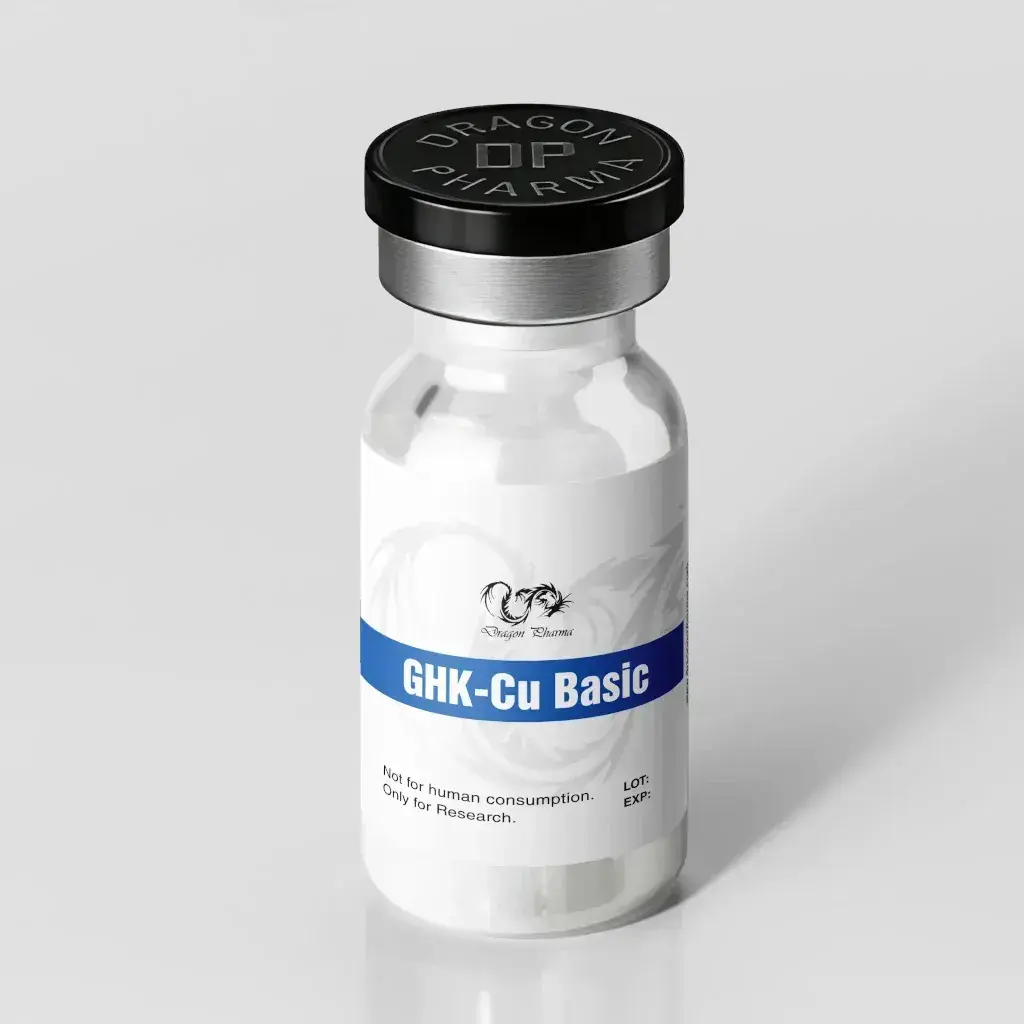
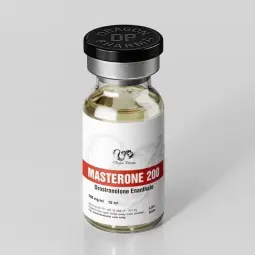
GHK-Cu Basic Injectable
GHK-Cu Basic 10 mg contains the copper tripeptide complex glycyl-L-histidyl-L-lysine-Cu²⁺, a naturally occurring metallopeptide first isolated from human plasma. The peptide sequence Gly-His-Lys has a high affinity for copper(II) ions, forming a stable 1:1 complex that serves as a bioavailable copper delivery system. In the body, GHK-Cu concentrations decline significantly with age, with plasma levels at age 60 being approximately six times lower than at age 20.
In research contexts, GHK-Cu is studied for its role in collagen synthesis and tissue remodeling. It stimulates collagen and elastin production in fibroblast cultures, promotes angiogenesis, and modulates expression of genes involved in tissue repair and antioxidant defense. The copper component serves as a cofactor for lysyl oxidase, an enzyme essential for collagen and elastin cross-linking. These mechanisms are the basis for its investigation in wound healing, skin regeneration, and anti-aging research.
In bodybuilding and recovery contexts, GHK-Cu is referenced anecdotally for supporting connective tissue repair, joint health, and skin quality. However, no clinical trials have evaluated **injectable** GHK-Cu in humans, and all existing human evidence comes from **topical** applications. Injectable use falls outside any approved indication, and the safety profile for systemic administration is completely uncharacterized.
Research Properties of GHK-Cu Basic 10 mg
- Copper tripeptide complex (Gly-His-Lys-Cu²⁺) found naturally in human plasma
- Stimulates collagen and elastin synthesis in fibroblast cultures
- Investigated for wound healing, angiogenesis, and tissue remodeling
- Modulates expression of genes involved in antioxidant defense and repair
- 10 mg per vial for research applications
Copper Tripeptide Complex
GHK-Cu (glycyl-L-histidyl-L-lysine-Cu²⁺) is a naturally occurring tripeptide-copper complex present in human plasma, saliva, and urine. The peptide binds copper with high affinity (log K ~16.4), forming a stable complex that protects against free copper toxicity while delivering the metal to target cells. The copper is coordinated in a square-planar geometry by the N-terminal amino group, the Gly-His amide nitrogen, and the histidine imidazole nitrogen.
The biological activity of GHK-Cu involves multiple mechanisms. It stimulates collagen synthesis in fibroblast cultures at concentrations as low as 10⁻¹² M, with maximal effect at 10⁻⁹ M. It also promotes angiogenesis, modulates matrix metalloproteinase (MMP) and tissue inhibitor of metalloproteinase (TIMP) balance, and influences expression of more than 4,000 genes as shown in transcriptomic analyses.
Pharmacokinetic data for **injectable** GHK-Cu in humans is entirely absent. The peptide's stability is highly pH-dependent, with the copper complex dissociating below pH 4.0. Topical penetration studies indicate limited permeation through intact stratum corneum without carrier systems.
Defining Characteristic
Copper-Dependent Tissue Remodeling
GHK-Cu's defining research characteristic is its dual role: delivering bioavailable copper for enzymatic collagen cross-linking while the peptide itself modulates gene expression related to tissue repair and antioxidant defense.
GHK-Cu Basic 10 mg vs Other Dragon Pharma Preparations
Dragon Pharma offers several peptides referenced in recovery and tissue repair research. BPC 157 is a gastric pentadecapeptide studied for angiogenesis and gut health through VEGF and NO pathways. TB 500 is a thymosin beta-4 fragment investigated for cell migration and actin regulation. GHK-CU is the standard GHK-Cu formulation from Dragon Pharma, while GHK-Cu Basic represents a simplified research presentation. These compounds operate through different mechanisms and are sometimes referenced together in tissue repair research contexts.
Typical Dosage Ranges
Common reference ranges for **injectable** GHK-Cu are not well characterized in publicly available research literature. No validated human dosing protocol exists. Community protocols reference 1–2 mg subcutaneously one to three times weekly, but these are anecdotal extrapolations without human safety or efficacy data. Topical cosmetic studies have used concentrations of 0.1–1% GHK-Cu, which does not translate to injectable dosing.
| Use Case |
Common Reference Range |
Frequency |
| Topical cosmetic (clinical studies) |
0.1–1% concentration |
Once or twice daily |
| Injectable (community, unverified) |
1–2 mg |
1–3× weekly (anecdotal) |
Reconstitution & Handling
GHK-Cu Basic 10 mg is supplied as a lyophilized powder requiring reconstitution. Bacteriostatic Water is commonly referenced for reconstituting research peptides. The reconstituted solution should be kept at pH 4.5–7.4, as the copper complex dissociates below pH 4.0. A 10 mg vial reconstituted with 2 mL yields a concentration of 5 mg/mL. Store reconstituted solution at 2–8°C and protect from light and oxidizers.
Stacking & Research Considerations
In community research contexts, GHK-Cu is sometimes referenced alongside BPC 157 or TB 500 for combined tissue repair support. However, no controlled studies have examined the safety or efficacy of these combinations. GHK-Cu's mechanism involves copper delivery and gene expression modulation, which is distinct from BPC 157 and TB 500's pathways.
Important
Individual Response Varies
The information above is for educational reference and does not constitute medical advice. GHK-Cu has not been evaluated by the FDA for safety or efficacy in injectable applications.
Important Safety Information
Topical GHK-Cu has been used in cosmetic products with a generally favorable safety profile, and the Cosmetic Ingredient Review (CIR) has confirmed its safety for topical use. However, **injectable** GHK-Cu has never been tested in human clinical trials. No Phase 1 safety data, no human pharmacokinetic studies, and no long-term safety follow-up exist for systemic administration.
Important
Non-Medical Use
Non-medical use of injectable GHK-Cu falls outside any approved indication. The FDA has not approved injectable GHK-Cu for any indication, and copper toxicity from overdose can lead to multi-organ failure, neurologic impairment, and even death.
Potential Adverse Effects
Copper is a redox-active transition metal, and free copper drives Fenton chemistry and oxidative injury. While GHK-Cu binding silences copper's redox activity, the safety of systemic copper delivery via injection is unknown. Theoretical risks include copper accumulation in tissues, potential effects on copper homeostasis, and unknown long-term consequences of repeated administration.
Community reports describe injection site reactions and occasional fatigue, but these are anecdotal and not derived from controlled trials. The absence of reported complications should not be interpreted as evidence of safety.
Conditions Requiring Medical Evaluation
Individuals with Wilson's disease (copper metabolism disorder), liver disease, or known copper sensitivity should exercise particular caution. No formal contraindication list exists for injectable GHK-Cu because no approved indication exists. Pregnancy and breastfeeding are contraindications due to lack of safety data.
Monitoring Considerations
No standardized monitoring protocol exists for injectable GHK-Cu. If used in any research context, monitoring of copper levels, liver function, and inflammatory markers may be considered, though no reference ranges for non-medical contexts are established.
Product Care
Storage & Handling
Store lyophilized powder at -20°C for long-term storage, protected from light and moisture. Maintain pH between 4.5 and 7.4 during reconstitution, as the copper complex dissociates below pH 4.0. Avoid co-incubation with strong oxidizers. Store reconstituted solution at 2–8°C and use within a reasonable timeframe.
Keep all research peptides and injectable products out of the reach of children.
Further Safety Information
USA Domestic 3–5 business days
International 10–15 business days
Order Processing 24–48 business hours
Tracking Provided after dispatch
Direct Supply
Discreet Delivery & Original Packaging
The outer shipping package remains discreet, with no external product details. Products are supplied through the official Dragon Pharma distribution chain.
What to Expect
- Orders are processed after payment confirmation
- USA Domestic shipping is typically faster when local stock is available
- International orders include tracking, though update frequency may vary by destination
- Multiple warehouses may result in separate shipments when applicable
Authenticity Verification
To verify your GHK-Cu Basic 10 mg product, use the security code on the vial label and cross-check it on the official Dragon Pharma site. Original packaging and batch documentation help reinforce product legitimacy.
For complete delivery details, tracking policy, and reshipment terms, please see our Shipping Info page.
Recommended Conditions
Store lyophilized powder at -20°C for long-term storage, protected from light and moisture. The unopened vial should be kept under conditions that preserve the peptide's structural integrity until reconstitution.
Once reconstituted, GHK-Cu solution should be stored at 2–8°C and used within a reasonable timeframe. Maintain pH between 4.5 and 7.4. Do not freeze reconstituted solution. Discard if solution becomes cloudy or develops particulate matter.
Keep out of reach of children. Follow proper handling practices for research peptides and use appropriate sterile technique during reconstitution.
Quick Reference
Do & Don't
- Do store lyophilized powder at -20°C for long-term storage
- Do protect from light and moisture
- Do maintain pH between 4.5 and 7.4 during reconstitution
- Don't freeze reconstituted solution
- Don't expose to strong oxidizers
- Don't use if powder appears discolored
What is GHK-Cu Basic 10 mg used for?
GHK-Cu Basic 10 mg is a research peptide supplied as a lyophilized powder. It contains the copper tripeptide complex GHK-Cu, which is investigated for collagen synthesis, wound healing, and tissue remodeling. There is no FDA-approved injectable human indication for GHK-Cu.
How often should GHK-Cu Basic 10 mg be administered?
Common reference ranges for injectable GHK-Cu are not well characterized in publicly available research literature. No validated human dosing protocol exists. Community protocols reference 1–2 mg subcutaneously one to three times weekly, but these are anecdotal extrapolations without human safety data.
Does GHK-Cu Basic 10 mg require PCT?
GHK-Cu is not an anabolic steroid and does not suppress endogenous testosterone production. Post-cycle therapy designed for steroid cycles is not applicable. Its mechanism involves copper delivery and gene expression modulation, not hormonal pathways.
What does GHK-Cu do?
GHK-Cu stimulates collagen and elastin synthesis in fibroblasts, promotes angiogenesis, and modulates expression of genes involved in tissue repair and antioxidant defense. The copper component serves as a cofactor for lysyl oxidase, which cross-links collagen and elastin fibers.
How long does GHK-Cu take to work?
No established onset timeline exists for injectable GHK-Cu in humans because no clinical trials have been completed. Topical cosmetic studies have observed skin improvements over 12 weeks, but these timelines do not apply to injectable use.
Is GHK-Cu the best copper peptide?
GHK-Cu is the most extensively studied copper peptide, with research spanning collagen synthesis, wound healing, and gene expression modulation. However, no single copper peptide is universally superior, and injectable use remains unvalidated in humans.
What is the difference between GHK-Cu and BPC 157?
GHK-Cu is a copper-binding tripeptide that stimulates collagen synthesis and gene expression remodeling. BPC 157 is a gastric pentadecapeptide studied for angiogenesis and gut health through VEGF and NO pathways. Their mechanisms and research applications are fundamentally different.
What is the difference between GHK-Cu and TB 500?
TB 500 is a thymosin beta-4 fragment investigated for cell migration and actin regulation. GHK-Cu is a copper tripeptide that modulates collagen synthesis and gene expression. These compounds operate through entirely different biological pathways.
Is 10 mg of GHK-Cu a lot?
10 mg is the total labeled content of the GHK-Cu Basic 10 mg vial. Because no standardized injectable human dosage exists for this research peptide, the milligram amount cannot be classified as high or low relative to established protocols.
What strength is GHK-Cu Basic 10 mg?
GHK-Cu Basic 10 mg by Dragon Pharma contains 10 mg of GHK-Cu Basic per vial as a lyophilized powder. The vial size is 2 mL. This is a research presentation.
Can GHK-Cu be stacked with other peptides?
There is no established research on combining GHK-Cu with other peptides. In community contexts, it is sometimes referenced alongside BPC 157 or TB 500 for tissue repair support, but no controlled studies support these combinations.
No reviews found
Please log in to write GHK-Cu Basic 10 mg review.