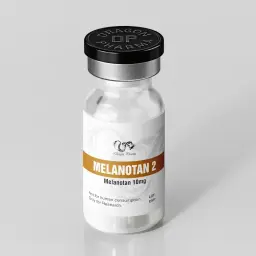


PT-141 10 mg is a lyophilized powder research peptide manufactured by Dragon Pharma, containing 10 mg of Bremelanotide (PT-141) per 2 mL vial.
PT-141 (bremelanotide) is a synthetic cyclic heptapeptide analog of alpha-melanocyte-stimulating hormone (α-MSH) that acts as an agonist at melanocortin receptors, primarily MC3R and MC4R, which are expressed in the central nervous system. Unlike PDE5 inhibitors such as sildenafil, which act on the vascular system to improve blood flow, bremelanotide works centrally in the brain to generate sexual desire and arousal. This mechanistic distinction explains why it is commonly referenced in contexts where libido is a primary concern.
Bremelanotide is FDA-approved under the brand name Vyleesi for the treatment of premenopausal women with acquired, generalized hypoactive sexual desire disorder (HSDD), administered as a 1.75 mg subcutaneous injection in the abdomen or thigh at least 45 minutes before anticipated sexual activity. However, Vyleesi is not indicated for the treatment of HSDD in postmenopausal women or in men, and it is not indicated to enhance sexual performance.
In non-medical bodybuilding and performance contexts, PT-141 is sometimes referenced for libido support during anabolic steroid cycles, where testosterone suppression can cause low sexual desire. It is not a performance-enhancing peptide in the muscle-building sense and does not build muscle, burn fat, or improve athletic performance. All such use falls outside approved indications.
PT-141 10 mg is supplied as a lyophilized (freeze-dried) powder in a 2 mL vial. This form requires reconstitution with a suitable solvent such as bacteriostatic water before use.
Bremelanotide is a melanocortin receptor agonist that acts centrally in the brain to influence sexual desire and arousal through MC3R and MC4R activation.
Bremelanotide is a synthetic analog of α-MSH, sharing structural similarity with melanotan II but distinguished by a C-terminal carboxylic acid modification that alters its receptor selectivity profile. It binds with highest affinity to MC4R and MC3R, receptors concentrated in the hypothalamus and limbic system where they influence sexual motivation and reward pathways.
The peptide has approximately 100% bioavailability following subcutaneous administration, with a half-life of approximately 2.7 hours and a time-to-peak of about 1 hour. Despite the relatively short plasma half-life, the duration of subjective effects is substantially longer, commonly reported to last 6–24 hours or more, reflecting the downstream neural signaling initiated by receptor activation.
A 2025 study in female Syrian hamsters examined whether bremelanotide acts directly on the mesolimbic dopamine reward circuit. The results did not support the hypothesis that bremelanotide acts anatomically on the reward circuitry, nor did they provide evidence for a direct reward-enhancing mechanism, suggesting its effects may operate through other central pathways.
PT-141 acts on melanocortin receptors in the brain to generate desire, whereas PDE5 inhibitors act peripherally on vascular smooth muscle. The FDA label states the recommended dose is 1.75 mg subcutaneously at least 45 minutes before anticipated activity, with a maximum of one dose per 24 hours and no more than 8 doses per month.
Dragon Pharma offers several products that are commonly referenced alongside PT-141 10 mg in sexual health and performance contexts. Cialis (tadalafil) is a PDE5 inhibitor that improves erectile function through vascular mechanisms, complementing PT-141’s central desire effects when used together. Viagra (sildenafil) is another PDE5 inhibitor with a shorter duration of action. Cock Bombs is a pre-combined Cialis/Viagra product. For prolactin management, which is often relevant when testosterone is suppressed, Caber is commonly referenced.
The information below is provided for educational reference only. Bremelanotide (Vyleesi) is a prescription medication approved for a specific indication; medical use requires appropriate diagnosis and clinical supervision. Non-medical use falls outside approved indications.
The FDA-approved dose of bremelanotide (Vyleesi) is 1.75 mg administered subcutaneously in the abdomen or thigh, as needed, at least 45 minutes before anticipated sexual activity. Patients should not administer more than one dose within 24 hours, and more than 8 doses per month is not recommended. In non-medical community contexts, users sometimes reference starting at lower doses (0.5–1 mg) to establish tolerance before moving to the 1.75 mg range, and some report a microdosing strategy of 15–20 mcg injected multiple times daily, though this is not FDA-sanctioned and lacks clinical validation.
| Use Case | Common Reference Range | Administration Frequency |
|---|---|---|
| FDA-approved (Vyleesi) | 1.75 mg | At least 45 min before activity, max 1 dose/24 hrs |
| Community conservative start | 0.5–1 mg | Once daily, PRN |
| Community working range | 1.0–1.75 mg | Once daily, max 2–3x/week |
| Community microdosing (not validated) | 15–20 mcg | Multiple times daily |
In non-medical contexts, PT-141 is sometimes stacked with PDE5 inhibitors such as Cialis (tadalafil) or Viagra (sildenafil) for combined central desire and peripheral blood flow effects. A 2005 study found that the combination of bremelanotide and sildenafil produced a significantly greater erectile response than either agent alone. For individuals using anabolic steroids, Caber (cabergoline) is sometimes referenced to manage prolactin elevation, which can itself contribute to low libido.
Community protocols typically reference usage as-needed rather than in structured cycles. However, there is a risk of tachyphylaxis (diminishing response with frequent use), and spacing doses at least 48–72 hours apart is commonly referenced to preserve effectiveness. Bacteriostatic Water is commonly used for reconstitution.
Nausea is the most commonly reported adverse reaction, occurring in approximately 40% of patients in Phase 3 trials, with 13% requiring anti-emetic therapy and some discontinuing due to this effect. Nausea typically begins 30–60 minutes post-injection and lasts 1–2 hours. Structured mitigation strategies referenced in community contexts include starting at a lower dose (0.5–1 mg), taking an anti-emetic such as ondansetron 30 minutes before injection, eating a light meal 1–2 hours before, and staying hydrated. Notably, the FDA label states that pre-treatment with ondansetron was not found to be effective in clinical studies, though community reports suggest benefit in some individuals.
Other common side effects include facial flushing (20%), headache (11%), injection-site reactions (13%), and transient blood pressure elevation of approximately 5–10 mmHg systolic that peaks 2–4 hours post-dose and resolves within 12 hours.
PT-141 acts on melanocortin receptors in the central nervous system rather than the hypothalamic-pituitary-gonadal axis. It does not suppress endogenous testosterone production and does not require post-cycle therapy. However, in bodybuilding contexts, it is sometimes used during PCT or periods of suppressed testosterone to address libido concerns, while traditional PCT agents such as Clomid or Nolvadex work to restore endogenous hormone production.
Dosing strategies and tolerance management should be adjusted based on individual response. The information above is for educational reference and does not constitute medical advice.
Bremelanotide (Vyleesi) is a prescription medication approved for premenopausal women with acquired, generalized HSDD. It is contraindicated in patients with uncontrolled hypertension or known cardiovascular disease.
Vyleesi is contraindicated in patients who have uncontrolled hypertension or known cardiovascular disease. Before initiating treatment, patients’ cardiovascular risk should be considered and blood pressure should be well-controlled. Vyleesi is not recommended for patients at high risk for cardiovascular disease.
The FDA label states that Vyleesi is not indicated for the treatment of HSDD in postmenopausal women or in men, and it is not indicated to enhance sexual performance.
PT-141 obtained through research peptide channels is not approved for human use. Any use outside the FDA-approved indication for Vyleesi falls outside approved indications. Product concentration and laboratory verification do not establish that non-medical use is safe or appropriate for an individual.
Nausea is the most common adverse reaction, reported in 40% of Vyleesi-treated patients in Phase 3 trials, with 13% requiring anti-emetic therapy and some discontinuing treatment due to this effect. Nausea typically lasts about 2 hours but can be longer in some individuals.
Focal hyperpigmentation, including darkening of the face, gums, and breasts, was reported in 1% of patients receiving up to 8 doses per month in Phase 3 trials. In a separate study, 38% of patients developed focal hyperpigmentation after receiving Vyleesi daily for 8 days. Patients with darker skin were more likely to develop this effect. Resolution of hyperpigmentation was not confirmed in all patients after discontinuation, and more than 8 monthly doses is not recommended.
Vyleesi transiently increases blood pressure (maximal increase of 6 mmHg systolic, 3 mmHg diastolic) and reduces heart rate (up to 5 beats per minute), peaking 2–4 hours post-dose and resolving within 12 hours. Taking doses less than 24 hours apart may increase the risk of additive blood pressure effects.
Vyleesi is contraindicated in patients with uncontrolled hypertension or known cardiovascular disease. Patients with high blood pressure, heart problems, kidney problems, or liver problems should discuss these conditions with a healthcare provider before use.
Women who can become pregnant should use effective contraception during treatment with Vyleesi and discontinue use if pregnancy is suspected. There is a pregnancy registry for women exposed to Vyleesi during pregnancy.
Before initiating Vyleesi and periodically during treatment, patients’ cardiovascular risk should be considered and blood pressure should be well-controlled. In non-medical contexts, individuals commonly reference home blood pressure monitoring, checking sitting BP one hour pre-dose and 3–4 hours post-dose for the first few sessions, especially if other compounds that affect blood pressure are being used.
No published laboratory reports are available for this specific product. Product potency verification would apply to tested samples only and is separate from any clinical monitoring of the individual.
For the FDA-approved product, Vyleesi should be stored at or below 25°C (77°F), not frozen, and protected from light. For lyophilized research peptide vials, store tightly sealed in the original container, protected from light, and desiccated at -20°C for long-term storage. After reconstitution, store refrigerated at 2–8°C and use within the period specified.
Keep all medications and injectable products out of the reach of children. Follow the storage instructions provided with the product packaging.
PT-141 10 mg by Dragon Pharma is supplied through the official distribution chain and shipped in original manufacturer packaging with discreet, privacy-focused handling.
The outer shipping package remains discreet, with privacy-focused handling and no unnecessary external product details. Products are supplied through the official Dragon Pharma distribution chain.
To verify your PT-141 10 mg product, use the security code on the vial label and cross-check it on the Dragon Pharma official site. Official presentation, batch-linked lab proof when available, and original packaging help reinforce product legitimacy and buyer confidence.
For complete delivery details, tracking policy, and reshipment terms, please see our Shipping Info page.
Proper storage conditions help preserve peptide stability and overall product integrity throughout shelf life.
Store the lyophilized (dry) powder tightly sealed in its original container, protected from light, and desiccated at -20°C for long-term storage. The FDA-approved Vyleesi product is stored at or below 25°C (77°F), not frozen, and protected from light. For research peptide vials, brief handling at refrigerated or ambient conditions is acceptable provided the container is allowed to equilibrate to room temperature before opening to prevent moisture uptake.
After reconstitution, store refrigerated at 2–8°C and use within the period specified. Avoid repeated freeze-thaw cycles.
Keep out of reach of children. Follow proper handling and sterile technique when administering the product.
Answers to common questions about PT-141 10 mg, its mechanism, product strength, and laboratory testing.
PT-141 10 mg contains bremelanotide, a melanocortin receptor agonist. The FDA-approved product (Vyleesi) is indicated for premenopausal women with acquired, generalized hypoactive sexual desire disorder (HSDD). In non-medical bodybuilding contexts, it is sometimes referenced for libido support during anabolic steroid cycles, though such use falls outside approved indications.
The FDA-approved dosing is 1.75 mg subcutaneously at least 45 minutes before anticipated sexual activity, with no more than one dose within 24 hours and no more than 8 doses per month. Community protocols often reference starting at lower doses (0.5–1 mg) to establish tolerance, and spacing doses at least 48–72 hours apart to preserve responsiveness.
No. PT-141 acts on melanocortin receptors in the central nervous system rather than the hypothalamic-pituitary-gonadal axis. It does not suppress endogenous testosterone production and does not require post-cycle therapy.
Bremelanotide is a melanocortin receptor agonist that binds MC3R and MC4R in the central nervous system, generating sexual desire and arousal through central mechanisms. Unlike PDE5 inhibitors which act on the vascular system, it works in the brain to influence sexual motivation.
The FDA label states administration at least 45 minutes before anticipated sexual activity. The plasma half-life is approximately 2.7 hours, but subjective effects commonly last 6–24 hours or longer, with some users reporting residual effects for up to 48 hours.
Viagra (sildenafil) is a PDE5 inhibitor that acts on the vascular system to improve penile blood flow. PT-141 (bremelanotide) is a melanocortin receptor agonist that acts on the central nervous system to generate desire and arousal. A 2005 study found that combining bremelanotide with sildenafil produced a greater erectile response than either alone.
Melanotan 2 is a non-selective melanocortin agonist that binds MC1R through MC5R, producing tanning effects alongside sexual arousal. PT-141 was derived from melanotan II research but has a modified structure that alters receptor selectivity, with effects more focused on sexual desire. Stacking the two at full doses is generally advised against due to overlapping melanocortin receptor activation.
1.75 mg is the FDA-approved dose for Vyleesi, administered subcutaneously. In community contexts, some users start at lower doses (0.5–1 mg) to assess tolerance before moving to the full dose. The 10 mg vial contains multiple doses at these levels.
PT-141 10 mg is labeled at 10 mg of Bremelanotide (PT-141) per vial. It is supplied as a lyophilized powder in a 2 mL vial, requiring reconstitution before use.
No published laboratory report is currently available for this specific product. Product potency and purity verification would apply to tested samples only and should not be interpreted as a measurement of every vial or production batch.
Lyophilized PT-141 is typically reconstituted with a suitable solvent such as Bacteriostatic Water or sterile water. The volume of solvent added determines the concentration of the resulting solution. Proper sterile technique should be used during reconstitution.