
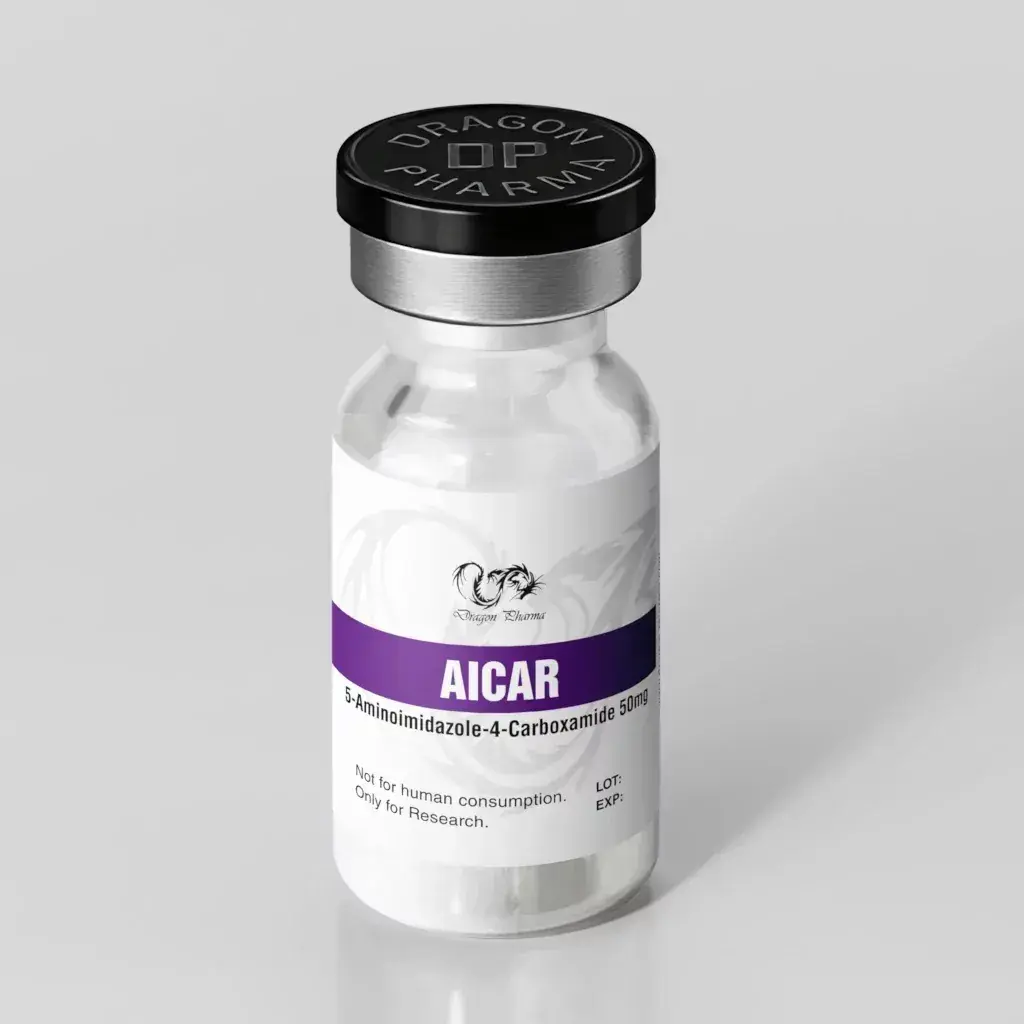
AICAR 50 mg is a lyophilized research peptide manufactured by Dragon Pharma, supplied as 50 mg per 2 mL vial for laboratory research purposes.
AICAR 50 mg contains AICAR (5-aminoimidazole-4-carboxamide ribonucleotide), also known as acadesine, a cell-permeable nucleoside analog that activates AMP-activated protein kinase (AMPK). AMPK is a master regulator of cellular energy homeostasis, and AICAR's activation of this enzyme triggers metabolic pathways typically associated with exercise, including increased glucose uptake, fatty acid oxidation, and mitochondrial biogenesis.
AICAR has been studied in human clinical trials for cardiovascular applications, specifically cardioprotection during coronary artery bypass graft (CABG) surgery. A 1997 JAMA meta-analysis pooled five randomized, placebo-controlled trials across 4,043 patients and reported a 27% reduction in perioperative myocardial infarction and a 50% reduction in early cardiac death. However, the program did not result in FDA approval. A second wave of trials in chronic lymphocytic leukemia (CLL) also failed to achieve approval. As of April 2026, AICAR has no FDA-approved indication for any use.
In non-medical bodybuilding and biohacking contexts, AICAR is discussed as a potential "exercise mimetic" based on a 2008 Salk Institute mouse study that reported increased running endurance in sedentary mice. Human endurance and fat-loss benefits have never been demonstrated in clinical trials. AICAR is classified as a WADA-prohibited substance under S4.5 (Hormone and Metabolic Modulators), banned both in-competition and out-of-competition.
AICAR 50 mg is supplied as a lyophilized powder in a 2 mL vial. The powder requires reconstitution with an appropriate solvent before laboratory use. Once reconstituted, the solution should be stored refrigerated at 2-8°C and used within approximately 14-28 days.
AICAR (acadesine) is a nucleoside analog that mimics AMP and activates AMPK, the master regulator of cellular energy metabolism.
AICAR belongs to the class of AMPK-activating compounds. Its mechanism involves intracellular phosphorylation to ZMP (5-aminoimidazole-4-carboxamide ribonucleotide monophosphate), which mimics AMP and allosterically activates AMPK. Once activated, AMPK promotes fatty acid oxidation, glucose uptake into skeletal muscle, and mitochondrial biogenesis. AICAR also inhibits hepatic glucose production and cholesterol synthesis in the liver.
The pharmacokinetic properties of AICAR include a molecular weight of 338.21 Da and a chemical formula of C9H14N4O5. The half-life is approximately 2-3 hours. In human clinical trials for CABG surgery, AICAR was administered as an intravenous infusion at doses around 0.1 mg/kg/min for 7 hours. In the CLL Phase I/II trial, the maximum tolerated dose was 210 mg/kg.
Preclinical research has identified several effects of AICAR beyond AMPK activation. It has antiproliferative effects, notably by specifically inducing apoptosis of aneuploid cells. Some effects of AICAR are AMPK-independent, suggesting multiple targets that have not been fully characterized. In mice, AICAR has been shown to enhance endurance of sedentary animals.
AICAR has no FDA-approved indication for any use. Its most advanced clinical development program (cardioprotection in CABG surgery) was completed in the 1990s and did not result in approval. No active IND for metabolic, endurance, or performance indications is publicly registered.
Dragon Pharma offers a range of research peptides and compounds. AICAR 50 mg is positioned as a research peptide with a distinct mechanism targeting AMPK, complementing other metabolic research compounds.
For PPARδ agonist research, Dragon Pharma offers GW501516, which targets a different metabolic pathway and is also commonly referenced in bodybuilding contexts. For mitochondrial research compounds, MOTS-C and SS-31 target different aspects of mitochondrial function. AICAR's AMPK-activating mechanism represents a distinct research approach.
The information below is provided for educational reference only. AICAR is a research compound that has never been approved for human use. No human safety or efficacy data exists for fitness, endurance, or performance applications. Non-medical use falls outside any approved indications and carries unknown health risks.
No established human dosage exists for AICAR in fitness or performance contexts. In clinical trials, AICAR was administered intravenously for cardioprotection and at high doses (up to 210 mg/kg) for CLL. In non-medical bodybuilding contexts, community references suggest subcutaneous doses ranging from 10 mg to 50 mg daily, with some protocols using 10 mg as a beginner dose, 25 mg as moderate, and 50 mg every other day as aggressive. Forum logs reference doses as low as 16 mg. These doses are extrapolated from animal studies and community anecdote, not from human clinical data for fitness applications.
| Use Case | Common Reference Range | Frequency |
|---|---|---|
| Preclinical research (mouse) | 0.5 mg/g/day | Daily |
| Clinical trial (CABG, IV) | 0.1 mg/kg/min | 7-hour infusion |
| Clinical trial (CLL, IV) | Up to 210 mg/kg | Per protocol |
| Non-medical (community reference) | 10–50 mg | Daily or EOD |
Community doses are roughly 500 times below animal study levels on a body-weight basis, and real-world effects remain subtle and debated. Human efficacy has never been demonstrated in clinical trials.
AICAR is not an anabolic compound and is not stacked for muscle-building purposes. In non-medical contexts, it is sometimes referenced alongside other metabolic research compounds. Dragon Pharma offers GW501516 as a PPARδ agonist with a different mechanism, and MOTS-C as a mitochondrial-derived peptide. Community discussions reference combining AICAR with GW501516 for complementary metabolic effects, though no clinical data exists on such combinations.
Because AICAR's human safety profile is not established for fitness applications, cycle structure and support compounds remain speculative. Any use should be considered experimental.
The most significant safety concern from clinical trials is hyperuricemia (elevated uric acid). In the CABG meta-analysis, hyperuricemia occurred in 5.1% of acadesine-treated patients compared to 0.7% of placebo patients (odds ratio 7.32, p < 0.001). Mild increases in plasma uric acid were observed only in patients receiving high doses and were without clinical sequelae.
Hypoglycemia is a theoretical risk because AICAR-driven AMPK activation increases GLUT4-mediated glucose uptake. Individuals with diabetes or those who are fasted or insulin-sensitive may be particularly vulnerable. Gastrointestinal discomfort has also been reported in clinical trials. Long-term human safety data do not exist for fitness-relevant doses or durations.
AICAR is not part of any post-cycle therapy protocol. It has no relationship to the hypothalamic-pituitary-gonadal axis. Its research focus has been on metabolic and cardiovascular endpoints, not hormonal recovery. PCT compounds such as Clomid and Nolvadex address different biological systems entirely.
AICAR has never been approved for human use. Its clinical development was discontinued without FDA approval. The information above is for educational reference and does not constitute medical advice. Human use for fitness or performance is not supported by evidence and is prohibited by WADA.
AICAR is an experimental research compound that has never been approved for human use. Clinical trials for cardioprotection and CLL did not result in FDA approval. No human safety data exists for fitness applications.
AICAR is not FDA-approved for any indication. It has no approved label and no legitimate prescription pathway for fitness, endurance, or metabolic optimization. Material sold as a research chemical is not manufactured to pharmaceutical standards and carries unknown purity, sterility, and dose accuracy risks. AICAR is classified as a WADA-prohibited substance under S4.5 (Hormone and Metabolic Modulators), banned both in-competition and out-of-competition.
AICAR is sold strictly for research purposes. It is not a dietary supplement, medication, or approved therapeutic agent. Human consumption for fitness or performance is not recommended and may pose unknown health risks. Product quality does not establish that human use is safe or appropriate.
Hyperuricemia is the most consistently reported adverse effect from clinical trials. In the CABG meta-analysis, hyperuricemia occurred in 5.1% of acadesine-treated patients compared to 0.7% of placebo patients (OR 7.32, p < 0.001). This is attributable to AICAR's metabolism, which increases uric acid burden. Individuals with a history of hyperuricemia or gout may be particularly at risk.
Hypoglycemia is a theoretical concern because AICAR-driven AMPK activation increases GLUT4-mediated glucose uptake. This risk may be elevated in fasted or insulin-sensitive individuals. Gastrointestinal discomfort has also been reported. Off-target cell cycle effects have been identified in preclinical models, and endogenous nucleosides may block AICAR-stimulated AMPK activation, creating unpredictable pharmacodynamics.
Long-term human safety data do not exist for fitness-relevant doses or durations. The long-term consequences of chronic AMPK activation in healthy individuals are not known.
AICAR has no approved indications and no established contraindications because no human use is supported. However, clinical trial data and mechanistic considerations suggest particular caution for individuals with a history of hyperuricemia or gout, predisposition to hypoglycemia, known hypersensitivity to adenosine analogs or nucleoside compounds, and pregnancy or breastfeeding (no reproductive/developmental data). Competitive athletes subject to WADA jurisdiction should be aware that detectable exogenous AICAR constitutes a doping violation regardless of source or intent.
No monitoring protocols exist for AICAR because it has no approved human use for fitness applications. In clinical trials, safety monitoring included assessment of uric acid levels and renal function. For research settings, standard laboratory safety monitoring would apply, with particular attention to uric acid and glucose levels.
Store lyophilized powder at -20°C in dry, dark conditions and limit moisture exposure. Once reconstituted, refrigerate at 2-8°C and use within approximately 14-28 days; do not freeze the mixed solution, as freezing can denature peptides. Keep all research compounds out of the reach of children. AICAR is classified as a WADA-prohibited substance under S4.5 and is banned in sport.
AICAR 50 mg is supplied through the official Dragon Pharma distribution chain and shipped in original manufacturer packaging with discreet, privacy-focused handling.
The outer shipping package remains discreet, with privacy-focused handling and no unnecessary external product details. Products are supplied through the official Dragon Pharma distribution chain.
To verify your AICAR 50 mg product, use the security code on the packaging and cross-check it on the Dragon Pharma official site. Official Dragon Pharma presentation and original packaging help reinforce product legitimacy and buyer confidence.
Proper storage conditions help preserve peptide integrity and stability throughout shelf life.
Store lyophilized powder at -20°C in dry, dark conditions and limit moisture exposure. Keep the vial in its original packaging until use. Let frozen vials warm to room temperature before opening so condensation won't form.
Once reconstituted, refrigerate at 2-8°C and use within approximately 14-28 days; do not freeze the mixed solution, as freezing can denature peptides. Avoid repeated freeze-thaw cycles of the reconstituted solution. Keep out of reach of children.
Answers to common questions about AICAR 50 mg, its research status, mechanism of action, and safety considerations.
AICAR 50 mg is a research peptide studied as an AMPK activator for metabolic research. It was clinically investigated for cardioprotection during CABG surgery and for chronic lymphocytic leukemia, but neither program resulted in FDA approval. It has no approved human use and is sold strictly for laboratory research purposes.
No established human dosage exists for AICAR in fitness or performance contexts. In clinical trials, it was administered intravenously at doses ranging from 0.1 mg/kg/min (CABG) to 210 mg/kg (CLL). In non-medical community contexts, subcutaneous doses of 10-50 mg daily or every other day are referenced. These community doses are roughly 500 times below animal study levels and are not supported by human clinical data.
AICAR has no relationship to the hypothalamic-pituitary-gonadal axis and is not part of any post-cycle therapy protocol. Its research focus has been on metabolic and cardiovascular endpoints, not hormonal recovery. PCT compounds such as Clomid and Nolvadex address entirely different biological systems.
AICAR is a cell-permeable nucleoside analog that is phosphorylated intracellularly to ZMP, which mimics AMP and activates AMPK. AMPK activation triggers metabolic pathways associated with exercise, including increased glucose uptake, fatty acid oxidation, and mitochondrial biogenesis. Some effects of AICAR are AMPK-independent, suggesting additional targets.
AICAR has a half-life of approximately 2-3 hours. In animal studies, metabolic effects were observed over days to weeks of treatment. In the mouse endurance study, effects were observed after a 4-week treatment period. No human data exists on the time course of AICAR effects for fitness or performance applications.
There is no single AMPK activator that is universally best. AICAR is a research tool commonly used to study AMPK biology. Other AMPK activators like metformin and A769662 work through different mechanisms. AICAR's lack of FDA approval and its WADA-prohibited status limit its legitimate use to laboratory research.
AICAR and GW501516 work through different mechanisms. AICAR activates AMPK by mimicking AMP, while GW501516 is a PPARδ agonist that modulates gene expression related to fatty acid oxidation. Both are WADA-prohibited substances and have been investigated for metabolic effects. AICAR's mechanism is more direct and acute, while GW501516's effects are mediated through transcriptional changes.
AICAR and MOTS-C have different mechanisms. MOTS-C is a mitochondrial-derived peptide that acts catalytically on the folate-methionine cycle, causing AICAR to accumulate endogenously. AICAR, when administered directly, activates AMPK more bluntly. MOTS-C is described as more "surgical" in comparison, targeting tissues where it naturally distributes.
No human dosing standards exist for AICAR in fitness contexts. The 50 mg vial strength is a research quantity. In animal studies, AICAR was administered at 0.5 mg/g/day, which for a 70 kg human would be approximately 35,000 mg daily—far beyond the 50 mg vial content. Community doses of 10-50 mg are extrapolated from animal studies but are roughly 500 times below the animal study levels on a body-weight basis.
AICAR 50 mg is labeled at 50 mg of AICAR per vial. It is supplied as a lyophilized powder in a 2 mL vial, requiring reconstitution before laboratory use.
Yes. Hyperuricemia is the most consistently reported adverse effect of AICAR in clinical trials. In the CABG meta-analysis, hyperuricemia occurred in 5.1% of acadesine-treated patients compared to 0.7% of placebo patients (OR 7.32, p < 0.001). AICAR metabolism increases uric acid burden. Individuals with a history of hyperuricemia or gout may be particularly at risk.
No. AICAR has never been approved by the FDA or any regulatory authority for human use. Its most advanced clinical development program (cardioprotection in CABG surgery) was completed in the 1990s and did not result in approval. As of April 2026, no active IND for AICAR in metabolic, endurance, or performance indications is publicly registered.