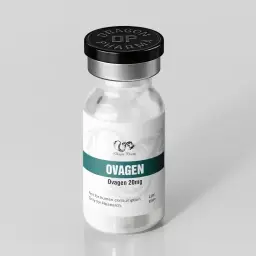

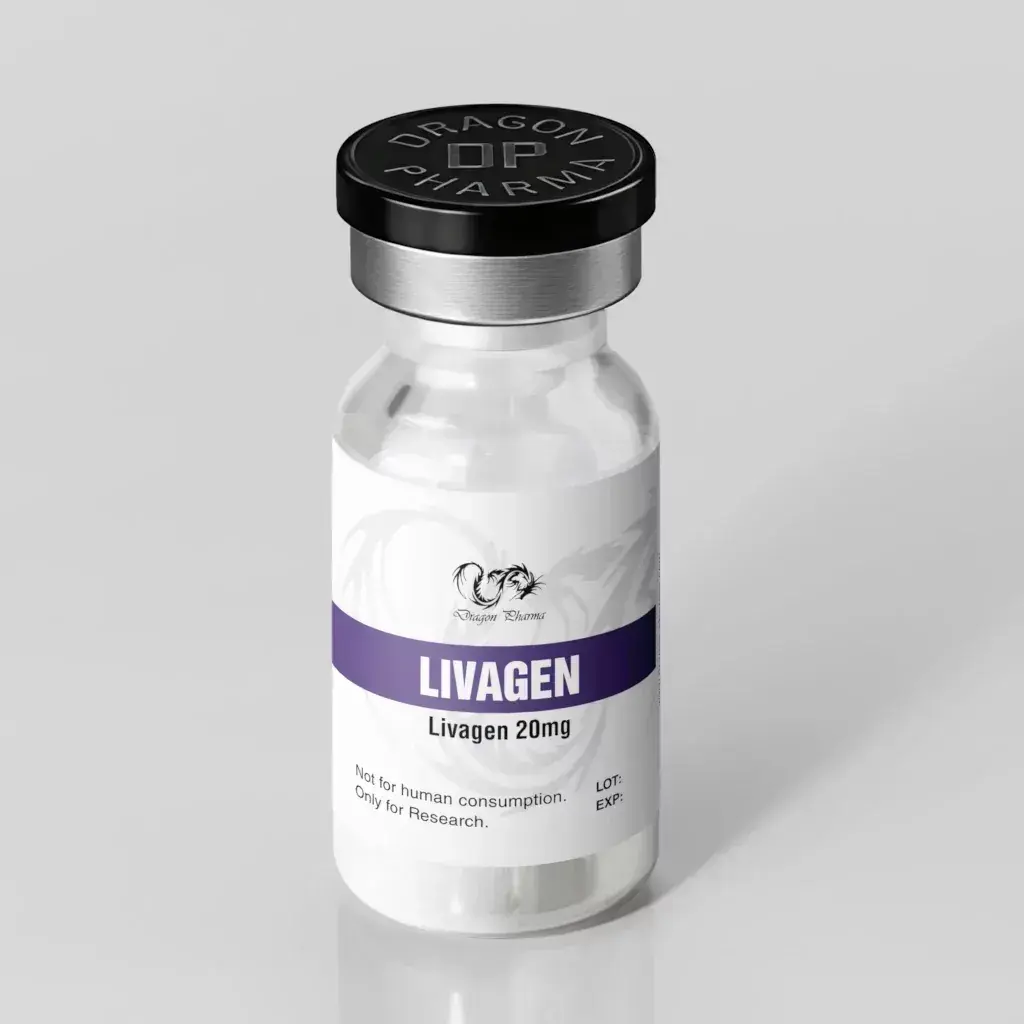
Livagen 20 mg is a lyophilized powder research peptide manufactured by Dragon Pharma, containing 20 mg of Livagen (KEDA tetrapeptide) per 2 mL vial.
Livagen is a synthetic tetrapeptide with the amino acid sequence Lys-Glu-Asp-Ala (KEDA), developed as part of the peptide bioregulator class by Russian researcher Vladimir Khavinson. It is one of several short peptides designed to target specific tissue types, with Livagen specifically studied for its interaction with liver tissue and hepatocyte gene expression.
In research settings, Livagen has been investigated for its proposed ability to interact with DNA regulatory sequences in hepatocytes, potentially modulating gene expression related to liver function, detoxification, and regeneration. The peptide is not FDA-approved for any human use, and the FDA has evaluated Livagen-related substances through the Pharmacy Compounding Advisory Committee process. In non-medical contexts, Livagen is sometimes referenced for its proposed liver-supporting properties, though such use falls outside approved indications.
Unlike peptides that act through cell surface receptors, Livagen is proposed to enter cells and interact directly with chromatin, causing decondensation of heterochromatin and increased gene transcription. This mechanism, if validated, would represent an epigenetic approach to modulating tissue-specific gene expression rather than a conventional receptor-mediated signaling pathway.
Livagen 20 mg is supplied as a lyophilized (freeze-dried) powder in a 2 mL vial. This form requires reconstitution with a suitable solvent such as bacteriostatic water before use.
Livagen is a synthetic tetrapeptide bioregulator designed to target liver tissue through direct interaction with hepatocyte DNA and chromatin remodeling mechanisms.
Livagen (Lys-Glu-Asp-Ala) is classified as a peptide bioregulator or "cytogen," a category of short synthetic peptides developed to interact with specific tissue types and modulate gene expression. The tetrapeptide was synthesized based on analysis of liver polypeptide preparations, with the goal of reproducing the tissue-specific effects of larger peptide complexes in a defined, small molecule.
The proposed mechanism involves direct interaction with DNA regulatory sequences in hepatocytes, particularly AT-rich regions in gene promoter areas, leading to chromatin decondensation and increased transcription of genes involved in liver function. Research using fluorescence spectroscopy and molecular modeling has demonstrated that the KEDA tetrapeptide can bind to specific nucleotide sequences, and electron microscopy has shown decondensation of heterochromatin blocks in hepatocyte nuclei following Livagen treatment.
Animal studies have reported that Livagen administration increased protein synthesis in cultured hepatocytes from rats of different ages, with the highest effect observed in cells from old animals. A 2005 study examining digestive enzyme activity found that two weeks of oral Livagen administration reduced enzyme activity in young rats while increasing it in old rats, with activity in old animals approaching levels seen in young controls.
All published research on Livagen originates from Russian institutions, primarily the St. Petersburg Institute of Bioregulation and Gerontology. No independent Western replication or controlled human clinical trials have been conducted. The evidence base is rated as very low, with the chromatin-binding mechanism remaining theoretical.
Dragon Pharma offers several peptide bioregulators and research peptides that are commonly referenced alongside Livagen 20 mg. Ovagen is another Khavinson bioregulator peptide, similarly investigated for tissue-specific gene regulation. Vesugen and Cardiogen are bioregulator peptides studied for vascular and cardiac tissue respectively. Epitalon is a well-known bioregulator peptide studied for pineal gland effects and telomerase activation. For general liver and tissue support, Glutathione provides antioxidant support through a different mechanism.
The information below is provided for educational reference only. Livagen is not FDA-approved for any human use in the United States. All use in non-medical contexts falls outside approved indications.
Common reference ranges for Livagen in non-medical contexts are derived from community protocols rather than clinical trial data. No human dosing trial has established a safe or effective amount, and the FDA has not approved Livagen for any indication. Community protocols commonly reference short cycles of 10–20 days with doses ranging from 10 mg to 20 mg per administration, followed by extended breaks.
| Use Case | Common Reference Range | Administration Frequency |
|---|---|---|
| Community reference (standard) | 10–20 mg per administration | Daily for 10–20 days, 2–3 cycles yearly |
| Community reference (conservative) | 5–10 mg per administration | Daily for 10–20 days |
| Research (animal studies) | Variable by study | Variable by study |
These figures are anecdotal and not medically established. The underlying human evidence for any specific amount is weak, and no figure should be read as a recommended or validated amount.
Livagen is sometimes referenced as a component of peptide bioregulator stacks in non-medical contexts. In longevity-focused stacks, Livagen is commonly combined with other bioregulator peptides such as Thymalin, Cortagen, and Vesiluten, with protocols typically running 10–12 weeks active followed by 6–8 week breaks. In immune optimization protocols, Livagen is sometimes included alongside Thymalin and Vilon, administered twice weekly during active cycles.
Community protocols for bioregulator peptides typically reference cycling logic based on the premise that gene expression changes persist after a course of administration, making continuous dosing unnecessary. This cycling logic has not been independently validated. Bacteriostatic Water is commonly referenced for reconstitution.
No human safety data exist for Livagen in controlled trials. The peptide is characterized as having excellent safety in published Russian studies, with no adverse effects reported in animal or cell culture research. As a small tetrapeptide, Livagen is rapidly metabolized to common amino acids, and its small size reduces theoretical immunogenicity concerns.
However, the absence of human clinical trial data means the full range of potential adverse effects is unknown. Injection-site reactions are a theoretical concern for any injectable peptide. Individuals with liver conditions or those taking hepatotoxic medications should exercise particular caution.
Livagen acts on hepatocyte gene expression and chromatin remodeling rather than the hypothalamic-pituitary-gonadal axis. Post-cycle therapy in the context of testosterone recovery is not applicable, as Livagen does not affect endogenous testosterone production. A break between cycles is commonly referenced in community protocols to allow chromatin changes and gene expression effects to take hold while avoiding potential adaptation.
Dosing strategies for Livagen are not established in clinical settings. The information above is for educational reference and does not constitute medical advice.
Livagen is not FDA-approved for any human use in the United States. It is a research compound with no established human safety profile in controlled clinical trials.
Livagen is a synthetic tetrapeptide bioregulator that has been studied primarily in Russian research institutions. No controlled human clinical trials have been conducted, and no regulatory agency has approved Livagen for any indication. The peptide is not on the 503A Bulks List, and compounded Livagen products are not eligible for the exemptions that apply to certain bulk drug substances used in traditional compounding.
All available safety data come from in vitro studies and animal models. The absence of reported adverse effects in these studies does not establish safety in humans.
Livagen is not FDA-approved for human use. Any use outside of approved research applications falls outside approved indications. Product concentration and laboratory verification do not establish that non-medical use is safe or appropriate for an individual.
No human adverse event data exist for Livagen. Published Russian studies describe the peptide as having an excellent safety profile with no adverse effects in animal models or cell culture experiments. As a small tetrapeptide, Livagen is rapidly metabolized to its constituent amino acids (lysine, glutamic acid, aspartic acid, and alanine), which are common dietary components.
Theoretical concerns include injection-site reactions and potential immunogenicity, though the small size of the peptide reduces this risk. The long-term effects of Livagen use have not been established.
Individuals with liver disease, hepatic impairment, or those taking hepatotoxic medications should exercise particular caution, as Livagen is proposed to act on hepatocytes. Because Livagen has not been studied in humans, the full range of contraindications and potential drug interactions is unknown.
No safety data exist for Livagen in pregnancy, lactation, or pediatric populations. Individuals with a history of cancer or hormone-sensitive conditions should consult a qualified healthcare professional before considering Livagen, as the peptide’s effects on gene expression are not fully characterized.
No established monitoring protocol exists for Livagen in non-medical contexts. In research settings where Livagen has been studied, endpoints have focused on liver function markers, protein synthesis rates, and chromatin structure rather than standardized safety parameters.
No published laboratory reports are available for this specific product. Product potency verification would apply to tested samples only and is separate from any monitoring of the individual.
Lyophilized Livagen should be stored tightly sealed in its original container, protected from light, and kept desiccated at -20°C for long-term storage. After reconstitution, store refrigerated at 2–8°C and use within 2–4 weeks. Avoid repeated freeze-thaw cycles.
Keep all peptides and injectable products out of the reach of children. Follow the storage instructions provided with the product packaging.
Livagen 20 mg by Dragon Pharma is supplied through the official distribution chain and shipped in original manufacturer packaging with discreet, privacy-focused handling.
The outer shipping package remains discreet, with privacy-focused handling and no unnecessary external product details. Products are supplied through the official Dragon Pharma distribution chain.
To verify your Livagen 20 mg product, use the security code on the vial label and cross-check it on the Dragon Pharma official site. Official presentation, batch-linked lab proof when available, and original packaging help reinforce product legitimacy and buyer confidence.
For complete delivery details, tracking policy, and reshipment terms, please see our Shipping Info page.
Proper storage conditions help preserve peptide stability and overall product integrity throughout shelf life.
Store the lyophilized (dry) powder tightly sealed in its original container, protected from light, and desiccated at -20°C for long-term storage. Brief handling at refrigerated or ambient conditions is acceptable provided the container is allowed to equilibrate to room temperature before opening to prevent moisture uptake.
Livagen is a small tetrapeptide with excellent chemical stability as a dry powder. After reconstitution, store refrigerated at 2–8°C and use within 2–4 weeks. Avoid repeated freeze-thaw cycles.
Keep out of reach of children. Follow proper handling and sterile technique when administering the product.
Answers to common questions about Livagen 20 mg, its mechanism, product strength, and research status.
Livagen 20 mg contains the KEDA tetrapeptide, a synthetic peptide bioregulator studied for its proposed interaction with hepatocyte DNA and effects on liver gene expression. No human clinical trials have evaluated Livagen for any indication, and all use outside research applications falls outside approved indications.
Community protocols commonly reference Livagen being administered daily for 10–20 day cycles, followed by extended breaks of several months. Doses in these protocols range from 10 mg to 20 mg per administration. These figures are anecdotal and not medically established, as no human trial has established a safe or effective dose.
No. Livagen acts on hepatocyte gene expression and chromatin remodeling rather than the hypothalamic-pituitary-gonadal axis. It does not suppress endogenous testosterone production, so post-cycle therapy in the context of testosterone recovery is not applicable. A break between cycles is commonly referenced in community protocols to allow chromatin changes and gene expression effects to take hold.
Livagen is proposed to interact with DNA regulatory sequences in hepatocytes, causing chromatin decondensation and increased transcription of genes involved in liver function, detoxification, and regeneration. Animal studies have reported increased protein synthesis in cultured hepatocytes and modulation of digestive enzyme activity. The specific molecular targets and mechanisms have not been independently validated.
The time course for Livagen is not established in humans. Published animal research describes effects on protein synthesis and enzyme activity developing over the course of administration, with two-week treatment periods used in rat studies. Community protocols typically reference 10–20 day cycles, with benefits proposed to persist after the cycle ends due to epigenetic changes.
There is no evidence-based “best” liver-support peptide. Livagen is proposed to act through hepatocyte gene regulation, while Glutathione provides antioxidant support through a different mechanism. The appropriate approach depends on individual goals and circumstances, and all non-medical use falls outside approved indications.
Both are synthetic tetrapeptide bioregulators developed by Vladimir Khavinson, but they target different tissues. Livagen (Lys-Glu-Asp-Ala) is studied for liver tissue, while Ovagen is investigated for different organ-specific effects. The two peptides have distinct amino acid sequences and proposed tissue targets.
Livagen (Lys-Glu-Asp-Ala) is studied for liver tissue, while Epitalon (Ala-Glu-Asp-Gly) is investigated for pineal gland effects and telomerase activation. Both are Khavinson bioregulator peptides with tissue-specific effects, but they have different amino acid sequences and research applications.
The 20 mg vial strength provides flexibility for reconstitution and dosing. Community protocols commonly reference 10–20 mg per administration, so a single 20 mg vial would provide one to two doses depending on the protocol. Because dosing is not clinically established, the appropriate amount should be based on research context rather than a fixed protocol.
Livagen 20 mg is labeled at 20 mg of Livagen (KEDA tetrapeptide) per vial. It is supplied as a lyophilized powder in a 2 mL vial, requiring reconstitution before use.
No published laboratory report is currently available for this specific product. Product potency and purity verification would apply to tested samples only and should not be interpreted as a measurement of every vial or production batch.
Lyophilized Livagen is typically reconstituted with a suitable solvent such as Bacteriostatic Water or sterile water. The volume of solvent added determines the concentration of the resulting solution. Because reported amounts are small, mixing the powder correctly matters more than usual, and a misread on the syringe can swing the actual dose several-fold. Proper sterile technique should be used during reconstitution.