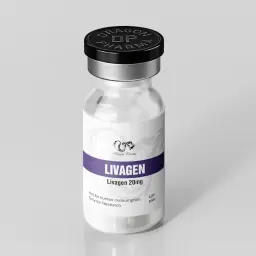
Testagen 20 mg is a lyophilized powder research peptide manufactured by Dragon Pharma and supplied as 20 mg of Testagen per 2 mL vial.
Testagen 20 mg contains the KEDG tetrapeptide, a synthetic short peptide belonging to the Khavinson bioregulator class. Its amino acid sequence is H-Lys-Glu-Asp-Gly-OH, consisting of lysine, glutamic acid, aspartic acid, and glycine. Unlike anabolic steroids or growth hormone secretagogues, Testagen is investigated for its proposed epigenetic regulatory effects on gene expression in target tissues.
In research contexts, Testagen is studied for its potential interaction with DNA and histones, with proposed downstream effects on endocrine signaling pathways. The peptide is believed to penetrate cell and nuclear membranes, where it may modulate transcription of genes associated with testicular function and hormonal regulation. These mechanisms remain investigational and are not established clinical facts.
Unlike testosterone replacement therapy or gonadotropin products, Testagen is not FDA-approved for any human indication. Its use in bodybuilding contexts is referenced anecdotally but falls outside approved medical indications. The 20 mg vial size is a research presentation, and no standardized human dosage has been established through regulatory review.
Testagen 20 mg is supplied as a lyophilized powder requiring reconstitution with a suitable diluent before research use. The 2 mL vial size provides adequate capacity for the reconstituted solution.
Testagen is a short peptide bioregulator with the KEDG sequence. Its research profile is distinct from anabolic steroids, growth hormone secretagogues, and gonadotropins.
Testagen belongs to the Khavinson peptide class, a group of short synthetic peptides developed in Russian research institutions for their proposed tissue-specific regulatory effects. The KEDG sequence was identified from testicular tissue extracts, suggesting a possible affinity for reproductive endocrine tissues.
Research indicates that short peptides like KEDG can penetrate cellular and nuclear membranes, potentially interacting directly with DNA and histone proteins to influence gene expression. This epigenetic mechanism is distinct from receptor-mediated signaling used by most hormone-based compounds.
The proposed biological targets of Testagen include the pituitary gland and thyroid function, with downstream effects on testosterone and TSH regulation hypothesized but not established through large-scale human trials.
Testagen is proposed to act through direct DNA interaction rather than cell-surface receptor binding. This epigenetic mechanism differs fundamentally from testosterone, HGH, or GHRH analogues.
Dragon Pharma offers several peptides referenced in bodybuilding research contexts with different mechanisms. Dragontropin HGH provides exogenous growth hormone directly, while Sermorelin stimulates endogenous GH release through GHRH receptor activation. Ipamorelin works through ghrelin receptor pathways. Testagen's proposed epigenetic mechanism is distinct from all of these.
The information below is provided for educational reference only. Testagen is a research peptide with no FDA-approved human indication. Medical use requires appropriate regulatory approval and clinical supervision. Non-medical use falls outside approved indications.
Common reference ranges for Testagen are not well characterized in publicly available bodybuilding resources. Published research on this KEDG tetrapeptide is limited, and no standardized human dosage has been established through regulatory review. Any research protocols should be based on tissue-specific peptide conventions rather than anabolic steroid dosing paradigms.
| Use Case | Common Reference Range | Frequency |
|---|---|---|
| Research (non-clinical) | Not well characterized | Not established |
| Medical (clinical use) | No FDA-approved indication | Not applicable |
Testagen 20 mg is supplied as a lyophilized powder requiring reconstitution. Bacteriostatic Water is commonly referenced for reconstituting research peptides. Standard sterile technique and peptide handling practices should be observed.
Because Testagen's proposed mechanism involves epigenetic regulation rather than direct receptor activation, its effects—if any—may follow different timelines and dose-response relationships than conventional hormone products. Researchers should treat dosage information from unrelated compound classes as non-transferable.
The information above is for educational reference and does not constitute medical advice. Testagen has not been evaluated by the FDA for safety or efficacy.
Testagen is a research peptide with no FDA-approved human indication. Its safety profile in humans has not been established through regulatory review.
Testagen has not been evaluated by the FDA for safety or efficacy in any human indication. Published research on the KEDG tetrapeptide is limited primarily to laboratory investigations and small-scale studies. No established safe dosage, contraindications, or adverse event profile is available from regulatory sources.
Non-medical use of Testagen falls outside any approved indication. Product purity and laboratory verification do not establish that non-medical use is safe or appropriate for an individual.
Because Testagen is proposed to interact with DNA and modulate gene expression, theoretical risks include unintended effects on cellular regulation. No systematic human safety data are available to characterize common or rare adverse effects. This uncertainty distinguishes Testagen from better-characterized compounds.
Individuals with hormone-sensitive conditions, active malignancy, or known peptide hypersensitivity should exercise particular caution with any investigational peptide. No formal contraindication list exists for Testagen because it has not undergone regulatory review.
If Testagen is used in any research context, monitoring of relevant endocrine markers may be prudent given its proposed targets. However, no standardized monitoring protocol exists for this compound. Laboratory testing of the product itself is separate from clinical monitoring of the individual.
Store the lyophilized powder under recommended conditions and protect from conditions that could compromise peptide integrity. Follow standard practices for handling lyophilized peptide products and inspect the vial before reconstitution.
Keep all research peptides and injectable products out of the reach of children.
Testagen 20 mg by Dragon Pharma is supplied through the official distribution chain and shipped with discreet, privacy-focused handling.
The outer shipping package remains discreet, with no external product details. Products are supplied through the official Dragon Pharma distribution chain.
To verify your Testagen 20 mg product, use the security code on the vial label and cross-check it on the official Dragon Pharma site. Original packaging and batch documentation help reinforce product legitimacy.
For complete delivery details, tracking policy, and reshipment terms, please see our Shipping Info page.
Proper storage conditions help preserve peptide integrity and maintain product stability throughout shelf life.
Store the lyophilized powder in a cool, dry place protected from light and moisture. The unopened vial should be kept under conditions that preserve the peptide's structural integrity until reconstitution.
Once reconstituted, Testagen solution should be handled according to standard peptide practices. The reconstituted solution is typically less stable than the lyophilized powder.
Keep out of reach of children. Follow proper handling practices for research peptides and use appropriate sterile technique during reconstitution.
Answers to common questions about Testagen 20 mg, KEDG tetrapeptide research, and product details.
Testagen 20 mg is a research peptide supplied as a lyophilized powder. It contains the KEDG tetrapeptide, which is investigated for proposed epigenetic regulatory effects on gene expression. There is no FDA-approved human indication for Testagen.
Common reference ranges for Testagen administration are not well characterized in publicly available bodybuilding resources. No standardized human dosage or frequency has been established through regulatory review. Any research protocols should not assume dosing conventions from unrelated compound classes.
Testagen is not an anabolic steroid and is not proposed to suppress endogenous testosterone production through the same mechanism as AAS. Post-cycle therapy designed for steroid cycles is not applicable to Testagen research. The KEDG peptide's proposed mechanism is epigenetic rather than hormonal suppression.
Testagen is proposed to interact with DNA and histone proteins after penetrating cell and nuclear membranes, potentially modulating gene expression in target tissues. Its research profile suggests possible effects on endocrine signaling, but these mechanisms remain investigational. Testagen is not a hormone and does not provide exogenous testosterone or growth hormone.
No established onset timeline exists for Testagen because it has not undergone regulatory review for any human indication. Its proposed epigenetic mechanism would theoretically involve gene expression changes that develop over longer periods than direct hormone administration, but this is speculative.
No single bioregulator peptide is universally superior. The Khavinson peptide class includes multiple compounds investigated for different tissue targets. Testagen's research focus is distinct from other peptides in Dragon Pharma's catalog, and appropriate selection depends on the specific research context.
Testagen (KEDG) and Sermorelin are both short peptides but have entirely different mechanisms. Sermorelin is a GHRH analogue that stimulates growth hormone release through receptor binding. Testagen is a Khavinson bioregulator proposed to act through direct DNA interaction. Their research profiles are not comparable.
Ipamorelin is a ghrelin receptor agonist that stimulates GH release through a well-characterized receptor pathway. Testagen (KEDG) is a bioregulator tetrapeptide proposed to act through epigenetic mechanisms. These compounds belong to different research categories.
20 mg is the total labeled content of the Testagen 20 mg vial. Because no standardized human dosage exists for this research peptide, the milligram amount cannot be classified as high or low relative to established protocols. This differs from compounds with well-characterized clinical dosing.
Testagen 20 mg by Dragon Pharma contains 20 mg of Testagen per vial as a lyophilized powder. The vial size is 2 mL. This is a research presentation.
There is no established research on combining Testagen with other peptides. Because its proposed mechanism involves epigenetic regulation rather than receptor signaling, interactions with other compounds are not well understood. Any combination research would be exploratory.