
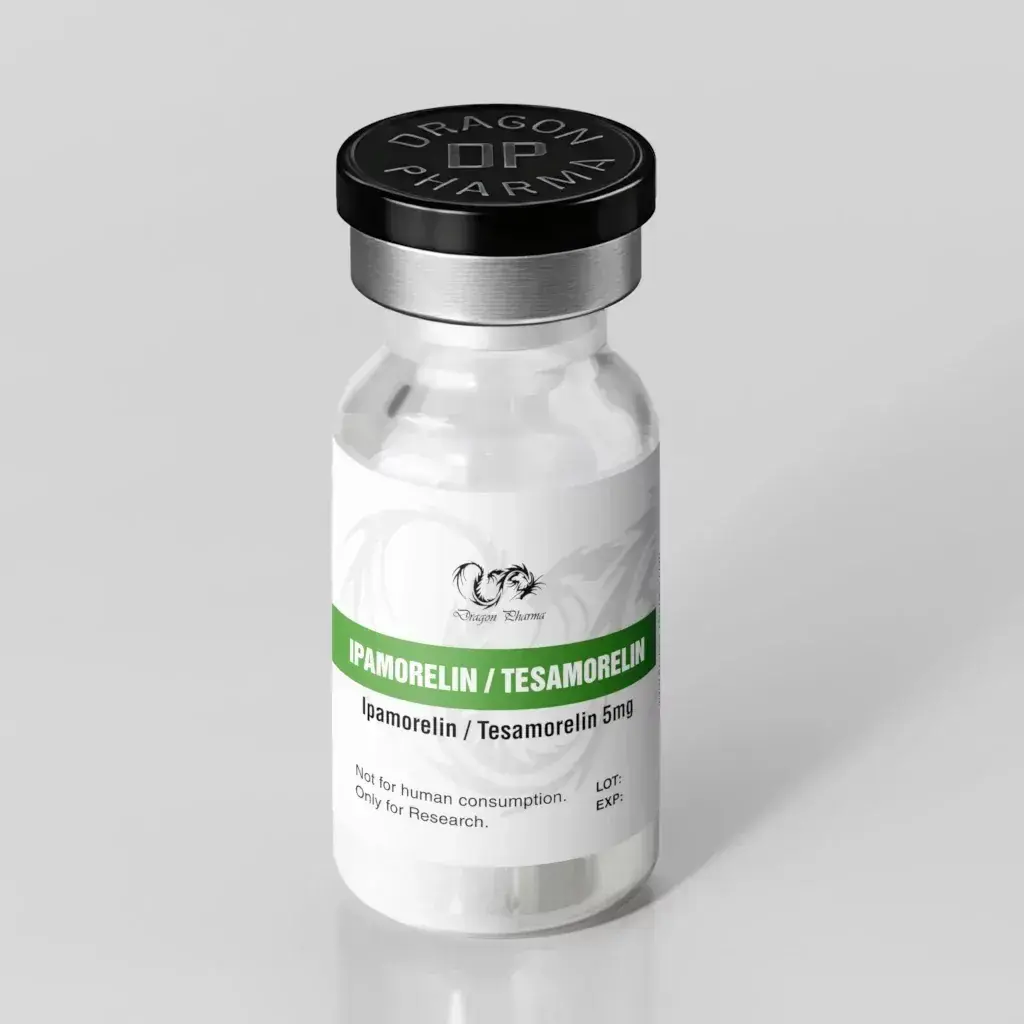
Ipamorelin/Tesamorelin is a lyophilized powder research peptide blend manufactured by Dragon Pharma, containing 5 mg of Ipamorelin and 5 mg of Tesamorelin per 2 mL vial for a total strength of 10 mg/vial.
Ipamorelin/Tesamorelin combines two distinct growth hormone secretagogues that act through different mechanisms on the GH axis. Ipamorelin is a selective ghrelin receptor (GHS-R1a) agonist that stimulates pulsatile GH release with minimal effects on cortisol, prolactin, or appetite. Tesamorelin is a synthetic growth hormone-releasing hormone (GHRH) analog that binds GHRH receptors on the pituitary to stimulate GH synthesis and release.
The rationale for combining these peptides is mechanistic: GHRP-class compounds like ipamorelin and GHRH analogs like tesamorelin stimulate GH through complementary pathways, producing a larger combined GH pulse than either alone. This dual-mechanism approach is commonly referenced in non-medical contexts for its potential to amplify endogenous GH release and downstream IGF-1 production.
Tesamorelin is the only FDA-approved compound in this blend, indicated specifically for reduction of excess abdominal fat in HIV-infected patients with lipodystrophy. Ipamorelin has no FDA approval and was discontinued in Phase 2 trials for postoperative ileus due to lack of efficacy. The combination has not been evaluated in controlled human studies.
Ipamorelin/Tesamorelin is supplied as a lyophilized (freeze-dried) powder in a 2 mL vial. This form requires reconstitution with a suitable solvent such as bacteriostatic water before use.
This dual-peptide blend combines two GH secretagogues with distinct receptor targets and complementary mechanisms of action on the somatotropic axis.
Ipamorelin acts as a selective agonist at the ghrelin receptor (GHS-R1a), stimulating GH release through mechanisms that are additive with GHRH signaling. It was originally developed by Novo Nordisk and investigated in Phase 2 clinical trials for postoperative ileus before development was discontinued.
Tesamorelin is a stabilized GHRH analog that binds GHRH receptors on pituitary somatotroph cells, stimulating GH synthesis and pulsatile release. In clinical studies, 2 mg of tesamorelin daily for 2 weeks increased mean overnight GH secretion by approximately 70% and more than doubled IGF-1 levels. After 3 months of treatment, IGF-1 remained elevated by an average of 60%.
The combination of a GHRP and a GHRH analog is the dominant dual-mechanism approach in GH optimization protocols, based on the hypothesis that activating both pathways produces a larger GH pulse than either alone.
Tesamorelin has a short elimination half-life of approximately 26–38 minutes after subcutaneous administration, while ipamorelin has a half-life of approximately 2 hours. The GHRH component provides the initial trigger for GH synthesis and release, while the GHRP component sustains and amplifies the pulse through a separate receptor pathway.
Dragon Pharma offers several peptide products that are commonly referenced alongside this blend. Ipamorelin is available as a standalone product for those who prefer independent dosing of the GHRP component. Tesamorelin provides the GHRH analog separately. CJC 1295 No DAC/Ipamorelin is an alternative GHRP+GHRH combination that pairs ipamorelin with a different GHRH analog. GHRP-2 and GHRP-6 are less selective GHRP alternatives that produce stronger GH pulses but with more cortisol, prolactin, and appetite effects compared to ipamorelin.
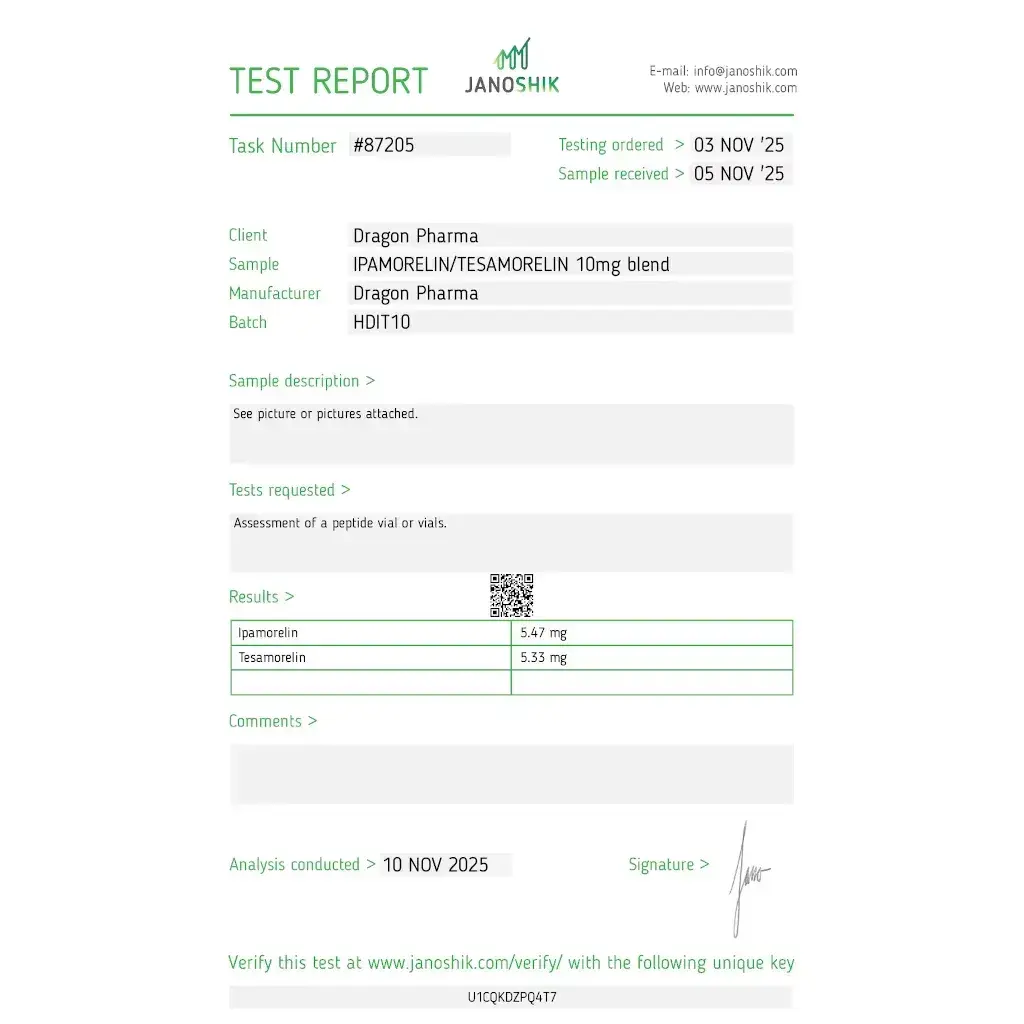
Published laboratory reports for Ipamorelin/Tesamorelin are shown below with the test date, measured concentrations, and percentage of the product's label claims.
 View Report
Laboratory results apply to the specific tested sample represented in each published report and should not be interpreted as a measurement of every vial or production batch.
The information below is provided for educational reference only. Tesamorelin is a prescription medication approved for a specific indication; ipamorelin is not FDA-approved for any human use. All non-medical use falls outside approved indications.
Dosing for this combination requires accounting for the fixed 1:1 ratio of the two components. Published clinical data exist for tesamorelin alone (1.28–2 mg daily), while ipamorelin dosing is derived from community protocols (200–300 mcg per administration). Because the blend contains equal amounts of each peptide, the total dose administered will deliver equal quantities of both.
| Use Case | Common Reference Range | Administration Frequency |
|---|---|---|
| Tesamorelin (clinical, FDA label) | 1.28 mg (EGRIFTA WR) or 2 mg (EGRIFTA SV) | Once daily |
| Ipamorelin (community reference) | 200–300 mcg per administration | 1–3 times daily |
| Blend (non-medical, community reference) | 200–300 mcg total (100–150 mcg each peptide) | Once or twice daily |
| Blend (advanced community reference) | 500–1,000 mcg total (250–500 mcg each) | Once daily, bedtime |
Common reference ranges for this specific combination are not well characterized in publicly available bodybuilding resources. The table above reflects extrapolation from individual component data rather than validated combination protocols.
This blend is itself a pre-combined stack of a GHRP (ipamorelin) and a GHRH analog (tesamorelin). In community contexts, this combination is sometimes referenced as a comprehensive GH optimization protocol, though the specific pairing of ipamorelin with tesamorelin is less commonly discussed than ipamorelin with CJC 1295 No DAC/Ipamorelin.
Community protocols for GH secretagogue blends typically reference cycles of 8–12 weeks followed by a 4-week break. Bedtime administration is commonly referenced for the ipamorelin component to amplify the natural nocturnal GH pulse, while tesamorelin is sometimes referenced for morning administration in clinical contexts. The fixed ratio of this blend does not allow for independent timing of each component.
The ipamorelin component is consistently referenced as the most tolerable GHRP, with minimal effects on cortisol, prolactin, and appetite. The tesamorelin component carries the side effect profile of an FDA-approved GHRH analog, including injection-site reactions, fluid retention, joint pain, and potential increases in blood glucose.
Tesamorelin’s FDA label warns of increased risk of neoplasms, glucose intolerance, and fluid retention. These risks apply to the tesamorelin component of the blend and should be considered in the context of the full 5 mg dose per vial.
Neither ipamorelin nor tesamorelin suppresses endogenous testosterone production, as both act on the GH axis rather than the hypothalamic-pituitary-gonadal axis. Post-cycle therapy is therefore not applicable in the context of testosterone recovery. A break of at least 4 weeks between cycles is commonly referenced to allow GH receptor resensitization.
Dosing strategies for this combination are not established. The information above is for educational reference and does not constitute medical advice.
Tesamorelin is FDA-approved for a specific indication in HIV-infected patients with lipodystrophy. Ipamorelin is not FDA-approved for any human use, and the FDA has recommended against permitting it in compounded drug products. The combination has not been evaluated in controlled human studies.
Tesamorelin is contraindicated in patients with disruption of the hypothalamic-pituitary axis, active malignancy, known hypersensitivity to tesamorelin, and pregnancy. The FDA has evaluated ipamorelin and recommended against placing it on the 503A Bulks List due to significant safety concerns, including potential immunogenicity and lack of safety data.
In 2024, the FDA concluded that ipamorelin-related substances may raise safety concerns including potential immunogenicity risk when given subcutaneously due to potential for aggregation and impurities, and noted a lack of nonclinical and clinical safety data.
This blend is not FDA-approved for human use. Tesamorelin is approved only for a specific indication in HIV-infected patients with lipodystrophy, not for bodybuilding or performance enhancement. Any non-medical use falls outside approved indications. Product concentration and laboratory verification do not establish that non-medical use is safe or appropriate for an individual.
Tesamorelin’s FDA label lists the following risks: increased risk of new malignancy or reactivation of existing malignancy; increased IGF-1 levels requiring monitoring; fluid retention including carpal tunnel syndrome; glucose intolerance and diabetes; serious allergic reactions; and injection-site reactions. Common side effects include pain in legs and arms, muscle pain, and swelling.
An FDA review of ipamorelin clinical data reported hypokalemia, insomnia, hyperglycemia, nausea, and abdominal distention as adverse effects. The long-term effects of ipamorelin use have not been established, and no completed human trials have examined its effects on body composition, bone density, or recovery.
Tesamorelin is contraindicated in patients with active malignancy or history of malignancy, pituitary disorders, and pregnancy. Individuals with diabetes or glucose intolerance should exercise particular caution due to the risk of hyperglycemia.
For ipamorelin, populations of particular theoretical concern based on proposed mechanism include active or suspected malignancy, acromegaly or elevated baseline IGF-1, type 2 diabetes, pregnancy, and hypopituitary disorders.
Tesamorelin’s FDA label requires monitoring of IGF-1 levels during therapy and assessment of blood sugar before and during treatment. In non-medical contexts, individuals commonly reference periodic IGF-1 blood testing to assess GH axis activation.
No published laboratory reports are available for this specific product beyond the potency verification shown in the Lab Reports tab. That testing applies to the tested sample only and is separate from any clinical monitoring of the individual.
Store the lyophilized powder in its original container, protected from light. Tesamorelin vials should be stored at room temperature between 20°C to 25°C before reconstitution, and the reconstituted solution should be refrigerated. After reconstitution, use within the period specified by the manufacturer. Do not freeze.
Keep all peptides and injectable products out of the reach of children. Follow the storage instructions provided with the product packaging.
Ipamorelin/Tesamorelin by Dragon Pharma is supplied through the official distribution chain and shipped in original manufacturer packaging with discreet, privacy-focused handling.
The outer shipping package remains discreet, with privacy-focused handling and no unnecessary external product details. Products are supplied through the official Dragon Pharma distribution chain.
To verify your Ipamorelin/Tesamorelin product, use the security code on the vial label and cross-check it on the Dragon Pharma official site. Official presentation, batch-linked lab proof, and original packaging help reinforce product legitimacy and buyer confidence.
For complete delivery details, tracking policy, and reshipment terms, please see our Shipping Info page.
Proper storage conditions help preserve peptide stability and overall product integrity throughout shelf life.
Store the lyophilized (dry) powder tightly sealed in its original container, protected from light, and desiccated at -20°C for long-term storage. Tesamorelin’s FDA labeling states that vials should be stored at room temperature between 20°C to 25°C (68°F to 77°F) before reconstitution, and the reconstituted solution should be refrigerated.
After reconstitution, use the solution within the period specified by the manufacturer. Do not freeze reconstituted solution. Keep protected from light.
Keep out of reach of children. Follow proper handling and sterile technique when administering the product.
Answers to common questions about Ipamorelin/Tesamorelin, its components, product strength, and laboratory testing.
Ipamorelin/Tesamorelin is a research peptide blend containing a GHRP (ipamorelin) and a GHRH analog (tesamorelin). Tesamorelin is FDA-approved for reduction of excess abdominal fat in HIV-infected patients with lipodystrophy. Ipamorelin has no approved human use. In non-medical contexts, this combination is commonly referenced for GH stimulation, though such use falls outside approved indications.
Because the blend contains equal amounts of each peptide, dosing requires accounting for the fixed 1:1 ratio. Clinical tesamorelin dosing is 1.28–2 mg once daily. Community ipamorelin protocols reference 200–300 mcg per administration. A blend dose of 200–300 mcg total would deliver 100–150 mcg of each peptide. Common reference ranges for this specific combination are not well characterized.
Neither component suppresses endogenous testosterone production, as both act on the GH axis rather than the hypothalamic-pituitary-gonadal axis. Post-cycle therapy is therefore not applicable in the context of testosterone recovery. A break between cycles is commonly referenced to allow GH receptor resensitization.
Ipamorelin stimulates GH release by activating the ghrelin receptor (GHS-R1a) with minimal effects on cortisol or prolactin. Tesamorelin is a GHRH analog that binds GHRH receptors on the pituitary to stimulate GH synthesis and pulsatile release. Together they activate complementary GH-release pathways.
Tesamorelin has a short half-life of 26–38 minutes, while ipamorelin has a half-life of approximately 2 hours. Effects on GH and IGF-1 levels occur after each administration. In clinical studies, tesamorelin at 2 mg daily increased mean overnight GH secretion by approximately 70% and more than doubled IGF-1 after 2 weeks.
There is no single GH protocol that is universally best. This blend combines a selective GHRP with an FDA-approved GHRH analog. Ipamorelin alone is more commonly used in community protocols, and CJC 1295 No DAC/Ipamorelin is a more frequently referenced GHRP+GHRH combination. The appropriate choice depends on individual goals and risk tolerance.
Ipamorelin alone provides selective GHRP-class GH stimulation with minimal side effects. The addition of tesamorelin introduces GHRH-receptor activation for a complementary mechanism. Tesamorelin also carries the side effect profile and monitoring requirements of an FDA-approved GHRH analog.
CJC 1295 No DAC/Ipamorelin pairs ipamorelin with a different GHRH analog (Mod GRF 1-29). Both combinations use the same GHRP component but different GHRH analogs. Tesamorelin is a stabilized GHRH analog with FDA approval for a specific indication, while Mod GRF 1-29 is not FDA-approved.
200 mcg total would deliver 100 mcg of each peptide. For reference, clinical tesamorelin dosing is 1.28–2 mg (1,280–2,000 mcg) daily. Community ipamorelin protocols reference 200–300 mcg per administration. The 10 mg vial contains 5,000 mcg of each peptide, providing 16–50 doses depending on protocol.
Ipamorelin/Tesamorelin is labeled at 10 mg total peptide content per vial, consisting of 5 mg Ipamorelin and 5 mg Tesamorelin. It is supplied as a lyophilized powder in a 2 mL vial.
Yes. A published laboratory report dated November 10, 2025 measured Ipamorelin/Tesamorelin at 5.47 mg Ipamorelin (109.4% of label claim) and 5.33 mg Tesamorelin (106.6% of label claim). The batch number for this report is #HDIT10.
The complete report can be viewed in the Lab Reports tab. Laboratory results apply to the tested sample represented by the individual report and should not be interpreted as a measurement of every vial.
Lyophilized Ipamorelin/Tesamorelin is typically reconstituted with a suitable solvent such as Bacteriostatic Water or sterile water. The volume of solvent added determines the concentration of the resulting solution. Proper sterile technique should be used during reconstitution.