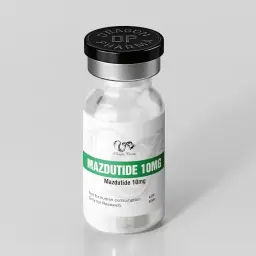


Survodutide 10 mg is a lyophilized powder research peptide manufactured by Dragon Pharma, containing 10 mg of Survodutide per 2 mL vial.
Survodutide is an investigational dual agonist at the glucagon receptor (GCGR) and the glucagon-like peptide-1 receptor (GLP-1R) . It is designed to replicate the actions of oxyntomodulin, an endogenous hormone that influences body weight and liver health through simultaneous activation of both receptors . The GLP-1 component contributes to appetite suppression, slowed gastric emptying, and glucose-dependent insulin secretion, while the glucagon component is hypothesized to increase energy expenditure and enhance lipid metabolism .
Survodutide is not FDA-approved for any human use in the United States. It is currently in Phase 3 clinical development by Boehringer Ingelheim and Zealand Pharma, with the SYNCHRONIZE Phase 3 trial program evaluating its effects in people with obesity, with and without type 2 diabetes . The FDA has issued warning letters to companies selling unapproved survodutide products, stating that such products are unapproved new drugs .
In clinical trials, survodutide has been administered as a once-weekly subcutaneous injection with gradual dose titration . Phase 3 data from SYNCHRONIZE-1 reported weight reductions of up to 16.6% at 76 weeks, along with visceral fat reductions of up to 34% and liver fat reductions of up to 63.1%. These investigational findings do not establish that non-medical use is safe or appropriate, and all non-medical use falls outside approved indications.
Survodutide 10 mg is supplied as a lyophilized (freeze-dried) powder in a 2 mL vial. This form requires reconstitution with a suitable solvent such as bacteriostatic water before use.
Survodutide is a dual agonist at the glucagon and GLP-1 receptors, engineered for extended duration of action to support once-weekly dosing .
Survodutide binds to and activates both the GLP-1 receptor and the glucagon receptor . GLP-1 receptor activation contributes to appetite suppression, slowed gastric emptying, and glucose-dependent insulin secretion. Glucagon receptor activation is hypothesized to increase energy expenditure and enhance lipid metabolism, with studies showing selective reductions in visceral and liver fat .
In the Phase 3 SYNCHRONIZE-1 trial, survodutide achieved weight reductions of up to 16.6% at 76 weeks in adults with obesity without type 2 diabetes. An MRI-based body composition substudy showed a 34% reduction in visceral fat and a 63.1% reduction in liver fat content at the maximum dosage. The trial also reported that muscle mass was preserved, distinguishing survodutide from some other weight-loss interventions.
Tolerability data from SYNCHRONIZE-1 showed that 19% to 24.8% of participants discontinued treatment due to gastrointestinal side effects, compared to 2.9% to 5.4% in the placebo group. The most common adverse events were nausea, vomiting, and diarrhea, occurring predominantly during dose escalation.
Survodutide is administered as a once-weekly subcutaneous injection with gradual dose titration to improve gastrointestinal tolerability. Community protocols reference starting at 0.3–0.6 mg weekly and escalating slowly over weeks to target doses of 3.6–6.0 mg.
Dragon Pharma offers several compounds that act on metabolic pathways. Mazdutide is a dual GLP-1/glucagon receptor agonist approved in China for weight management. Retatrutide is a triple GIP/GLP-1/glucagon receptor agonist under investigation. Cagrilintide is an amylin analog investigated for weight management. These compounds differ in receptor targets and clinical development status from survodutide.
Published laboratory reports for Survodutide 10 mg are shown below with the test date, measured concentration, and percentage of the product's 10 mg label claim.
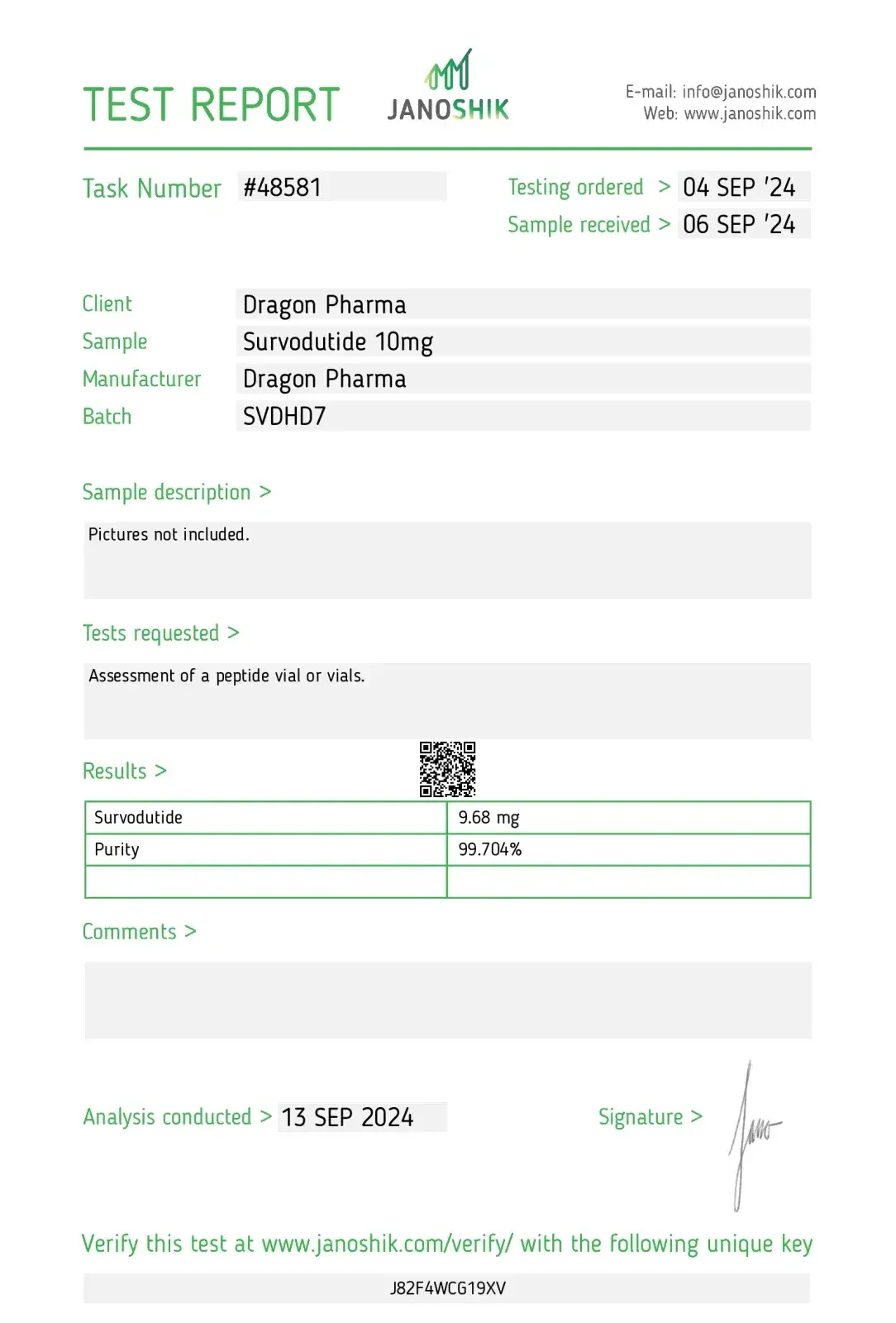 View Report
Laboratory results apply to the specific tested sample represented in each published report and should not be interpreted as a measurement of every vial or production batch.
The information below is provided for educational reference only. Survodutide is not FDA-approved for any human use in the United States. All use in non-medical contexts falls outside approved indications and is not supported by safety or efficacy data.
Survodutide has been studied in clinical trials using once-weekly subcutaneous injections with gradual dose titration. Published Phase 3 protocols have used up-titration to 3.6 mg or 6.0 mg weekly over 76 weeks. Community protocols commonly reference starting at 0.3–0.6 mg weekly and escalating slowly over weeks, with target doses of 1.2–2.4 mg for intermediate use and 3.6–4.8 mg for advanced protocols.
| Use Case | Common Reference Range | Injection Frequency |
|---|---|---|
| Clinical trial (SYNCHRONIZE-1) | 3.6 mg or 6.0 mg | Once weekly, 76 weeks |
| Community beginner | 0.3–0.6 mg | Once weekly, titrated |
| Community intermediate | 1.2–2.4 mg | Once weekly |
| Community advanced | 3.6–4.8 mg | Once weekly |
Survodutide is not typically referenced in stacking protocols due to its potent dual-receptor mechanism. Clinical trials have evaluated survodutide as monotherapy. Community discussions sometimes reference combining GLP-1/glucagon dual agonists with GIP/GLP-1 dual agonists (such as tirzepatide) to approximate a triple-agonist profile, but this approach is investigational and not supported by clinical data.
Community protocols for survodutide are not well characterized because the compound remains investigational and has not been available for legal non-trial use. The FDA has issued warning letters to companies selling unapproved survodutide products . Bacteriostatic Water is commonly referenced for reconstitution of lyophilized peptides.
Gastrointestinal side effects are the most commonly reported adverse events, including nausea, vomiting, and diarrhea. In the Phase 3 SYNCHRONIZE-1 trial, treatment discontinuation due to adverse events occurred in 19% to 24.8% of participants on survodutide, compared to 2.9% to 5.4% on placebo. These effects occurred predominantly during the dose-escalation phase.
Community mitigation strategies include slow titration, nighttime injections, smaller low-fat meals, adequate hydration and electrolytes, and holding at the current dose step an extra 2–4 weeks if gastrointestinal symptoms have not settled.
Survodutide is not a hormonal compound that suppresses the hypothalamic-pituitary-gonadal axis. Post-cycle therapy in the context of testosterone recovery is not applicable. No rebound or withdrawal protocols are established for survodutide because non-medical use is not supported by clinical data.
Dosing strategies for survodutide are derived from clinical trial protocols that involved medical supervision and monitoring. The information above is for educational reference and does not constitute medical advice.
Survodutide is not FDA-approved for any human use in the United States. It is an investigational medication available only through clinical trials. The FDA has issued warning letters to companies selling unapproved survodutide products .
Survodutide is an investigational dual glucagon/GLP-1 receptor agonist. It has not been approved by any regulatory agency, and it is legally available only through clinical trials . Products sold outside of clinical trials may contain unknown ingredients, harmful contaminants, or incorrect amounts of active ingredient .
The FDA has specifically warned that compounded survodutide products are unapproved new drugs and misbranded, and that no FDA-approved applications are in effect for these products .
Survodutide is not FDA-approved for human use. Any use outside of approved clinical trials falls outside approved indications. Product concentration and laboratory verification do not establish that non-medical use is safe or appropriate for an individual.
Gastrointestinal side effects are the most commonly reported adverse events. In the Phase 3 SYNCHRONIZE-1 trial, treatment discontinuation due to adverse events occurred in 19% to 24.8% of participants on survodutide, compared to 2.9% to 5.4% on placebo. The most common events were nausea, vomiting, and diarrhea, occurring predominantly during dose escalation.
Other potential effects reported in community contexts include resting heart rate increases of approximately 3–7 bpm, transient elevations in ALT/AST due to glucagon-mediated liver enzyme shifts, and injection-site reactions.
Survodutide is not recommended for patients with severe gastrointestinal disease, as it has not been studied in this population. Because it is an investigational compound, the full range of contraindications and drug interactions has not been established.
Individuals with pancreatic, gallbladder, or renal conditions should exercise particular caution. The long-term effects of chronic survodutide use have not been established.
In clinical trials, survodutide has been administered with medical supervision and monitoring for gastrointestinal, metabolic, and other adverse effects. Monitoring may include assessment of blood glucose, pancreatic enzymes, gallbladder function, and liver enzymes.
No published laboratory reports are available for this specific product beyond the potency verification shown in the Lab Reports tab. That testing applies to the tested sample only and is separate from clinical monitoring of the individual.
Lyophilized survodutide should be stored in its original container, protected from light, and refrigerated at 2°C to 8°C. After reconstitution, store refrigerated and use within the period specified. Do not freeze reconstituted solution.
Keep out of reach of children. Follow proper handling and sterile technique when administering the product.
Survodutide 10 mg by Dragon Pharma is supplied through the official distribution chain and shipped in original manufacturer packaging with discreet, privacy-focused handling.
The outer shipping package remains discreet, with privacy-focused handling and no unnecessary external product details. Products are supplied through the official Dragon Pharma distribution chain.
To verify your Survodutide 10 mg product, use the security code on the vial label and cross-check it on the Dragon Pharma official site. Official presentation, batch-linked lab proof, and original packaging help reinforce product legitimacy and buyer confidence.
For complete delivery details, tracking policy, and reshipment terms, please see our Shipping Info page.
Proper storage conditions help preserve peptide stability and overall product integrity throughout shelf life.
Store the lyophilized (dry) powder in its original container, protected from light, and refrigerated at 2°C to 8°C. Brief handling at room temperature is acceptable provided the container is allowed to equilibrate before opening to prevent moisture uptake.
After reconstitution, store refrigerated at 2–8°C and use within the period specified. Do not freeze reconstituted solution. Avoid repeated freeze-thaw cycles.
Keep out of reach of children. Follow proper handling and sterile technique when administering the product.
Answers to common questions about Survodutide 10 mg, its mechanism, product strength, and laboratory testing.
Survodutide 10 mg contains survodutide, a dual glucagon/GLP-1 receptor agonist. It is under investigation in Phase 3 clinical trials for obesity and metabolic dysfunction-associated steatotic liver disease (MASLD). It is not FDA-approved for any human use, and all non-medical use falls outside approved indications.
In clinical trials, survodutide has been administered as a once-weekly subcutaneous injection with gradual dose titration. Clinical protocols have used up-titration to 3.6 mg or 6.0 mg weekly over 76 weeks.
No. Survodutide acts on metabolic hormone receptors (glucagon and GLP-1) and does not suppress the hypothalamic-pituitary-gonadal axis. Post-cycle therapy in the context of testosterone recovery is not applicable. No rebound or withdrawal protocols are established because non-medical use is not supported by clinical data.
Survodutide is a dual agonist that activates both GLP-1 and glucagon receptors. GLP-1 receptor activation contributes to appetite suppression and glucose-dependent insulin secretion, while glucagon receptor activation is hypothesized to increase energy expenditure and enhance lipid metabolism, with studies showing selective reductions in visceral and liver fat.
In Phase 3 clinical trials, weight reductions were observed over 76 weeks of treatment. The onset of noticeable effects varies by individual, dose, and titration schedule. Community protocols typically reference a 6-month minimum commitment for meaningful results.
There is no single weight loss peptide that is universally best. Survodutide has demonstrated significant weight reductions and selective visceral/liver fat reduction in Phase 3 trials. Retatrutide 60 mg is a triple receptor agonist under investigation, and Mazdutide is a dual agonist approved in China. The appropriate approach depends on individual circumstances and medical guidance.
Tirzepatide is a dual GIP/GLP-1 receptor agonist, while survodutide is a dual GLP-1/glucagon receptor agonist. Both are under investigation or approved for specific indications. Survodutide is noted for stronger visceral and hepatic fat reduction, while tirzepatide may offer smoother appetite control.
Semaglutide is a selective GLP-1 receptor agonist, while survodutide activates both GLP-1 and glucagon receptors. The glucagon component is hypothesized to increase energy expenditure and enhance lipid metabolism. Semaglutide is FDA-approved; survodutide is not.
1.5 mg is within the range used in community protocols, which commonly reference intermediate doses of 1.2–2.4 mg weekly. Clinical trials have used up to 6.0 mg weekly. The 10 mg vial provides multiple doses at community reference levels.
Survodutide 10 mg is labeled at 10 mg of Survodutide per vial. It is supplied as a lyophilized powder in a 2 mL vial, requiring reconstitution before use.
Yes. A published laboratory report dated September 13, 2024 measured Survodutide 10 mg at 9.68 mg, equivalent to 96.8% of its 10 mg label claim. The batch number for this report is #SVDHD7.
The complete report can be viewed in the Lab Reports tab. Laboratory results apply to the tested sample represented by the individual report and should not be interpreted as a measurement of every vial.
Lyophilized survodutide is typically reconstituted with a suitable solvent such as Bacteriostatic Water or sterile water. The volume of solvent added determines the concentration of the resulting solution. Proper sterile technique should be used during reconstitution.