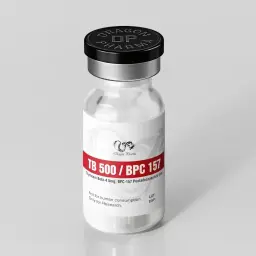


Mazdutide 10 mg is a lyophilized powder research peptide manufactured by Dragon Pharma, containing 10 mg of Mazdutide per 2 mL vial.
Mazdutide is a long-acting synthetic peptide that functions as a dual agonist at both the glucagon-like peptide-1 receptor (GLP-1R) and the glucagon receptor (GCGR). This dual mechanism distinguishes it from selective GLP-1 receptor agonists, combining the appetite-suppressing and glucose-lowering effects of GLP-1 activation with the energy expenditure and lipid metabolism effects associated with glucagon receptor signaling.
Mazdutide received approval from China's National Medical Products Administration (NMPA) in June 2025 for long-term weight management in adults with obesity or overweight, and in September 2025 for glycemic control in adults with type 2 diabetes. It is not FDA-approved for any human use in the United States, and there is no legal pathway for human use of mazdutide in the US as of April 2026. In non-medical bodybuilding contexts, mazdutide is sometimes referenced for its effects on body weight and body composition, though such use falls outside approved indications.
Clinical trials have demonstrated significant weight reductions with mazdutide. In a Phase 3 trial (GLORY-2) of Chinese adults with obesity, once-weekly mazdutide 9 mg produced a mean weight reduction of 16.65% after 60 weeks compared with 1.50% for placebo. In a US Phase 2 trial, mazdutide 10 mg produced an estimated mean weight reduction of 15.6% at 32 weeks, and the 16 mg dose produced 18.1%. These investigational findings do not establish that non-medical use is safe or appropriate.
Mazdutide 10 mg is supplied as a lyophilized (freeze-dried) powder in a 2 mL vial. This form requires reconstitution with a suitable solvent such as bacteriostatic water before use.
Mazdutide is a dual GLP-1/glucagon receptor agonist with a fatty acyl side chain that extends its duration of action to support once-weekly dosing.
Mazdutide is based on the endogenous peptide hormone oxyntomodulin and is engineered for balanced activation of both GLP-1 and glucagon receptors. GLP-1 receptor activation contributes to appetite suppression, slowed gastric emptying, and glucose-dependent insulin secretion. Glucagon receptor activation is hypothesized to increase energy expenditure and enhance lipid metabolism.
In a Phase 3 trial comparing mazdutide to dulaglutide in Chinese adults with type 2 diabetes, mazdutide produced significantly greater reductions in body weight, with a least-squares mean treatment difference of −3.78% for 4 mg and −5.76% for 6 mg relative to dulaglutide. A US Phase 2 trial in adults with overweight or obesity showed dose-dependent weight reductions across mazdutide doses up to 16 mg over 32 weeks.
Treatment with mazdutide has been associated with broad improvements in cardiometabolic risk markers, including reductions in systolic blood pressure, LDL cholesterol, triglycerides, and HbA1c in clinical trials. A Bayesian network meta-analysis of nine RCTs confirmed dose-dependent improvements in weight, central adiposity, glycemic control, and lipid profiles.
Mazdutide’s fatty acyl side chain extends its time of action, supporting once-weekly subcutaneous administration. Dose escalation over several weeks is typically used to improve gastrointestinal tolerability.
Dragon Pharma offers several compounds that act on metabolic pathways. Retatrutide 60 mg is a triple GIP/GLP-1/glucagon receptor agonist studied for obesity and type 2 diabetes. Cagrilintide is an amylin analog investigated for weight management. Survodutide is another dual GLP-1/glucagon receptor agonist with a different molecular structure. AOD 9604 is a growth hormone fragment studied for fat metabolism. These compounds differ in receptor targets and clinical development status.
Published laboratory reports for Mazdutide 10 mg are shown below with the test date, measured concentration, and percentage of the product's 10 mg label claim.
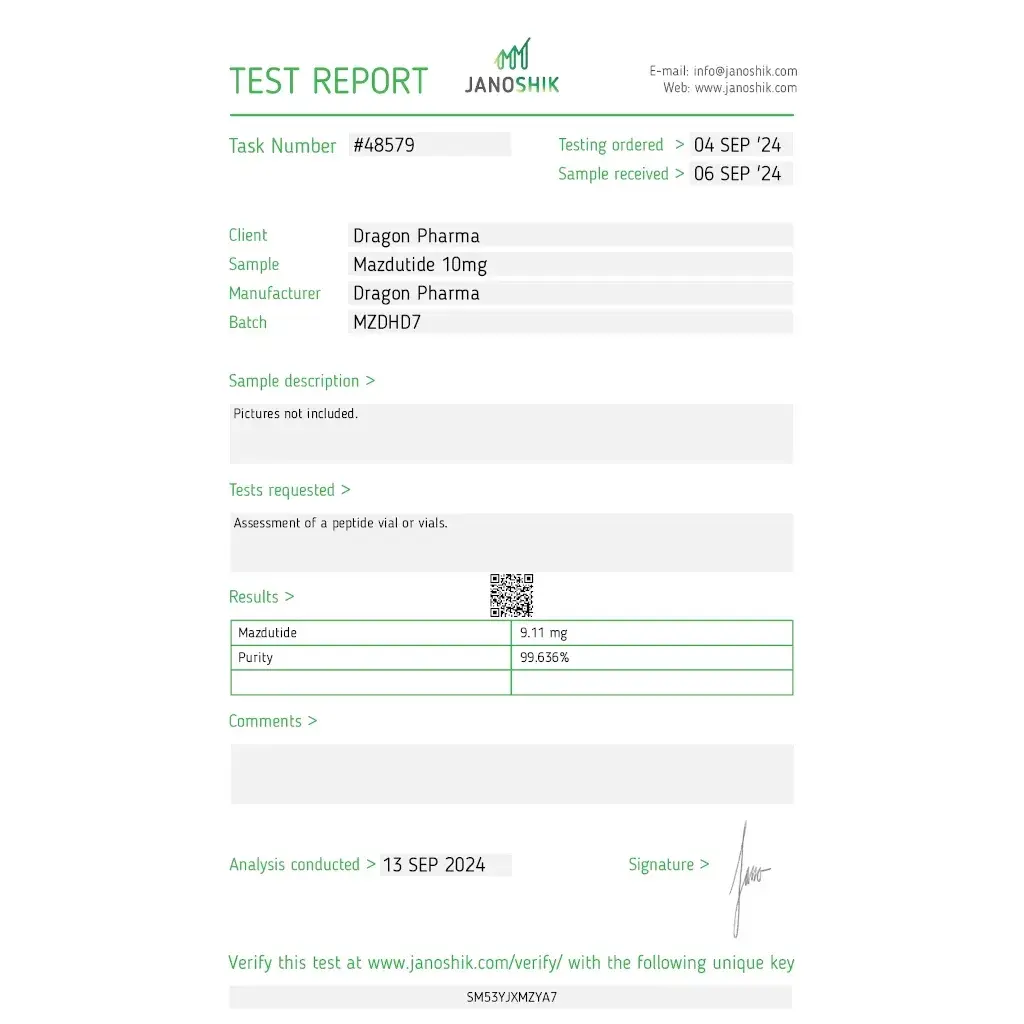 View Report
Laboratory results apply to the specific tested sample represented in each published report and should not be interpreted as a measurement of every vial or production batch.
The information below is provided for educational reference only. Mazdutide is not FDA-approved for any human use in the United States. All use in non-medical contexts falls outside approved indications.
In clinical trials, mazdutide has been administered as a once-weekly subcutaneous injection with gradual dose escalation. Published protocols have used titration schedules starting at low doses and increasing over weeks to target doses of 4 mg, 6 mg, 9 mg, or higher. The 10 mg vial strength provides flexibility for reconstitution and dosing based on individual protocol requirements.
| Use Case | Common Reference Range | Injection Frequency |
|---|---|---|
| Clinical trial (starting dose) | 1.5 mg | Once weekly, weeks 1–4 |
| Clinical trial (titration) | 3 mg → 4.5 mg → 6 mg | Once weekly, 4-week intervals |
| Clinical trial (maintenance target) | 4 mg, 6 mg, or 9 mg | Once weekly |
| US Phase 2 (higher dose exploration) | 10 mg or 16 mg | Once weekly |
Mazdutide is not typically referenced in stacking protocols in non-medical contexts due to its potent dual-receptor mechanism. Clinical trials have evaluated mazdutide as monotherapy. Community protocols for mazdutide are not well characterized because the compound remains unapproved in the US and has no legal pathway for human use outside clinical trials.
Because mazdutide is not FDA-approved and does not appear on the 503A bulk drug substances list, compounded mazdutide products are not lawfully available through US compounding pharmacies. Bacteriostatic Water is commonly referenced for reconstitution of lyophilized peptides.
The most commonly reported adverse events in clinical trials were gastrointestinal in nature, including nausea, vomiting, diarrhea, and constipation. In the GLORY-2 Phase 3 trial, vomiting occurred in 53.1% of the mazdutide group versus 1.3% for placebo, nausea in 46.9% versus 3.2%, and diarrhea in 39.4% versus 6.5%. Most events were mild to moderate and occurred predominantly during dose escalation.
Hypoglycemia occurs in approximately 10% of patients, primarily in those with type 2 diabetes taking concomitant insulin or sulfonylureas. Small increases in resting heart rate (2–4 beats per minute) have been observed, consistent with the GLP-1 receptor agonist class.
Mazdutide is not a hormonal compound that suppresses the hypothalamic-pituitary-gonadal axis. Post-cycle therapy in the context of testosterone recovery is not applicable. No rebound or withdrawal protocols are established for mazdutide because non-medical use is not supported by clinical data.
Dosing strategies for mazdutide are derived from clinical trial protocols that involved medical supervision and monitoring. The information above is for educational reference and does not constitute medical advice.
Mazdutide is not FDA-approved for any human use in the United States. It is approved in China for weight management and type 2 diabetes, but this approval does not create a US prescribing label or legal pathway for human use in the US.
Mazdutide is an investigational dual GLP-1/glucagon receptor agonist in the United States. It has not been approved by the FDA, and there is no legal pathway for human use of mazdutide in the US outside an IRB-approved clinical research study. Products sold online as “mazdutide” are not regulated by the FDA, have not been independently verified for identity, purity, or potency, and present unknown contamination and dosing risks.
The FDA has warned companies over unapproved drugs containing mazdutide marketed directly to consumers as “for research purposes” or “not for human consumption”.
Mazdutide is not FDA-approved for human use. Any use outside of approved clinical trials falls outside approved indications. Product concentration and laboratory verification do not establish that non-medical use is safe or appropriate for an individual.
Common adverse effects reported in clinical trials include nausea, vomiting, diarrhea, constipation, decreased appetite, and injection-site reactions. Gastrointestinal events are dose-dependent and occur predominantly during dose escalation.
Serious risks include hypoglycemia (particularly with concomitant insulin or sulfonylureas), pancreatitis, gallbladder disease, and small increases in resting heart rate. Mazdutide is contraindicated in patients with a personal or family history of medullary thyroid carcinoma or MEN2, based on class-wide precautions for GLP-1 receptor agonists.
Long-term safety data beyond 60 weeks of treatment are not available. Effects on body composition, bone density, and weight regain upon discontinuation are not fully characterized.
Populations of particular theoretical concern based on the compound’s proposed mechanism include individuals with a personal or family history of medullary thyroid carcinoma or MEN2, individuals with a history of pancreatitis, pregnant or breastfeeding individuals, individuals with severe renal or hepatic impairment, and individuals using insulin or insulin secretagogues concurrently.
Published safety data for mazdutide come exclusively from trials conducted in Chinese populations over durations of 60 weeks or less. Long-term safety, safety in non-Asian populations, and safety in individuals with comorbidities not represented in the published trial populations have not been established.
In clinical trials, mazdutide has been administered with medical supervision and monitoring for gastrointestinal, metabolic, and cardiovascular effects. Monitoring may include assessment of blood glucose, pancreatic enzymes, gallbladder function, and heart rate.
No published laboratory reports are available for this specific product beyond the potency verification shown in the Lab Reports tab. That testing applies to the tested sample only and is separate from clinical monitoring of the individual.
Lyophilized mazdutide should be stored in its original container, protected from light, and kept refrigerated at 2°C to 8°C (36°F to 46°F). After reconstitution, store refrigerated and use within the period specified by the manufacturer. Do not freeze reconstituted solution.
Keep out of reach of children. Follow proper handling and sterile technique when administering the product.
Mazdutide 10 mg by Dragon Pharma is supplied through the official distribution chain and shipped in original manufacturer packaging with discreet, privacy-focused handling.
The outer shipping package remains discreet, with privacy-focused handling and no unnecessary external product details. Products are supplied through the official Dragon Pharma distribution chain.
To verify your Mazdutide 10 mg product, use the security code on the vial label and cross-check it on the Dragon Pharma official site. Official presentation, batch-linked lab proof, and original packaging help reinforce product legitimacy and buyer confidence.
For complete delivery details, tracking policy, and reshipment terms, please see our Shipping Info page.
Proper storage conditions help preserve peptide stability and overall product integrity throughout shelf life.
Store the lyophilized (dry) powder in its original container, protected from light, and refrigerated at 2°C to 8°C (36°F to 46°F). Brief handling at room temperature is acceptable provided the container is allowed to equilibrate before opening to prevent moisture uptake.
After reconstitution, store refrigerated at 2–8°C and use within the period specified. Do not freeze reconstituted solution. Avoid repeated freeze-thaw cycles.
Keep out of reach of children. Follow proper handling and sterile technique when administering the product.
Answers to common questions about Mazdutide 10 mg, its mechanism, product strength, and laboratory testing.
Mazdutide 10 mg contains mazdutide, a dual GLP-1/glucagon receptor agonist approved in China for weight management and type 2 diabetes. In clinical trials, it has been studied for obesity and glycemic control. It is not FDA-approved for any human use in the United States, and all non-medical use falls outside approved indications.
In clinical trials, mazdutide has been administered as a once-weekly subcutaneous injection. Clinical protocols have used gradual dose titration over weeks to reach target doses. Community protocols for mazdutide are not well characterized because the compound remains unapproved in the US.
No. Mazdutide acts on metabolic hormone receptors (GLP-1 and glucagon) and does not suppress the hypothalamic-pituitary-gonadal axis. Post-cycle therapy in the context of testosterone recovery is not applicable. No rebound or withdrawal protocols are established because non-medical use is not supported by clinical data.
Mazdutide is a dual agonist that activates both GLP-1 and glucagon receptors. GLP-1 receptor activation contributes to appetite suppression and glucose-dependent insulin secretion, while glucagon receptor activation is hypothesized to increase energy expenditure and lipid metabolism. This dual mechanism distinguishes it from selective GLP-1 receptor agonists.
In clinical trials, weight reductions have been observed over 24 to 60 weeks of treatment. A US Phase 2 trial reported dose-dependent weight reductions at 32 weeks. The onset of noticeable effects varies by individual, dose, and titration schedule.
There is no single weight loss peptide that is universally best. Mazdutide has demonstrated significant weight reductions in clinical trials and is approved in China. Retatrutide 60 mg is a triple receptor agonist studied for obesity, and Cagrilintide is an amylin analog with a different mechanism. The appropriate approach depends on individual circumstances and medical guidance.
Tirzepatide is a dual GIP/GLP-1 receptor agonist, while mazdutide is a dual GLP-1/glucagon receptor agonist. Both are dual agonists, but they target different receptor combinations. Tirzepatide is FDA-approved for specific indications, while mazdutide is approved in China but not in the US.
Semaglutide is a selective GLP-1 receptor agonist, while mazdutide activates both GLP-1 and glucagon receptors. The glucagon receptor component is hypothesized to increase energy expenditure and lipid metabolism, potentially producing greater weight reductions than selective GLP-1 agonists. Semaglutide is FDA-approved; mazdutide is not.
10 mg is a higher dose than those used in many clinical trials, which have primarily evaluated 4 mg, 6 mg, and 9 mg. A US Phase 2 trial explored doses up to 16 mg. The 10 mg vial strength provides flexibility for reconstitution and dosing based on individual protocol requirements.
Mazdutide 10 mg is labeled at 10 mg of mazdutide per vial. It is supplied as a lyophilized powder in a 2 mL vial, requiring reconstitution before use.
Yes. A published laboratory report dated September 13, 2024 measured Mazdutide 10 mg at 9.11 mg, equivalent to 91.1% of its 10 mg label claim. The batch number for this report is #MZDHD7.
The complete report can be viewed in the Lab Reports tab. Laboratory results apply to the tested sample represented by the individual report and should not be interpreted as a measurement of every vial.
Lyophilized mazdutide is typically reconstituted with a suitable solvent such as Bacteriostatic Water or sterile water. The volume of solvent added determines the concentration of the resulting solution. Proper sterile technique should be used during reconstitution.