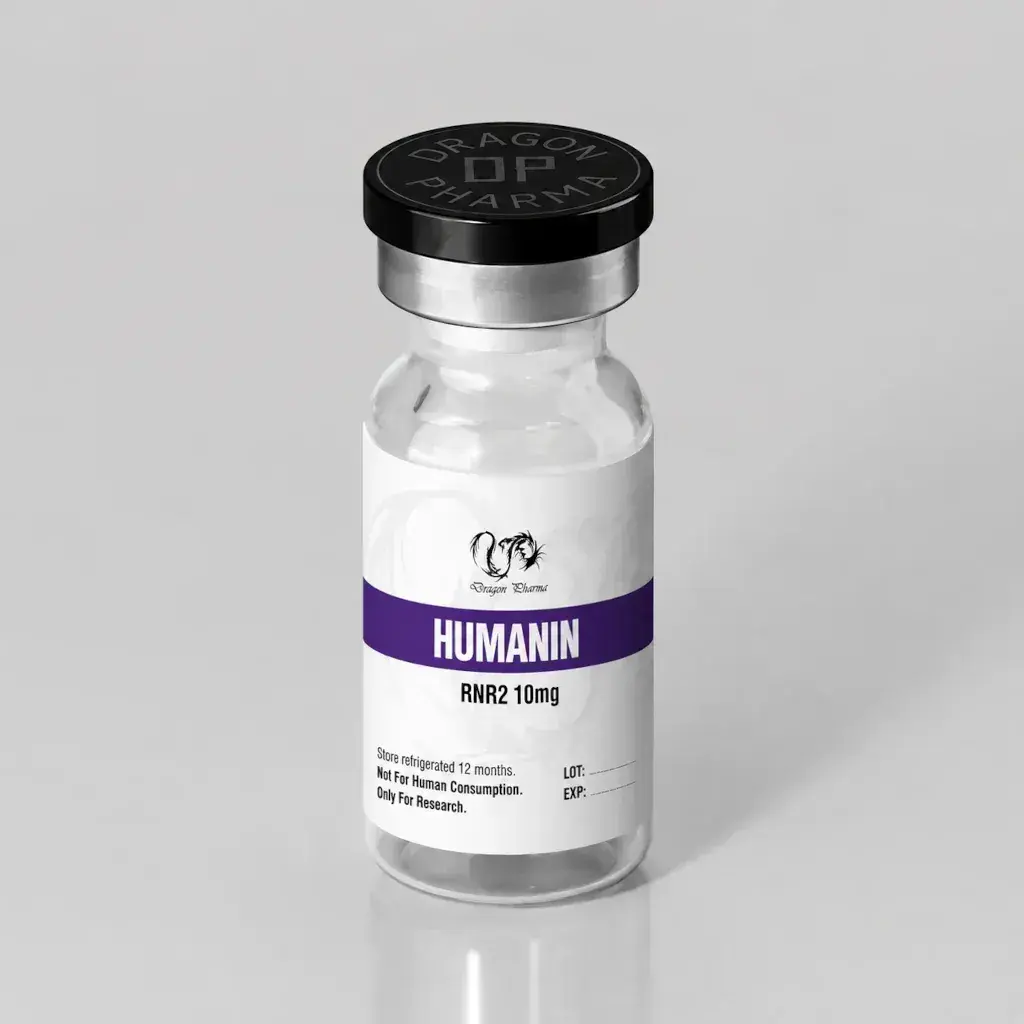
Humanin Injectable
Humanin 10 mg contains the 24-amino-acid mitochondrial-derived peptide (MDP) known as Humanin. Its sequence (MAPRGFSCLLLLTSEIDLPVKRRA) is encoded within the mitochondrial 16S ribosomal RNA gene. Unlike conventional receptor-binding peptides, Humanin is studied for its intracellular cytoprotective and anti-apoptotic mechanisms, particularly its ability to bind and sequester pro-apoptotic BCL-2 family proteins such as BAX and BID.
In research contexts, Humanin is investigated for neuroprotective effects against amyloid-beta toxicity, oxidative stress, and metabolic dysfunction. It has been shown to activate the JAK-STAT3 signaling pathway and to act as a ligand for formyl peptide receptors, mediating chemotaxis and inflammatory modulation. No FDA-approved human product exists for Humanin, and no clinical safety trials have been completed.
In bodybuilding and longevity communities, Humanin is referenced anecdotally for proposed mitochondrial support, insulin sensitivity, and cellular resilience during metabolic stress. However, such use falls outside any approved indication, and safety data in humans is entirely absent.
Research Properties of Humanin 10 mg
- 24-amino-acid mitochondrial-derived peptide (MDP)
- Anti-apoptotic activity via BAX and BID sequestration
- Investigated for neuroprotective and metabolic effects
- Lyophilized powder format for extended stability
- 10 mg per vial for research applications
Mitochondrial-Derived Peptide (MDP)
Humanin belongs to the emerging class of mitochondrial-derived peptides (MDPs), which are encoded within short open reading frames of the mitochondrial genome. This distinguishes it fundamentally from nuclear-encoded peptides and hormones. Its expression is responsive to cellular stress, suggesting a role as an endogenous cytoprotective signal.
The proposed mechanism of action involves binding to pro-apoptotic BCL-2 family proteins BAX and BID, sequestering them into amyloid-like fibrils and preventing their translocation to mitochondria. This blocks the mitochondrial outer membrane permeabilization (MOMP) step of apoptosis. Additional mechanisms include activation of JAK-STAT3 signaling and binding to formyl peptide receptors FPR2/FPRL1.
Circulating Humanin levels decline with age in mice, macaques, and humans, and compensatory increases have been observed in some disease states. The peptide has a short plasma half-life of approximately 30 minutes, though functional signaling may persist longer.
Defining Characteristic
Anti-Apoptotic Cytoprotection
Humanin's defining research activity is its ability to suppress apoptosis by sequestering BAX and BID, preventing mitochondrial permeabilization. This mechanism is distinct from receptor-mediated peptides and hormone analogues.
Humanin 10 mg vs Other Dragon Pharma Preparations
Dragon Pharma offers several mitochondrial-related peptides referenced in research contexts. MOTS-c is another mitochondrial-derived peptide studied for metabolic regulation through AMPK activation. SS-31 is a mitochondria-targeted tetrapeptide investigated for cardiolipin protection. Humanin's mechanism centers on anti-apoptotic BCL-2 protein sequestration, which is distinct from MOTS-c's metabolic signaling and SS-31's mitochondrial membrane interaction.
Typical Dosage Ranges
Common reference ranges for Humanin are not well characterized in publicly available bodybuilding resources. Community protocols reference doses ranging from 100 mcg to 1 mg, with some sources citing 2–5 mcg/kg body weight. However, these ranges are anecdotal and not derived from controlled human studies. No standardized dosage has been established through regulatory review.
| Use Case |
Common Reference Range |
Frequency |
| Research (non-clinical) |
100–500 mcg |
2–3× weekly (anecdotal) |
| Community protocol |
100 mcg |
Every 3–5 days |
Reconstitution & Handling
Humanin 10 mg is supplied as a lyophilized powder requiring reconstitution. Bacteriostatic Water is commonly referenced for reconstituting research peptides. A 10 mg vial reconstituted with 2 mL yields a concentration of 5 mg/mL. Standard sterile technique and peptide handling practices should be observed.
Stacking & Research Considerations
In community research contexts, Humanin is sometimes referenced alongside MOTS-c for complementary mitochondrial effects. However, no controlled studies have examined the safety or efficacy of these combinations, and humanin's anti-apoptotic mechanism raises theoretical concerns that warrant caution.
Important
Individual Response Varies
The information above is for educational reference and does not constitute medical advice. Humanin has not been evaluated by the FDA for safety or efficacy.
Important Safety Information
Humanin has never been tested in human clinical trials. No Phase 1 safety trial, no IND-enabling toxicology studies, and no GMP manufacturing for clinical use have been completed. The safety profile in humans is completely uncharacterized.
Important
Non-Medical Use
Non-medical use of Humanin falls outside any approved indication. No population exists for whom use of this compound is supported by evidence, and gray-market products are not manufactured under pharmaceutical standards.
Potential Adverse Effects
Because Humanin's proposed mechanism involves anti-apoptotic and cytoprotective activity, theoretical concerns include potential reduction of apoptotic clearance of abnormal cells, including malignant ones. Humanin has shown insulin-sensitizing effects in preclinical models, and interactions with glucose-lowering medications in humans have not been studied. No reproductive or developmental toxicology data exists.
Conditions Requiring Medical Evaluation
Theoretical cautions include active or suspected malignancy, concurrent metabolic therapy (insulin, sulfonylureas), and pregnancy or breastfeeding. However, because no approved indication exists, there is no formal contraindication list. Individuals with any medical condition should consult a healthcare provider before considering any research peptide.
Monitoring Considerations
No standardized monitoring protocol exists for Humanin. Preclinical models have assessed metabolic markers such as fasting insulin and HOMA-IR, but these have not been validated in humans for this compound. Laboratory testing of the product itself is separate from clinical monitoring of the individual.
Product Care
Storage & Handling
Store the lyophilized powder under recommended conditions and protect from conditions that could compromise peptide integrity. Follow standard practices for handling lyophilized peptide products and inspect the vial before reconstitution.
Keep all research peptides and injectable products out of the reach of children.
Further Safety Information
USA Domestic 3–5 business days
International 10–15 business days
Order Processing 24–48 business hours
Tracking Provided after dispatch
Direct Supply
Discreet Delivery & Original Packaging
The outer shipping package remains discreet, with no external product details. Products are supplied through the official Dragon Pharma distribution chain.
What to Expect
- Orders are processed after payment confirmation
- USA Domestic shipping is typically faster when local stock is available
- International orders include tracking, though update frequency may vary by destination
- Multiple warehouses may result in separate shipments when applicable
Authenticity Verification
To verify your Humanin 10 mg product, use the security code on the vial label and cross-check it on the official Dragon Pharma site. Original packaging and batch documentation help reinforce product legitimacy.
For complete delivery details, tracking policy, and reshipment terms, please see our Shipping Info page.
Recommended Conditions
Store the lyophilized powder in a cool, dry place protected from light and moisture. The unopened vial should be kept under conditions that preserve the peptide's structural integrity until reconstitution.
Once reconstituted, Humanin solution should be handled according to standard peptide practices. The reconstituted solution is typically less stable than the lyophilized powder and should be stored refrigerated (2–8°C) for up to 28 days.
Keep out of reach of children. Follow proper handling practices for research peptides and use appropriate sterile technique during reconstitution.
Quick Reference
Do & Don't
- Do store lyophilized powder cool and dry
- Do protect from light and moisture
- Do inspect vial before reconstitution
- Don't expose to excessive heat
- Don't freeze reconstituted solution
- Don't use if powder appears discolored
What is Humanin 10 mg used for?
Humanin 10 mg is a research peptide supplied as a lyophilized powder. It contains the mitochondrial-derived peptide Humanin, which is investigated for anti-apoptotic and cytoprotective effects in preclinical models. There is no FDA-approved human indication for Humanin.
How often should Humanin 10 mg be administered?
Common reference ranges for Humanin are not well characterized in publicly available bodybuilding resources. Community protocols reference 100–500 mcg administered 2–3 times weekly, but these are anecdotal and not derived from controlled studies.
Does Humanin 10 mg require PCT?
Humanin is not an anabolic steroid and does not suppress endogenous testosterone production. Post-cycle therapy designed for steroid cycles is not applicable. Its mechanism involves intracellular protein interactions and cytoprotective signaling, not hormonal pathways.
What does Humanin do?
Humanin is proposed to bind pro-apoptotic BCL-2 family proteins BAX and BID, sequestering them into fibrils and preventing mitochondrial permeabilization. It also activates JAK-STAT3 signaling and binds to formyl peptide receptors. These mechanisms are investigated for neuroprotective and cytoprotective effects.
How long does Humanin take to work?
No established onset timeline exists for Humanin in humans because no clinical trials have been completed. Preclinical models suggest acute signaling within hours, but downstream metabolic effects may develop over weeks. These timelines are speculative for human use.
Is Humanin the best mitochondrial peptide?
No single mitochondrial peptide is universally superior. Humanin's research profile focuses on anti-apoptotic cytoprotection, while MOTS-c is studied for metabolic regulation through AMPK activation. Appropriate selection depends on the specific research context.
What is the difference between Humanin and MOTS-c?
Humanin and MOTS-c are both mitochondrial-derived peptides but have different mechanisms. Humanin targets BCL-2 family proteins to suppress apoptosis, while MOTS-c activates AMPK signaling for metabolic regulation. Their research applications are complementary but distinct.
What is the difference between Humanin and SS-31?
SS-31 is a mitochondria-targeted tetrapeptide that interacts with cardiolipin on the inner mitochondrial membrane. Humanin is a 24-amino-acid peptide that sequesters BCL-2 proteins. These compounds operate through entirely different mitochondrial mechanisms.
Is 10 mg of Humanin a lot?
10 mg is the total labeled content of the Humanin 10 mg vial. Because no standardized human dosage exists for this research peptide, the milligram amount cannot be classified as high or low relative to established protocols. Community protocols reference doses in the microgram range.
What strength is Humanin 10 mg?
Humanin 10 mg by Dragon Pharma contains 10 mg of Humanin per vial as a lyophilized powder. The vial size is 2 mL. This is a research presentation.
Can Humanin be stacked with other peptides?
There is no established research on combining Humanin with other peptides. In community contexts, it is sometimes referenced alongside MOTS-c for mitochondrial support, but no controlled studies support these combinations. Humanin's anti-apoptotic mechanism warrants particular caution.
No reviews found
Please log in to write Humanin 10 mg review.