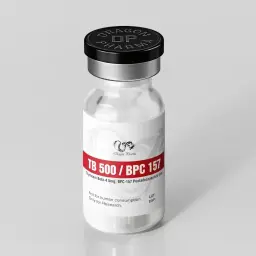


Semax 5 mg is a lyophilized powder research peptide manufactured by Dragon Pharma, containing 5 mg of Semax per 2 mL vial.
Semax is a synthetic heptapeptide analogue of the adrenocorticotropic hormone fragment ACTH(4-7), with the amino acid sequence Met-Glu-His-Phe-Pro-Gly-Pro (MEHFPGP). It was developed at the Institute of Molecular Genetics of the Russian Academy of Sciences and has been registered in the Russian Federation since 1994 for cerebrovascular indications, including ischemic stroke and cognitive decline.
Unlike its parent hormone ACTH, Semax is completely devoid of hormonal activity. It has been shown to stimulate memory and attention in both rodents and humans after intranasal application. The proposed mechanism of action involves the concept of a "synacton" — a complex of the parent molecule and its metabolic fragments (HFPGP and PGP) that act together on neuronal membranes with distinct but interacting binding sites.
In research settings, Semax has been studied for its neuroprotective and nootropic properties. A single intranasal application of Semax (50 μg/kg) in rats has been shown to produce rapid, gene- and region-specific changes in neurotrophin gene expression, including a 1.4-fold increase in BDNF protein levels and a 3-fold increase in exon III BDNF mRNA levels in the hippocampus. Semax is not FDA-approved for any human use in the United States and is available only as a compounded preparation under specific conditions.
Semax 5 mg is supplied as a lyophilized (freeze-dried) powder in a 2 mL vial. This form requires reconstitution with a suitable solvent such as bacteriostatic water or sterile saline before use.
Semax is a synthetic heptapeptide derived from the ACTH(4-7) sequence with a C-terminal Pro-Gly-Pro extension that enhances metabolic stability and bioavailability.
Semax is an analogue of the N-terminal fragment (4-7) of adrenocorticotropic hormone, extended with a C-terminal Pro-Gly-Pro sequence. This structural modification confers resistance to enzymatic degradation and prolongs its activity compared to the native ACTH fragment. The peptide is completely devoid of hormonal activity, distinguishing it from its parent hormone.
The proposed mechanism of action involves the "synacton" concept, where Semax and its major metabolic fragments (HFPGP and PGP) act as a complex of bioregulators on neuronal membranes with distinct but interacting binding sites. Research has demonstrated that Semax modulates the expression and activation of the hippocampal BDNF/trkB system, with a single application producing a 1.4-fold increase in BDNF protein and a 1.6-fold increase in trkB tyrosine phosphorylation.
Semax also affects the serotonergic system. Studies have shown that Semax administration significantly increases 5-HIAA (a serotonin metabolite) tissue content in the hypothalamus and striatum by up to 120–130% within 2 hours, with extracellular levels in the striatum increasing up to 180% between 1 and 4 hours after injection.
Semax is registered in the Russian Federation for cerebrovascular indications and has been used clinically for over three decades. It is not FDA-approved for any indication in the United States, and no large-scale multicenter trials conforming to international regulatory standards have been published.
Dragon Pharma offers several research peptides that are commonly referenced alongside Semax 5 mg in cognitive and neurological contexts. Selank is a tuftsin-derived peptide studied for anxiolytic effects through GABAergic modulation, often stacked with Semax for combined cognitive and anxiolytic effects. P21 is a peptide derived from CNTF studied for neuroprotection and neurogenesis. DSIP is a delta sleep-inducing peptide investigated for sleep regulation and stress response. These compounds act through different mechanisms than Semax's neurotrophic modulation.
Published laboratory reports for Semax 5 mg are shown below with the test date, measured concentration, and percentage of the product's 5 mg label claim.
 View Report
Laboratory results apply to the specific tested sample represented in each published report and should not be interpreted as a measurement of every vial or production batch.
The information below is provided for educational reference only. Semax is not FDA-approved for any human use in the United States. All use in non-medical contexts falls outside approved indications.
In Russian clinical research, Semax has been studied at intranasal doses of 0.25–1.0 mg per administration, corresponding to approximately 4.0–16.0 μg/kg body weight. In a clinical trial for acute ischemic stroke, the most effective daily doses were 12 mg for moderate strokes and 18 mg for severe strokes. Preclinical animal studies have used intranasal doses of 50 μg/kg, subcutaneous doses of 0.05–1 mg/kg, and intraperitoneal doses of 0.015–0.5 mg/kg.
| Use Case | Common Reference Range | Administration Frequency |
|---|---|---|
| Human clinical (nootropic study) | 0.25–1.0 mg per dose | Once daily (20–24 h effect) |
| Clinical (ischemic stroke) | 12–18 mg per day | Per clinical protocol |
| Preclinical (rat, intranasal) | 50 μg/kg | Single application |
| Preclinical (rat, SC) | 0.05–1 mg/kg | Daily or every other day |
Semax is sometimes referenced in community protocols alongside Selank, pairing Semax's cognitive-stimulating and neurotrophic effects with Selank's anxiolytic properties. This combination is commonly referenced for daytime focus and stress management.
Community protocols for Semax typically reference cycles of 2–4 weeks followed by a break, though this practice is based on community experience rather than validated clinical protocols. Russian clinical use has employed 10-day treatment courses. Bacteriostatic Water is commonly referenced for reconstitution.
Clinical data from Russian trials report that Semax is generally well-tolerated with a minor percentage of side effects. Commonly reported side effects include nasal irritation with intranasal administration, transient headache, and mild fatigue after initial dosing.
Warnings include mood changes or irritability, sleep disturbance, and HPA axis considerations in individuals with known adrenal or pituitary pathology. The safety profile of extended or repeated courses beyond published 10-day protocols has not been established.
Semax acts on neurotrophic and monoaminergic systems rather than the hypothalamic-pituitary-gonadal axis. It does not suppress endogenous testosterone production, and post-cycle therapy in the context of testosterone recovery is not applicable.
Dosing strategies for Semax are based primarily on Russian clinical data and community reports. The information above is for educational reference and does not constitute medical advice.
Semax is not FDA-approved for any human use in the United States. It is registered in the Russian Federation for cerebrovascular indications, but this approval does not confer FDA approval or constitute evidence of safety or efficacy under FDA standards.
Semax is not FDA-approved for any indication in the United States and has not been submitted to the FDA for review. In the United States, Semax is available only as a 503A compounded preparation dispensed pursuant to a patient-specific prescription from a licensed provider. The safety and efficacy of Semax have not been established through adequate and well-controlled clinical trials under FDA standards.
The evidence base for Semax consists predominantly of clinical and mechanistic studies conducted by Russian research institutions and published largely in Russian-language journals. Independent Western replication is essentially absent, and long-term safety data and independent pharmacovigilance data are not available.
Semax is not FDA-approved for human use. Any use outside of approved research applications falls outside approved indications. Product concentration and laboratory verification do not establish that non-medical use is safe or appropriate for an individual.
Commonly reported side effects include nasal irritation with intranasal administration, transient headache, and mild fatigue after initial dosing. Warnings include mood changes or irritability, sleep disturbance, and nasal mucosal irritation with repeated intranasal administration.
Mechanistic considerations of particular relevance include pregnancy or breastfeeding (no reproductive or developmental data), history of or active seizure disorder (theoretical CNS excitatory potential), active or suspected neuroendocrine malignancy (theoretical concern given ACTH-fragment lineage), known hypersensitivity to Semax or formulation components, and hepatic or renal impairment.
Semax should not be used by anyone outside an IRB-approved clinical research study. Individuals with a history of or active seizure disorder, active or suspected neuroendocrine malignancy, or known hypersensitivity to Semax should avoid use.
The safety profile of extended or repeated courses beyond published 10-day protocols has not been established.
No specific bloodwork monitoring is required for Semax based on available data. It is non-hormonal and does not affect HPTA, prolactin, or metabolic markers. In non-medical contexts, individuals commonly reference standard health monitoring rather than Semax-specific testing.
No published laboratory reports are available for this specific product beyond the potency verification shown in the Lab Reports tab. That testing applies to the tested sample only and is separate from any clinical monitoring of the individual.
Lyophilized Semax should be stored at -20°C for long-term stability (≥4 years). After reconstitution in bacteriostatic water, store at 2–8°C and use within 30 days. Avoid repeated freeze-thaw cycles.
Keep all peptides and injectable products out of the reach of children. Follow the storage instructions provided with the product packaging.
Semax 5 mg by Dragon Pharma is supplied through the official distribution chain and shipped in original manufacturer packaging with discreet, privacy-focused handling.
The outer shipping package remains discreet, with privacy-focused handling and no unnecessary external product details. Products are supplied through the official Dragon Pharma distribution chain.
To verify your Semax 5 mg product, use the security code on the vial label and cross-check it on the Dragon Pharma official site. Official presentation, batch-linked lab proof, and original packaging help reinforce product legitimacy and buyer confidence.
For complete delivery details, tracking policy, and reshipment terms, please see our Shipping Info page.
Proper storage conditions help preserve peptide stability and overall product integrity throughout shelf life.
Store the lyophilized (dry) powder tightly sealed in its original container, protected from light, and desiccated at -20°C for long-term storage (≥4 years). Brief handling at refrigerated or ambient conditions is acceptable provided the container is allowed to equilibrate to room temperature before opening to prevent moisture uptake.
After reconstitution in bacteriostatic water, store at 2–8°C and use within 30 days. Avoid repeated freeze-thaw cycles.
Keep out of reach of children. Follow proper handling and sterile technique when administering the product.
Answers to common questions about Semax 5 mg, its mechanism, product strength, and laboratory testing.
Semax 5 mg contains a synthetic ACTH(4-7) analogue. In Russian clinical research, it is studied for neuroprotective and nootropic effects, including cognitive enhancement and neuroprotection. It is not FDA-approved for any human use, and all non-medical use falls outside approved indications.
Human clinical studies have used intranasal Semax at 0.25–1.0 mg per dose, with effects lasting 20–24 hours. Russian clinical protocols for stroke used 12–18 mg daily in divided doses. Community protocols commonly reference once-daily intranasal or subcutaneous administration.
No. Semax acts on neurotrophic and monoaminergic systems rather than the hypothalamic-pituitary-gonadal axis. It does not suppress endogenous testosterone production, and post-cycle therapy in the context of testosterone recovery is not applicable.
Semax modulates the expression and activation of the hippocampal BDNF/trkB system, with a single application producing a 1.4-fold increase in BDNF protein and a 1.6-fold increase in trkB phosphorylation. It also affects the serotonergic system, increasing 5-HIAA levels in the hypothalamus and striatum.
In human studies, a single intranasal dose of Semax produced beneficial effects on operator work efficiency lasting 20–24 hours. In animal studies, BDNF mRNA levels changed as early as 20 minutes after administration, with maximum gene expression attained by 90 minutes.
There is no evidence-based “best” nootropic peptide. Semax is studied for neurotrophic and cognitive effects, while Selank is investigated for anxiolytic effects through GABAergic modulation. The two are often stacked for combined effects. The appropriate choice depends on individual goals.
Semax is an ACTH(4-7) analogue studied for cognitive enhancement through BDNF upregulation, while Selank is a tuftsin-derived peptide studied for anxiolytic effects through GABAergic modulation. They are often stacked together to produce a state of calm alertness.
Semax is an ACTH(4-7) analogue studied for BDNF modulation, while P21 is a peptide derived from CNTF studied for neuroprotection and neurogenesis through a different mechanism. Both are investigated for cognitive support but act through distinct pathways.
1.0 mg is within the range used in human clinical studies, which administered 0.25–1.0 mg per dose intranasally. This corresponds to approximately 4.0–16.0 μg/kg body weight. The 5 mg vial contains multiple doses at this level.
Semax 5 mg is labeled at 5 mg of Semax per vial. It is supplied as a lyophilized powder in a 2 mL vial, requiring reconstitution before use.
Yes. A published laboratory report dated November 20, 2023 measured Semax 5 mg at 5.20 mg, equivalent to 104% of its 5 mg label claim. The batch number for this report is #HDSX923.
The complete report can be viewed in the Lab Reports tab. Laboratory results apply to the tested sample represented by the individual report and should not be interpreted as a measurement of every vial.
Lyophilized Semax is typically reconstituted with a suitable solvent such as Bacteriostatic Water or sterile saline. The volume of solvent added determines the concentration of the resulting solution. Proper sterile technique should be used during reconstitution.