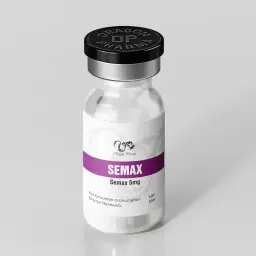
DSIP 10 mg is a lyophilized research peptide manufactured by Dragon Pharma, supplied as 10 mg per 2 mL vial for laboratory research purposes.
DSIP 10 mg contains DSIP (Delta Sleep-Inducing Peptide), a naturally occurring nonapeptide first isolated from rabbit cerebral venous blood in 1977 by the Schoenenberger-Monnier group in Basel. Its amino acid sequence is Trp-Ala-Gly-Gly-Asp-Ala-Ser-Gly-Glu, with a molecular formula of C35H48N10O15 and a molecular weight of 848.8 g/mol. DSIP is found in neurons, peripheral organs, and plasma, and is described as a neuropeptide that induces mainly delta sleep in mammals.
The proposed mechanisms of DSIP involve central neurotransmission pathways, influencing corticotropin-releasing factor (CRF), melatonin, and growth hormone secretion via the hypothalamic-pituitary axis. Research suggests it may enhance slow-wave sleep architecture and assist in stabilizing circadian rhythms. Beyond sleep, DSIP has been investigated for effects on electrophysiological activity, neurotransmitter levels, circadian and locomotor patterns, hormonal levels, and the activity of neuropharmacological drugs including their withdrawal. A 2006 review in the Journal of Neurochemistry described DSIP as "a still unresolved riddle," noting that its structure is different from any other known sleep-promoting factor and that its mechanism of action remains to be established.
DSIP is not approved by the FDA for any indication. A 1992 double-blind study of 16 chronic insomniac patients found that short-term treatment with DSIP produced weak, statistically significant effects on objective sleep quality (higher sleep efficiency and shorter sleep latency), but concluded that DSIP was "not likely to be of major therapeutic benefit" for chronic insomnia. A 1987 case report described successful treatment of a patient with chronic delayed sleep phase insomnia, advancing the main sleep phase by 5 hours and allowing complete withdrawal from benzodiazepine dependence. DSIP remains an unapproved new drug with no established human dosing protocol.
DSIP 10 mg is supplied as a lyophilized powder in a 2 mL vial. The powder requires reconstitution with an appropriate solvent before laboratory use. Once reconstituted, the solution should be refrigerated and handled according to standard research peptide protocols.
DSIP is a naturally occurring nonapeptide studied for its effects on sleep architecture, stress response, and neuroendocrine signaling.
DSIP belongs to the class of neuropeptides. It was originally isolated from rabbit cerebral venous blood and named for its association with delta-wave activity during deep sleep. The peptide is found in neurons, peripheral organs, and plasma. Its amino acid sequence is Trp-Ala-Gly-Gly-Asp-Ala-Ser-Gly-Glu, making it a nonapeptide with a molecular weight of 848.8 g/mol.
The pharmacokinetic profile of DSIP is characterized by a very short half-life. The commonly cited figure is around 15 minutes, with a peak within a few minutes, based on in vitro work rather than human study. This creates a puzzle: a peptide that clears in roughly 15 minutes should not still be shaping sleep architecture hours later, yet reported effects are about a whole night. Binding to carrier proteins may extend how long it persists in the body, but there is no reliable published human pharmacokinetic study to settle this.
The proposed mechanism involves modulation of central neurotransmission pathways. Research suggests DSIP may influence corticotropin-releasing factor (CRF), melatonin, and growth hormone secretion via the hypothalamic-pituitary axis. A 2006 review noted that DSIP's structure is different from any other known sleep-promoting factor and that its mechanism remains to be established. Some research has explored DSIP's interaction with the pituitary, suggesting it may mediate GH and corticosteroid release through G-protein-coupled neuropeptide receptors.
DSIP has a commonly cited half-life of around 15 minutes, with a peak within a few minutes, based on in vitro work rather than human study. This short half-life is a central puzzle in DSIP research, as its reported effects on sleep architecture appear to outlast its circulating presence.
Dragon Pharma offers a range of research peptides relevant to sleep, recovery, and neuroendocrine research. DSIP 10 mg is positioned as a sleep-related neuropeptide, distinct from growth hormone secretagogues and recovery peptides.
For research focused on endogenous GH stimulation, Dragon Pharma offers CJC-DAC and CJC 1295 No DAC/Ipamorelin. For cognitive research peptides, Semax and Selank target different neurotrophic pathways. DSIP's proposed mechanism involves sleep architecture modulation and neuroendocrine signaling, representing a distinct research approach.
The information below is provided for educational reference only. DSIP is a research compound that has not been approved for human use. No established human dosing protocol exists. Non-medical use falls outside any approved indications and carries unknown health risks.
No established human dosing protocol exists for DSIP because it has never been approved for any use. In non-medical community contexts, the convention commonly quoted is 100 to 300 mcg subcutaneously, 30 to 60 minutes before bed, often cycled a few weeks on and a few weeks off. A recovery-focused peptide protocol reference lists DSIP at 100-200 mcg once daily, 30 minutes before bed, with a 4-6 week on, 2-4 week off cycle. One educational resource cites 100 mcg to 800 mcg subcutaneously at bedtime, with use limited to 1-2 nights a week to prevent tachyphylaxis.
| Use Case | Common Reference Range | Frequency |
|---|---|---|
| Non-medical (low reference) | 100–200 mcg | Once daily, pre-bed |
| Non-medical (higher reference) | 200–300 mcg | Once daily, pre-bed |
| Non-medical (cyclic) | 100–800 mcg | 1–2 nights per week |
Community doses are referenced from non-medical discussions and are not supported by clinical evidence. DSIP has no established human dosing protocol.
DSIP is not an anabolic compound and is not stacked for muscle-building purposes. In non-medical research contexts, it is sometimes referenced alongside recovery peptides. A recovery stack protocol combines DSIP with BPC 157 and TB 500, based on the rationale that tissue repair peaks during deep sleep when growth hormone release is highest, and DSIP enhances deep sleep architecture to create a larger recovery window.
Cycling patterns commonly referenced are 4-6 weeks on followed by 2-4 weeks off, not because tolerance develops (it does not in the clinical record) but because theoretical HPA-axis modulation argues for periodic washout on principle. There is no need to taper off; stopping cold produces no rebound insomnia or withdrawal because DSIP is not a GABAergic and does not occupy a receptor that produces dependence.
Across approximately 40 years of clinical research use, including insomniac patients, opiate withdrawal protocols, and chronic pain pilots, no major adverse events have been reported at standard doses. A 1992 study of chronic insomniac patients noted that DSIP was administered without notable side effects or tolerance across repeated dosing.
Commonly reported effects in non-medical contexts include injection-site irritation (mild redness or a transient welt at subcutaneous sites), vivid dreams or altered dream recall, and morning grogginess. Morning grogginess is usually a dose or timing issue; moving the injection earlier or reducing the dose typically resolves it. For users on ACE inhibitors, a theoretical peptidase interaction has been flagged in the anesthesiology literature, not a hard contraindication but worth knowing if blood pressure drifts low.
DSIP is not part of any post-cycle therapy protocol. It has no relationship to the hypothalamic-pituitary-gonadal axis, and its research focus has been on sleep architecture and neuroendocrine signaling. PCT compounds such as Clomid and Nolvadex address entirely different biological systems.
DSIP has never been approved for human use. The human research on what it actually does is small, old, and inconclusive. The information above is for educational reference and does not constitute medical advice. Human use is not supported by evidence.
DSIP is an experimental research peptide that has never been approved for human use. No human safety data exists for non-medical applications.
DSIP is not FDA-approved for any indication. It was removed from the FDA's Category 2 bulk-substances list in April 2026, and its Pharmacy Compounding Advisory Committee reviewed it in July 2026. That removal is widely reported as a green light, but it was not one: the nominations were withdrawn, there was no safety finding, and DSIP remains an unapproved new drug. Products sold online as research chemicals are not FDA-regulated and carry unknown contamination, dosing, and safety risks.
DSIP 10 mg is sold strictly for research purposes. It is not a dietary supplement, medication, or approved therapeutic agent. Human consumption for sleep enhancement or any other purpose is not recommended and may pose unknown health risks.
In clinical research settings, DSIP has shown a favorable safety profile. A 1992 double-blind study of chronic insomniac patients found no notable side effects or tolerance across repeated dosing. Treatment of withdrawal syndromes with DSIP led to fast and complete remission in many cases, with no major adverse events observed across repeated administrations.
In non-medical contexts, commonly reported effects include injection-site irritation, vivid dreams or altered dream recall, and morning grogginess. Morning grogginess is usually a dose or timing issue rather than a peptide issue; moving the injection earlier or reducing the dose typically resolves it. For users on ACE inhibitors, a theoretical peptidase interaction has been flagged in the anesthesiology literature, though this is not a hard contraindication.
No published chronic toxicology, genotoxicity, reproductive toxicity, or carcinogenicity data exists for DSIP in humans. The 2006 review described DSIP as "a still unresolved riddle," and no human pharmacokinetic study exists to settle its half-life or tissue distribution.
DSIP has no approved indications and no established contraindications because no human use is supported. However, given the lack of human safety data, individuals with pre-existing sleep disorders, hormonal conditions, or those taking medications that affect sleep architecture should be particularly cautious. No human reproductive or developmental toxicology data exists.
No monitoring protocols exist for DSIP because it has no approved human use. In clinical research settings, monitoring included polysomnography for sleep structure and subjective sleep quality assessments. No routine bloodwork is required for DSIP itself, as it does not appear to affect lipids, liver enzymes, hematocrit, or the HPTA in any way that shows up on a standard panel.
Store lyophilized powder refrigerated or frozen for long-term stability. Once reconstituted, store at 2-8°C and use within 30 days. Protect from light and heat. Keep all research compounds out of the reach of children.
DSIP 10 mg is supplied through the official Dragon Pharma distribution chain and shipped in original manufacturer packaging with discreet, privacy-focused handling.
The outer shipping package remains discreet, with privacy-focused handling and no unnecessary external product details. Products are supplied through the official Dragon Pharma distribution chain.
To verify your DSIP 10 mg product, use the security code on the packaging and cross-check it on the Dragon Pharma official site. Official Dragon Pharma presentation and original packaging help reinforce product legitimacy and buyer confidence.
Proper storage conditions help preserve peptide integrity and stability throughout shelf life.
Store lyophilized powder refrigerated or frozen for long-term stability. Keep the vial in its original packaging until use. Once reconstituted, store at 2-8°C and use within 30 days.
Protect from light and heat. Do not freeze the reconstituted solution, as freezing can damage peptide structure. If the solution turns cloudy or discolored, discard it. Keep out of reach of children.
Answers to common questions about DSIP 10 mg, its research status, mechanism of action, and safety considerations.
DSIP 10 mg is a research peptide studied for its effects on sleep architecture and neuroendocrine signaling. It is a naturally occurring nonapeptide originally isolated from rabbit cerebral venous blood. It has never been approved for human use and is sold strictly for laboratory research purposes.
No established human dosing protocol exists. In non-medical community contexts, the convention commonly quoted is 100 to 300 mcg subcutaneously, 30 to 60 minutes before bed, often cycled a few weeks on and a few weeks off. Some protocols reference 100-800 mcg 1-2 nights per week to prevent tachyphylaxis.
DSIP has no relationship to the hypothalamic-pituitary-gonadal axis and is not part of any post-cycle therapy protocol. Its research focus has been on sleep architecture and neuroendocrine signaling, not hormonal recovery. PCT compounds such as Clomid and Nolvadex address entirely different biological systems.
DSIP is a neuropeptide found in neurons, peripheral organs, and plasma. It is described as inducing mainly delta sleep in mammals and has been observed to affect electrophysiological activity, neurotransmitter levels, circadian and locomotor patterns, hormonal levels, and the activity of neuropharmacological drugs. Its mechanism of action remains to be established.
DSIP has a commonly cited half-life of around 15 minutes, with a peak within a few minutes. In non-medical community protocols, users typically report mild subjective effects in the first 1-3 nights, with measured deep-sleep minutes climbing around nights 4-7, and full effect by week 2-3.
There is no single sleep peptide that is universally best, and DSIP's human evidence is limited. A 1992 double-blind study found weak effects and concluded DSIP was "not likely to be of major therapeutic benefit" for chronic insomnia. DSIP is not a sedative and does not work like one.
DSIP and CJC-DAC have different mechanisms. DSIP is a neuropeptide studied for sleep architecture modulation, while CJC-1295 is a GHRH analog that stimulates growth hormone release. The two are sometimes referenced together in recovery stacks, based on the rationale that deep sleep supports GH-mediated tissue repair.
DSIP and BPC 157 target different systems. DSIP is studied for sleep regulation and neuroendocrine function, while BPC 157 is studied for tissue repair and angiogenesis. A recovery stack protocol combines them based on the rationale that healing peaks during deep sleep.
No human dosing standards exist for DSIP. The 10 mg vial strength is a research quantity. At a community-referenced dose of 100-300 mcg, the vial provides approximately 33-100 doses. This is a standard research vial size for lyophilized peptides.
DSIP 10 mg is labeled at 10 mg of DSIP per vial. It is supplied as a lyophilized powder in a 2 mL vial, requiring reconstitution before laboratory use.
This product page does not include a published laboratory report for the current batch. DSIP is cheap to synthesize and cheap to underdose, so a batch-specific HPLC and mass spec COA from an independent third-party lab is often recommended. For researchers requiring batch-specific testing documentation, please contact customer support.
No. DSIP has never been approved by the FDA or any regulatory authority for human use. It was removed from the FDA's Category 2 bulk-substances list in April 2026, but that removal was widely misreported as a green light. The nominations were withdrawn, there was no safety finding, and DSIP remains an unapproved new drug.