
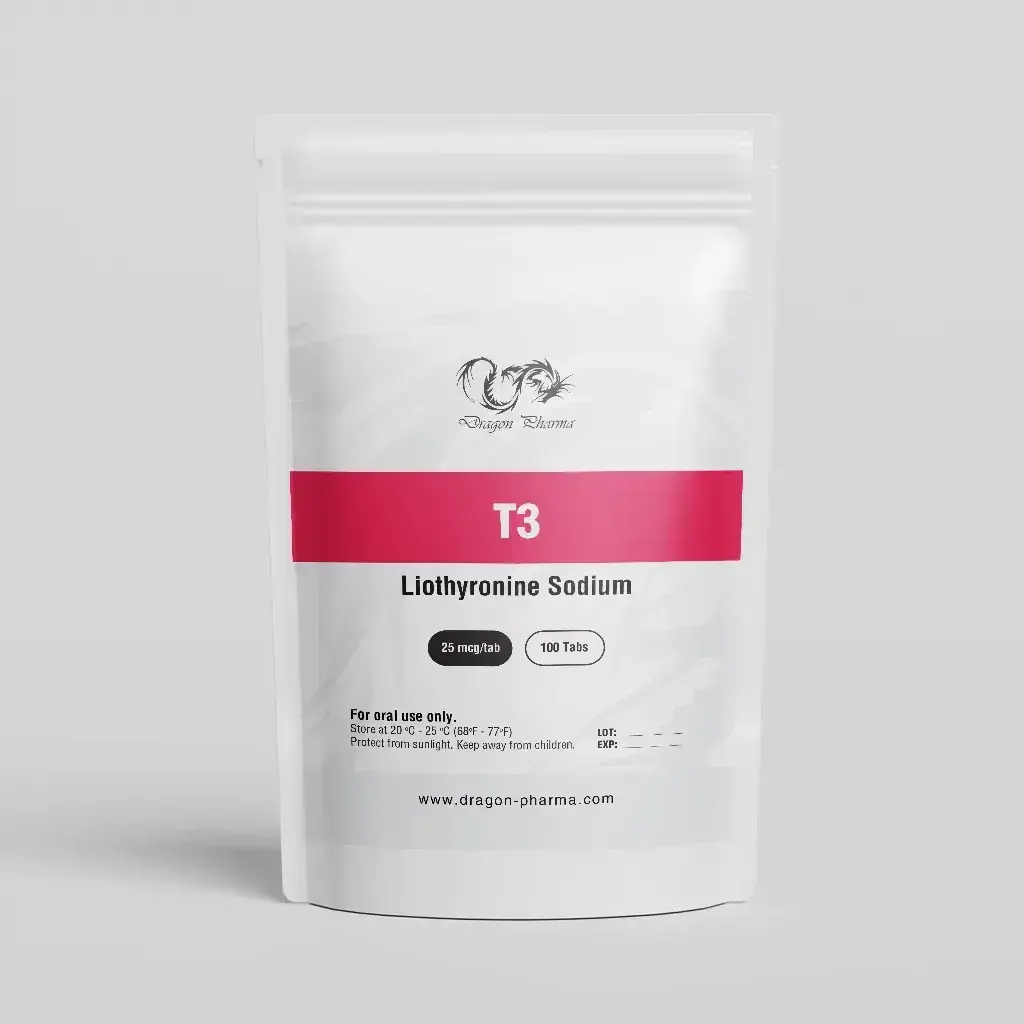
T3 25 mcg is an oral liothyronine sodium tablet manufactured by Dragon Pharma, dosed at 25 mcg per tablet in a 100-tablet package.
T3 25 mcg contains liothyronine sodium, a synthetic form of triiodothyronine (T3), the active thyroid hormone. In medical practice, liothyronine is indicated for replacement therapy in hypothyroidism, as an adjunct in the management of well-differentiated thyroid cancer, and as a diagnostic agent in thyroid suppression tests . The FDA label explicitly states that thyroid hormones, including liothyronine sodium, should not be used for the treatment of obesity or for weight loss, and that larger doses may produce serious or life-threatening toxicity .
Liothyronine works by binding to thyroid hormone receptors in the nucleus, which regulates gene expression and influences metabolic rate, protein synthesis, and oxygen consumption. Unlike levothyroxine (T4), which requires peripheral conversion to T3, liothyronine provides active hormone directly. Following oral administration, liothyronine is almost completely absorbed (approximately 95% bioavailability), with peak serum levels reached within 2 to 4 hours. The half-life is approximately 2.5 days .
In non-medical bodybuilding contexts, T3 is commonly referenced during contest preparation and cutting phases for its effects on metabolic rate. A Biomogging cycle guide notes that T3 is "widely used in bodybuilding and physique sports to accelerate fat loss during caloric deficit," with T3 increasing basal metabolic rate by 10–15% at moderate doses . However, the same source emphasizes that T3 is "profoundly catabolic at higher doses" and that a testosterone base is required to preserve lean tissue . The 25 mcg strength of Dragon Pharma's T3 aligns with the commonly referenced starting point for non-medical use.
T3 25 mcg is supplied as an oral tablet containing 25 mcg of liothyronine sodium per tablet. Oral administration allows for convenient dosing without the need for injection equipment.
Liothyronine sodium is a synthetic form of the active thyroid hormone triiodothyronine (T3), which regulates metabolic rate, thermogenesis, and numerous other physiological processes.
Liothyronine belongs to the class of thyroid hormones. It is the sodium salt of L-triiodothyronine, the biologically active form of thyroid hormone. The chemical formula is C15H11I3NNaO4, with a molecular weight of approximately 672.95 g/mol . Liothyronine is produced synthetically and is chemically identical to the naturally occurring hormone produced by the thyroid gland.
The pharmacokinetics of liothyronine differ significantly from levothyroxine (T4). While T4 has a long half-life of approximately 7 days and requires peripheral deiodination to become active, liothyronine has a much shorter half-life of approximately 2.5 days and provides active hormone directly. Oral bioavailability is approximately 95%, and peak serum concentrations are achieved within 2 to 4 hours after administration . This rapid onset and shorter duration make T3 more difficult to titrate than T4, but it also allows for quicker dose adjustments if needed.
The FDA prescribing information includes a boxed warning stating that thyroid hormones, including liothyronine sodium, should not be used for the treatment of obesity or for weight loss. In euthyroid patients, doses within the range of daily hormonal requirements are ineffective for weight reduction, and larger doses may produce serious or even life-threatening manifestations of toxicity, particularly when given in association with sympathomimetic amines . The label also notes that over-replacement can decrease bone mineral density and that therapy in patients with diabetes may worsen glycemic control .
Liothyronine has a short half-life of approximately 2.5 days, compared to approximately 7 days for levothyroxine. This shorter half-life allows for quicker dose adjustments but also requires more careful monitoring to maintain stable hormone levels.
Dragon Pharma offers a range of compounds relevant to metabolic support and fat loss. T3 25 mcg is positioned as a thyroid hormone option, complementing other products used during cutting phases.
For the T4 form of thyroid hormone, Dragon Pharma offers T4, which is commonly used in replacement therapy and requires peripheral conversion to T3. For beta-2 agonist-based fat loss approaches, Clenbuterol is commonly referenced. For alternative metabolic support, Salbutamol is also available.
The information below is provided for educational reference only. Liothyronine is a prescription thyroid hormone; medical use requires appropriate diagnosis, clinical supervision and ongoing monitoring. Non-medical use falls outside approved indications and is explicitly warned against in the FDA label.
In medical practice, liothyronine dosing is individualized according to patient response and laboratory findings. For hypothyroidism, the usual starting dose is 5–25 mcg daily, with gradual titration based on TSH and T3 levels . In non-medical bodybuilding contexts, T3 is commonly referenced at 25–75 mcg daily for fat loss, with a typical protocol involving titration from 12.5–25 mcg up to a maximum of 50–75 mcg, followed by a taper . A Biomogging cycle guide notes that doses above 75 mcg significantly increase muscle wasting risk and cardiovascular stress without proportional fat-loss benefit .
| Use Case | Common Reference Range | Frequency |
|---|---|---|
| Medical (hypothyroidism) | 5–25 mcg starting, titrated | Once daily |
| Bodybuilding (fat loss, moderate) | 25–50 mcg | Split into 2 doses |
| Bodybuilding (contest prep, aggressive) | 50–75 mcg | Split into 2–3 doses |
T3 25 mcg tablets may be split to achieve lower starting doses such as 12.5 mcg. Doses above 75 mcg are associated with significantly increased risk.
T3 is not an anabolic compound. In non-medical bodybuilding contexts, it is used during cutting phases and contest preparation, commonly alongside anabolic steroids to preserve lean tissue. A Biomogging cycle guide emphasizes that "T3 requires an AAS base (testosterone minimum) to be muscle-sparing" and that running T3 solo or on a SARM-only base is "a guaranteed way to lose muscle alongside fat" . Dragon Pharma offers Clenbuterol as a commonly referenced fat-loss agent, and T4 as an alternative thyroid hormone option.
Cycle duration for non-medical use is typically 4–8 weeks, with a taper over 1–2 weeks to allow endogenous thyroid function to recover . The Biomogging guide notes that "abrupt discontinuation can cause severe fatigue, depression, and metabolic crash" and that tapering by 12.5 mcg every 2–3 days is recommended .
At supraphysiologic doses, T3 can cause palpitations, ectopic beats, and blood pressure drift upward, which are common above 75 mcg . Anxiety, irritability, and racing thoughts are dose-dependent, and splitting AM/midday dosing may help . GI acceleration including loose stools and cramping usually settles within a week but persistent symptoms above 50 mcg indicate a need to back off .
Rare but serious effects include atrial fibrillation and sustained tachyarrhythmia, with risk climbing above 75 mcg, particularly in users with existing LVH or on trenbolone . Angina or ischemic chest pain is a hard stop due to increased myocardial oxygen demand . Thyroid storm is essentially only seen with reckless dose escalation (≥150 mcg) or combining T3 with undiagnosed Graves' disease . Adrenal crisis can occur in users with undiagnosed adrenal insufficiency, as T3 accelerates cortisol clearance .
T3 itself does not suppress the hypothalamic-pituitary-testicular axis (HPTA), so no PCT is required for T3 specifically. The HPT (thyroid) axis restarts on its own within 4–8 weeks of a proper taper . The Biomogging guide recommends confirming recovery with TSH/fT3/fT4 labs at 4 and 8 weeks off . If the cycle included anabolic steroids, standard PCT for the androgens should be run; T3 does not change that .
Dosing strategies and support protocols should be adjusted based on experience level and bloodwork where possible. The information above is for educational reference and does not constitute medical advice. The FDA label explicitly states that thyroid hormones should not be used for weight loss.
Liothyronine is a prescription thyroid hormone that can affect cardiovascular, metabolic, and skeletal function. Medical use requires appropriate diagnosis, clinical supervision and ongoing monitoring.
Liothyronine sodium carries a boxed warning stating that thyroid hormones, either alone or with other therapeutic agents, should not be used for the treatment of obesity or for weight loss. In euthyroid patients, doses within the range of daily hormonal requirements are ineffective for weight reduction, and larger doses may produce serious or even life-threatening manifestations of toxicity, particularly when given in association with sympathomimetic amines .
Non-medical use of liothyronine for fat loss or metabolic enhancement is explicitly warned against in the FDA label and falls outside approved indications. Product quality does not establish that non-medical use is safe or appropriate.
Cardiac adverse reactions, including atrial fibrillation, are a significant risk, particularly in the elderly and in patients with underlying cardiovascular disease. The FDA label recommends initiating liothyronine at less than the full replacement dose in these populations . Over-replacement can increase bone resorption and decrease bone mineral density, and the lowest effective dose should be used . Therapy may worsen glycemic control in patients with diabetes mellitus, potentially requiring increased antidiabetic agent or insulin requirements .
In non-medical contexts, dose-dependent side effects reported by users include palpitations, ectopic beats, blood pressure drift upward (common above 75 mcg), anxiety, irritability, GI acceleration, and menstrual irregularity in women . Rare but serious effects include atrial fibrillation, angina, thyroid storm (essentially only with reckless dose escalation), and adrenal crisis in users with undiagnosed adrenal insufficiency .
Liothyronine should not be used to treat myxedema coma via the oral route; intravenous therapy is required in that emergency . In patients with concomitant adrenal insufficiency, replacement glucocorticoids should be administered prior to initiating liothyronine treatment to avoid precipitating acute adrenal crisis . Hard contraindications for non-medical use include untreated hypertension, recent myocardial infarction, unstable angina, known tachyarrhythmia (especially atrial fibrillation), untreated adrenal insufficiency, and pregnancy at supraphysiologic doses .
Medically supervised liothyronine therapy requires periodic monitoring of TSH and T3 levels as well as clinical status . The FDA label emphasizes that proper dose titration and careful monitoring are critical to prevent the persistence of hypothyroidism or the development of hyperthyroidism . For non-medical use, the Biomogging guide recommends pulling labs at week 3–4 to confirm the axis is responding as expected, and again at 4 and 8 weeks after discontinuation to confirm thyroid recovery .
Store at 20–25°C (77°F); excursions permitted to 15–30°C (59–86°F) . Keep the product securely stored and protected from conditions that could compromise the tablets or packaging. Inspect the product before use and do not use if it appears damaged or otherwise abnormal. Keep all medications out of the reach of children.
T3 25 mcg is supplied through the official Dragon Pharma distribution chain and shipped in original manufacturer packaging with discreet, privacy-focused handling.
The outer shipping package remains discreet, with privacy-focused handling and no unnecessary external product details. Products are supplied through the official Dragon Pharma distribution chain.
To verify your T3 25 mcg product, use the security code on the packaging and cross-check it on the Dragon Pharma official site. Official Dragon Pharma presentation and original packaging help reinforce product legitimacy and buyer confidence.
Proper storage conditions help preserve tablet integrity and stability throughout shelf life.
Store in a cool, dry place at controlled room temperature (15–25°C). Protect from excessive heat, moisture, and direct light. Keep the tablets in their original packaging until use.
Do not use if the packaging appears damaged or if the tablets show signs of deterioration. Keep out of reach of children.
Answers to common questions about T3 25 mcg, liothyronine sodium, thyroid hormone, product strength and safety considerations.
T3 25 mcg contains liothyronine sodium, a synthetic thyroid hormone. In medical practice, it is used for replacement therapy in hypothyroidism, as an adjunct in thyroid cancer management, and as a diagnostic agent. The FDA label explicitly states it should not be used for weight loss. In non-medical bodybuilding contexts, T3 is commonly referenced for fat loss during cutting phases.
In medical practice, liothyronine is typically taken once daily. In non-medical bodybuilding contexts, T3 is commonly split into 2–3 doses throughout the day to provide more stable blood levels. Common reference ranges are 25–50 mcg daily for moderate fat loss and 50–75 mcg for contest preparation . Dosing should be individualized.
T3 itself does not suppress the hypothalamic-pituitary-testicular axis, so no PCT is required for T3 specifically. The thyroid axis restarts on its own within 4–8 weeks of a proper taper . If the cycle included anabolic steroids, standard PCT for the androgens should be run; T3 does not change that .
Liothyronine is the active form of thyroid hormone (T3). It binds to thyroid hormone receptors in the nucleus, regulating gene expression and influencing metabolic rate, protein synthesis, and oxygen consumption. Unlike T4 (levothyroxine), which requires peripheral conversion, liothyronine provides active hormone directly.
Following oral administration, liothyronine is almost completely absorbed, with peak serum levels reached within 2 to 4 hours. The half-life is approximately 2.5 days . Metabolic effects are typically noticed within days, though full effects on body composition develop over weeks of consistent use.
There is no single thyroid hormone that is universally best for fat loss, and the FDA label explicitly warns against using thyroid hormones for weight loss. T3 is more potent and faster-acting than T4, but it is also more catabolic at higher doses and carries greater cardiovascular risk. Dragon Pharma offers T4 as an alternative thyroid hormone option.
T3 (liothyronine) is the active form of thyroid hormone, while T4 (levothyroxine) is a prohormone that requires peripheral conversion to T3. T3 has a shorter half-life (approximately 2.5 days vs 7 days for T4) and a faster onset of action. Dragon Pharma offers T4 as an alternative.
T3 and Clenbuterol work through completely different mechanisms. T3 is a thyroid hormone that increases metabolic rate, while clenbuterol is a beta-2 agonist that stimulates thermogenesis. Both are commonly referenced in cutting contexts, but T3 is considered more catabolic and requires an anabolic base to preserve muscle .
In medical practice, 25 mcg is a common starting dose for hypothyroidism and is within the range of daily hormonal requirements . In non-medical bodybuilding contexts, 25 mcg is the commonly referenced starting point for fat loss, with titration up to 50–75 mcg for more aggressive protocols . The 25 mcg strength of Dragon Pharma's T3 aligns with these starting reference points.
T3 25 mcg is labeled at 25 mcg of liothyronine sodium per tablet. It is supplied in a 100-tablet package, giving 2,500 mcg of total labeled liothyronine sodium content.
Yes. Abrupt discontinuation of T3 can cause severe fatigue, depression, and metabolic crash as endogenous thyroid function rebounds . A taper over 1–2 weeks is recommended, typically by reducing 12.5 mcg every 2–3 days . This allows the natural thyroid axis to re-establish without the shock of sudden temperature and energy collapse .
Yes. Cardiac adverse reactions, including atrial fibrillation, are a significant risk with liothyronine, particularly in the elderly and in patients with underlying cardiovascular disease . In non-medical contexts, risk of atrial fibrillation and sustained tachyarrhythmia climbs above 75 mcg, especially in users with existing LVH or on trenbolone . Angina or ischemic chest pain is a hard stop .