
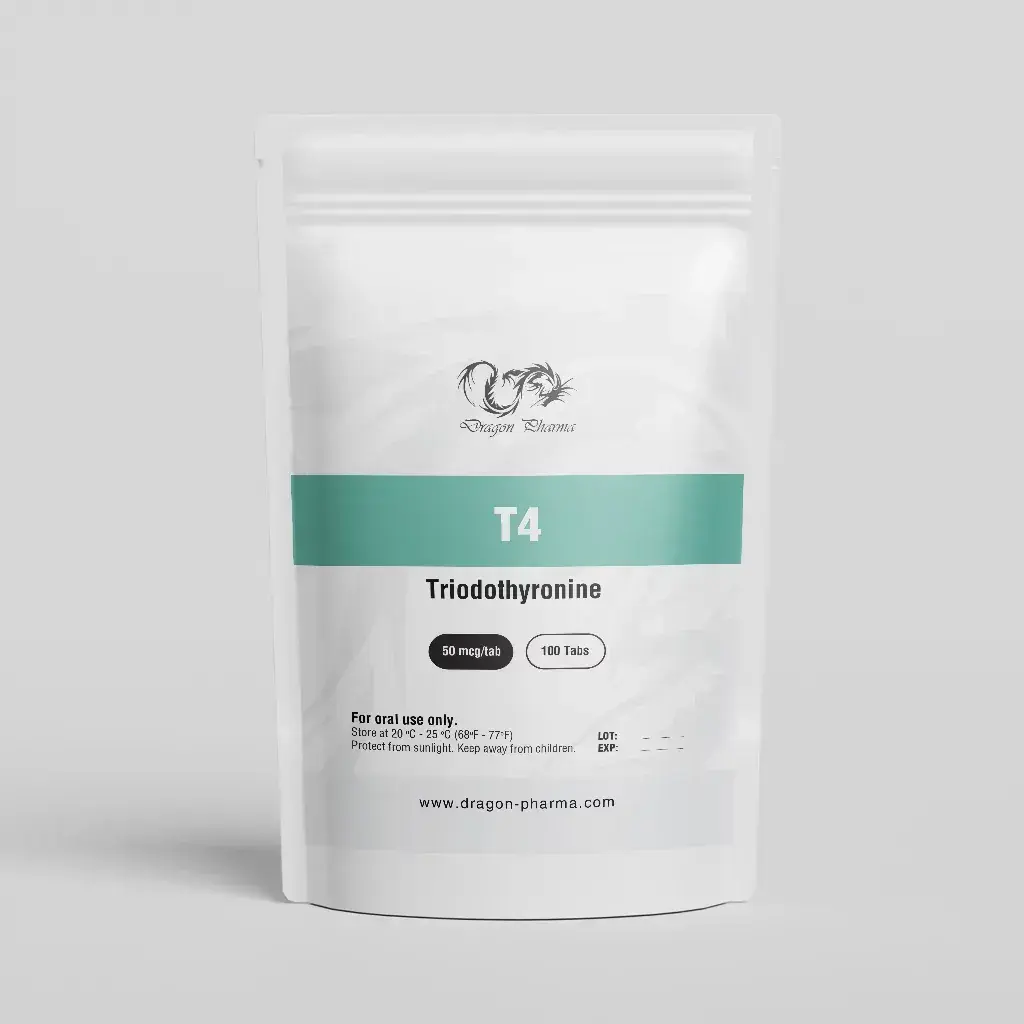
T4 50 mcg is an oral levothyroxine sodium tablet manufactured by Dragon Pharma, dosed at 50 mcg per tablet in a 100-tablet package.
T4 50 mcg contains levothyroxine sodium, a synthetic form of thyroxine (T4), the primary thyroid hormone produced by the thyroid gland. In medical practice, levothyroxine is indicated as replacement therapy in primary (thyroidal), secondary (pituitary), and tertiary (hypothalamic) congenital or acquired hypothyroidism, and as an adjunct to surgery and radioiodine therapy in the management of thyrotropin-dependent well-differentiated thyroid cancer. The FDA label explicitly states that thyroid hormones, including levothyroxine sodium, should not be used for the treatment of obesity or for weight loss.
Levothyroxine works by providing exogenous T4, which is then peripherally converted to the active hormone T3 (triiodothyronine) by deiodinase enzymes in the liver and kidneys. Approximately 80% of circulating T3 is derived from peripheral conversion of T4. This conversion step means that T4 has a slower onset of action than T3, with a peak therapeutic effect that may not be attained for 4 to 6 weeks. The half-life of levothyroxine in euthyroid patients is approximately 6 to 7 days, which is considerably longer than the 2.5-day half-life of T3.
In non-medical bodybuilding contexts, T4 is sometimes referenced during cutting phases for metabolic support. A bodybuilding guide notes that T4 is used "less often" than T3 because it is "much weaker than Cytomel and requires longer dosing" . A Biomogging cycle guide emphasizes that "unlike T3, there's no benefit to front-loading T4 — the long half-life means you climb into steady state whether you want to or not". The 50 mcg strength of Dragon Pharma's T4 aligns with the commonly referenced starting dose for non-medical use.
T4 50 mcg is supplied as an oral tablet containing 50 mcg of levothyroxine sodium per tablet. Oral administration allows for convenient once-daily dosing.
Levothyroxine sodium is a synthetic form of thyroxine (T4), the primary thyroid hormone, which is peripherally converted to the active hormone T3.
Levothyroxine belongs to the class of thyroid hormones. It is the synthetic sodium salt of thyroxine (T4), the major hormone secreted by the thyroid gland. The chemical name is (S)-2-amino-3- propanoic acid sodium salt. Levothyroxine is chemically identical to the naturally occurring hormone.
The pharmacokinetics of levothyroxine involve absorption from the gastrointestinal tract ranging from 40% to 80%, with the majority absorbed from the jejunum and upper ileum. Absorption is increased by fasting and decreased by malabsorption syndromes and certain foods such as soybean infant formula. Circulating thyroid hormones are greater than 99% bound to plasma proteins, including thyroxine-binding globulin (TBG), thyroxine-binding prealbumin (TBPA), and albumin. The liver is the major site of degradation, with approximately 80% of the daily dose deiodinated to yield equal amounts of T3 and reverse T3 (rT3).
The FDA label includes a boxed warning stating that thyroid hormones, including levothyroxine sodium, either alone or with other therapeutic agents, should not be used for the treatment of obesity or for weight loss. In euthyroid patients, doses within the range of daily hormonal requirements are ineffective for weight reduction. Larger doses may produce serious or even life-threatening manifestations of toxicity, particularly when given in association with sympathomimetic amines.
Levothyroxine has a half-life of approximately 6 to 7 days in euthyroid patients, compared to approximately 2.5 days for T3 (liothyronine). This long half-life means steady-state levels take weeks to achieve and dose adjustments require patience.
Dragon Pharma offers a range of compounds relevant to metabolic support and thyroid function. T4 50 mcg is positioned as a thyroid hormone option, complementing other products used during cutting phases or for replacement purposes.
For the active T3 form of thyroid hormone, Dragon Pharma offers T3 25 mcg, which provides liothyronine directly without requiring peripheral conversion. For beta-2 agonist-based fat loss approaches, Clenbuterol is commonly referenced. For alternative metabolic support, Salbutamol is also available.
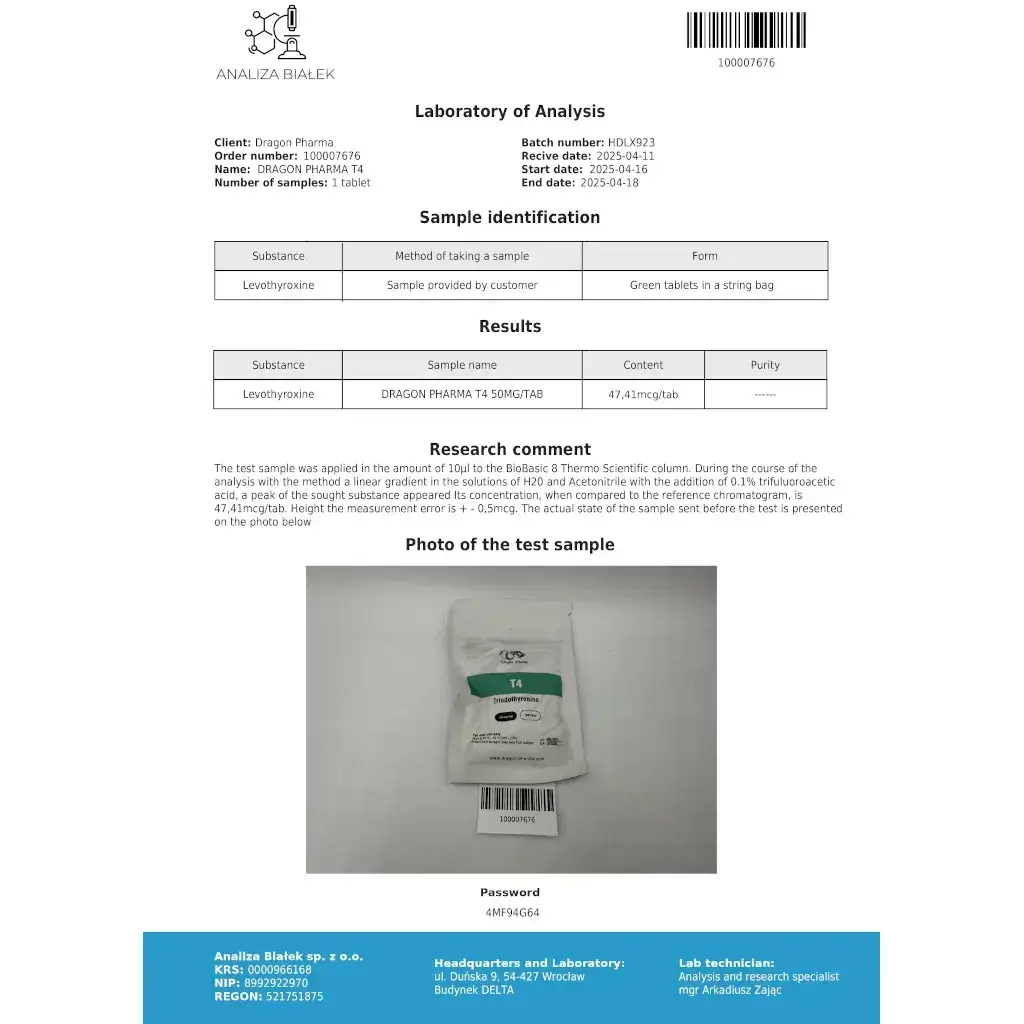
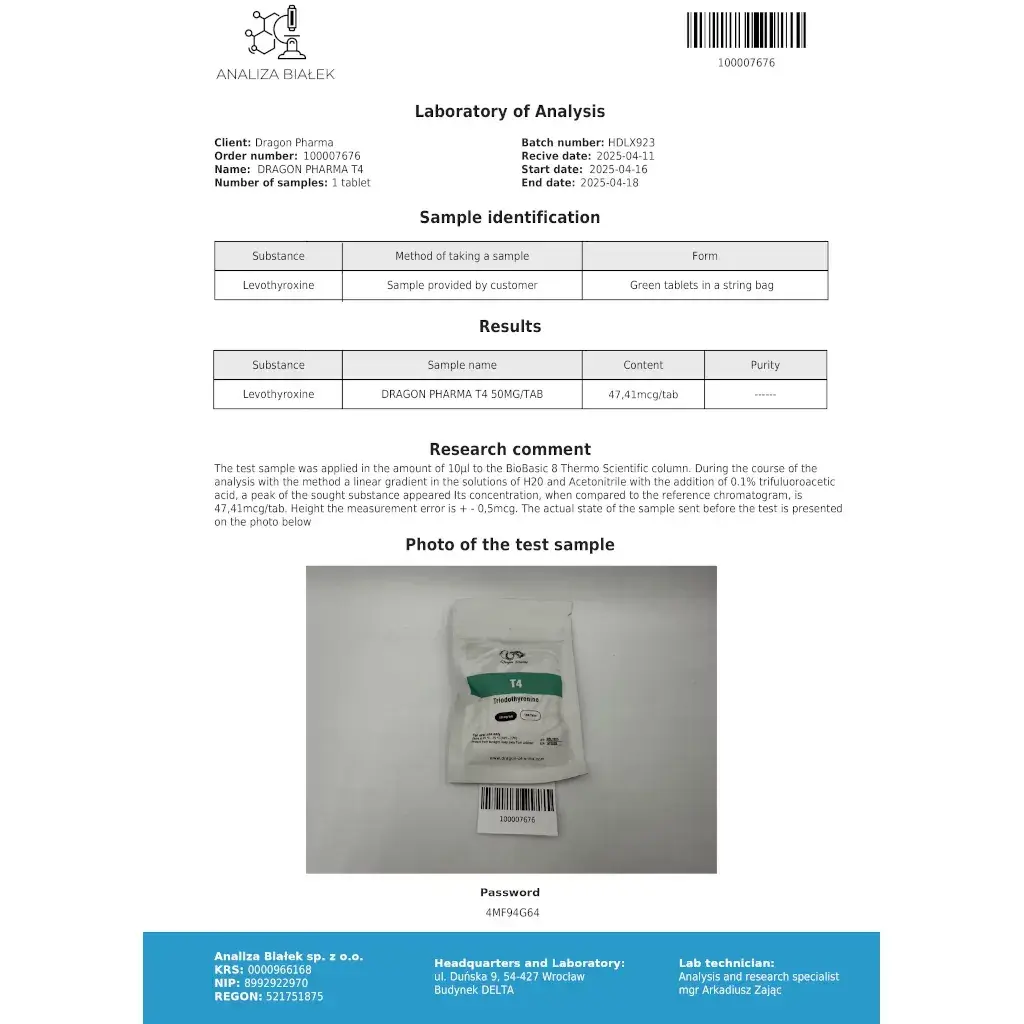
Published laboratory reports for T4 50 mcg are shown below with the test date, measured content and percentage of the product's 50 mcg label claim.
 View Report
Laboratory results apply to the specific tested sample represented in each published report and should not be interpreted as a measurement of every tablet or production batch.
The information below is provided for educational reference only. Levothyroxine is a prescription thyroid hormone; medical use requires appropriate diagnosis, clinical supervision and ongoing monitoring. Non-medical use falls outside approved indications and is explicitly warned against in the FDA label.
In medical practice, the recommended starting daily dosage of levothyroxine in adults with hypothyroidism is based on age and comorbid cardiac conditions. For healthy adults, the full replacement dose is approximately 1.6 mcg/kg/day. For patients over 50 or those with underlying cardiac disease, a lower starting dose of 12.5 to 25 mcg is recommended. In non-medical bodybuilding contexts, T4 is commonly referenced at 50–100 mcg daily for metabolic support, with a typical protocol involving a starting dose of 75 mcg held for 6 weeks before assessment. Such use falls outside approved medical indications and is explicitly discouraged by the FDA.
| Use Case | Common Reference Range | Frequency |
|---|---|---|
| Medical (hypothyroidism, healthy adults) | 1.6 mcg/kg/day | Once daily, fasting |
| Medical (elderly or cardiac patients) | 12.5–25 mcg starting | Once daily, fasting |
| Bodybuilding (non-medical, metabolic support) | 50–100 mcg | Once daily, fasting |
T4 50 mcg tablets may be split to achieve lower starting doses such as 25 mcg. Administration must be on an empty stomach, 30–60 minutes before breakfast, with separation from calcium, iron, and other interfering agents.
T4 is not an anabolic compound. In non-medical bodybuilding contexts, it is sometimes used during cutting phases for metabolic support, though it is referenced less often than T3 because of its weaker potency and longer onset . A Biomogging cycle guide notes that T4 is "a metabolic floor you build early and walk down carefully" rather than a "finish on show day" tool. Dragon Pharma offers T3 25 mcg as a more potent thyroid hormone option that provides active T3 directly.
Tapering is important on the way down. The Biomogging guide recommends dropping 25 mcg every 5–7 days rather than stopping cold, as "abrupt discontinuation produces the classic 'thyroid crash' — fatigue, edema, cold intolerance, rebound weight".
At supraphysiologic doses, levothyroxine can cause symptoms of hyperthyroidism including palpitations, tachycardia, arrhythmias, increased pulse and blood pressure, heart failure, angina, tremors, muscle weakness, nervousness, irritability, insomnia, and heat intolerance. Cardiac adverse reactions, including atrial fibrillation, are a significant risk, particularly in the elderly and patients with underlying cardiovascular disease. Over-replacement can increase bone resorption and decrease bone mineral density; the lowest effective dose should be used.
In non-medical contexts, elevated resting heart rate is a common marker of over-replacement. The Biomogging guide recommends checking resting heart rate every morning before dosing; if it climbs more than 15 bpm over baseline or crosses approximately 85 bpm at rest, the dose should be reduced.
Levothyroxine itself does not suppress the hypothalamic-pituitary-testicular axis, so no PCT is required for T4 specifically. However, exogenous T4 suppresses TSH within 2–4 weeks, and the HPT axis needs time to restart. The Biomogging guide recommends confirming recovery with TSH and free T4 labs at 4 to 6 weeks post-cycle before considering another run. If the cycle included anabolic steroids, standard PCT for the androgens should be run; T4 does not change that.
Dosing strategies and support protocols should be adjusted based on experience level and bloodwork where possible. The information above is for educational reference and does not constitute medical advice. The FDA label explicitly states that thyroid hormones should not be used for weight loss.
Levothyroxine is a prescription thyroid hormone that can affect cardiovascular, skeletal, and metabolic function. Medical use requires appropriate diagnosis, clinical supervision and ongoing monitoring.
Levothyroxine sodium carries a boxed warning stating that thyroid hormones, either alone or with other therapeutic agents, should not be used for the treatment of obesity or for weight loss. In euthyroid patients, doses within the range of daily hormonal requirements are ineffective for weight reduction. Larger doses may produce serious or even life-threatening manifestations of toxicity, particularly when given in association with sympathomimetic amines such as those used for their anorectic effects.
Non-medical use of levothyroxine for fat loss or metabolic enhancement is explicitly warned against in the FDA label and falls outside approved indications. Product quality does not establish that non-medical use is safe or appropriate.
Adverse reactions associated with levothyroxine therapy are primarily those of hyperthyroidism due to therapeutic overdosage. They include fatigue, increased appetite, weight loss, heat intolerance, fever, excessive sweating, headache, hyperactivity, nervousness, anxiety, irritability, emotional lability, insomnia, tremors, muscle weakness, muscle spasm, palpitations, tachycardia, arrhythmias, increased pulse and blood pressure, heart failure, angina, myocardial infarction, and dyspnea.
Cardiac adverse reactions, including atrial fibrillation, are a significant risk, particularly in the elderly and in patients with underlying cardiovascular disease. Levothyroxine should be initiated at less than the full replacement dose in these populations. Over-replacement can increase bone resorption and decrease bone mineral density; the lowest effective dose should be used. Therapy may worsen glycemic control in patients with diabetes mellitus, potentially requiring increased antidiabetic agent or insulin requirements.
Levothyroxine is contraindicated in patients with uncorrected adrenal insufficiency. In patients with concomitant adrenal insufficiency, replacement glucocorticoids should be administered prior to initiating levothyroxine treatment to avoid precipitating acute adrenal crisis. Oral thyroid hormone products should not be used to treat myxedema coma; intravenous therapy is required in that emergency.
Medically supervised levothyroxine therapy requires periodic monitoring of serum TSH and free T4 levels as well as clinical status. The FDA label emphasizes that proper dose titration and careful monitoring are critical to prevent the persistence of hypothyroidism or the development of hyperthyroidism. In non-medical contexts, the Biomogging guide recommends baseline labs (TSH, fT4, fT3, reverse T3) before starting, a repeat full panel at week 6, and confirmation of TSH recovery at 4 to 6 weeks post-cycle.
Store at 20–25°C (77°F); excursions permitted to 15–30°C (59–86°F). Keep the product securely stored and protected from heat, moisture, and light. Inspect the product before use and do not use if it appears damaged or otherwise abnormal. Keep all medications out of the reach of children.
T4 50 mcg is supplied through the official Dragon Pharma distribution chain and shipped in original manufacturer packaging with discreet, privacy-focused handling.
The outer shipping package remains discreet, with privacy-focused handling and no unnecessary external product details. Products are supplied through the official Dragon Pharma distribution chain.
To verify your T4 50 mcg product, use the security code on the packaging and cross-check it on the Dragon Pharma official site. Official Dragon Pharma presentation, batch-linked lab proof, and original packaging help reinforce product legitimacy and buyer confidence.
Proper storage conditions help preserve tablet integrity and stability throughout shelf life.
Store in a cool, dry place at controlled room temperature (15–25°C). Protect from excessive heat, moisture, and direct light. Keep the tablets in their original packaging until use.
Do not use if the packaging appears damaged or if the tablets show signs of deterioration. Keep out of reach of children.
Answers to common questions about T4 50 mcg, levothyroxine sodium, thyroid hormone, product strength and safety considerations.
T4 50 mcg contains levothyroxine sodium, a synthetic thyroid hormone. In medical practice, it is used as replacement therapy in hypothyroidism and as an adjunct in thyroid cancer management. The FDA label explicitly states it should not be used for weight loss. In non-medical bodybuilding contexts, T4 is sometimes referenced during cutting phases for metabolic support, though it is used less often than T3.
Levothyroxine is administered as a single daily dose, on an empty stomach, 30–60 minutes before breakfast. In non-medical bodybuilding contexts, T4 is commonly referenced at 50–100 mcg daily, with a typical protocol starting at 75 mcg and holding for 6 weeks before assessment. Dosing must be individualized.
T4 itself does not suppress the hypothalamic-pituitary-testicular axis, so no PCT is required for T4 specifically. However, exogenous T4 suppresses TSH within 2–4 weeks, and the HPT axis needs time to restart. A taper is recommended, dropping 25 mcg every 5–7 days rather than stopping cold. If the cycle included anabolic steroids, standard PCT for the androgens should be run.
Levothyroxine is a synthetic form of thyroxine (T4), the primary thyroid hormone. It is peripherally converted to the active hormone T3 by deiodinase enzymes in the liver and kidneys. T3 then binds to thyroid hormone receptors in the nucleus, regulating gene expression and influencing metabolic rate, protein synthesis, and oxygen consumption.
The peak therapeutic effect of a given dose of levothyroxine may not be attained for 4 to 6 weeks due to its long half-life. In non-medical contexts, subjective effects (slightly warmer, more energy) emerge around week 2–3 and peak at week 6 as steady state lands. Users who bump their dose too early because "it's not doing anything yet" overshoot by week 6.
There is no single thyroid hormone that is universally best for fat loss, and the FDA label explicitly warns against using thyroid hormones for weight loss. T4 is weaker and slower-acting than T3, requiring longer dosing periods. Dragon Pharma offers T3 25 mcg as a more potent alternative that provides active hormone directly.
T4 (levothyroxine) is a prohormone that requires peripheral conversion to T3, while T3 (liothyronine) is the active form. T4 has a longer half-life (6–7 days vs 2.5 days for T3) and a slower onset of action. Bodybuilding guides note that T4 is "much weaker than Cytomel and requires longer dosing" .
T4 and Clenbuterol work through completely different mechanisms. T4 is a thyroid hormone that increases metabolic rate, while clenbuterol is a beta-2 agonist that stimulates thermogenesis. Both are sometimes referenced in cutting contexts, but T4 is considered weaker and slower-acting than T3 .
In medical practice, 50 mcg is a common starting dose for hypothyroidism in some patients, though the full replacement dose for a 70 kg adult is approximately 100–125 mcg/day. In non-medical bodybuilding contexts, 50 mcg is within the commonly referenced range of 50–100 mcg daily. The 50 mcg strength of Dragon Pharma's T4 aligns with these reference points.
T4 50 mcg is labeled at 50 mcg of levothyroxine sodium per tablet. It is supplied in a 100-tablet package, giving 5,000 mcg of total labeled levothyroxine sodium content.
Yes. A published laboratory report dated April 18, 2025 measured T4 50 mcg at 47.41 mcg/tablet, equivalent to 94.82% of its 50 mcg label claim. The batch number for this report was #HDLX923. The complete report can be viewed in the Lab Reports tab.
Yes. Levothyroxine should be administered as a single daily dose, on an empty stomach, 30–60 minutes before breakfast. Absorption is increased by fasting and decreased by food, coffee, calcium, iron, and other agents. Coffee interferes with intestinal absorption, reducing oral bioavailability.