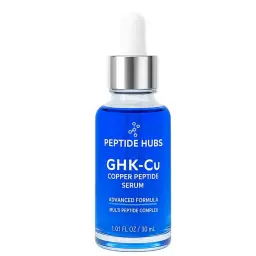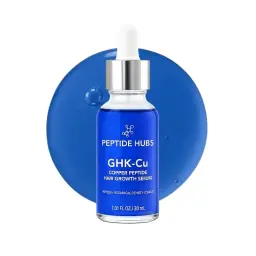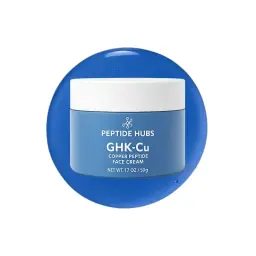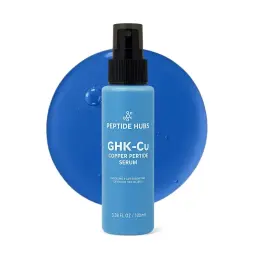

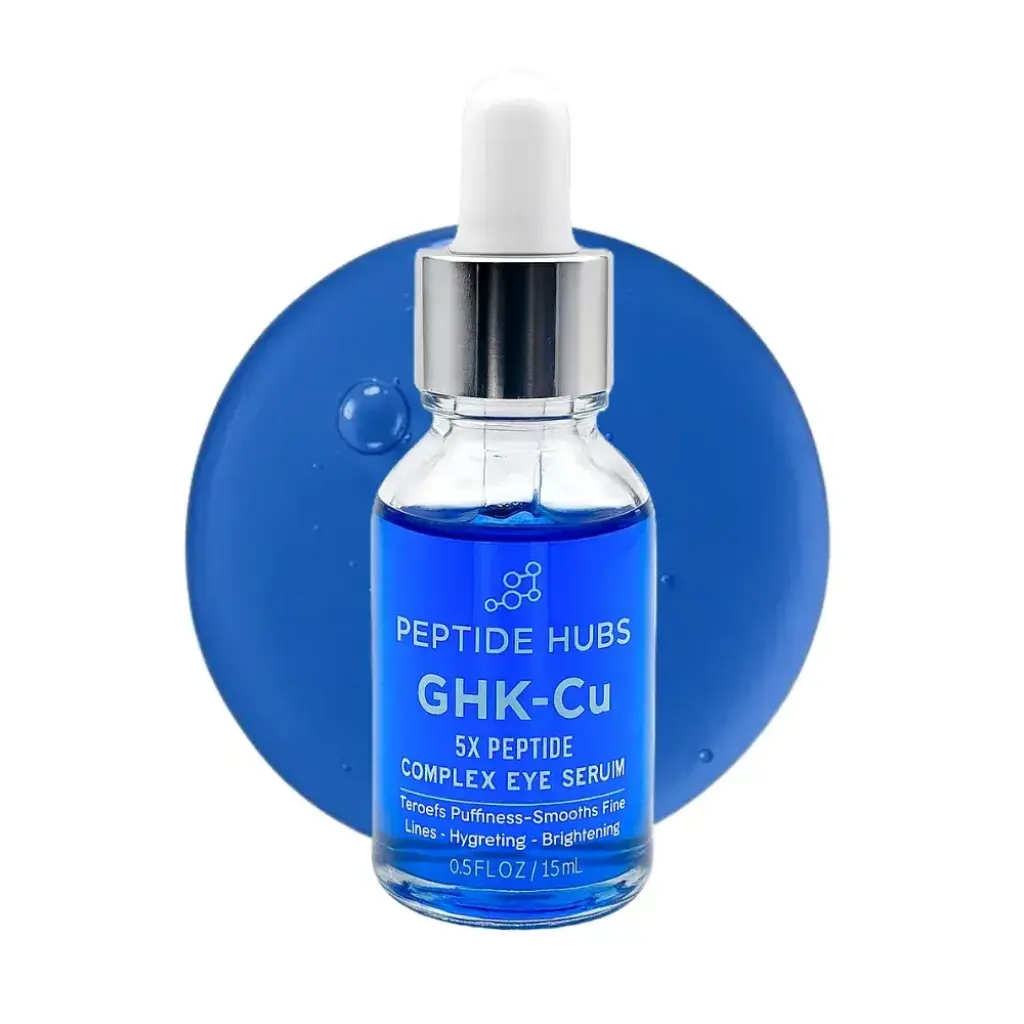
GHK-Cu Eye Serum is a topical cosmetic formulation manufactured by Peptide Hubs, supplied in a 0.5 fl oz (15 mL) container and featuring the copper tripeptide complex GHK-Cu.
GHK-Cu Eye Serum contains GHK-Cu (copper tripeptide-1), a naturally occurring complex of the tripeptide glycyl-L-histidyl-L-lysine with copper(II). This peptide-copper complex is found in human plasma, saliva, and urine, with concentrations that decline with age. The GHK-Cu Eye Serum is designed for topical application around the delicate eye area, where skin is thinner and more prone to visible signs of aging.
GHK-Cu has been studied extensively for its role in tissue remodeling and skin regeneration. Research indicates that GHK-Cu stimulates collagen, elastin, and glycosaminoglycan synthesis while promoting angiogenesis and supporting the proliferation of fibroblasts and keratinocytes. Controlled studies on aged skin have demonstrated that GHK-Cu tightens skin, improves elasticity and firmness, reduces fine lines and wrinkles, and reduces photodamage and hyperpigmentation.
In cosmetic contexts, GHK-Cu is not FDA-approved as a drug but is widely used as a cosmetic ingredient. The Cosmetic Ingredient Review (CIR) Expert Panel has assessed copper peptides and found them safe for use in cosmetic formulations at currently marketed concentrations. The GHK-Cu Eye Serum is formulated for external cosmetic use only and is not intended to diagnose, treat, cure, or prevent any disease.
GHK-Cu Eye Serum is supplied as a topical formulation in a 0.5 fl oz (15 mL) container. It is designed for external cosmetic application only.
GHK-Cu is a copper-binding tripeptide complex composed of glycyl-L-histidyl-L-lysine and copper(II) ions. The peptide has a high affinity for copper, forming a stable chelate that is biologically active in tissue remodeling processes.
GHK-Cu functions through multiple mechanisms at the cellular level. The copper component serves as a cofactor for enzymes involved in collagen synthesis, including lysyl oxidase, which is essential for cross-linking collagen and elastin fibers. The peptide portion helps deliver copper directly to target cells and may have signaling properties of its own.
Research indicates that GHK-Cu modulates gene expression, particularly genes involved in tissue remodeling, inflammation control, and antioxidant responses. It may also stimulate the production of glycosaminoglycans and proteoglycans, which are important components of healthy skin and connective tissue. The peptide is hydrophilic and has limited permeation through the stratum corneum, which is why liposomal encapsulation and other delivery strategies have been investigated.
Unlike many cosmetic peptides, GHK-Cu occurs naturally in the human body, and its levels decline with age. This has led to interest in topical supplementation as a cosmetic strategy for supporting skin health.
GHK-Cu is an endogenous peptide-copper complex found in human plasma, saliva, and urine. Its natural decline with age and demonstrated effects on collagen synthesis distinguish it from synthetic cosmetic peptides.
Peptide Hubs offers GHK-Cu in a topical eye serum format. Related research peptides include GHK-CU 50 mg, a lyophilized powder format for laboratory reconstitution, and Glow Blend 70 mg, a combination research peptide product.
For general topical research support, Bacteriostatic Water is commonly used for reconstitution of lyophilized peptides.
The information below is provided for educational reference only. GHK-Cu Eye Serum is a cosmetic product for external use only. It is not intended for injection, ingestion, or any systemic route of administration.
For topical cosmetic products containing GHK-Cu, informal usage guidance suggests applying a small amount to the target area once or twice daily. There are no FDA-approved dosing guidelines for topical GHK-Cu, and usage recommendations vary by product formulation.
| Use Case | Common Reference Range | Application Frequency |
|---|---|---|
| Eye area (cosmetic) | Small amount (per product instructions) | Once or twice daily |
| General topical use | Per product label | Follow manufacturer guidance |
| Research applications | Protocol-dependent | Per experimental design |
Note: Dosing is not standardized for topical GHK-Cu products, and every formulation may differ. Read product instructions before use.
Some informal guidance suggests avoiding concurrent use of GHK-Cu with retinoid-containing products, as both may exfoliate the skin and cause irritation. If using retinoids, alternating nights is sometimes recommended. Vitamin C serums may also interact with GHK-Cu due to pH differences, and separating application times by a few hours is commonly suggested.
The eye area requires less product than other facial areas, and gentle application is advised.
Skin irritation is the most commonly reported adverse effect of topical GHK-Cu, though it remains uncommon at standard cosmetic concentrations. Symptoms may include mild redness, tingling, itching, or warmth at the application site, typically resolving within hours of discontinuing use. Skin discoloration (blue-green tint) has been reported rarely at high concentrations or with excessive application, and resolves upon discontinuation.
Post-cycle therapy is not applicable to GHK-Cu Eye Serum, as it is a topical cosmetic product and does not affect hormonal pathways.
Topical cosmetic results vary by individual. The information above is for educational reference and does not constitute medical advice.
GHK-Cu is a cosmetic ingredient, not an FDA-approved drug. The Cosmetic Ingredient Review (CIR) Expert Panel has assessed copper peptides and found them safe for use in cosmetic formulations at currently marketed concentrations.
GHK-Cu Eye Serum is for external use only. It should not be ingested, injected, or applied to open wounds or mucous membranes. Systemic administration of GHK-Cu has a much more limited safety record than topical use, and extrapolation from topical data to systemic routes requires caution.
GHK-Cu Eye Serum is a topical cosmetic product. It is not approved for oral, injectable, or any other systemic route of administration. Non-topical use falls outside approved indications.
Topical skin irritation is the most commonly reported adverse effect, though uncommon at standard cosmetic concentrations. Symptoms include mild redness, tingling, itching, or warmth, typically transient and resolving upon discontinuation. Contact dermatitis (irritant or allergic) has been reported rarely.
Skin discoloration with a blue-green tint may occur at high concentrations or with excessive application, resulting from the characteristic color of copper(II) complexes; this is not harmful and resolves upon discontinuation or concentration reduction.
Individuals with a documented allergy to copper or copper compounds should avoid GHK-Cu in all formulations. GHK-Cu is contraindicated in Wilson's disease and other copper metabolism disorders due to the theoretical risk of additional copper loading, even from topical application.
Topical GHK-Cu should not be applied to open wounds near the eyes or on broken skin.
No specific monitoring is required for topical cosmetic use of GHK-Cu. Users should discontinue use if irritation develops and consult a healthcare provider if symptoms persist.
Store in a cool, dry place away from direct light, heat, and humidity. Keep out of reach of children. Follow the storage instructions provided with the product packaging.
GHK-Cu Eye Serum is supplied through the Peptide Hubs distribution chain and shipped with discreet, privacy-focused handling.
The outer shipping package remains discreet, with privacy-focused handling. Products are supplied through the official Peptide Hubs distribution chain.
To verify your GHK-Cu Eye Serum product, use the security code on the label and cross-check it on the Peptide Hubs official site. Original packaging helps reinforce product legitimacy.
For complete delivery details, tracking policy, and reshipment terms, please see our Shipping Info page.
Proper storage conditions help preserve product integrity and stability throughout the product's shelf life.
Store GHK-Cu Eye Serum in a cool, dry place away from direct light, heat, and humidity. Keep the container tightly closed when not in use. Follow the storage instructions provided on the product packaging.
Do not freeze the product. Avoid exposure to excessive heat or direct sunlight, which may degrade the formulation.
Keep out of reach of children. For external use only.
Answers to common questions about GHK-Cu Eye Serum, the GHK-Cu peptide, and topical cosmetic applications.
GHK-Cu Eye Serum is a topical cosmetic product designed for application around the eye area. GHK-Cu has been studied for its effects on skin remodeling, collagen synthesis, and reducing visible signs of aging such as fine lines and wrinkles. It is not intended to diagnose, treat, cure, or prevent any disease.
Informal guidance for topical GHK-Cu products suggests applying a small amount to the target area once or twice daily. Dosing is not standardized, and each product may differ. Read the product instructions for specific guidance.
No. Post-cycle therapy is not applicable to GHK-Cu Eye Serum, as it is a topical cosmetic product and does not affect hormonal pathways. It does not suppress endogenous testosterone production or alter the hypothalamic-pituitary-gonadal axis.
GHK-Cu is a copper peptide complex that has been studied for its role in tissue remodeling. Research indicates it stimulates collagen, elastin, and glycosaminoglycan synthesis while supporting angiogenesis and cell proliferation. The copper component serves as a cofactor for enzymes involved in collagen cross-linking.
Topical cosmetic results vary by individual. Some studies on GHK-Cu have assessed effects over 4 weeks of twice-daily application. Long-term consistent use is typically needed for any possible results.
GHK-Cu is not FDA-approved as a drug. It is used as a cosmetic ingredient, and the Cosmetic Ingredient Review (CIR) Expert Panel has assessed copper peptides as safe in cosmetic formulations at currently marketed concentrations.
GHK-Cu Eye Serum is a ready-to-use topical cosmetic formulation, while GHK-CU 50 mg is a lyophilized powder intended for laboratory reconstitution and research applications. The Eye Serum is designed for direct external cosmetic use.
Some informal guidance suggests avoiding concurrent use of GHK-Cu with retinoid-containing products, as both may exfoliate the skin and cause irritation. Vitamin C serums may also interact due to pH differences, and separating application times by a few hours is commonly suggested.
A 0.5 fl oz (15 mL) container is a standard size for an eye serum product. Given that only a small amount is typically applied to the eye area, this quantity should provide sufficient product for an extended period of regular use.
GHK-Cu Eye Serum by Peptide Hubs is supplied in a 0.5 fl oz (15 mL) container. The product is a topical formulation for external cosmetic use.
Store GHK-Cu Eye Serum in a cool, dry place away from direct light, heat, and humidity. Keep the container tightly closed when not in use. Do not freeze the product. Follow the storage instructions on the product packaging.