
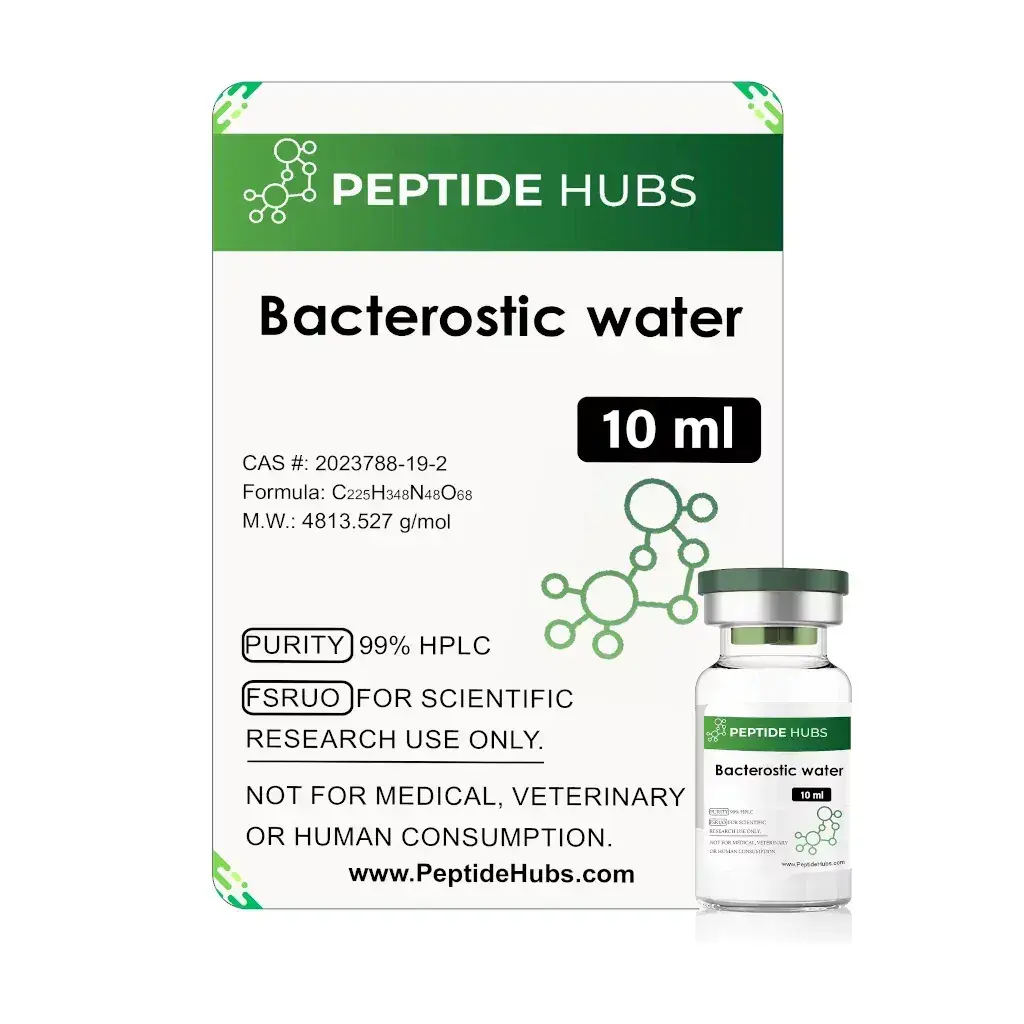
Bacteriostatic Water is a sterile water solution manufactured by Peptide Hubs and supplied as a 0.9% benzyl alcohol solution in a 10 mL vial.
Bacteriostatic Water is a sterile, non-pyrogenic preparation of water for injection containing 0.9% (9 mg/mL) benzyl alcohol added as a bacteriostatic preservative. It is supplied in a multiple-dose container from which repeated withdrawals may be made to dilute or dissolve drugs for injection. The preservative inhibits bacterial growth, allowing multiple entries into the same vial over a period of up to 28 days when stored properly.
In research and non-medical contexts, bacteriostatic water is the standard diluent for reconstituting lyophilized peptide powders. Unlike sterile water without preservative—which must be used within 24-48 hours of opening—bacteriostatic water allows multiple-dose use from a single vial, making it the preferred choice for peptides that will be drawn from repeatedly over days or weeks. The benzyl alcohol preservative maintains sterility between withdrawals, reducing contamination risk in multi-dose scenarios.
It is important to note that bacteriostatic water is not intended for intravenous administration without additives, as it lacks electrolytes and can cause hemolysis if injected directly. It is also contraindicated in neonates due to the potential toxicity of benzyl alcohol. Bacteriostatic water is not a drug itself but a pharmaceutical aid used for diluting or dissolving medications prior to injection.
Bacteriostatic Water is a sterile water solution containing 0.9% benzyl alcohol as a bacteriostatic preservative. It is supplied in a 10 mL multiple-dose vial designed for repeated withdrawals during peptide reconstitution.
Bacteriostatic Water is a sterile aqueous solution containing 0.9% benzyl alcohol as a preservative. It is not a therapeutic agent but a pharmaceutical diluent used to reconstitute lyophilized powders for injection.
Bacteriostatic Water belongs to the class of pharmaceutical diluents, which are sterile liquids used to dissolve or dilute medications prior to parenteral administration. Unlike therapeutic compounds, bacteriostatic water has no pharmacological activity of its own; its purpose is to serve as a vehicle for other drugs or peptides.
The defining characteristic of bacteriostatic water is its preservative content. The 0.9% benzyl alcohol concentration inhibits bacterial growth, allowing the same vial to be entered multiple times over a period of up to 28 days without compromising sterility. This contrasts with sterile water for injection, which lacks preservatives and must be used immediately after opening or discarded within 24-48 hours. In a study evaluating alteplase stability, only the solution reconstituted with bacteriostatic water met USP antimicrobial effectiveness criteria, while the sterile water preparation failed.
In peptide research and non-medical reconstitution contexts, bacteriostatic water is the standard diluent. Its ability to maintain sterility across multiple withdrawals makes it essential for peptides that are reconstituted once and drawn from over days or weeks.
Bacteriostatic water is distinguished by its 0.9% benzyl alcohol content, which inhibits bacterial growth and enables multiple-dose use from a single vial. This preservative property is the primary functional difference from sterile water for injection.
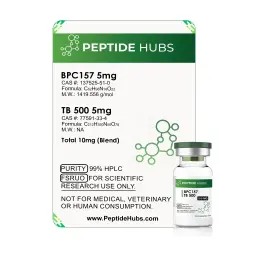
Peptide Hubs offers Bacteriostatic Water as a companion product for its line of research peptides. Within this lineup, BPC 157 and TB 500 are lyophilized powders that require reconstitution before use, making bacteriostatic water an essential accessory for handling these products.
For research contexts requiring preservative-free diluent, sterile water for injection represents an alternative, though it must be used immediately and cannot support multiple-dose withdrawals. Bacteriostatic water is the standard choice for most peptide reconstitution applications where the vial will be entered more than once.
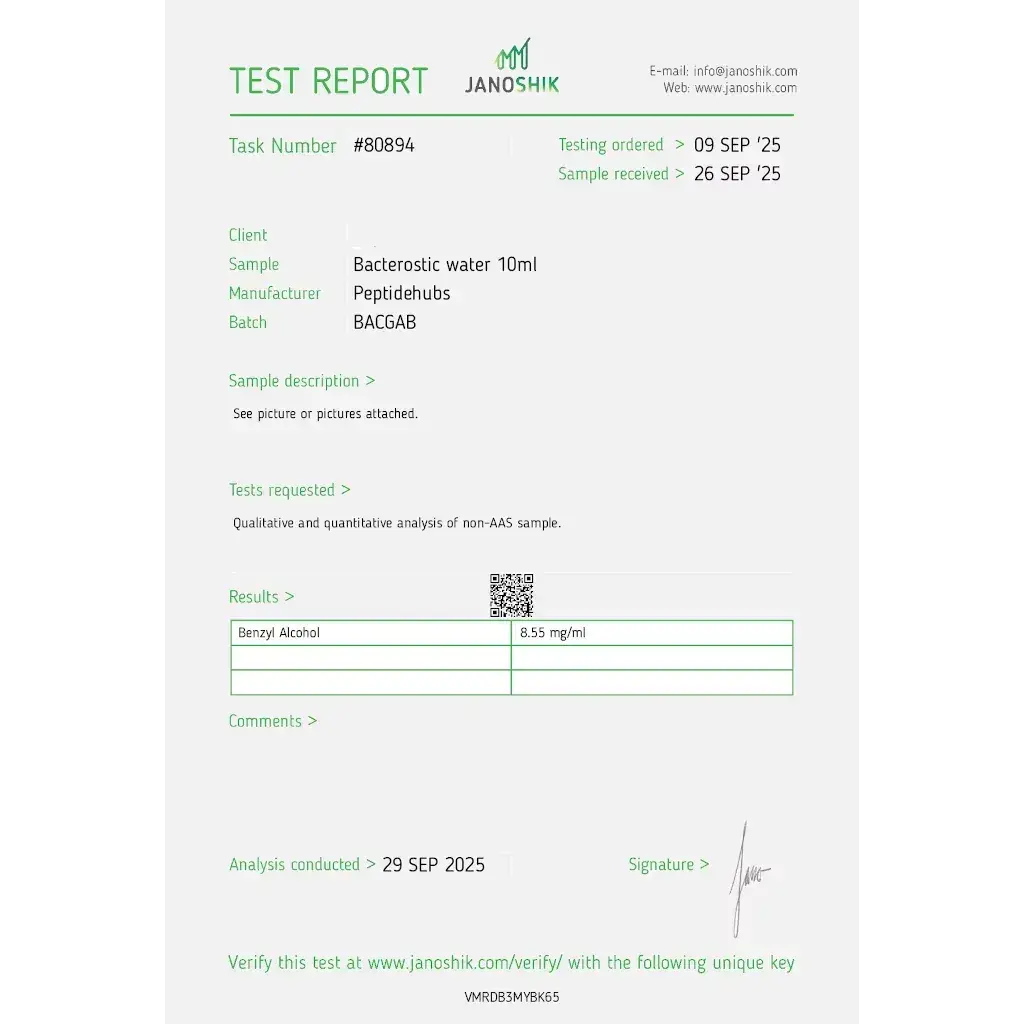
Published laboratory reports for Bacteriostatic Water are shown below with the test date, measured content, and batch number.
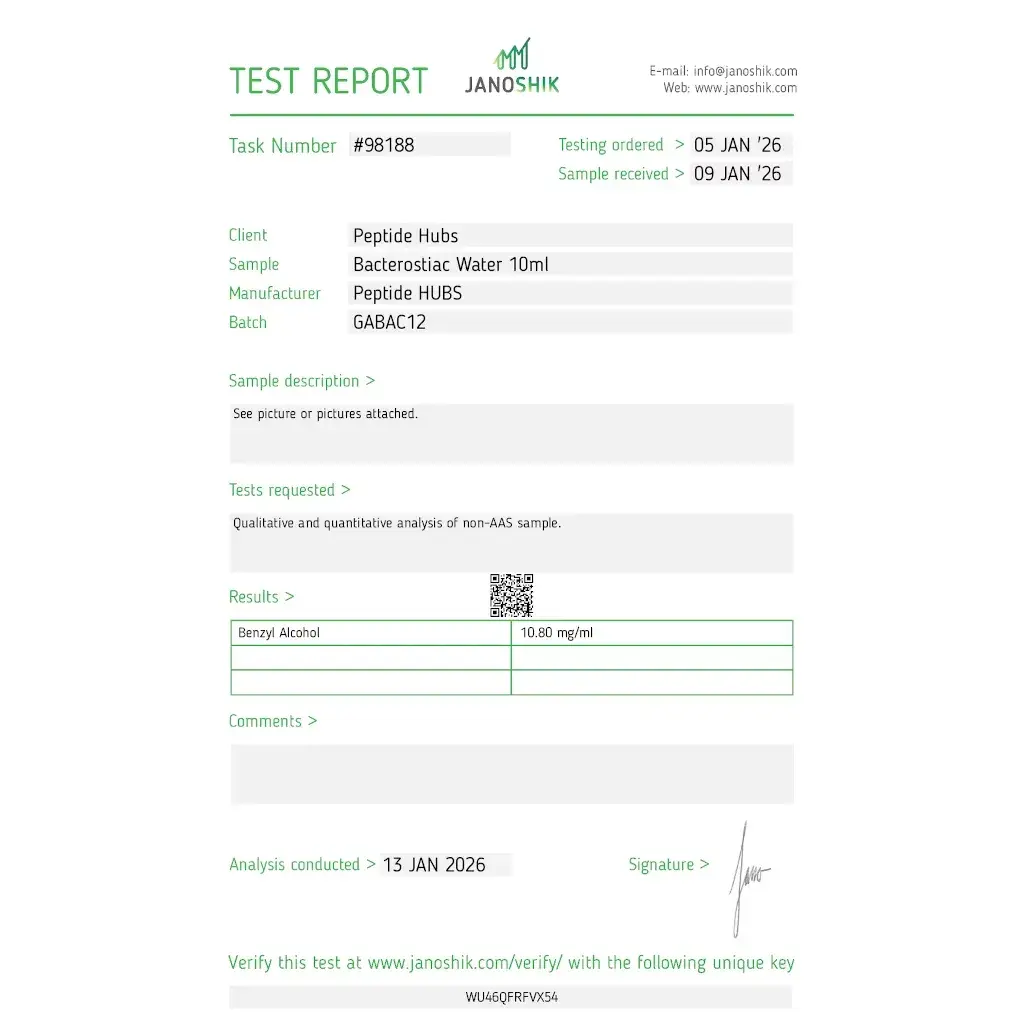 View Report
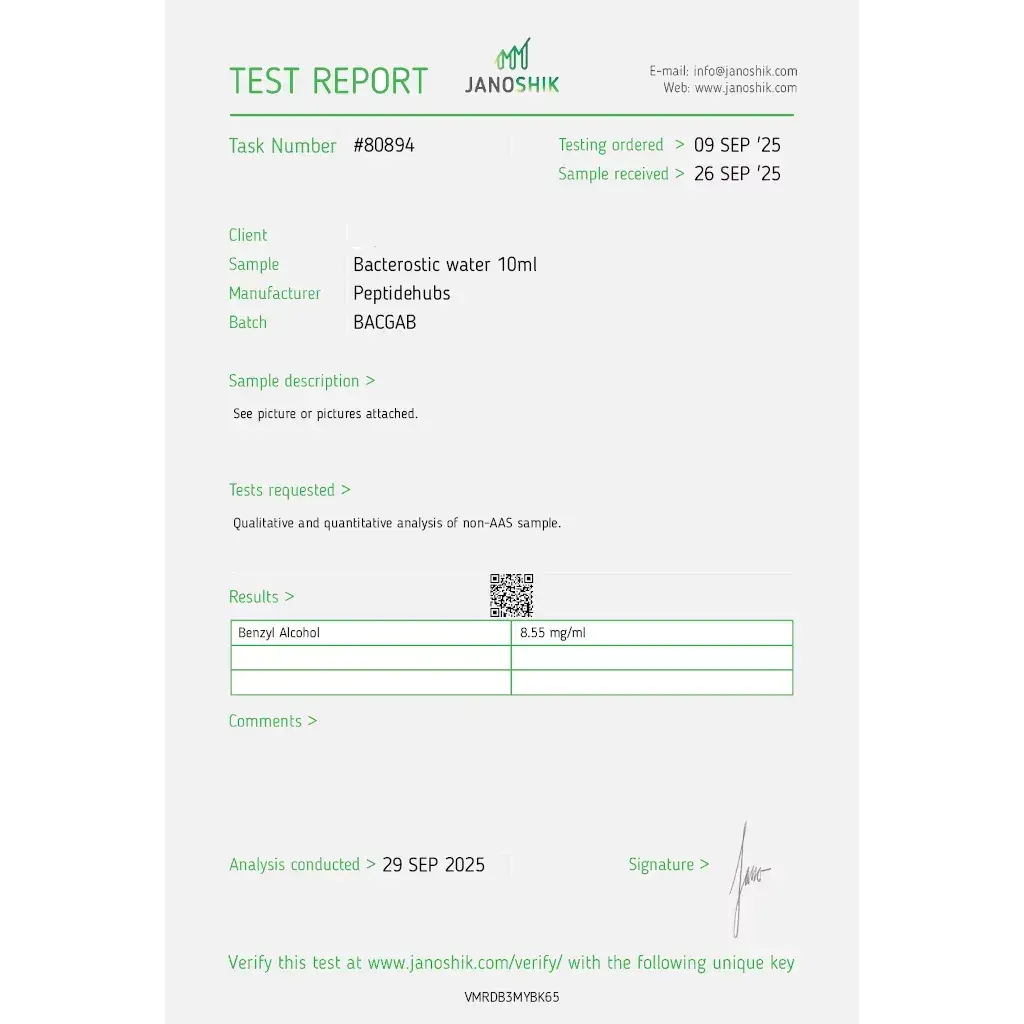 View Report
Laboratory results apply to the specific tested sample represented in each published report and should not be interpreted as a measurement of every vial or production batch.
The information below is provided for educational reference only. Bacteriostatic Water is a diluent, not a therapeutic agent. Its use is limited to reconstituting or diluting medications and research compounds under appropriate conditions.
The volume of bacteriostatic water used for reconstitution depends on the amount of peptide in the vial and the desired concentration. The standard formula is: Concentration (mg/mL) = Peptide amount (mg) ÷ Water volume (mL).
| Peptide Amount | Water Added | Concentration |
|---|---|---|
| 5 mg | 1 mL | 5 mg/mL (5000 mcg/mL) |
| 5 mg | 2 mL | 2.5 mg/mL (2500 mcg/mL) |
| 10 mg | 2 mL | 5 mg/mL (5000 mcg/mL) |
Choose a volume that yields convenient dosing volumes (e.g., 0.1 mL or 0.2 mL per dose). There is no universal “correct” amount; the ratio depends on the specific peptide and desired dose.
Proper technique preserves peptide integrity. Wipe both vial stoppers with alcohol swabs and allow to dry. Draw the desired volume of bacteriostatic water into a syringe. Insert the needle into the peptide vial at a 45-degree angle, pointing at the vial wall—not directly at the powder. Slowly inject the water over 10-15 seconds, letting it run down the inside wall. Never spray directly onto the powder, as this can cause mechanical stress on peptide bonds.
After adding water, gently swirl the vial in circular motions. Never shake, as shaking creates foam and applies mechanical stress that can denature the peptide. Let the vial sit for 2-5 minutes if not fully dissolved. The solution should be clear; discard if cloudiness or particles persist.
Unopened bacteriostatic water vials have a long shelf life when stored at controlled room temperature (20-25°C). Once opened or entered, the vial should be stored refrigerated and used within 28 days, after which the preservative’s effectiveness may diminish.
Reconstituted peptide solutions prepared with bacteriostatic water are typically stable for 3-4 weeks when refrigerated at 2-8°C. Avoid repeated freeze-thaw cycles, which can degrade peptide structure.
Bacteriostatic water is a diluent and has no therapeutic dosing range. All reconstitution information is provided for educational reference and does not constitute medical guidance.
Bacteriostatic Water is a pharmaceutical diluent, not a therapeutic agent. Its safety profile relates to the preservative content and its intended use as a reconstitution vehicle.
Bacteriostatic Water contains 0.9% benzyl alcohol as a preservative. Benzyl alcohol has been associated with toxicity in neonates, and solutions containing this preservative must not be used in this patient population. Where water is required for preparing or diluting medications for use in neonates, only preservative-free Sterile Water for Injection should be used.
Intravenous administration of Bacteriostatic Water without a solute may result in hemolysis. It should not be used for intravenous injection unless the osmolar concentration of additives results in an approximate isotonic admixture.
Bacteriostatic Water is a diluent intended for pharmaceutical use. Its application in non-medical contexts for peptide reconstitution falls outside approved indications and should be approached with appropriate caution.
Adverse reactions associated with bacteriostatic water are typically related to the technique of reconstitution or administration rather than the solution itself. These may include febrile response, local tenderness, abscess, tissue necrosis or infection at the injection site, venous thrombosis, and phlebitis.
Some drugs may be incompatible with benzyl alcohol, potentially affecting stability or causing precipitation. Consult the specific drug’s prescribing information for compatibility.
Bacteriostatic water is contraindicated in neonates due to benzyl alcohol toxicity risk. It should not be used for epidural or spinal anesthesia procedures. Individuals with known hypersensitivity to benzyl alcohol should avoid products containing this preservative.
No specific monitoring is required for bacteriostatic water itself. When used to reconstitute medications, monitor the patient for adverse reactions to the reconstituted drug and for signs of injection site complications.
Store unopened vials at controlled room temperature (20-25°C). Once entered, the vial should be stored refrigerated and used within 28 days. Inspect the solution before use; do not use if it appears cloudy or contains particulate matter. Keep out of reach of children.
Bacteriostatic Water is supplied through the official Peptide Hubs distribution chain and shipped in original manufacturer packaging with discreet handling.
The outer shipping package remains discreet, with privacy-focused handling. Products are supplied through the official Peptide Hubs distribution chain.
To verify your Bacteriostatic Water product, use the security code on the vial label and cross-check it on the Peptide Hubs official site. Original packaging and manufacturer presentation help reinforce product legitimacy.
For complete delivery details, tracking policy, and reshipment terms, please see our Shipping Info page.
Proper storage conditions help preserve the sterility and integrity of bacteriostatic water throughout its shelf life.
Store unopened vials at controlled room temperature (20-25°C) and protect from excessive heat, moisture, and direct light. Keep in original packaging until use.
Once the vial has been entered, store refrigerated at 2-8°C and use within 28 days. The benzyl alcohol preservative inhibits bacterial growth during this period, but the vial should be inspected before each use.
Keep out of reach of children. Follow proper handling and aseptic technique when withdrawing solution.
Answers to common questions about Bacteriostatic Water, reconstitution solutions, and peptide handling.
Bacteriostatic Water is a sterile diluent used to reconstitute lyophilized peptide powders and dilute injectable medications. Its 0.9% benzyl alcohol preservative allows multiple-dose withdrawals from a single vial over up to 28 days.
Draw the desired volume of bacteriostatic water into a syringe, then inject it slowly into the peptide vial at a 45-degree angle, pointing at the vial wall. Swirl gently—never shake—until the powder dissolves completely.
Bacteriostatic Water is a diluent and has no hormonal activity. It does not suppress testosterone production and does not require post-cycle therapy.
Sterile water serves as a vehicle for dissolving or diluting medications prior to injection. The bacteriostatic version contains benzyl alcohol, which inhibits bacterial growth and allows multiple withdrawals from the same vial.
Once entered, a bacteriostatic water vial should be stored refrigerated and used within 28 days. The benzyl alcohol preservative maintains sterility during this period, but the vial should be inspected before each use.
Bacteriostatic water is the standard reconstitution solution for multi-dose peptide vials because its preservative allows repeated withdrawals over 28 days. Sterile water without preservative is suitable only for single-use applications.
Bacteriostatic water contains 0.9% benzyl alcohol as a preservative, allowing multiple-dose use from one vial for up to 28 days. Sterile water for injection lacks preservatives and must be used immediately after opening or discarded within 24-48 hours.
Bacteriostatic Water is a diluent used to reconstitute peptide powders, while BPC 157 is a research peptide that requires reconstitution with bacteriostatic water before use. They serve entirely different purposes in the research process.
A 10 mL vial provides enough diluent for multiple peptide reconstitutions, since typical reconstitution volumes are 1-2 mL per peptide vial. The 10 mL size supports extended use across several research compounds.
Bacteriostatic Water contains 0.9% benzyl alcohol as a bacteriostatic preservative. It is supplied in a 10 mL multiple-dose vial.
Yes. Published laboratory reports for this Bacteriostatic Water product show batch GABAC12 tested on January 13, 2026, and batch BACGAB tested on September 29, 2025. The reports verify content and labeling accuracy.
Store unopened vials at controlled room temperature (20-25°C). Once entered, refrigerate at 2-8°C and use within 28 days. Do not freeze.