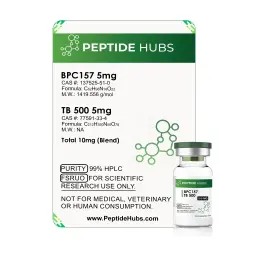

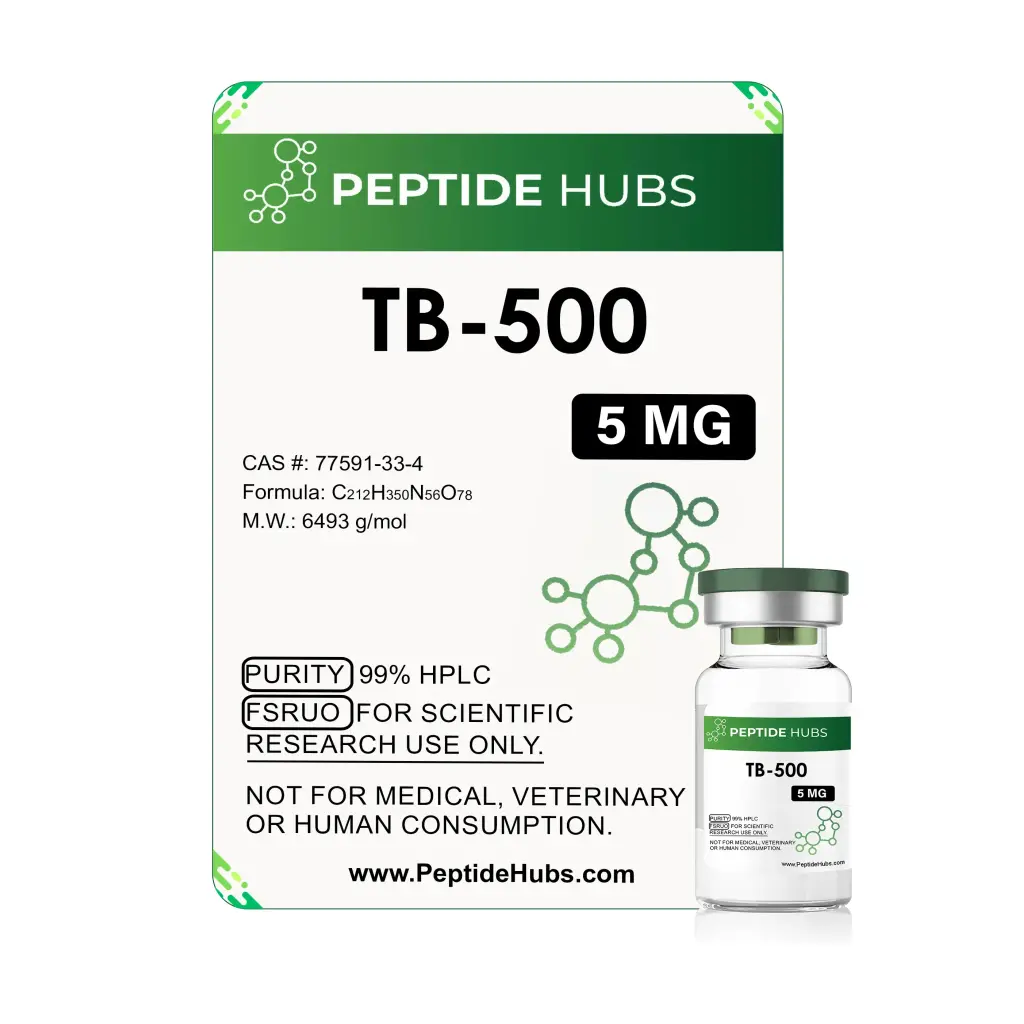
TB 500 5 mg is a lyophilized research peptide manufactured by Peptide Hubs and supplied in a 2 mL vial containing 5 mg of Thymosin Beta 4.
TB 500 5 mg contains Thymosin Beta 4, a synthetic seven-amino-acid fragment corresponding to the active region (LKKTETQ) of the naturally occurring 43-amino-acid protein thymosin beta-4. This fragment is understood to be the actin-binding domain responsible for the parent protein's tissue repair and cell migration properties.
In preclinical research, Thymosin Beta 4 has been studied for its roles in wound healing, tissue repair, and actin sequestration. It is a naturally occurring peptide present in nearly all mammalian cells and is regarded as the main intracellular G-actin sequestering molecule. The TB-500 fragment has been investigated in animal models of musculoskeletal recovery and cardiac protection.
In non-medical bodybuilding contexts, TB 500 is commonly referenced for recovery and tissue repair applications, though it is not FDA-approved for any human indication. The FDA has evaluated TB-500-related bulk drug substances and determined that the evaluation criteria weigh against placing them on the 503A compounding list due to insufficient characterization and safety data.
TB 500 5 mg is supplied as a lyophilized powder, a freeze-dried format designed to preserve peptide integrity during storage. Reconstitution is required before research use.
Thymosin Beta 4 is a naturally occurring actin-sequestering protein encoded by the X-linked TMSB4X gene. The TB-500 fragment represents the active N-terminal acetylated 17-23 region of the full-length protein.
The TB-500 fragment consists of seven amino acids (Ac-Leu-Lys-Lys-Thr-Glu-Thr-Gln-OH) corresponding to residues 17-23 of human thymosin beta-4. This region is understood to contain the actin-binding site responsible for the parent protein's biological activity.
Thymosin beta-4 itself is the major intracellular G-actin sequestering molecule in eukaryotic cells. It plays a role in cell migration, tissue repair, and angiogenesis. The TB-500 fragment has been investigated in animal models for its potential to promote wound healing and tissue repair.
Unlike anabolic-androgenic steroids or growth hormone secretagogues, TB 500 is not associated with muscle-building or hormonal pathways. Its research profile centers on tissue repair, cell migration, and actin regulation mechanisms.
TB 500 represents the active actin-binding region of thymosin beta-4, distinguishing it from structural or hormonal peptides. Its mechanism centers on G-actin sequestration and cell migration rather than receptor-mediated signaling pathways.
Peptide Hubs offers TB 500 in a 5 mg lyophilized powder format. Related research peptides in the tissue repair category include BPC 157 5 mg, a pentadecapeptide studied for its cytoprotective properties. For research involving growth hormone pathways, CJC-1295 No DAC 5 mg represents a GHRH analogue with a different mechanism of action.
A combination research product containing both TB 500 and BPC 157 is also available as TB 500/BPC 157 10 mg.
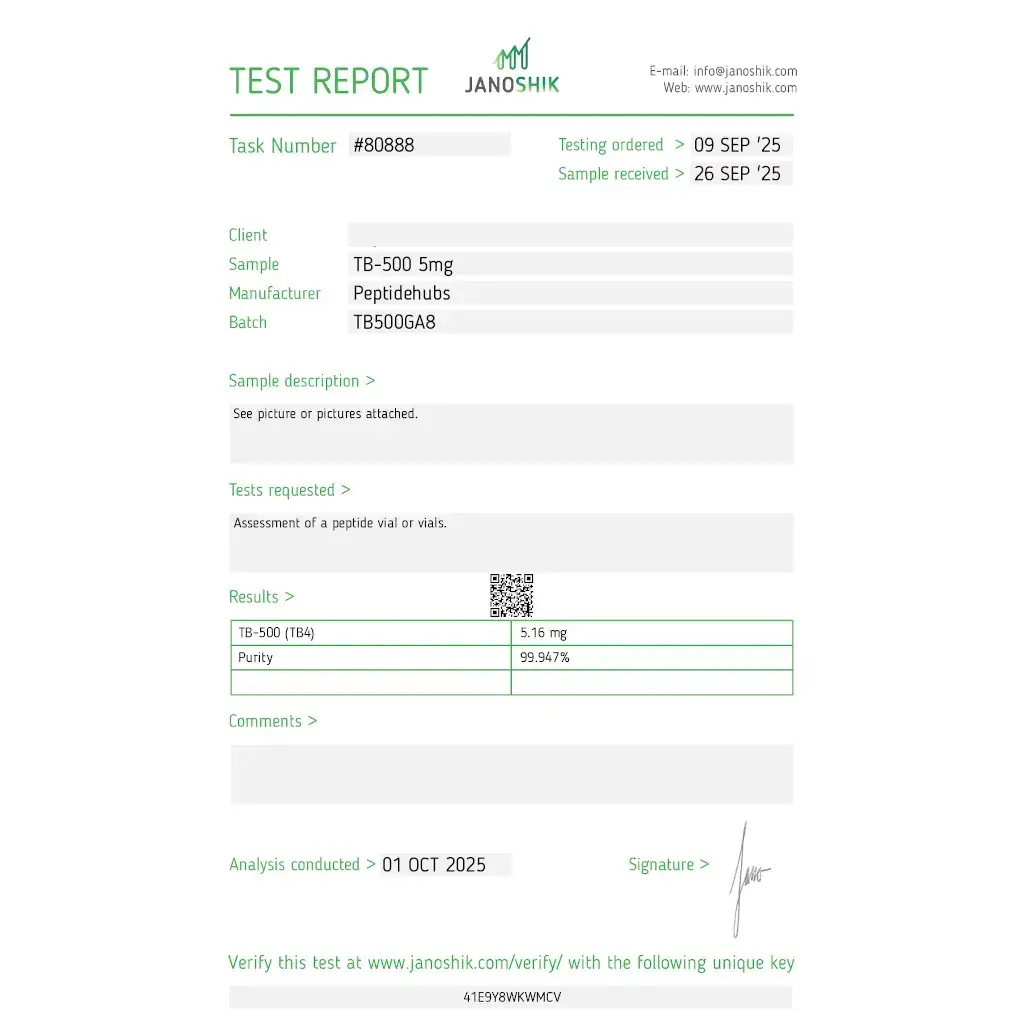
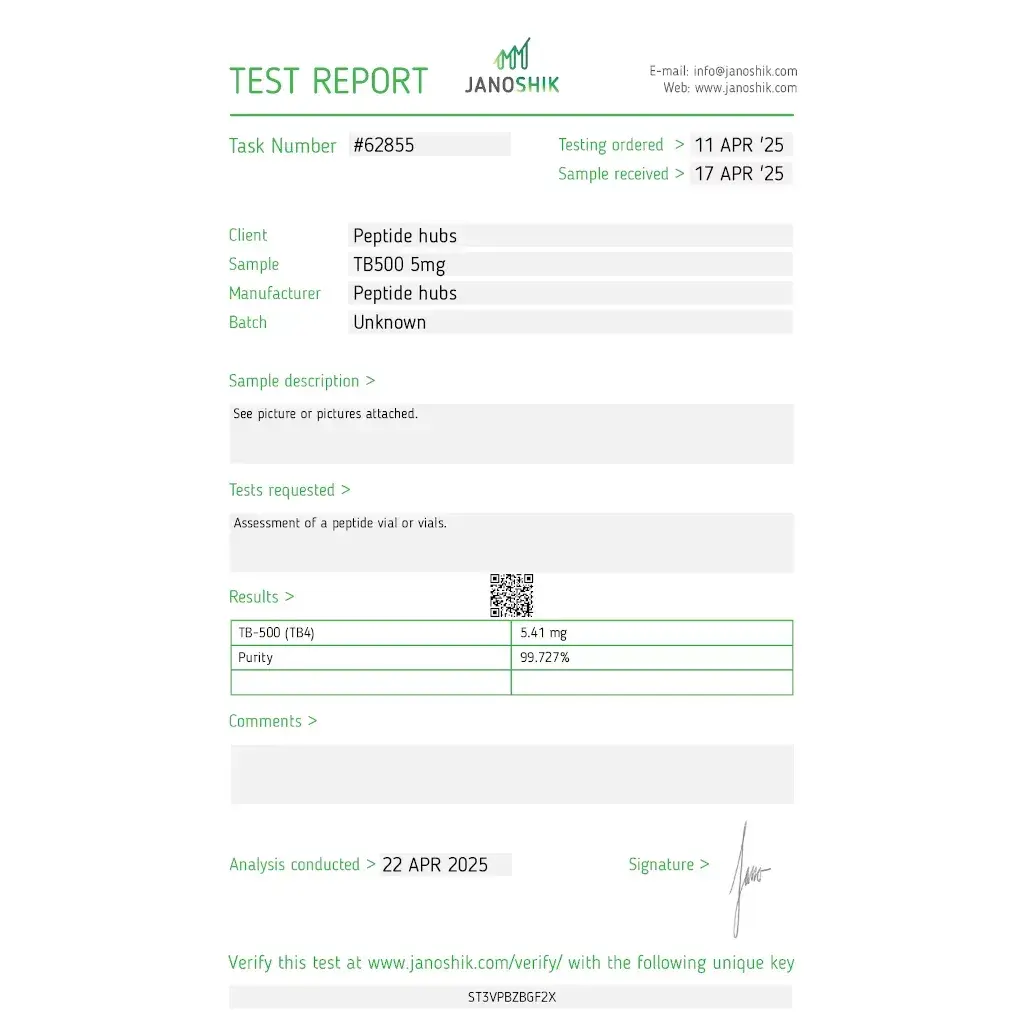
Published laboratory reports for TB 500 5 mg by Peptide Hubs are shown below with the test date, measured content, and percentage of the product's 5 mg label claim.
 View Report
 View Report
Laboratory results apply to the specific tested sample represented in each published report and should not be interpreted as a measurement of every vial or production batch.
The information below is provided for educational reference only. TB 500 is a research peptide that has not been evaluated or approved by the FDA for medical use. Any non-medical use falls outside approved indications and should not be undertaken without appropriate supervision.
In non-medical research and bodybuilding contexts, TB 500 is commonly referenced at doses of 2 to 5 mg per week, often divided into two or more administrations. Some protocols reference a loading phase of 5–10 mg per week for the first 2–4 weeks, followed by a maintenance phase of 2–5 mg per week.
| Use Case | Common Reference Range | Injection Frequency |
|---|---|---|
| Loading phase (non-medical) | 5–10 mg / week | 2–3 administrations per week |
| Maintenance phase (non-medical) | 2–5 mg / week | 1–2 administrations per week |
| Localized application | Protocol-dependent | Per research design |
Note: Clinical evidence for TB 500 in humans is extremely limited, with most available data derived from animal studies. Dosing protocols referenced in non-medical contexts are not supported by controlled human trials.
In non-medical research contexts, TB 500 is sometimes referenced in combination with BPC 157 5 mg, another peptide studied for tissue repair properties. A combination product containing both peptides is also available as TB 500/BPC 157 10 mg. Cycle lengths referenced in research contexts typically range from 4 to 12 weeks.
The FDA has noted that there is a lack of clinical data on TB 500 safety in humans, and no adverse event reports were retrieved in a search of the FAERS database through March 2025. Theoretical concerns include immunogenicity and aggregation risks associated with injectable peptide administration. The proangiogenic properties of thymosin beta-4 raise concerns regarding use in individuals with subclinical or undiagnosed malignancies.
Post-cycle therapy is not applicable to TB 500, as the peptide does not suppress endogenous testosterone production or alter hormonal axes. TB 500 acts on actin-binding and cell migration mechanisms without direct hormonal effects.
Research peptide protocols should be based on published study designs and appropriate institutional oversight. The information above is for educational reference and does not constitute medical advice or a recommendation for use.
Thymosin Beta 4 and the TB-500 fragment are not FDA-approved for any human indication. The FDA has evaluated TB-500-related bulk drug substances and determined that the criteria weigh against placing them on the 503A compounding list.
TB-500 is a peptide consisting of seven amino acids that has been investigated primarily in preclinical models. The FDA has noted concerns about the potential for immunogenicity and aggregation when peptides such as TB-500 are administered via injectable routes.
There are no clinical studies or human exposure data using TB-500 via any route of administration, and potential safety risks associated with its use in humans are unknown.
TB 500 is not approved for human use in the United States. Non-medical use of research peptides falls outside approved indications and carries unknown risks.
The FDA Adverse Event Reporting System did not retrieve any reports associated with TB-500 through March 2025, though FAERS data have limitations and reporting is voluntary. There are no published case reports in the medical literature on the use of TB-500 in humans.
The proangiogenic properties of thymosin beta-4 raise theoretical concerns regarding use in individuals who may harbor subclinical or undiagnosed malignancies, as angiogenesis is a hallmark of tumor growth and metastatic progression.
TB-500 has not been evaluated for use in pregnancy, breastfeeding, or pediatric populations. Individuals with active malignancy or a history of angiogenic-dependent conditions should exercise particular caution given the proangiogenic properties of thymosin beta-4.
Research use of TB-500 should be conducted under appropriate institutional oversight with defined protocols for monitoring and adverse event reporting. Clinical monitoring parameters for TB-500 have not been established in FDA-reviewed literature.
Keep the vial securely stored and protected from conditions that could compromise the product. Inspect the vial before use and do not use a product that appears damaged or compromised.
TB 500 5 mg is supplied through the Peptide Hubs distribution chain and shipped with discreet, privacy-focused handling.
The outer shipping package remains discreet, with privacy-focused handling. Products are supplied through the official Peptide Hubs distribution chain.
To verify your TB 500 5 mg product, use the security code on the vial label and cross-check it on the Peptide Hubs official site. Original packaging and batch-linked laboratory documentation help reinforce product legitimacy.
For complete delivery details, tracking policy, and reshipment terms, please see our Shipping Info page.
Proper storage conditions help preserve peptide integrity and stability throughout the product's shelf life.
Store the lyophilized powder refrigerated at 2–8°C and protected from light. Keep the vial in its original packaging until use.
After reconstitution, store the solution refrigerated at 2–8°C and use within 28 days. Do not freeze reconstituted solution.
Reconstituted TB 500 solution should be clear and colorless. Cloudiness or visible particulates indicate degradation and the vial should be discarded.
Answers to common questions about TB 500 5 mg, the Thymosin Beta 4 peptide, laboratory testing, and research applications.
TB 500 5 mg is a research peptide supplied as lyophilized powder. Thymosin Beta 4 has been studied in preclinical models for tissue repair and wound healing applications. In non-medical bodybuilding contexts, it is commonly referenced for recovery support, though such use falls outside approved indications.
Non-medical protocols commonly reference TB 500 at 2–5 mg per week, often divided into two or more administrations. Some protocols reference a loading phase of 5–10 mg per week followed by maintenance dosing.
No. Post-cycle therapy is not applicable to TB 500, as the peptide does not suppress endogenous testosterone production or alter hormonal axes. TB 500 acts on actin-binding mechanisms without direct hormonal effects.
Thymosin Beta 4 is the major intracellular G-actin sequestering molecule in eukaryotic cells and plays roles in cell migration, tissue repair, and angiogenesis. The TB-500 fragment corresponds to the actin-binding region of the full-length protein.
In preclinical studies, effects on tissue repair have been observed over days to weeks depending on the model. No human clinical data exist to establish an onset timeline for TB 500.
There is no single repair peptide that is universally best. TB 500 and BPC 157 5 mg act through different mechanisms and are sometimes studied together. A combination product containing both is available as TB 500/BPC 157 10 mg.
TB 500 and BPC 157 have different structures and mechanisms. TB 500 is a fragment of thymosin beta-4 that acts on actin sequestration, while BPC 157 is a pentadecapeptide studied for cytoprotective properties. Both are research peptides, not approved medications.
TB 500 and Thymosin Alpha-1 are derived from different proteins. TB 500 corresponds to a fragment of thymosin beta-4, while Thymosin Alpha-1 is a separate peptide studied for immune modulation. Thymosin Alpha-1 10 mg is available from Peptide Hubs for research use.
A 5 mg vial of TB 500 is a research-scale quantity. At commonly referenced non-medical doses of 2–5 mg per week, a 5 mg vial provides approximately 1–2 weeks of material depending on the protocol.
TB 500 5 mg by Peptide Hubs is labeled at 5 mg per vial. The product is supplied as lyophilized powder in a 2 mL vial.
Yes. The latest published laboratory report dated October 1, 2025 measured TB 500 5 mg at 5.16 mg, equivalent to 103.20% of its 5 mg label claim. An earlier report from April 22, 2025 measured 5.41 mg. Both reports can be viewed in the Lab Reports tab.
Lyophilized peptides are typically reconstituted with bacteriostatic water or sterile saline. Bacteriostatic Water is commonly used for peptide reconstitution to maintain sterility over multiple draws. For a 5 mg vial, adding 2 mL of diluent yields a concentration of 2.5 mg per mL.