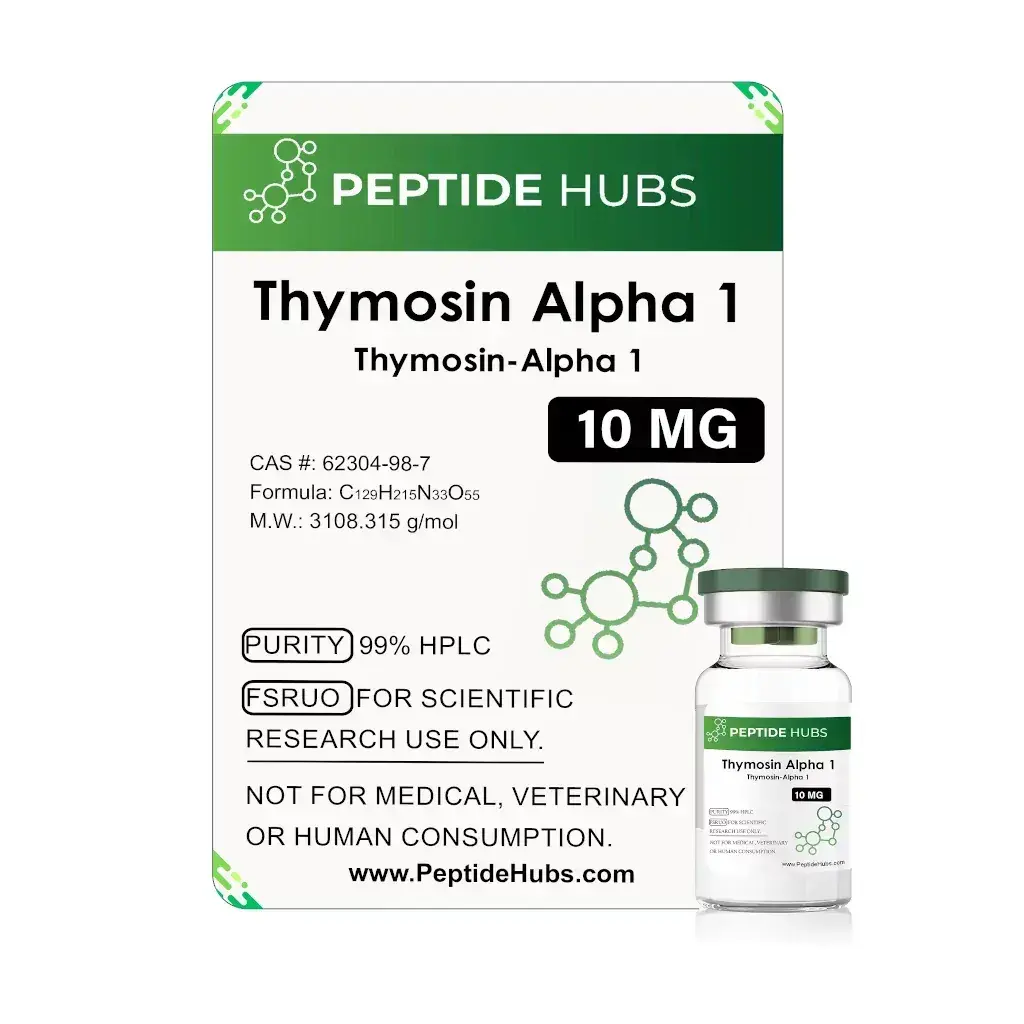
Thymosin Alpha-1 10 mg is a lyophilized immunomodulatory peptide manufactured by Peptide Hubs and supplied in a 2 mL vial containing 10 mg of Thymosin Alpha-1.
Thymosin Alpha-1 10 mg contains Thymosin Alpha-1 (also known as thymalfasin), a synthetic 28-amino-acid polypeptide that mirrors the N-terminal fragment of prothymosin alpha. It is produced recombinantly for clinical use and is sold under the brand name Zadaxin in over 35 countries, primarily for chronic hepatitis B and as an immune adjunct in cancer patients.
Thymosin Alpha-1 is not FDA-approved for any indication in the United States. Its mechanism of action is not completely understood but is thought to center on augmentation of T-cell function, including promotion of T-cell differentiation and maturation, increased production of Th1 cytokines such as interferon-gamma and interleukin-2, and activation of natural killer cell-mediated cytotoxicity. Preclinical studies show it can upregulate toll-like receptor expression in dendritic cells and activate NF-kB and JNK/P38/AP1 pathways.
In non-medical research contexts, Thymosin Alpha-1 is commonly referenced for immune modulation applications, though such use falls outside approved indications. Clinical evidence for the peptide shows mechanistic plausibility but inconsistent therapeutic efficacy across different indications, with a large Phase 3 sepsis trial finding no clear reduction in 28-day all-cause mortality.
Thymosin Alpha-1 10 mg is supplied as a lyophilized powder, a freeze-dried format designed to preserve peptide integrity during storage. Reconstitution is required before research use.
Thymosin Alpha-1 is a 28-amino-acid polypeptide originally isolated from thymosin fraction 5, a bovine thymus extract. It is produced synthetically for clinical and research use and has been characterized extensively in immunology literature.
Thymosin Alpha-1 promotes T-cell differentiation and maturation, with in vitro studies showing increases in CD4+, CD8+, and CD3+ cells. It enhances production of interferon-gamma, IL-2, and IL-3 following activation by mitogens or antigens, and increases natural killer cell activity.
The peptide has a plasma half-life of approximately 2 hours with rapid absorption and peak serum levels achieved at approximately 2 hours after subcutaneous administration. There is no evidence of accumulation following multiple subcutaneous doses.
Clinical investigations have explored Thymosin Alpha-1 across hepatitis B, hepatitis C, sepsis, cancer, and COVID-19 indications. Results have been mixed, with a large Phase 3 sepsis trial (TESTS) finding no significant reduction in 28-day all-cause mortality. The Cochrane Collaboration has noted very low-certainty evidence for histological improvement in chronic hepatitis B.
Thymosin Alpha-1 is internationally approved as Zadaxin in over 35 countries for chronic hepatitis B, but remains unapproved by the FDA for any US indication. Its mechanism centers on T-cell function augmentation rather than direct antiviral or hormonal activity.
Peptide Hubs offers Thymosin Alpha-1 in a 10 mg lyophilized powder format. Related immunomodulatory and tissue repair peptides include TB 500 5 mg, a thymosin beta-4 fragment studied for actin sequestration and cell migration, and BPC 157 5 mg, a pentadecapeptide investigated for cytoprotective properties.
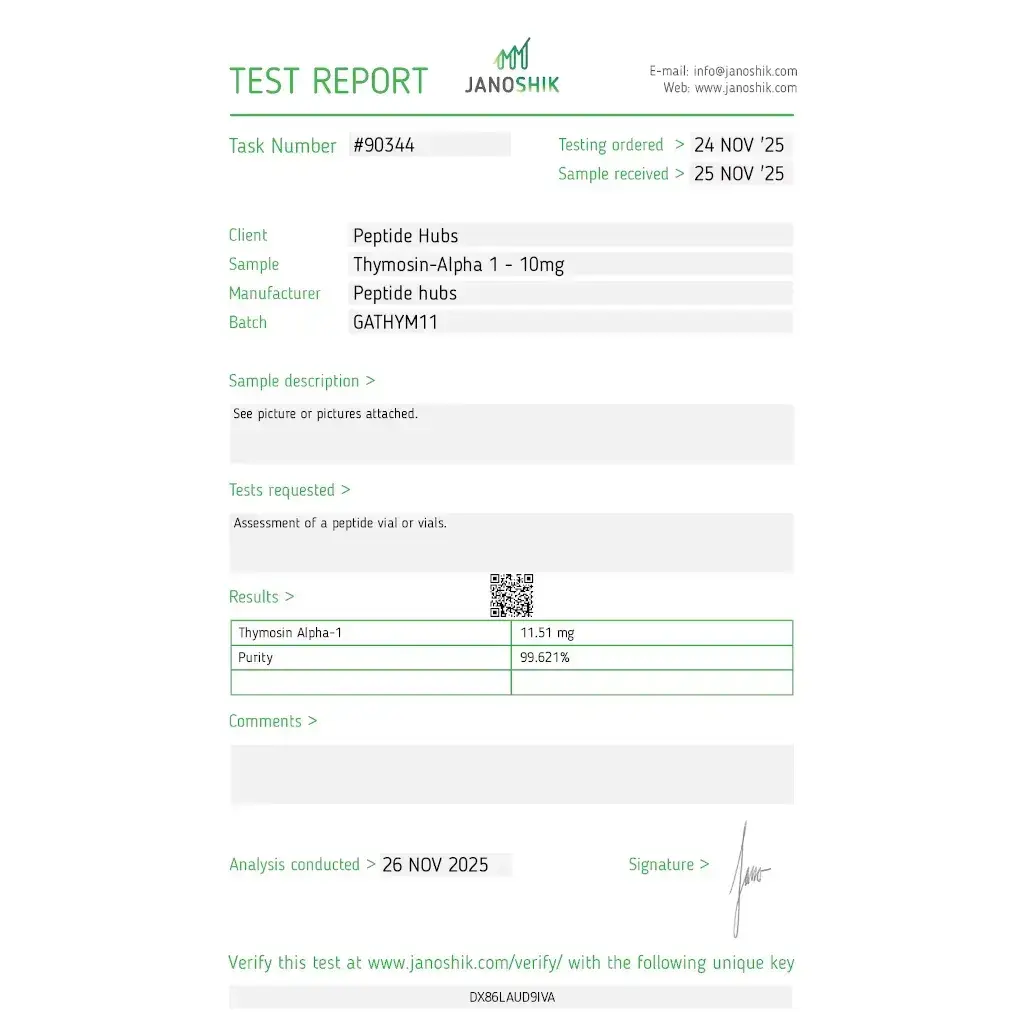
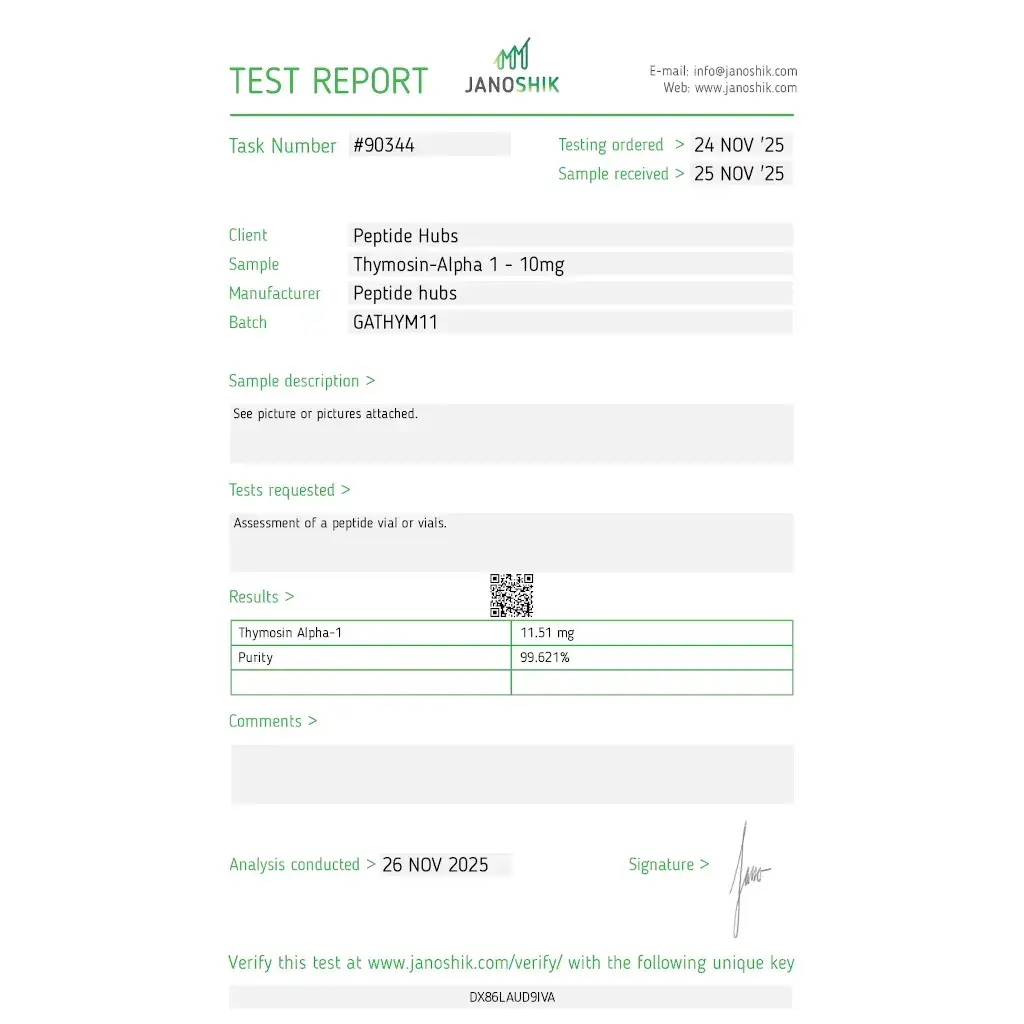
Published laboratory reports for Thymosin Alpha-1 10 mg by Peptide Hubs are shown below with the test date, measured content, and percentage of the product's 10 mg label claim.
 View Report
Laboratory results apply to the specific tested sample represented in each published report and should not be interpreted as a measurement of every vial or production batch.
The information below is provided for educational reference only. Thymosin Alpha-1 is not FDA-approved for any indication; medical use requires clinical supervision. Non-medical use falls outside approved indications.
In international clinical use for chronic hepatitis B, Thymosin Alpha-1 is administered at 1.6 mg subcutaneously twice weekly, with doses separated by 3 or 4 days, for six months (52 doses). Clinical trials have also used 1.6 mg daily for 7 days as a loading dose in sepsis and immunotherapy protocols.
| Use Case | Common Reference Range | Injection Frequency |
|---|---|---|
| Hepatitis B (international approval) | 1.6 mg | Twice weekly, 6 months |
| Loading dose (clinical trials) | 1.6–3.2 mg | Once daily for 7 days |
| Research protocols | Protocol-dependent | Per experimental design |
Note: The 10 mg vial is a research-scale quantity. At clinical doses of 1.6 mg, a 10 mg vial provides approximately 6 doses.
In clinical research, Thymosin Alpha-1 has been studied in combination with other immunomodulatory agents including anti-PD-1 monoclonal antibodies in melanoma and as an adjuvant to hepatitis B vaccination. In non-medical research contexts, it is sometimes referenced alongside other immune-supportive peptides, though combination protocols are not well characterized.
Common side effects reported in clinical use include injection-site redness or soreness, transient fatigue, and mild flu-like symptoms in the initial weeks of therapy. A transient increase in ALT to more than twice baseline value (flare) can occur during therapy for hepatitis B, and treatment is generally continued unless signs of liver failure appear.
Post-cycle therapy is not applicable to Thymosin Alpha-1, as the peptide does not suppress endogenous testosterone production or alter the hypothalamic-pituitary-gonadal axis. Thymosin Alpha-1 acts on immune function without direct hormonal effects.
Research peptide protocols should be based on published study designs and appropriate institutional oversight. The information above is for educational reference and does not constitute medical advice or a recommendation for use.
Thymosin Alpha-1 is not FDA-approved for any indication in the United States. Internationally, it is approved as Zadaxin in over 35 countries primarily for chronic hepatitis B. The FDA has classified Thymosin Alpha-1 as Category 2 under the 503A bulk substance framework as of February 2026.
Thymosin Alpha-1 has been studied in clinical trials across multiple indications with generally acceptable safety profiles. In a Phase 3 sepsis trial involving 1,106 adults, no secondary or safety outcome differed statistically significantly between Thymosin Alpha-1 and placebo groups.
The Cochrane Collaboration has noted very low-certainty evidence for histological improvement in chronic hepatitis B, with high risk of bias and substantial heterogeneity across included trials.
Thymosin Alpha-1 is not approved for human use in the United States outside of clinical trial or compassionate use contexts. Non-medical use of research peptides falls outside approved indications and carries unknown risks.
Reported side effects include injection-site redness or soreness, transient fatigue, and mild flu-like symptoms in the initial weeks of therapy. In a Cochrane review of chronic hepatitis B trials, one or more adverse events considered non-serious were observed in 10.6% of participants versus 21.5% in control groups.
A transient increase in ALT (flare) can occur during therapy, which should generally be continued unless signs and symptoms of liver failure are observed.
Populations where mechanistic risk may be most evident include active autoimmune disease with significant immune activity, organ transplant recipients on immunosuppressive therapy, pregnancy or breastfeeding (no safety data), known hypersensitivity to Thymosin Alpha-1, and pre-existing hepatic disease.
Warnings include potential for immune activation exceeding therapeutic range in patients with autoimmune predisposition. Monitoring of absolute lymphocyte count, liver enzymes, and inflammatory markers is warranted throughout therapy.
Clinical monitoring during Thymosin Alpha-1 therapy may include absolute lymphocyte count, liver enzymes, and inflammatory markers. In hepatitis B trials, ALT flares were monitored with the understanding that treatment should generally continue unless signs of liver failure appear.
Keep the vial securely stored and protected from conditions that could compromise the product. Inspect the vial before use and do not use a product that appears damaged or compromised.
Keep all medications and injectable products out of the reach of children. Follow the storage instructions provided with the product packaging.
Thymosin Alpha-1 10 mg is supplied through the Peptide Hubs distribution chain and shipped with discreet, privacy-focused handling.
The outer shipping package remains discreet, with privacy-focused handling. Products are supplied through the official Peptide Hubs distribution chain.
To verify your Thymosin Alpha-1 10 mg product, use the security code on the vial label and cross-check it on the Peptide Hubs official site. Original packaging and batch-linked laboratory documentation help reinforce product legitimacy.
For complete delivery details, tracking policy, and reshipment terms, please see our Shipping Info page.
Proper storage conditions help preserve peptide integrity and stability throughout the product's shelf life.
Store the lyophilized powder refrigerated at 2–8°C and protected from light. Keep the vial in its original packaging until use.
After reconstitution, store the solution refrigerated at 2–8°C and use within 28 days. Do not freeze reconstituted solution.
Reconstituted Thymosin Alpha-1 solution should be clear and colorless. Cloudiness or visible particulates indicate degradation and the vial should be discarded.
Answers to common questions about Thymosin Alpha-1 10 mg, the Thymosin Alpha-1 peptide, laboratory testing, and research applications.
Thymosin Alpha-1 10 mg is a research peptide supplied as lyophilized powder. Internationally, Thymosin Alpha-1 is approved as Zadaxin in over 35 countries for chronic hepatitis B. In non-medical research contexts, it is studied for immune modulation applications, though such use falls outside approved indications.
In international clinical use for chronic hepatitis B, Thymosin Alpha-1 is administered at 1.6 mg subcutaneously twice weekly with doses separated by 3 or 4 days. Clinical trials have also used 1.6 mg daily for 7 days as a loading dose.
No. Post-cycle therapy is not applicable to Thymosin Alpha-1, as the peptide does not suppress endogenous testosterone production or alter the hypothalamic-pituitary-gonadal axis. Thymosin Alpha-1 acts on immune function without direct hormonal effects.
Thymosin Alpha-1 is an immunomodulatory peptide that promotes T-cell differentiation and maturation, enhances production of Th1 cytokines such as interferon-gamma and IL-2, and increases natural killer cell activity. Its mechanism of action is not completely understood but centers on augmentation of T-cell function.
Thymosin Alpha-1 is rapidly absorbed with peak serum levels achieved at approximately 2 hours after subcutaneous administration, and it has a plasma half-life of approximately 2 hours. Clinical effects in hepatitis B trials were assessed at 12-month follow-up after completing 6 months of therapy.
No. Thymosin Alpha-1 is not FDA-approved for any indication in the United States. It is approved internationally as Zadaxin in over 35 countries, primarily for chronic hepatitis B, but this international approval does not constitute FDA approval.
Thymosin Alpha-1 and TB 500 are derived from different proteins and have distinct research profiles. Thymosin Alpha-1 is a 28-amino-acid immunomodulatory peptide, while TB 500 is a fragment of thymosin beta-4 studied for actin sequestration and cell migration. TB 500 5 mg is available from Peptide Hubs.
Thymosin Alpha-1 and BPC 157 have different structures and mechanisms. Thymosin Alpha-1 acts on T-cell function and immune modulation, while BPC 157 is a pentadecapeptide studied for cytoprotective and tissue repair properties. BPC 157 5 mg is available from Peptide Hubs.
A 10 mg vial of Thymosin Alpha-1 is a research-scale quantity. At the international clinical dose of 1.6 mg, a 10 mg vial provides approximately 6 doses.
Thymosin Alpha-1 10 mg by Peptide Hubs is labeled at 10 mg per vial. The product is supplied as lyophilized powder in a 2 mL vial.
Yes. A published laboratory report dated November 26, 2025 measured Thymosin Alpha-1 10 mg at 11.51 mg, equivalent to 115.10% of its 10 mg label claim. The complete report with batch number GATHYM11 can be viewed in the Lab Reports tab.
Lyophilized peptides are typically reconstituted with bacteriostatic water or sterile saline. Bacteriostatic Water is commonly used for peptide reconstitution to maintain sterility over multiple draws. For a 10 mg vial, adding 2 mL of diluent yields a concentration of 5 mg per mL.