SS-31 Peptide
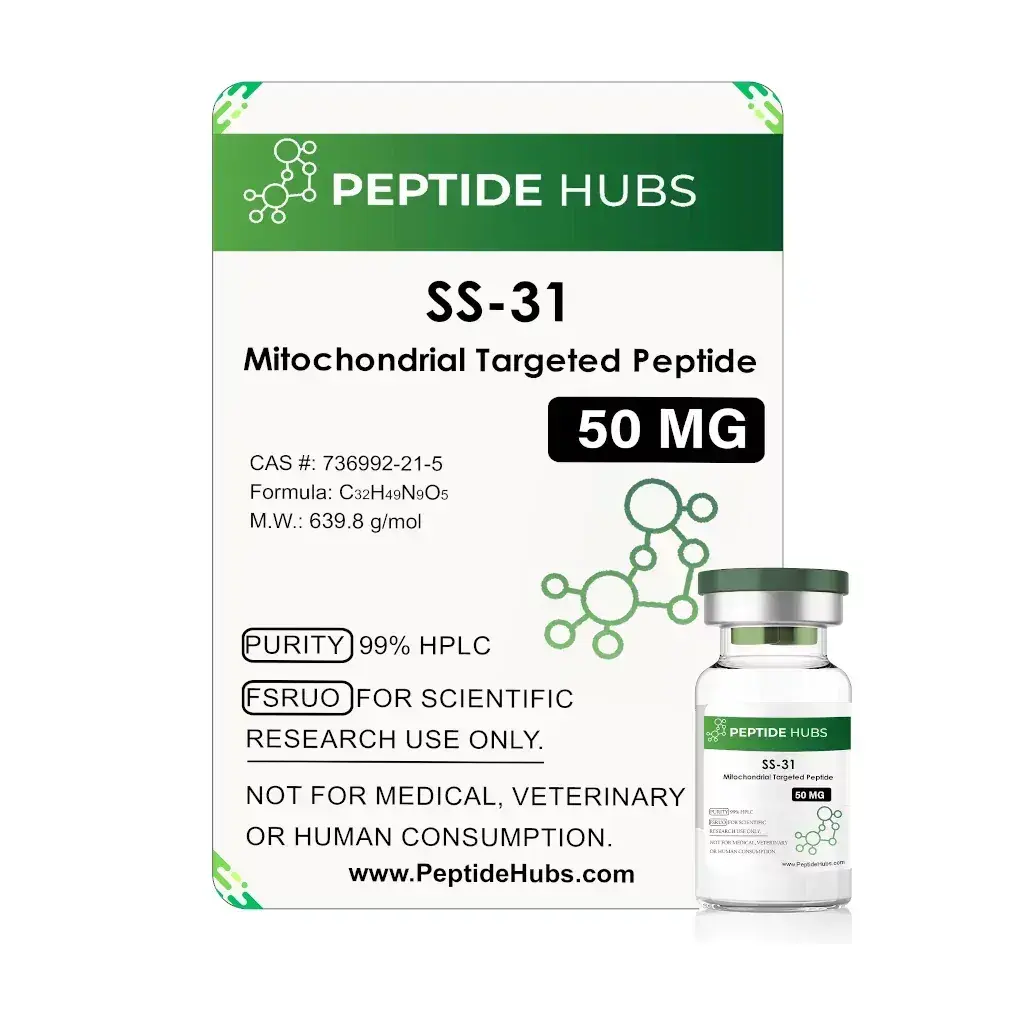
SS-31 50 mg contains SS-31, also known as elamipretide, a synthetic aromatic-cationic tetrapeptide with the sequence D-Arg-Dmt-Lys-Phe-NH2. It is designed to selectively target the inner mitochondrial membrane and bind to cardiolipin, a phospholipid critical for mitochondrial structure and function.
In September 2025, the FDA approved elamipretide (SS-31) under the brand name Forzinity as the first treatment for Barth syndrome, an ultra-rare mitochondrial disease. This approval represents a historic milestone as the first mitochondria-targeted therapeutic to receive FDA approval. SS-31 has also been studied in preclinical models of acute kidney injury, heart failure, spinal cord injury, and age-related mitochondrial dysfunction.
In non-medical bodybuilding research contexts, SS-31 is commonly referenced for its potential to support mitochondrial bioenergetics and recovery capacity. It does not act on testosterone, growth hormone, or other anabolic pathways, distinguishing it from traditional performance-enhancing compounds.
Key Benefits of SS-31 50 mg
- Mitochondria-targeting tetrapeptide with selective cardiolipin binding
- FDA-approved (September 2025) as Forzinity for Barth syndrome
- Studied for mitochondrial bioenergetics and oxidative stress reduction
- Lyophilized powder format for extended storage stability
- Supplied in a 2 mL vial suitable for laboratory reconstitution
Mitochondria-Targeting Tetrapeptide
SS-31 selectively binds to cardiolipin, a phospholipid found almost exclusively in the inner mitochondrial membrane. This interaction stabilizes mitochondrial cristae structure, reduces oxidative stress, and enhances ATP production. Unlike many mitochondrial antioxidants that rely on receptor binding, SS-31 acts through electrostatic and hydrophobic interactions with membrane phospholipids.
The peptide has been reported to cross the blood-brain barrier due to its alternating aromatic-cationic structure, enabling access to central nervous system targets. It has a short half-life requiring parenteral administration for research applications.
Recent research has identified phospholipid scramblase 3 (PLSCR3) as a key mediator of SS-31's mitochondrial protective effects, suggesting a novel mechanistic pathway beyond direct cardiolipin stabilization.
Defining Characteristic
Cardiolipin-Directed Mitochondrial Protection
SS-31 represents the first FDA-approved mitochondria-targeted therapeutic. Its mechanism centers on cardiolipin binding to stabilize the inner mitochondrial membrane, distinguishing it from receptor-based peptides and conventional antioxidants.
SS-31 50 mg vs Other Peptide Hubs Preparations
Peptide Hubs offers SS-31 in a 50 mg lyophilized powder format, providing a research-scale quantity suitable for extended protocols. The 50 mg vial is commonly referenced in bodybuilding research contexts at doses of 5–10 mg per day over 4–8 week cycles.
Related mitochondria-focused research peptides from Peptide Hubs include MOTS-C 10 mg, a mitochondrial-derived peptide studied for metabolic regulation, and AOD 9604 5 mg, a growth hormone fragment investigated for fat metabolism. For general peptide research support, Bacteriostatic Water is commonly used for reconstitution.
Typical Dosage Ranges
In the FDA-approved clinical context for Barth syndrome, elamipretide is administered at 40 mg per day via subcutaneous injection. In non-medical bodybuilding research contexts, SS-31 is commonly referenced at doses of 5 to 10 mg per day, typically administered subcutaneously in the morning over 4 to 8 week cycles.
| Use Case | Common Reference Range | Injection Frequency |
|---|
| FDA-approved (Barth syndrome) | 40 mg / day | Once daily subcutaneous |
| Bodybuilding research (non-medical) | 5–10 mg / day | Once daily, morning |
| Research protocols | Protocol-dependent | Per experimental design |
Note: The 5–10 mg daily range commonly referenced in bodybuilding contexts has not been confirmed by human bodybuilding trials. Clinical dosing for Barth syndrome uses 40 mg per day.
Stacking & Cycle Considerations
In non-medical research contexts, SS-31 is sometimes referenced in combination with other peptides, as it works through mitochondrial mechanisms without affecting testosterone or growth hormone pathways. Commonly referenced stacks include SS-31 with GH secretagogues such as CJC-1295/Ipamorelin 10 mg or healing peptides like BPC 157 5 mg.
Typical cycle structures referenced in bodybuilding research contexts involve 8 weeks on followed by 4 weeks off.
Managing Side Effects
In published clinical trials, SS-31 has generally been well tolerated. No serious adverse events have been clearly tied to SS-31 in published trials. Injection site reactions are possible with subcutaneous administration.
Individuals with active cancer, mitochondrial disease without specialist oversight, or those who are pregnant or breastfeeding are commonly advised to avoid SS-31 in non-medical contexts.
Post-Cycle Therapy
Post-cycle therapy is not applicable to SS-31, as the peptide does not suppress endogenous testosterone production or alter the hypothalamic-pituitary-gonadal axis. SS-31 acts on mitochondrial function without direct hormonal effects.
Important
Individual Response Varies
Research peptide protocols should be based on published study designs and appropriate institutional oversight. The information above is for educational reference and does not constitute medical advice or a recommendation for use.
Important Safety Information
The FDA approval of elamipretide for Barth syndrome was based on substantial evidence of safety and effectiveness in this specific ultra-rare disease population. However, clinical trials in other conditions including heart failure and primary mitochondrial myopathy have not consistently met primary efficacy endpoints.
SS-31 is not approved for non-medical bodybuilding or performance-enhancement use. Non-medical use of research peptides falls outside approved indications and carries unknown risks.
Important
Non-Medical Use
SS-31 is a prescription medication approved for Barth syndrome. Non-medical use of research peptides falls outside approved indications. Purchasing or using injectable SS-31 without a prescription may be illegal depending on jurisdiction.
Potential Adverse Effects
In published clinical trials, SS-31 has generally been well tolerated, with no serious adverse events clearly tied to the peptide. Injection site reactions may occur with subcutaneous administration. The FDA-approved labeling for Forzinity includes information on potential risks specific to the Barth syndrome population.
Conditions Requiring Medical Evaluation
SS-31 has not been evaluated for use in pregnancy, breastfeeding, or pediatric populations outside its approved indication. Individuals with active malignancy, known mitochondrial disease without specialist oversight, or those taking multiple psychiatric or cardiovascular medications are commonly advised to avoid non-medical SS-31 use.
Monitoring During Research Use
Research use of SS-31 should be conducted under appropriate institutional oversight with defined protocols for monitoring and adverse event reporting. Clinical monitoring parameters for non-medical SS-31 use have not been established.
Product Care
Storage & Handling
Keep the vial securely stored and protected from conditions that could compromise the product. Inspect the vial before use and do not use a product that appears damaged or compromised.
Further Safety Information
USA Domestic 3–5 business days
International 10–15 business days
Order Processing 24–48 business hours
Tracking Provided after dispatch
Direct Supply
Discreet Delivery & Original Packaging
The outer shipping package remains discreet, with privacy-focused handling. Products are supplied through the official Peptide Hubs distribution chain.
What to Expect
- Orders are processed after payment confirmation
- USA Domestic shipping is typically faster when local stock is selected
- International orders include tracking, though update frequency may vary by destination
- Multiple warehouses may result in separate shipments when applicable
Authenticity Verification
To verify your SS-31 50 mg product, use the security code on the vial label and cross-check it on the Peptide Hubs official site. Original packaging helps reinforce product legitimacy.
For complete delivery details, tracking policy, and reshipment terms, please see our Shipping Info page.
Recommended Conditions
Store the lyophilized powder frozen at -20°C for long-term storage (up to 3 years), protected from light and moisture. Once reconstituted, store the solution refrigerated at 2–8°C and use within 28 days.
For reconstitution, bacteriostatic water is commonly used to maintain sterility over multiple draws. Do not freeze reconstituted solution.
Quick Reference
Do & Don't
- Do store lyophilized powder frozen at -20°C
- Do protect from light and moisture
- Do use reconstituted solution within 28 days
- Don't freeze reconstituted solution
- Don't expose to excessive heat
- Don't use if solution appears cloudy or discolored
What is SS-31 50 mg used for?
SS-31 50 mg is a research peptide supplied as lyophilized powder. SS-31 (elamipretide) is FDA-approved for Barth syndrome under the brand name Forzinity. In non-medical research contexts, it is studied for mitochondrial support and recovery applications, though such use falls outside approved indications.
How often should SS-31 50 mg be injected?
In the FDA-approved clinical context for Barth syndrome, elamipretide is administered at 40 mg per day. In non-medical bodybuilding research contexts, SS-31 is commonly referenced at 5–10 mg per day, typically administered subcutaneously in the morning.
Does SS-31 50 mg require PCT?
No. Post-cycle therapy is not applicable to SS-31, as the peptide does not suppress endogenous testosterone production or alter hormonal axes. SS-31 acts on mitochondrial function without direct hormonal effects.
What does SS-31 do?
SS-31 is a mitochondria-targeting tetrapeptide that binds to cardiolipin in the inner mitochondrial membrane, stabilizing mitochondrial structure and enhancing ATP production. It has been studied across preclinical models of mitochondrial dysfunction, including kidney injury, heart failure, and spinal cord injury.
How long does SS-31 take to work?
In non-medical research contexts, mitochondrial changes from SS-31 are commonly reported to accumulate over 2 to 3 weeks of daily dosing, with most reported benefits appearing around week 3 or 4.
Is SS-31 approved by the FDA?
Yes. In September 2025, the FDA approved elamipretide (SS-31) under the brand name Forzinity as the first treatment for Barth syndrome, an ultra-rare mitochondrial disease. It is the first FDA-approved mitochondria-targeted therapeutic.
What is the difference between SS-31 and MOTS-c?
SS-31 and MOTS-c are both mitochondria-related research peptides but act through different mechanisms. SS-31 is a cardiolipin-binding tetrapeptide that stabilizes mitochondrial structure, while MOTS-c is a mitochondrial-derived peptide studied for metabolic regulation. Peptide Hubs offers MOTS-C 10 mg for research purposes.
What is the difference between SS-31 and BPC 157?
SS-31 and BPC 157 have entirely different mechanisms and research profiles. SS-31 targets mitochondrial cardiolipin, while BPC 157 is a pentadecapeptide studied primarily for tissue repair mechanisms. BPC 157 5 mg is available from Peptide Hubs for research use.
Is 50 mg a lot of SS-31?
A 50 mg vial of SS-31 is a research-scale quantity. At commonly referenced non-medical doses of 5–10 mg per day, a 50 mg vial provides approximately 5–10 days of material depending on the protocol.
What strength is SS-31 50 mg?
SS-31 50 mg by Peptide Hubs is labeled at 50 mg per vial. The product is supplied as lyophilized powder in a 2 mL vial.
How should SS-31 50 mg be reconstituted?
Lyophilized peptides are typically reconstituted with bacteriostatic water or sterile saline. Bacteriostatic Water is commonly used for peptide reconstitution to maintain sterility over multiple draws. For a 50 mg vial, adding 2 mL of diluent yields a concentration of 25 mg per mL.
Why is SS-31 called a mitochondria-targeting peptide?
SS-31 is called mitochondria-targeting because its alternating aromatic and cationic amino acid residues enable it to localize specifically to the inner mitochondrial membrane. There, it binds to cardiolipin with high selectivity, distinguishing it from general antioxidants.
No reviews found
Please log in to write SS-31 50 mg review.