
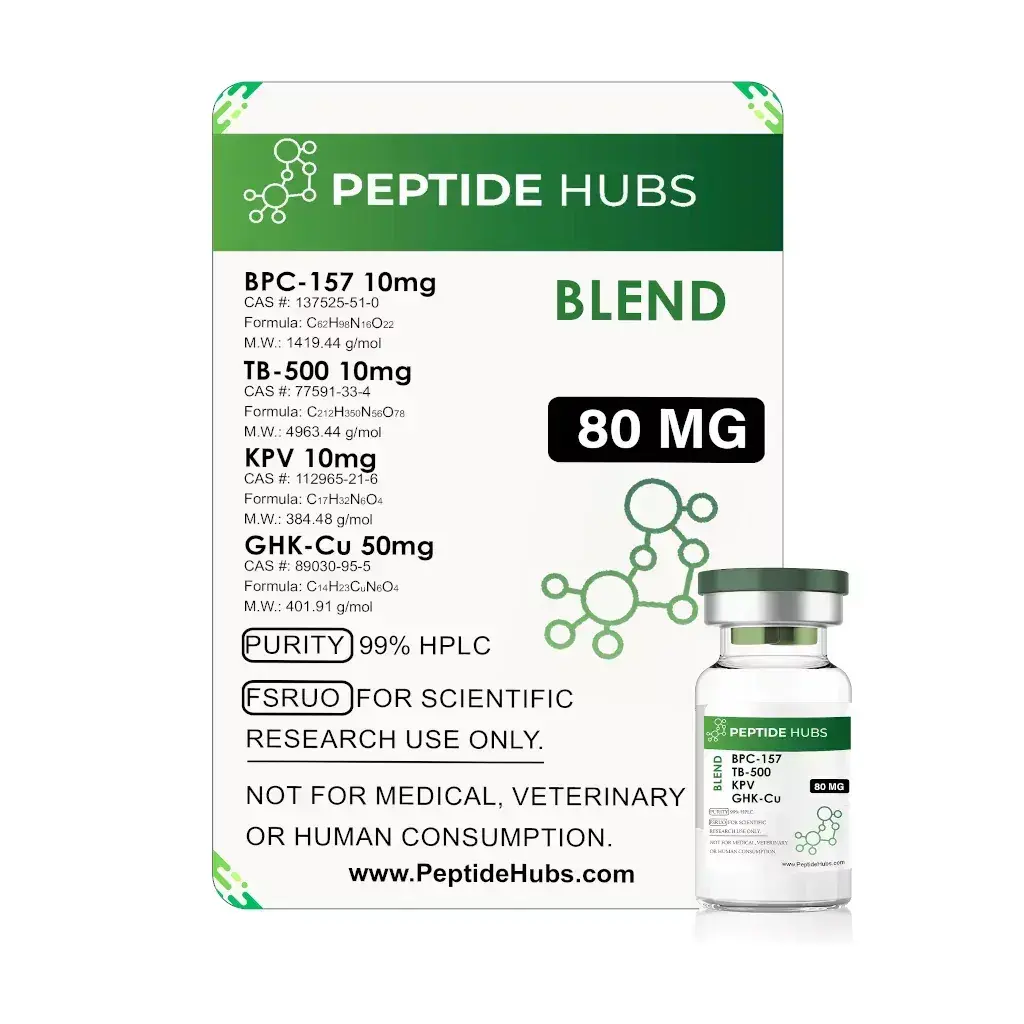
Klow Blend 80 mg is a lyophilized multi-peptide research blend manufactured by Peptide Hubs and supplied as a 80 mg/vial powder in a 2 mL vial, containing KPV 10 mg, BPC 157 10 mg, TB 500 10 mg, and GHK-Cu 50 mg.
Klow Blend 80 mg combines four research peptides targeting complementary aspects of inflammation modulation and tissue remodeling. KPV (Lys-Pro-Val) is the C-terminal tripeptide of alpha-melanocyte-stimulating hormone (α-MSH), studied for anti-inflammatory effects through inhibition of the NF-κB pathway. BPC 157 is a pentadecapeptide investigated for angiogenic and cytoprotective effects. TB 500 is a fragment of thymosin beta-4 studied for actin regulation and cell migration. GHK-Cu is a copper-binding tripeptide studied for collagen synthesis and extracellular matrix remodeling.
Each component of Klow Blend 80 mg operates through distinct mechanisms. KPV has been shown to reduce IL-1β secretion and inhibit ROS-mediated inflammatory signaling in keratinocytes. BPC 157 has demonstrated consistent healing effects across tendon, ligament, and muscle injury models. TB 500 regulates G-actin polymerization, maintaining the actin monomer pool essential for cell motility. GHK-Cu delivers copper as a cofactor for lysyl oxidase and other enzymes involved in collagen cross-linking.
None of the four components in Klow Blend 80 mg are FDA-approved for human use. KPV, BPC 157, TB 500, and GHK-Cu are all marketed as research chemicals. The blend has not been evaluated as a combination in any clinical trial, and the safety of the four-peptide mixture is unknown. In non-medical bodybuilding contexts, this blend is referenced for recovery-focused protocols targeting inflammation, connective tissue, and skin quality, though such use falls outside approved indications.
Klow Blend 80 mg is supplied as a lyophilized (freeze-dried) powder in a 2 mL vial. Reconstitution with an appropriate solvent is required before use in research contexts.
Klow Blend 80 mg is a four-component research peptide blend containing KPV (tripeptide, ~357 Da), BPC 157 (pentadecapeptide, ~1,419 Da), TB 500 (thymosin beta-4 fragment, ~889 Da), and GHK-Cu (copper tripeptide, ~402.9 Da free base).
Klow Blend 80 mg belongs to the class of multi-component peptide research products, which combine peptides targeting different biological pathways in a single vial. This approach is referenced in non-medical research contexts as a way to study complementary inflammation and tissue-remodeling mechanisms simultaneously. The four components of this blend operate through distinct and non-overlapping pathways.
KPV is a naturally occurring tripeptide derived from the C-terminal sequence of α-MSH. Research has demonstrated that KPV inhibits NF-κB activation and MAP kinase inflammatory signaling at nanomolar concentrations, reducing pro-inflammatory cytokine secretion. BPC 157 is a synthetic pentadecapeptide derived from a protective protein found in human gastric juice, studied for angiogenic and cytoprotective effects. TB 500 is a synthetic fragment of thymosin beta-4 that binds G-actin, maintaining a pool of actin monomers essential for cell motility and migration. GHK-Cu is a naturally occurring copper-binding tripeptide that declines with age and has been studied for collagen synthesis and anti-inflammatory effects.
In non-medical bodybuilding contexts, this blend is commonly referenced for recovery-focused protocols targeting connective tissue, joint health, and skin quality. None of the components are FDA-approved for human use, and no clinical trials have evaluated this specific four-peptide combination.
Klow Blend 80 mg is distinguished by its four-component design, combining an anti-inflammatory tripeptide (KPV), a pentadecapeptide (BPC 157), a thymosin fragment (TB 500), and a copper tripeptide (GHK-Cu) that target different aspects of tissue biology.
Peptide Hubs offers individual components as separate products for researchers who prefer to control ratios. BPC 157 is available as a standalone 5 mg vial, TB 500 as a standalone 5 mg vial, and GHK-CU as a standalone 50 mg vial.
For a simpler three-peptide recovery blend without KPV, Glow Blend offers BPC 157, TB 500, and GHK-Cu in a pre-mixed combination. For research requiring a reconstitution solution, Bacteriostatic Water is the standard diluent for preparing lyophilized peptides like Klow Blend 80 mg.
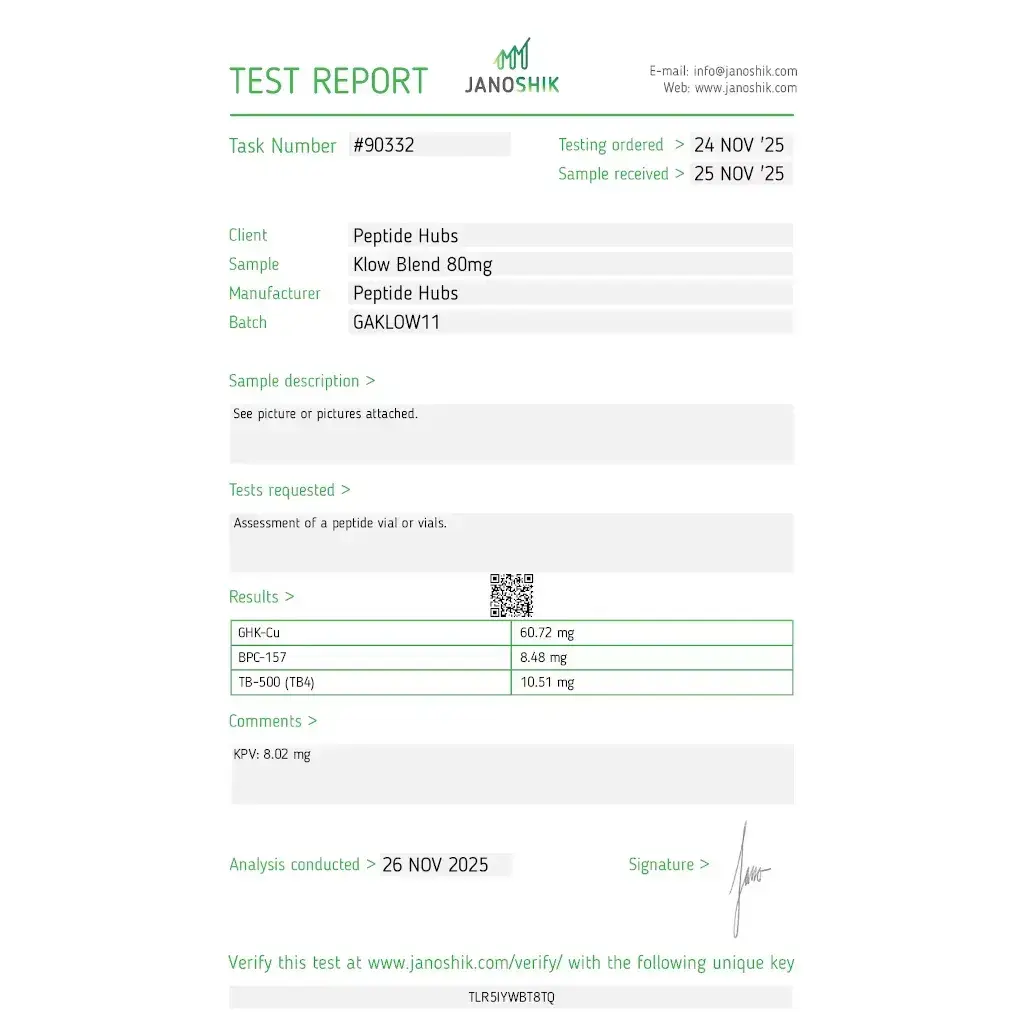
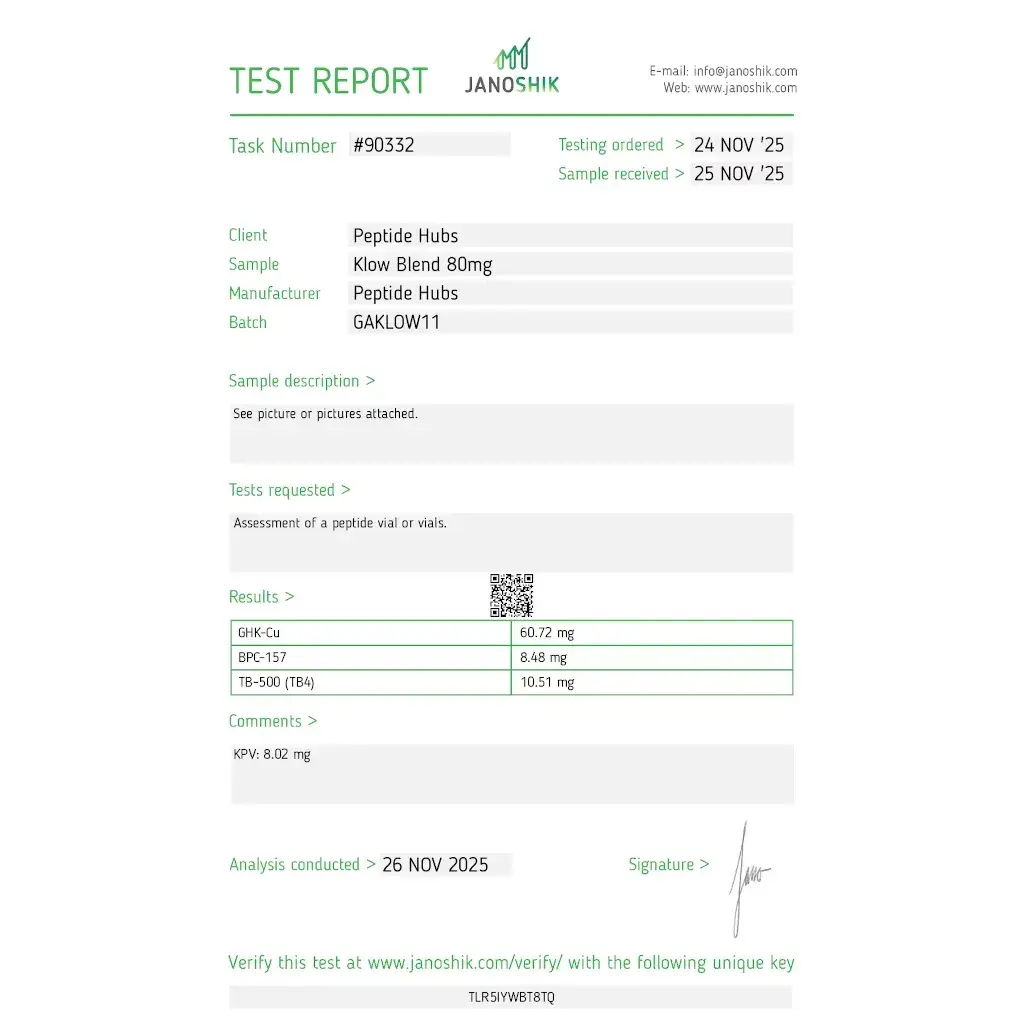
Published laboratory reports for Klow Blend 80 mg are shown below with the test date, measured content, and batch number.
 View Report
Laboratory results apply to the specific tested sample represented in each published report and should not be interpreted as a measurement of every vial or production batch.
The information below is provided for educational reference only. None of the components in Klow Blend 80 mg are FDA-approved human drugs. Their use for any non-medical purpose falls outside approved indications, and no established human dosing regimen exists for this combination.
Because Klow Blend 80 mg lacks FDA approval and published human dose-finding trials, there is no medically established dosage range. In non-medical bodybuilding and research communities, reference ranges are derived from community convention. Commonly referenced protocols use the total blend weight per injection, with the understanding that the individual peptide components are delivered in the fixed ratio defined by the formulation.
| Use Case | Common Reference Range | Injection Frequency |
|---|---|---|
| Recovery-focused protocol (non-medical) | 2–4 mg total blend | Once daily, 5 days on / 2 off |
| Standard protocol (non-medical) | 4–8 mg total blend | Once daily, 5 days on / 2 off |
| Cycle length (non-medical) | 4–12 weeks | Followed by 4-week break |
These ranges are community conventions, not evidence-based medical recommendations. The fixed-ratio formulation means that increasing the total blend dose proportionally increases every component, including GHK-Cu, which constitutes 62.5% of the total weight.
Klow Blend 80 mg is supplied as a lyophilized powder and requires reconstitution before use. A 80 mg vial reconstituted with 2.5 mL of solvent yields a concentration of 32 mg/mL total peptide, meaning a 4 mg dose would require drawing approximately 12.5 units on a U-100 insulin syringe. GHK-Cu turns the solution a clear blue; cloudiness or particulates indicate discarding.
Reconstituted solution should be stored refrigerated at 2–8°C and protected from light. Avoid repeated freeze-thaw cycles to maintain peptide integrity.
Klow Blend 80 mg already combines four peptides, so additional stacking is less common. Some non-medical protocols reference combining this blend with Glow Blend for additional recovery support, though this represents a combination of overlapping mechanisms with redundant BPC 157, TB 500, and GHK-Cu components.
Cycle lengths commonly referenced range from 4 to 12 weeks on, followed by a 2- to 4-week break. The 5 days on / 2 days off schedule is common in community protocols.
No human pharmacokinetic or dose-response data exists for Klow Blend 80 mg. All dosage information is derived from community convention and should not be interpreted as medical guidance.
None of the components in Klow Blend 80 mg are FDA-approved for human use. Safety data in humans is extremely limited for all four peptides, and non-medical use carries unknown risks.
KPV, BPC 157, TB 500, and GHK-Cu have not received FDA approval for human use. BPC 157 and GHK-Cu have been evaluated by the FDA for inclusion on the 503A bulk drug substances list and remain under regulatory review. TB 500 is on the World Anti-Doping Agency Prohibited List under S2.
Combining four unapproved peptides in a single formulation introduces additional unknown risks. No clinical trials have evaluated the safety or efficacy of this specific combination, and the potential for additive or synergistic adverse effects is unknown.
Klow Blend 80 mg is sold strictly as a research chemical for laboratory use only. It is not intended for human consumption, medical treatment, or veterinary applications. Non-medical use falls outside approved indications.
Human safety data for KPV, BPC 157, TB 500, and GHK-Cu is minimal. The FDA has noted for BPC 157 potential for immunogenicity, along with minimal establishment of purity, efficacy, or safety. For GHK-Cu, unregulated sourcing introduces risks of contamination and mislabeling, and improper injection technique may cause serious complications.
Community-reported side effects for these peptides include injection site reactions, nausea, dizziness, headache, and fatigue. GHK-Cu injection site redness lasting an hour is commonly reported at higher doses. These reports are anecdotal and not from controlled trials.
Given the absence of human safety data for this blend, any consideration of Klow Blend 80 mg use should involve consultation with a qualified healthcare professional. Individuals with active malignancy or a history of cancer should exercise particular caution due to the pro-angiogenic properties of BPC 157 and the theoretical concerns with GHK-Cu.
No established monitoring protocol exists for Klow Blend 80 mg. In research contexts, any adverse reactions should be documented and reported to appropriate authorities.
Store lyophilized powder at -20°C, sealed, dry, and protected from light. Once reconstituted, store refrigerated at 2–8°C and use within approximately 30 days. Avoid repeated freeze-thaw cycles. Keep out of reach of children.
Klow Blend 80 mg is supplied through the official Peptide Hubs distribution chain and shipped in original manufacturer packaging with discreet handling.
The outer shipping package remains discreet, with privacy-focused handling. Products are supplied through the official Peptide Hubs distribution chain.
To verify your Klow Blend 80 mg product, use the security code on the vial label and cross-check it on the Peptide Hubs official site. Original packaging and manufacturer presentation help reinforce product legitimacy.
For complete delivery details, tracking policy, and reshipment terms, please see our Shipping Info page.
Proper storage conditions help preserve peptide stability and integrity throughout shelf life.
Store lyophilized powder at -20°C, sealed, dry, and protected from light. Under these conditions, the dry powder is stable for extended periods.
Once reconstituted, store refrigerated at 2–8°C and use within approximately 30 days. Avoid repeated freeze-thaw cycles to maintain peptide integrity.
Keep out of reach of children. Follow proper handling practices.
Answers to common questions about Klow Blend 80 mg, multi-peptide research blends, and research compound handling.
Klow Blend 80 mg is a research blend of four peptides studied for complementary inflammation modulation and tissue-remodeling pathways. In non-medical bodybuilding contexts, it is commonly referenced for recovery-focused protocols, though such use falls outside approved indications and lacks clinical validation.
No established human dosing schedule exists. Community protocols commonly reference once-daily subcutaneous administration at 2–8 mg total blend, 5 days on and 2 days off, for cycles of 4–12 weeks.
None of the components in Klow Blend 80 mg suppress endogenous testosterone production, and the blend does not require post-cycle therapy in the way anabolic steroids do. However, any non-medical peptide use should be approached with caution given the absence of human safety data.
KPV is studied for NF-κB pathway inhibition and anti-inflammatory effects. BPC 157 is studied for angiogenic and cytoprotective effects. TB 500 is studied for actin regulation and cell migration. GHK-Cu is studied for collagen synthesis and tissue remodeling. Each component targets a different aspect of tissue biology.
No human data establishes a timeline for effects. Community reports suggest recovery-related effects may appear over 2–4 weeks of consistent use, while skin-related effects from the GHK-Cu component may take longer.
There is no universally “best” recovery peptide blend. Klow Blend 80 mg combines four well-studied peptides, but no clinical trials have evaluated this specific combination. Comparative human data is absent.
Klow Blend 80 mg contains four peptides—KPV, BPC 157, TB 500, and GHK-Cu—while Glow Blend contains three peptides (BPC 157, TB 500, and GHK-Cu). The addition of KPV in Klow Blend adds an anti-inflammatory tripeptide component studied for NF-κB pathway inhibition.
Klow Blend 80 mg contains BPC 157 alongside KPV, TB 500, and GHK-Cu, while BPC 157 is a single-peptide product. The blend is designed for research into complementary mechanisms, whereas single-peptide products allow isolated study.
8 mg is at the upper end of the range commonly referenced in community protocols (2–8 mg total blend per injection). Without human dose-response data, it is impossible to characterize any amount as appropriate or excessive.
Klow Blend 80 mg is labeled at 80 mg total per vial, containing KPV 10 mg, BPC 157 10 mg, TB 500 10 mg, and GHK-Cu 50 mg. It is supplied as a lyophilized powder in a 2 mL vial.
Yes. A published laboratory report dated November 26, 2025 measured Klow Blend 80 mg at 79.71 mg, equivalent to 99.6% of its 80 mg label claim. The batch number is GAKLOW11.
Store the lyophilized powder at -20°C, sealed, dry, and protected from light. Once reconstituted, refrigerate at 2–8°C and use within approximately 30 days. Avoid repeated freeze-thaw cycles.