
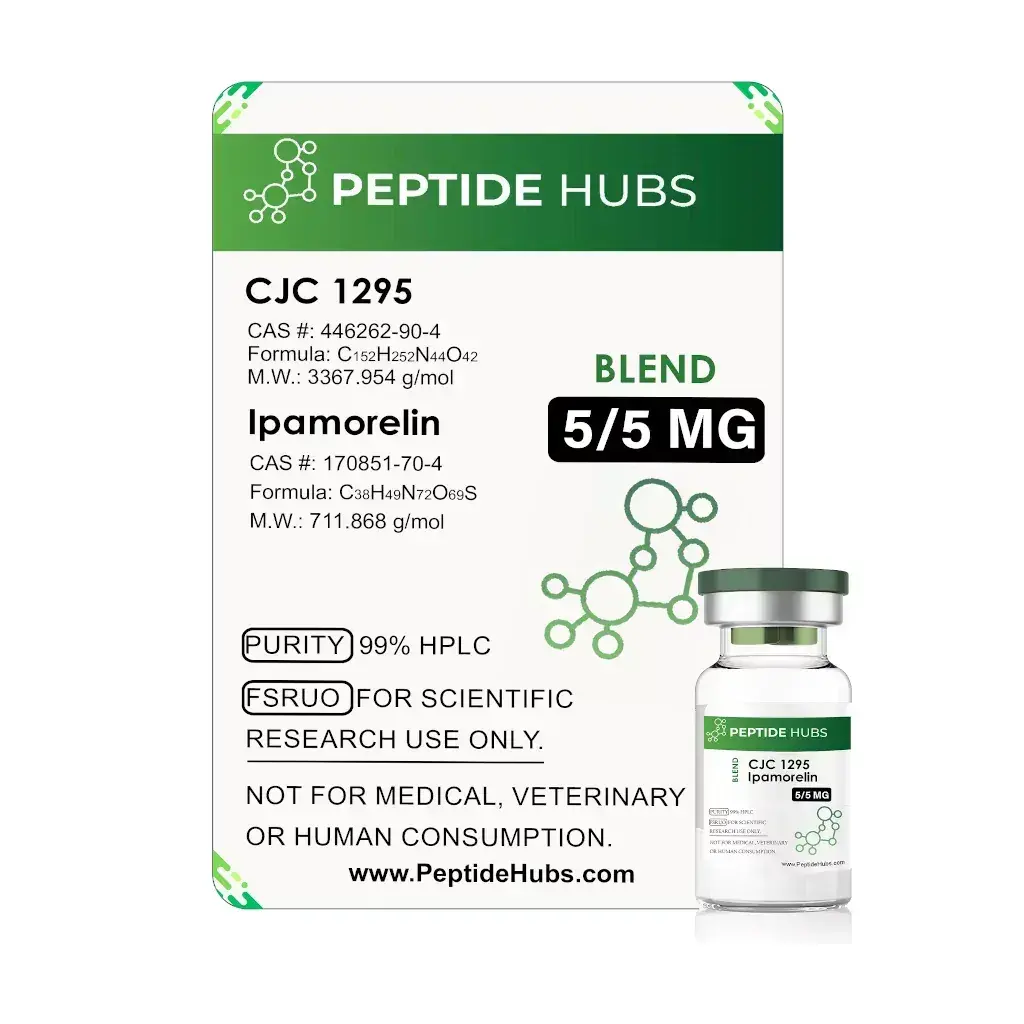
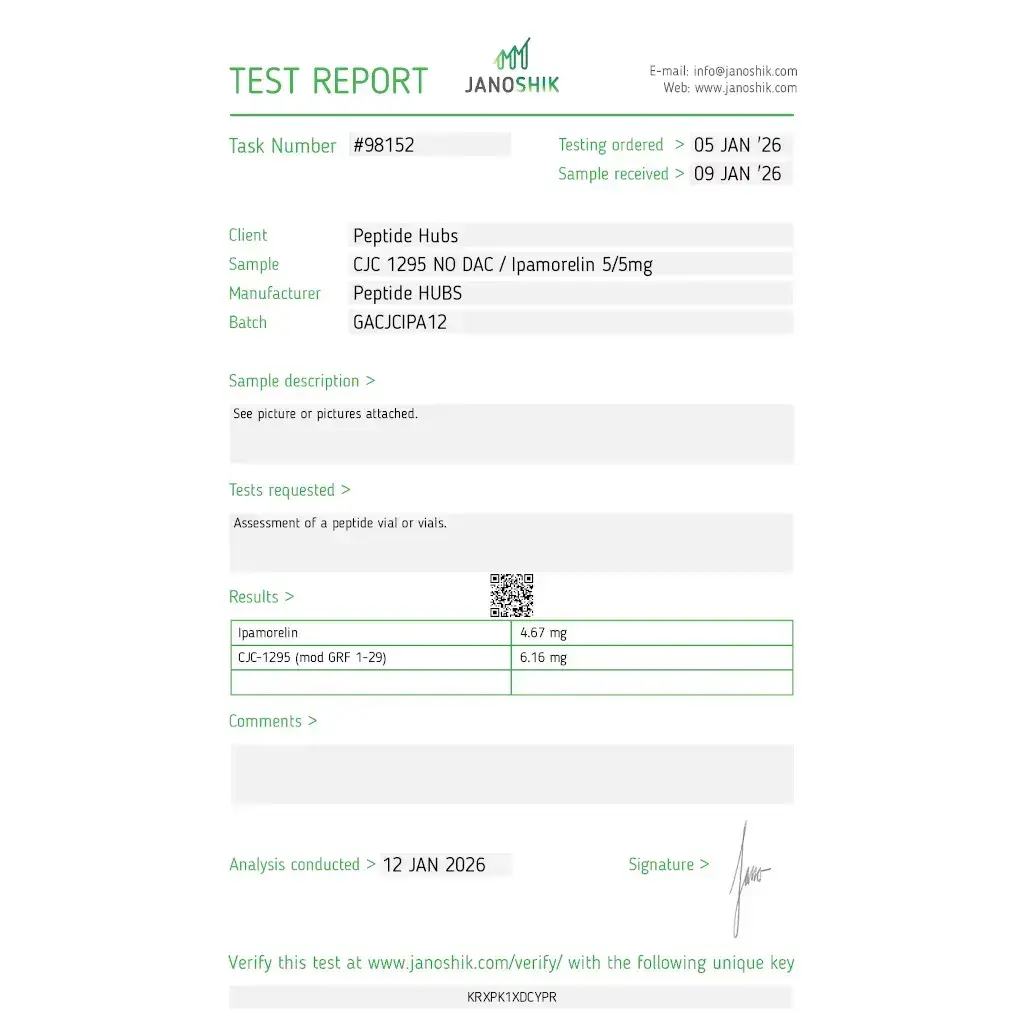
CJC-1295 No DAC/Ipamorelin is a lyophilized dual-peptide research blend manufactured by Peptide Hubs and supplied as a 10 mg/vial powder in a 2 mL vial, containing CJC 1295 No DAC 5 mg and Ipamorelin 5 mg.
CJC-1295 No DAC/Ipamorelin combines two complementary growth hormone secretagogues in a single lyophilized vial. CJC-1295 No DAC (Modified GRF 1-29) is a GHRH analog that acts on pituitary GHRH receptors, while Ipamorelin is a selective ghrelin receptor agonist that stimulates GH release through a distinct pathway. This dual-receptor approach is commonly referenced in research contexts for studying combined secretagogue signaling.
CJC-1295 No DAC, also known as Mod GRF 1-29, is a 29-amino-acid GHRH analog with four stabilizing substitutions designed to resist enzymatic degradation. Unlike CJC-1295 with DAC, this version lacks the albumin-binding moiety, resulting in a short half-life of approximately 25–30 minutes and producing a discrete, pulsatile GH release. Ipamorelin is a pentapeptide ghrelin receptor agonist (GHS-R) known for its selectivity, producing minimal effects on cortisol, prolactin, and appetite compared to older GHRPs.
Neither component is FDA-approved for any human indication. Both are classified as research chemicals and are prohibited in sport under WADA S2 (GHRH analogs and GH secretagogues). Human data is limited to GH/IGF-1 response studies; no outcome studies on body composition or the combination exist.
CJC-1295 No DAC/Ipamorelin is supplied as a lyophilized (freeze-dried) powder in a 2 mL vial. Reconstitution with an appropriate solvent is required before use in research contexts.
This blend combines Mod GRF 1-29 (CJC-1295 No DAC), a 29-amino-acid GHRH analog with a molecular weight of 3,367.9 g/mol, and Ipamorelin, a pentapeptide with a molecular weight of 711.9 g/mol.
This product is a lyophilized blend of two synthetic peptides classified as a multi-component growth hormone secretagogue. CJC-1295 No DAC acts as a GHRH analog, binding to pituitary GHRH receptors to stimulate GH synthesis and release. Ipamorelin acts as a selective ghrelin receptor agonist, triggering GH release through the GHS-R1a pathway.
The rationale for combining these peptides is complementary receptor targeting: one GHRH analog plus one GHRP can produce greater GH release than either alone, with a pulsatile rather than flat release profile. CJC-1295 No DAC has a half-life of approximately 25–30 minutes, while Ipamorelin’s half-life is approximately 2 hours. Both components are short-acting, requiring multiple daily administration in research protocols.
Neither component is approved by the FDA, EMA, or other regulatory agencies. Both were on the FDA 503A Category 2 compounding list and were removed in September 2024, but this removal did not create a legal compounding pathway; they remain unregulated research chemicals. A PCAC review for potential 503A inclusion was scheduled for July 2026.
The blend is distinguished by its dual mechanism: CJC-1295 No DAC targets GHRH receptors while Ipamorelin targets ghrelin receptors. This combination is studied for potential synergistic GH release through parallel signaling pathways.
Peptide Hubs offers individual components as separate products. CJC-1295 No DAC is available as a standalone 5 mg vial for researchers who prefer to control the ratio. Ipamorelin is also available separately as a 5 mg vial.
For pre-mixed combinations with different ratios, CJC-1295/Ipamorelin offers an alternative blend formulation. For GHRH analog research without the ghrelin component, Sermorelin or Tesamorelin provide single-agent options. For GHRP research without the GHRH component, Ipamorelin alone is available.
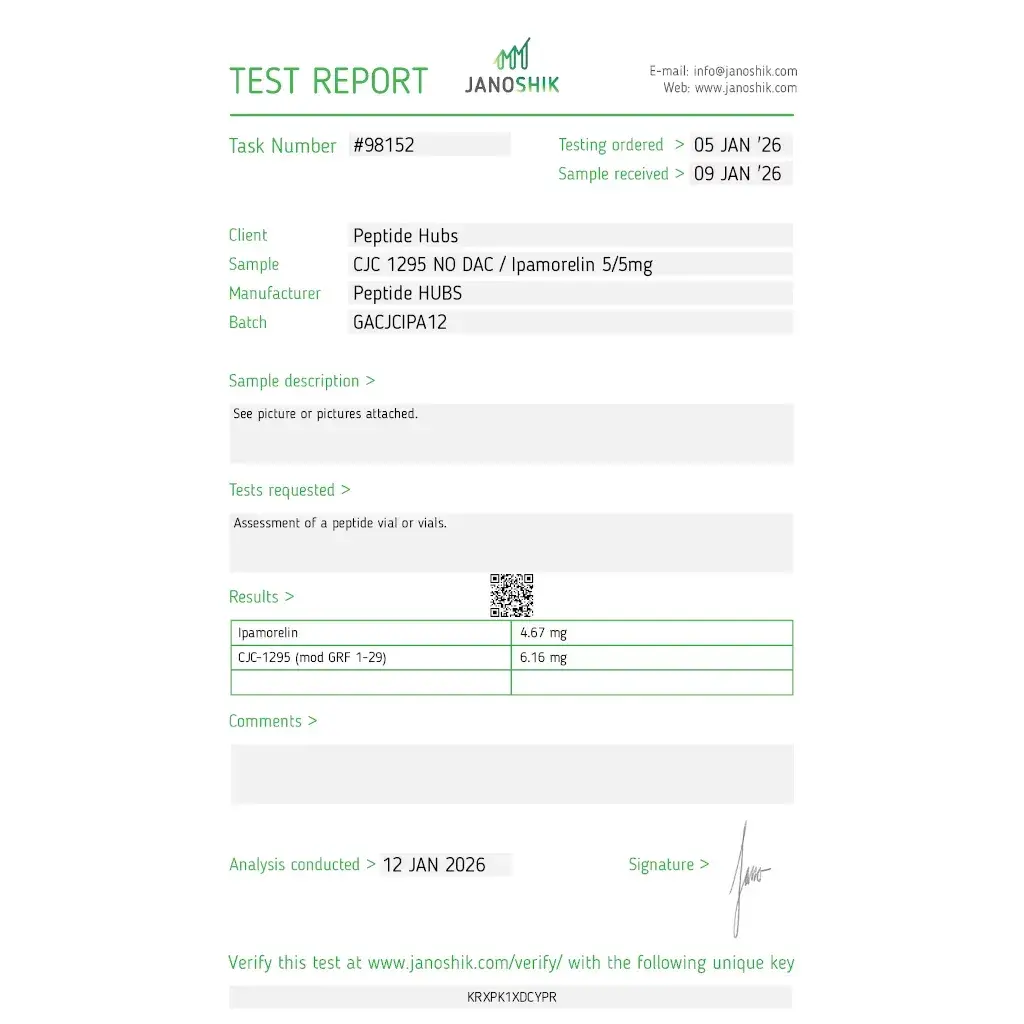
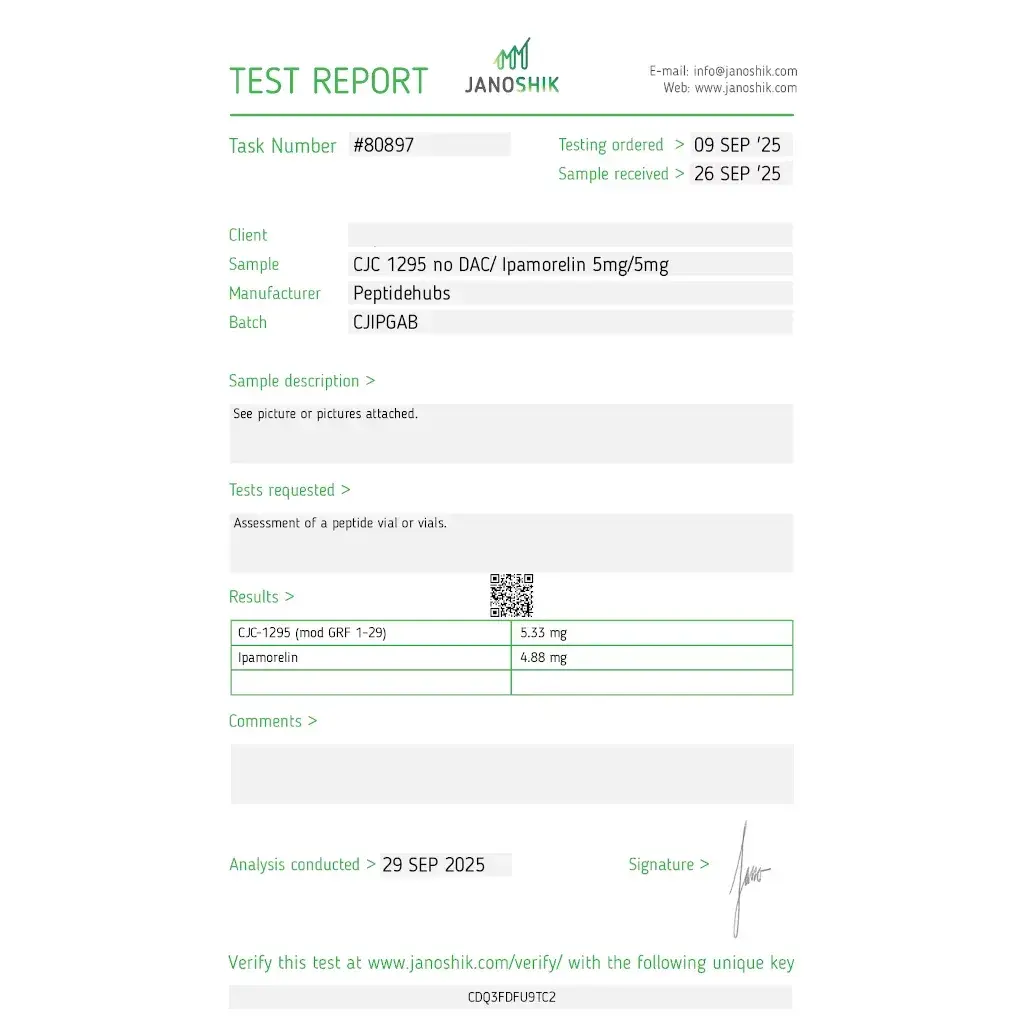
Published laboratory reports for CJC-1295 No DAC/Ipamorelin are shown below with the test date, measured content, and batch number.
 View Report
 View Report
Laboratory results apply to the specific tested sample represented in each published report and should not be interpreted as a measurement of every vial or production batch.
The information below is provided for educational reference only. Neither component of this blend is an FDA-approved human drug. Use for any non-medical purpose falls outside approved indications, and no established human dosing regimen exists.
Because this blend lacks FDA approval and published human dose-finding trials, there is no medically established dosage range. Non-medical community protocols commonly reference CJC-1295 No DAC at 100–300 mcg per injection, combined with Ipamorelin at 100–200 mcg per injection, administered 1–3 times daily.
| Use Case | Common Reference Range | Injection Frequency |
|---|---|---|
| Standard blend protocol (non-medical) | 100–200 mcg CJC + 100–200 mcg IPA | 1–3 times daily |
| Community-reported protocol | 135 mcg CJC + 135 mcg IPA | Once daily, fasted morning |
| Upper range (non-medical) | 300 mcg CJC + 300 mcg IPA | Once daily |
Community protocols commonly reference dosing in a fasted state, typically before bed and/or post-workout to align with natural GH pulses.
CJC-1295 No DAC/Ipamorelin is supplied as a lyophilized powder and requires reconstitution before use. A 10 mg vial (5 mg CJC + 5 mg IPA) reconstituted with 2 mL of solvent yields a concentration of 2.5 mg/mL CJC and 2.5 mg/mL IPA per mL of solution.
Some suppliers recommend acetic acid solution rather than standard bacteriostatic water to ensure proper dispersion of the CJC-1295 component. Reconstituted solution should be stored refrigerated at 2–8°C and protected from light.
This blend already combines two peptides, so additional stacking is less common. Some non-medical protocols reference adding MOTS-c or Tesamorelin for complementary metabolic effects, though no clinical evidence supports such combinations.
Community cycle lengths range from 8 to 14 weeks on, followed by a 3- to 4-week break before repeating.
No human dose-response data for therapeutic outcomes exists for this blend. All dosage information is derived from community convention and should not be interpreted as medical guidance.
Neither CJC-1295 No DAC nor Ipamorelin is FDA-approved for any human use. The FDA has evaluated CJC-1295-related bulk drug substances and found that available safety and characterization data are insufficient to support compounding.
CJC-1295 (in all forms) has not been approved by the FDA, EMA, or any other regulatory agency. There is no USP monograph, and no form of CJC-1295 is recognized in the European or Japanese Pharmacopeia. The FDA noted inconsistent naming conventions across nominations, making it unclear whether the proposed substances were free base, acetate, or TFA salt forms.
Ipamorelin is also not FDA-approved. Both compounds are on the WADA Prohibited List under S2 (Peptide Hormones, Growth Factors, Related Substances and Mimetics).
Both components are marketed as research chemicals and have been identified in unknown pharmaceutical preparations seized by authorities. Non-medical use falls outside approved indications.
Clinical studies of CJC-1295 with DAC (a related compound) reported injection site reactions in approximately 70% of subjects after a single dose and in all subjects after multiple doses. Other reported effects included headache, diarrhea, flushing, nausea, abdominal pain, transient dizziness, hypotension, and increased heart rate.
A Phase 2 clinical trial of CJC-1295 DAC was terminated in 2006 following the death of a subject who experienced an acute myocardial infarction approximately 2 hours after receiving an 11th weekly dose. The attending physician attributed the event to asymptomatic coronary artery disease with plaque rupture and occlusion.
For Ipamorelin, the selectivity profile with minimal cortisol and prolactin co-stimulation is considered a safety advantage over earlier-generation GHRPs. Common side effects in available data include injection site reactions, transient headache, flushing, and mild water retention.
Elevated GH and IGF-1 levels carry known risks, including those listed in FDA-approved recombinant human growth hormone product labeling. A cancer history, particularly any hormonally sensitive malignancy, requires careful evaluation before any IGF-1-elevating protocol. Glucose metabolism should be monitored because GH can affect insulin sensitivity.
No established monitoring protocol exists for non-medical use of this blend. Clinicians evaluating patients using GH-related peptides should consider monitoring IGF-1 levels, blood glucose, and potential injection site reactions.
Store lyophilized powder sealed, away from direct light. For long-term storage, keep in the freezer in an airtight container with desiccant. Once reconstituted, store refrigerated at 2–8°C and use within the recommended timeframe. Keep out of reach of children.
CJC-1295 No DAC/Ipamorelin is supplied through the official Peptide Hubs distribution chain and shipped in original manufacturer packaging with discreet handling.
The outer shipping package remains discreet, with privacy-focused handling. Products are supplied through the official Peptide Hubs distribution chain.
To verify your CJC-1295 No DAC/Ipamorelin product, use the security code on the vial label and cross-check it on the Peptide Hubs official site. Original packaging and manufacturer presentation help reinforce product legitimacy.
For complete delivery details, tracking policy, and reshipment terms, please see our Shipping Info page.
Proper storage conditions help preserve peptide stability and integrity throughout shelf life.
Lyophilized peptides can be kept at room temperature, away from direct light. For long-term storage, keep the material in the freezer in an airtight container with desiccant to avoid moisture. Use an amber vial or opaque container to protect from light.
Once reconstituted, the sample should be kept in the refrigerator. Avoid repeated freeze-thaw cycles to maintain peptide integrity.
Keep out of reach of children. Follow proper handling practices.
Answers to common questions about CJC-1295 No DAC/Ipamorelin, dual peptide blends, and research compound handling.
CJC-1295 No DAC/Ipamorelin is a research blend of two growth hormone secretagogues studied for their combined effects on GH release through different receptor pathways. In non-medical contexts, it is commonly referenced for GH axis research, though such use falls outside approved indications.
No established human dosing schedule exists. Community protocols commonly reference 1–3 daily subcutaneous injections due to the short half-life of both components, with dosing in a fasted state.
Neither component suppresses endogenous testosterone production and neither requires post-cycle therapy in the way anabolic steroids do. However, any non-medical peptide use should be approached with caution given the absence of comprehensive human safety data.
This blend combines a GHRH analog (Mod GRF 1-29) that binds pituitary GHRH receptors with a selective ghrelin receptor agonist (Ipamorelin) that stimulates GH release through the GHS-R1a pathway. The dual-receptor approach is studied for potential synergistic GH release.
Pharmacokinetically, CJC-1295 No DAC has a half-life of approximately 25–30 minutes and Ipamorelin approximately 2 hours, producing a GH pulse after administration. Community reports suggest sleep quality improvements may appear over 1–3 weeks of consistent use.
There is no universally “best” GH secretagogue combination. The GHRH + GHRP approach is commonly referenced because it targets two complementary pathways, but no controlled trials have compared this blend to alternatives. Both components are unapproved and WADA-prohibited.
CJC-1295 No DAC lacks the Drug Affinity Complex that extends half-life to approximately 6–8 days. The no-DAC version has a half-life of approximately 25–30 minutes, producing a sharper, more pulsatile GH response and requiring more frequent administration.
Sermorelin is a single GHRH analog available through licensed compounding pharmacies with an established legal profile, while Sermorelin as a research peptide is not legally compoundable. The CJC-1295/Ipamorelin blend adds a ghrelin receptor agonist component for dual-pathway research.
300 mcg is at the upper end of the range commonly referenced in community protocols. The GH response to GHRH analogs is described as saturable, meaning the GHRH receptor saturates at approximately 100 mcg; higher doses produce marginally more GH release at three times the cost.
CJC-1295 No DAC/Ipamorelin is labeled at 10 mg total per vial, containing CJC 1295 No DAC 5 mg and Ipamorelin 5 mg. It is supplied as a lyophilized powder in a 2 mL vial.
Yes. The latest published laboratory report dated January 12, 2026 measured CJC at 6.16 mg (123.2% of label claim) and Ipamorelin at 4.67 mg (93.4% of label claim). The batch number is GACJCIPA12.
Store the lyophilized powder away from direct light, and for long-term storage keep in the freezer in an airtight container with desiccant. Once reconstituted, refrigerate and use within the recommended timeframe. Avoid repeated freeze-thaw cycles.