
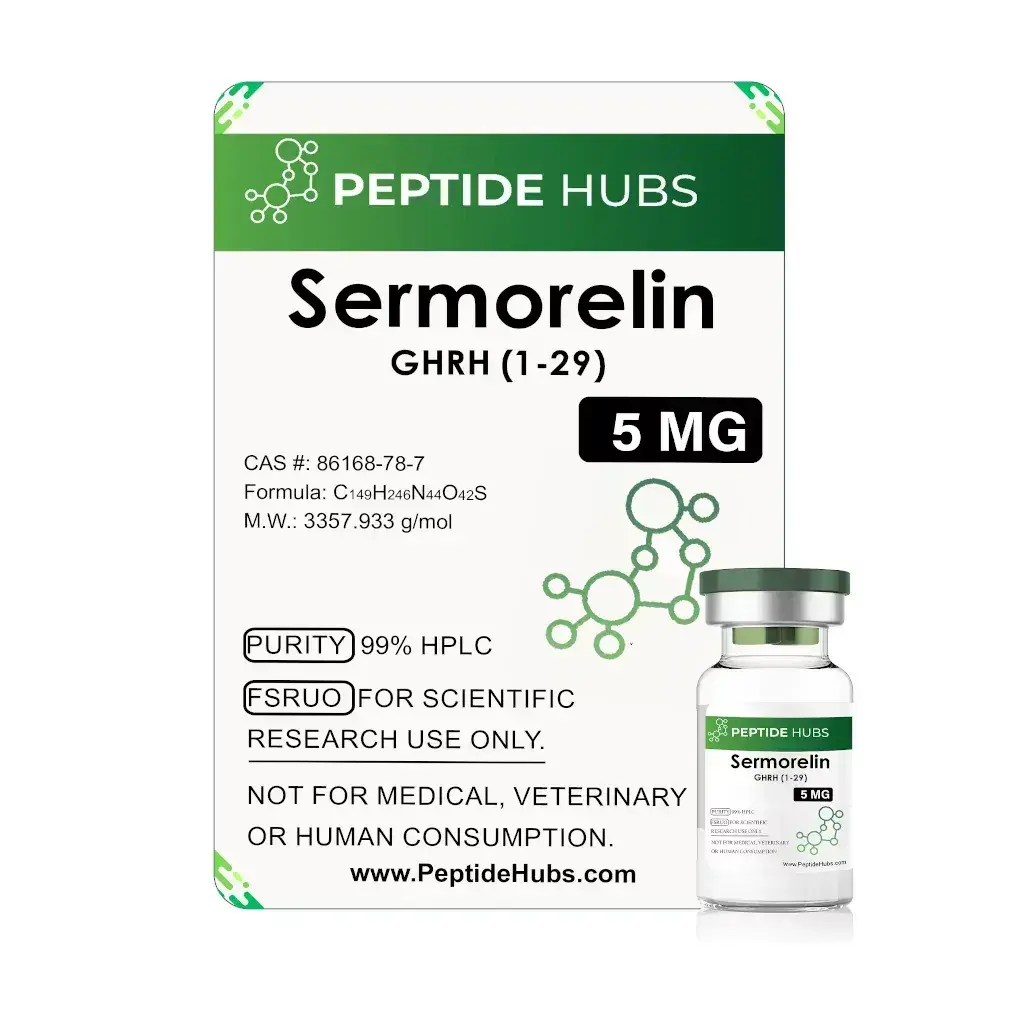
Sermorelin 5 mg is a lyophilized research peptide manufactured by Peptide Hubs and supplied in a 2 mL vial containing 5 mg of Sermorelin.
Sermorelin 5 mg contains Sermorelin, a synthetic 29-amino acid peptide corresponding to the amino-terminal segment of endogenous human growth hormone-releasing hormone (GHRH). It is also known as GRF(1-29) and acts as a GHRH receptor agonist.
In clinical medicine, Sermorelin was FDA-approved in 1990 under the brand name Geref for diagnostic evaluation of pituitary function and treatment of growth hormone deficiency in children. The branded product was later discontinued, though Sermorelin remains available through compounding pharmacies in some jurisdictions.
Sermorelin stimulates endogenous growth hormone secretion from the anterior pituitary by binding to GHRH receptors, preserving the body's natural feedback mechanisms that regulate GH release. Unlike exogenous growth hormone administration, Sermorelin relies on the pituitary's own synthesis and secretion pathways.
Sermorelin 5 mg is supplied as a lyophilized powder, a freeze-dried format designed to preserve peptide integrity during storage. Reconstitution is required before research use.
Sermorelin is a 29-amino acid peptide representing the biologically active amino-terminal portion of human growth hormone-releasing hormone. Its sequence corresponds to GHRH(1-29) with an amide at the C-terminus.
Sermorelin binds to GHRH receptors on pituitary somatotroph cells, stimulating growth hormone synthesis and secretion. This mechanism mimics the body's natural hypothalamic regulation of GH release, allowing IGF-1 feedback to modulate the response.
The peptide has a short plasma half-life of approximately 10–20 minutes, requiring subcutaneous administration for research applications. It is not orally bioavailable due to gastrointestinal protease degradation.
Unlike growth hormone secretagogues that act via ghrelin receptors (such as GHRP-2, GHRP-6, or ipamorelin), Sermorelin acts specifically through the GHRH receptor pathway, which represents a distinct mechanism of GH stimulation.
Sermorelin has a plasma half-life of approximately 10–20 minutes, requiring subcutaneous administration. Its short duration of action distinguishes it from longer-acting GHRH analogues such as CJC-1295 with DAC.
Peptide Hubs offers Sermorelin in a 5 mg lyophilized powder format. Related research peptides in the GH-IGF-1 axis category include CJC-1295 No DAC 5 mg, another GHRH analogue with a longer half-life, and Ipamorelin 5 mg, a selective ghrelin receptor agonist commonly studied in combination with GHRH analogues.
For research involving growth hormone secretagogues, GHRP-2 5 mg represents an alternative mechanism of GH stimulation via the ghrelin receptor pathway.
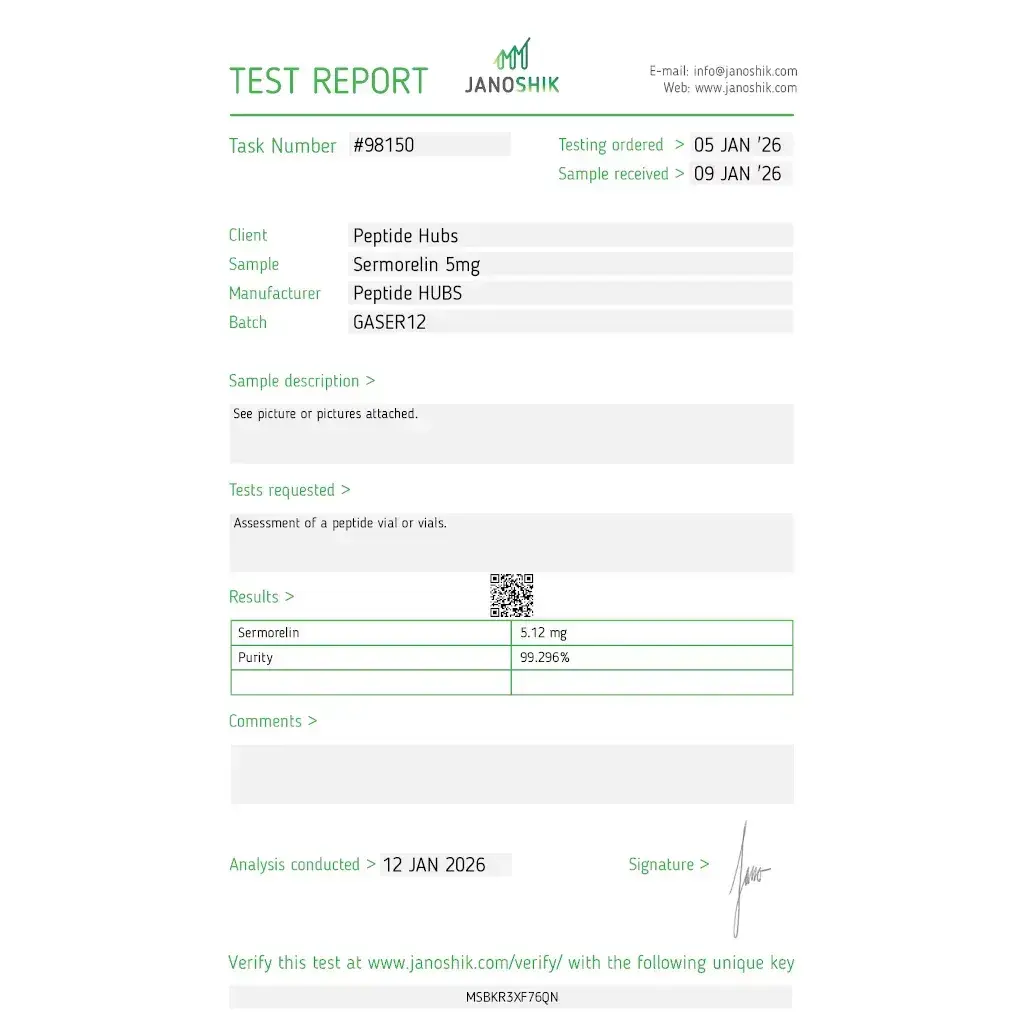
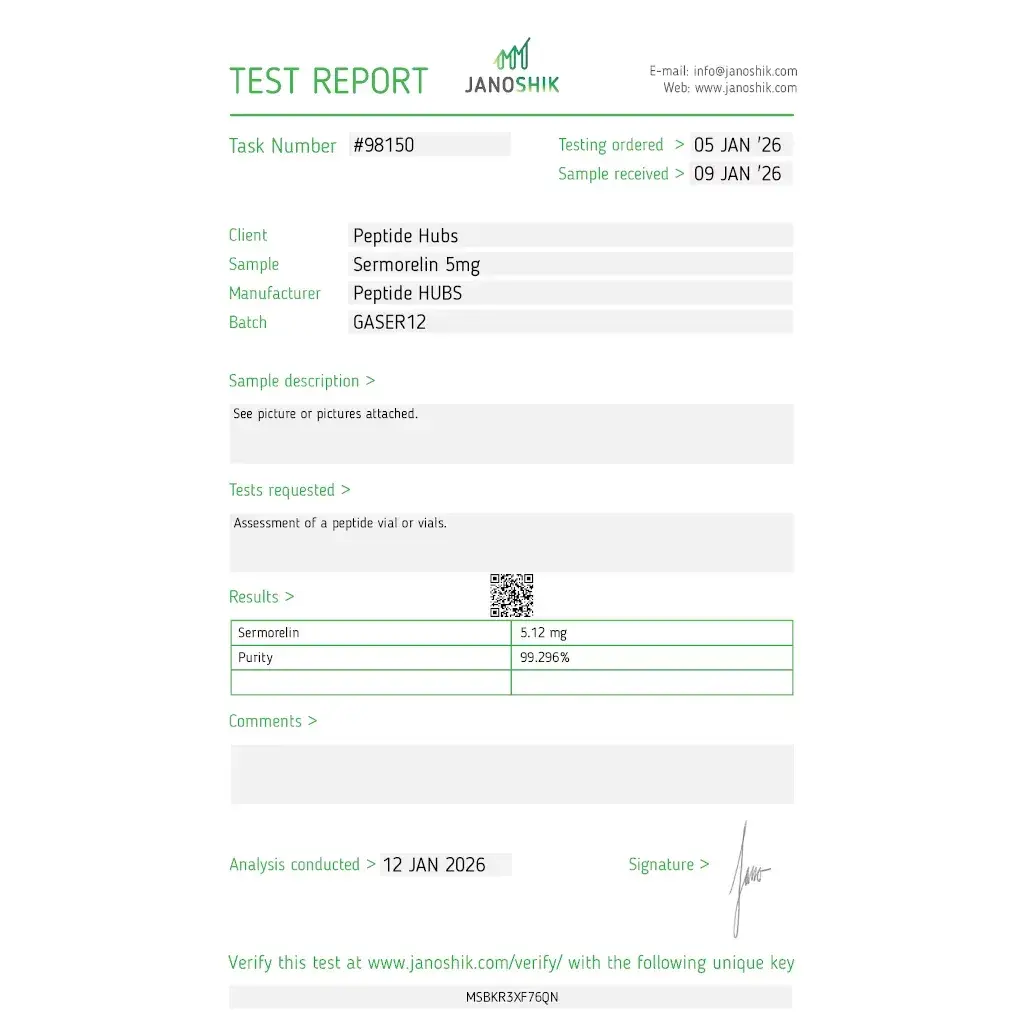
Published laboratory reports for Sermorelin 5 mg by Peptide Hubs are shown below with the test date, measured content, and percentage of the product's 5 mg label claim.
 View Report
Laboratory results apply to the specific tested sample represented in each published report and should not be interpreted as a measurement of every vial or production batch.
The information below is provided for educational reference only. Sermorelin is a prescription peptide in jurisdictions where it remains available through compounding; medical use requires appropriate diagnosis, clinical supervision and ongoing monitoring. Non-medical use falls outside approved indications.
In clinical research and compounded pharmacy contexts, Sermorelin has been commonly referenced at doses ranging from 100 mcg to 500 mcg per day, typically administered via subcutaneous injection. Some compounded protocols reference doses up to 1,000 mcg, though these higher amounts are less well characterized.
| Use Case | Common Reference Range | Injection Frequency |
|---|---|---|
| Diagnostic (clinical) | 1 mcg/kg body weight | Single administration |
| Compounded therapy (clinical) | 100–500 mcg / day | Once daily, typically at night |
| Research (non-clinical) | Commonly referenced at 100–300 mcg / day | Once daily |
Note: Sermorelin has a short half-life of approximately 10–20 minutes, which is why daily administration is referenced in most protocols.
In non-medical research contexts, Sermorelin is sometimes referenced in combination with ghrelin receptor agonists such as Ipamorelin 5 mg or GHRP-2 5 mg, as these act via complementary pathways to stimulate GH release. Research protocols involving combinations of GHRH analogues and growth hormone secretagogues are not standardized.
Reported adverse effects from clinical trials of injectable Sermorelin include injection site reactions (pain, redness, swelling), flushing, headache, and in some subjects transient hypersensitivity reactions. Because Sermorelin raises IGF-1, theoretical risks include promotion of pre-existing malignancies and fluid retention; active malignancy is considered a contraindication.
Post-cycle therapy is not applicable to Sermorelin, as the peptide does not suppress endogenous testosterone production or alter the hypothalamic-pituitary-gonadal axis in the manner of anabolic steroids. Sermorelin acts on the GH-IGF-1 axis through GHRH receptor stimulation without direct androgenic effects.
Research peptide protocols should be based on published study designs and appropriate institutional oversight. The information above is for educational reference and does not constitute medical advice or a recommendation for use.
Sermorelin was FDA-approved in 1990 for diagnostic and pediatric growth hormone deficiency indications under the brand name Geref, but the branded product has been discontinued. Sermorelin is not currently FDA-approved for adult use, and compounded Sermorelin is available only through licensed practitioners and accredited compounding pharmacies in some jurisdictions.
Sermorelin stimulates endogenous growth hormone secretion, which increases IGF-1 levels. Elevated IGF-1 is associated with theoretical risks including promotion of pre-existing malignancies and fluid retention. Active malignancy is considered a contraindication to Sermorelin use.
Because Sermorelin acts through the body's own GH synthesis and secretion pathways, it is less likely to result in GH excess compared to exogenous growth hormone administration. Normal IGF-1 feedback inhibition helps set a natural limit to the growth hormone stimulating effect.
Sermorelin is a prescription peptide that is not approved for over-the-counter use. Non-medical use of research peptides falls outside approved indications and carries unknown risks. Purchasing injectable Sermorelin without a prescription may be illegal depending on jurisdiction.
Documented adverse effects from clinical trials of injectable Sermorelin include injection site reactions (pain, redness, swelling), flushing, headache, and in some subjects transient hypersensitivity reactions.
Antibodies to GHRH may develop in some patients during extended therapy, potentially impairing the potency of the drug over time.
Sermorelin should be avoided in individuals with active malignancy, as IGF-1 elevation may theoretically promote tumor growth. Sermorelin has not been evaluated for use in pregnancy, breastfeeding, or pediatric populations beyond its historical approved indications.
Individuals with known hypersensitivity to Sermorelin or formulation components should avoid exposure. Pre-existing endocrine or metabolic conditions should be discussed with a qualified healthcare professional before Sermorelin use is considered.
Research use of Sermorelin should be conducted under appropriate institutional oversight with defined protocols for monitoring and adverse event reporting. Clinical monitoring parameters for compounded Sermorelin have not been established in FDA-reviewed literature beyond the discontinued approved product's labeling.
Keep the vial securely stored and protected from conditions that could compromise the product. Inspect the vial before use and do not use a product that appears damaged or compromised.
Keep all medications and injectable products out of the reach of children. Follow the storage instructions provided with the product packaging.
Sermorelin 5 mg is supplied through the Peptide Hubs distribution chain and shipped with discreet, privacy-focused handling.
The outer shipping package remains discreet, with privacy-focused handling. Products are supplied through the official Peptide Hubs distribution chain.
To verify your Sermorelin 5 mg product, use the security code on the vial label and cross-check it on the Peptide Hubs official site. Original packaging and batch-linked laboratory documentation help reinforce product legitimacy.
For complete delivery details, tracking policy, and reshipment terms, please see our Shipping Info page.
Proper storage conditions help preserve peptide integrity and stability throughout the product's shelf life.
Store unreconstituted lyophilized Sermorelin refrigerated at 2–8°C and protected from light. Keep the vial in its original packaging until use.
After reconstitution with bacteriostatic water, most compounding pharmacies recommend use within 30 days when stored refrigerated. Do not freeze reconstituted solution, as ice crystal formation disrupts peptide tertiary structure.
Reconstituted Sermorelin solution should be clear and colorless. Cloudiness, visible particulates, or a yellow tint indicate degradation or contamination and the vial should be discarded.
Answers to common questions about Sermorelin 5 mg, the Sermorelin peptide, laboratory testing, and research applications.
Sermorelin 5 mg is a research peptide supplied as lyophilized powder. Sermorelin was historically FDA-approved for diagnostic evaluation of pituitary function and treatment of growth hormone deficiency in children under the brand name Geref, but the branded product has been discontinued. In research contexts, it is studied for its effects on endogenous growth hormone secretion.
Because Sermorelin has a short plasma half-life of approximately 10–20 minutes, most clinical and compounded pharmacy protocols reference once-daily subcutaneous administration. Some protocols suggest administration at night to mimic the body's natural nocturnal GH release pattern.
No. Post-cycle therapy is not applicable to Sermorelin, as the peptide does not suppress endogenous testosterone production or alter the hypothalamic-pituitary-gonadal axis. Sermorelin acts on the GH-IGF-1 axis through GHRH receptor stimulation without direct androgenic effects.
Sermorelin is a synthetic GHRH(1-29) analogue that binds to GHRH receptors on pituitary somatotroph cells, stimulating endogenous growth hormone synthesis and secretion. This mechanism preserves the body's natural IGF-1 feedback regulation, unlike exogenous growth hormone administration.
Sermorelin stimulates GH release within minutes of administration due to its rapid onset of action at the pituitary receptor. However, downstream effects on IGF-1 levels and physiological outcomes develop over days to weeks depending on the research protocol and individual response.
Sermorelin was FDA-approved in 1990 under the brand name Geref for diagnostic and pediatric growth hormone deficiency indications, but the branded product has been discontinued. Sermorelin is not currently FDA-approved for adult use, though it remains available through compounding pharmacies in some jurisdictions.
Sermorelin and CJC-1295 are both GHRH analogues, but they differ in half-life and duration of action. Sermorelin has a short half-life of approximately 10–20 minutes, requiring daily administration, while CJC-1295 with DAC is modified for extended duration. Peptide Hubs offers CJC-1295 No DAC 5 mg as a related research peptide.
Sermorelin and Ipamorelin act through different mechanisms. Sermorelin is a GHRH receptor agonist, while Ipamorelin is a selective ghrelin receptor agonist. Both stimulate GH release but via complementary pathways. Ipamorelin 5 mg is available from Peptide Hubs for research use.
A 5 mg vial of Sermorelin is a research-scale quantity. Clinical protocols have typically referenced daily doses in the microgram range (100–500 mcg), meaning a 5 mg vial contains sufficient material for multiple doses depending on the reconstitution volume and desired concentration.
Sermorelin 5 mg by Peptide Hubs is labeled at 5 mg per vial. The product is supplied as lyophilized powder in a 2 mL vial.
Yes. A published laboratory report dated January 12, 2026 measured Sermorelin 5 mg at 5.12 mg, equivalent to 102.40% of its 5 mg label claim. The complete report with batch number GASER12 can be viewed in the Lab Reports tab.
Lyophilized peptides are typically reconstituted with bacteriostatic water or sterile saline. Bacteriostatic Water is commonly used for peptide reconstitution to maintain sterility over multiple draws. The appropriate diluent volume depends on your desired concentration for research.