
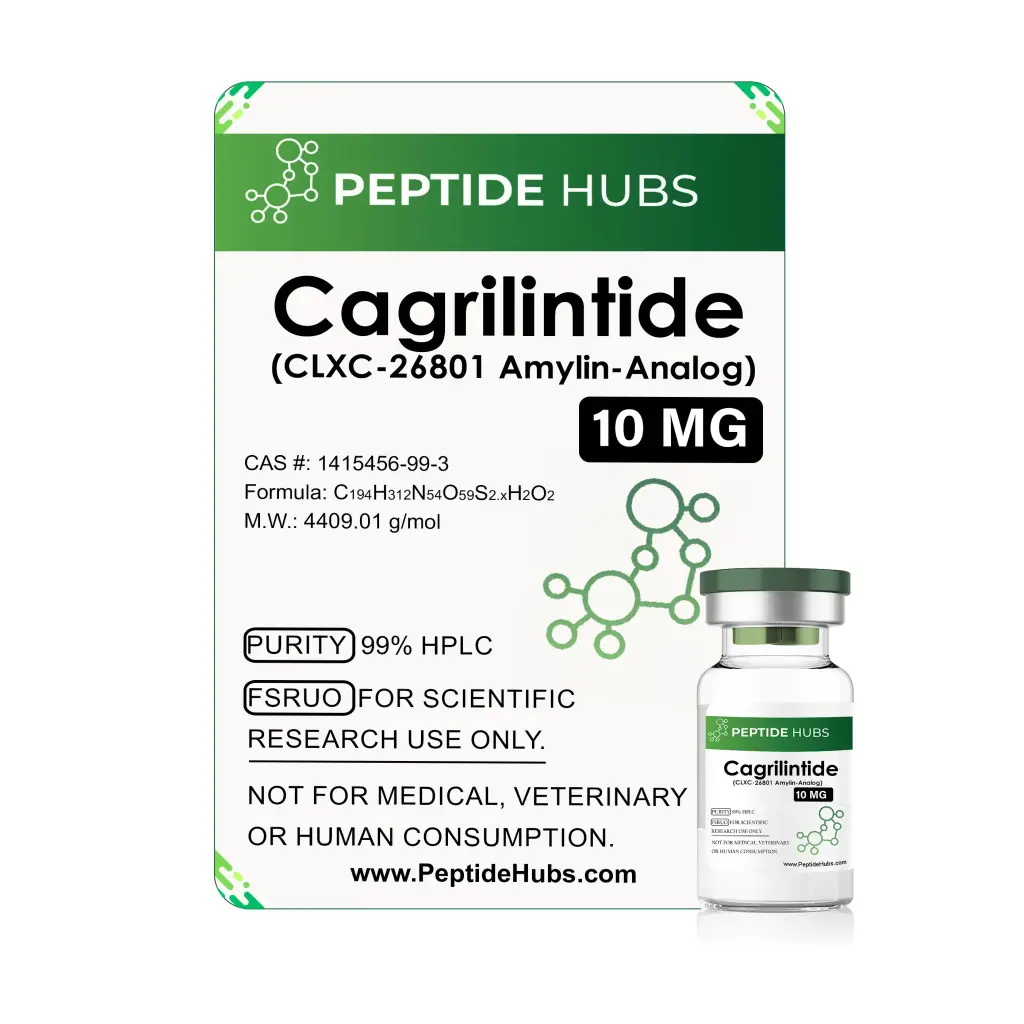
Cagrilintide 10 mg is a lyophilized amylin analog research product manufactured by Peptide Hubs and supplied as a 10 mg/vial powder in a 2 mL vial.
Cagrilintide 10 mg contains cagrilintide, a long-acting synthetic analog of the pancreatic hormone amylin. Amylin is co-secreted with insulin by pancreatic beta-cells in response to meals and plays a key role in satiety signaling and postprandial glucose regulation. Cagrilintide was engineered to retain amylin's receptor affinity while extending its duration of action, enabling once-weekly subcutaneous dosing.
Cagrilintide acts primarily through amylin receptors (AMY1R, AMY2R, and AMY3R) in the area postrema of the hindbrain, a region crucial for mediating satiety signals. Preclinical studies demonstrate that cagrilintide reduces food intake and body weight by decreasing fat mass while maintaining lean mass, with effects mediated through activation of neurons in the area postrema via amylin receptor subtypes 1 and 3. Unlike GLP-1 receptor agonists, cagrilintide's mechanism does not involve delayed gastric emptying, which may contribute to a different tolerability profile.
In clinical research, cagrilintide is being investigated both as monotherapy and in combination with the GLP-1 receptor agonist semaglutide (a combination known as CagriSema). Clinical trials have demonstrated that cagrilintide-semaglutide produces superior weight loss compared to semaglutide alone, with a mean difference of −7.44 kg in meta-analysis. However, cagrilintide is not FDA-approved as a standalone drug and remains an investigational compound under clinical development.
Cagrilintide 10 mg is supplied as a lyophilized (freeze-dried) powder in a 2 mL vial. Reconstitution with an appropriate solvent is required before use in research contexts.
Cagrilintide is a synthetic amylin analog with a molecular weight of approximately 4,400 Da. Its structure is based on human amylin with modifications that confer resistance to fibrillation and extended duration of action.
Cagrilintide belongs to the class of amylin receptor agonists, which mimic the action of endogenous amylin. Unlike GLP-1 receptor agonists that primarily act through incretin pathways, cagrilintide targets amylin receptors in the hindbrain to promote satiety and reduce food intake.
Structural studies reveal that cagrilintide binds to amylin receptors with a distinct "bypass" binding mode, anchoring at the receptor transmembrane bundle level through key molecular features including the F23 residue and a C-terminal P37 interaction with the receptor extracellular domain. Cryo-EM structures show that cagrilintide adopts similar binding modes in both amylin and calcitonin receptors, enabling dual receptor activation.
In non-medical bodybuilding contexts, cagrilintide is commonly referenced for appetite suppression and weight management support, particularly in combination with GLP-1 receptor agonists. However, the compound remains investigational and is not approved for any human indication.
Cagrilintide is distinguished by its activation of amylin receptors in the hindbrain rather than incretin receptors. This mechanism produces satiety effects through a different pathway than GLP-1 receptor agonists, potentially offering complementary benefits when used in combination.
Peptide Hubs offers several research peptides targeting metabolic pathways. Within this lineup, Survodutide is commonly discussed alongside cagrilintide for weight management research, though survodutide operates as a dual GLP-1/glucagon receptor agonist rather than an amylin analog. The two compounds address metabolic regulation through distinct mechanisms.
For research focused on tissue recovery rather than metabolic regulation, BPC 157 represents a different approach entirely, operating through angiogenic and cytoprotective mechanisms. These peptides are not interchangeable and target distinct biological pathways.
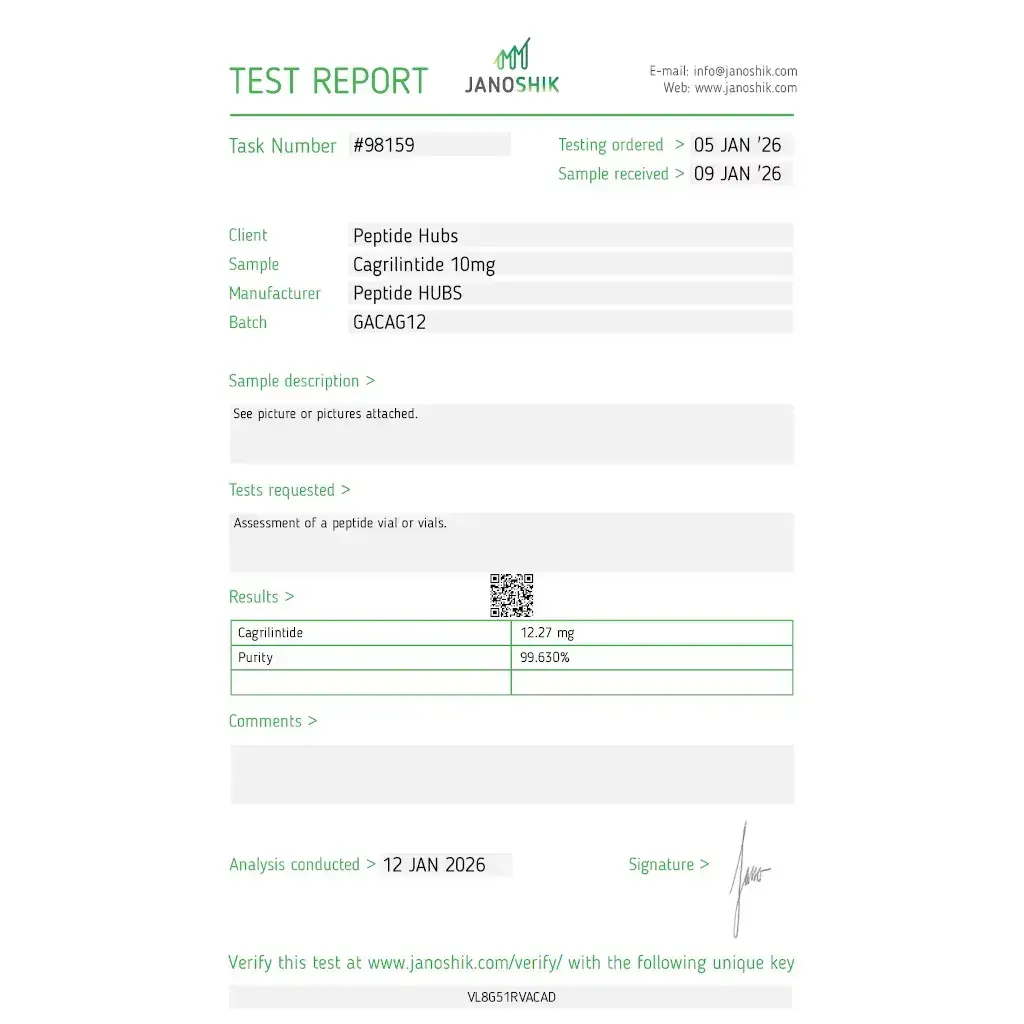
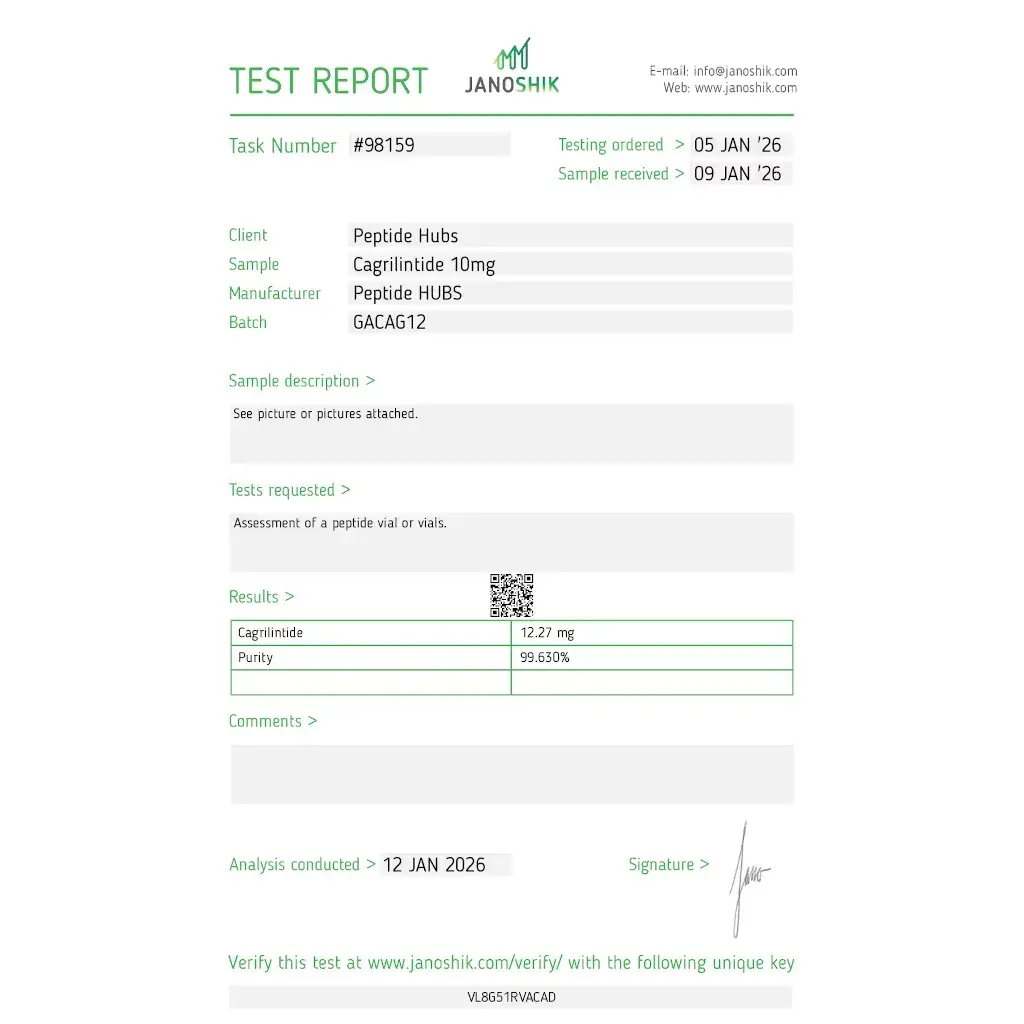
Published laboratory reports for Cagrilintide 10 mg are shown below with the test date, measured content, and batch number.
 View Report
Laboratory results apply to the specific tested sample represented in each published report and should not be interpreted as a measurement of every vial or production batch.
The information below is provided for educational reference only. Cagrilintide is an investigational drug not approved for any human use. Its use for any non-medical purpose falls outside approved indications, and no established human dosing regimen exists for non-clinical contexts.
In clinical trials, cagrilintide has been administered once weekly via subcutaneous injection using dose-escalation protocols. Phase 2 and Phase 3 trials have evaluated cagrilintide at doses ranging from 0.6 mg to 4.5 mg weekly, with the 2.4 mg dose being most commonly studied in combination with semaglutide.
| Use Case | Common Reference Range | Injection Frequency |
|---|---|---|
| Clinical trial initiation (medical) | 0.6–1.2 mg | Once weekly (titrated) |
| Clinical trial maintenance (medical) | 2.4–4.5 mg | Once weekly |
| Non-medical research protocol (anecdotal) | 0.25–1.0 mg | Once weekly or split |
Non-medical community protocols commonly reference starting doses significantly lower than clinical trial doses, with gradual titration based on individual tolerance. These ranges are anecdotal and not supported by controlled outcome data.
Cagrilintide 10 mg is supplied as a lyophilized powder and requires reconstitution before use. A 10 mg vial reconstituted with 2 mL of solvent yields a concentration of 5 mg/mL, meaning a 0.5 mg dose would require drawing 0.1 mL.
Some community protocols recommend using acetic acid solution rather than standard bacteriostatic water to maintain low pH and prevent amyloid fibril formation, though this is not supported by published stability data.
In non-medical bodybuilding contexts, cagrilintide is frequently discussed in combination with GLP-1 receptor agonists such as tirzepatide or semaglutide. Community reports describe using low doses of cagrilintide (0.25–0.5 mg weekly) added to existing GLP-1 protocols to enhance appetite suppression.
Clinical trial data supports the combination of cagrilintide with semaglutide (CagriSema), which has demonstrated superior weight loss compared to either agent alone. However, non-medical combinations have not been studied for safety or efficacy.
No established dosing protocol exists for non-medical cagrilintide use. All information is derived from clinical trial protocols or anecdotal community reports and should not be interpreted as medical guidance.
Cagrilintide is an investigational drug that has not received FDA approval for any indication. Safety data in humans is limited to controlled clinical trial settings, and non-medical use carries unknown risks.
Cagrilintide is currently being evaluated in Phase 3 clinical trials for weight management and type 2 diabetes. It has not been approved by the FDA for any human use, and the manufacturer has not authorized its distribution outside of clinical trials.
Use of cagrilintide outside of clinical trials or approved channels means the product has not been verified for purity, potency, or sterility by regulatory authorities. The risks of such use are unknown.
Cagrilintide is not approved for weight management, bodybuilding, or any other purpose. Non-medical use falls outside approved indications and is not supported by safety or efficacy data.
In clinical trials, the most commonly reported adverse events with cagrilintide-semaglutide combination therapy were gastrointestinal in nature, including nausea, vomiting, diarrhea, constipation, and abdominal pain. These events were reported by 79.6% of participants in the CagriSema group compared to 39.9% in the placebo group, and were mainly transient and mild-to-moderate in severity.
Injection-site reactions were more common with CagriSema compared to semaglutide alone (RR: 3.11; p=0.0123). Community reports describe potential blood pressure lowering effects, with one report describing a resting heart rate increase to 144 bpm and blood pressure of 89/62 in a user combining cagrilintide with retatrutide.
As a peptide administered parenterally, cagrilintide may pose immunogenicity risks. Amylin analogs have theoretical potential for amyloid fibril formation, though cagrilintide was specifically engineered to minimize this risk.
Given the absence of comprehensive human safety data for non-medical use, any consideration of cagrilintide should involve consultation with a qualified healthcare professional. Individuals with pre-existing medical conditions, particularly cardiovascular or blood pressure concerns, should exercise particular caution.
No established monitoring protocol exists for non-medical cagrilintide use. In clinical trial settings, participants undergo regular assessment of glycemic parameters, weight, and tolerability. Blood pressure monitoring may be relevant given community reports of hypotensive effects.
Lyophilized powder should be stored sealed and protected from light and moisture. Once reconstituted, store refrigerated and use within the recommended timeframe. Keep out of reach of children.
Cagrilintide 10 mg is supplied through the official Peptide Hubs distribution chain and shipped in original manufacturer packaging with discreet handling.
The outer shipping package remains discreet, with privacy-focused handling. Products are supplied through the official Peptide Hubs distribution chain.
To verify your Cagrilintide 10 mg product, use the security code on the vial label and cross-check it on the Peptide Hubs official site. Original packaging and manufacturer presentation help reinforce product legitimacy.
For complete delivery details, tracking policy, and reshipment terms, please see our Shipping Info page.
Proper storage conditions help preserve peptide stability and integrity throughout shelf life.
Store lyophilized powder sealed and protected from light and moisture. For longer-term storage, refrigeration or freezing of the unreconstituted powder may be appropriate, though specific stability data for this product is limited.
Once reconstituted, store refrigerated and use within the recommended timeframe for peptide solutions. Avoid repeated temperature fluctuations.
Keep out of reach of children. Follow proper handling practices.
Answers to common questions about Cagrilintide 10 mg, amylin analogs, and research peptide handling.
Cagrilintide 10 mg is a research peptide studied in clinical trials for weight management and type 2 diabetes. It acts as a long-acting amylin analog, promoting satiety through hindbrain receptor activation. In non-medical bodybuilding contexts, it is referenced for appetite suppression support, though such use falls outside approved indications.
Clinical trial protocols administer cagrilintide once weekly via subcutaneous injection with gradual dose titration. Non-medical community protocols sometimes reference less frequent dosing or splitting doses, but this is anecdotal and not supported by clinical data.
Cagrilintide does not suppress endogenous testosterone production and does not require post-cycle therapy in the way anabolic steroids do. However, its effects on appetite and metabolic function may persist after discontinuation, and any non-medical use should be approached with caution.
Cagrilintide is a long-acting amylin analog that activates amylin receptors in the hindbrain, promoting satiety and reducing food intake. Unlike GLP-1 receptor agonists, its mechanism does not involve delayed gastric emptying, which may contribute to a different tolerability profile.
In clinical trials, cagrilintide-semaglutide produced measurable weight reduction over 68 weeks, with a mean weight loss of 20.4% at the 2.4 mg/2.4 mg dose. Community reports suggest appetite suppression effects may be felt within days of dosing.
Cagrilintide is the most advanced amylin analog in clinical development, with Phase 3 trials completed for the CagriSema combination. However, it is not yet FDA-approved, and comparative data with other amylin analogs is limited.
Cagrilintide is an amylin analog that promotes satiety through hindbrain receptors, while Survodutide is a dual GLP-1/glucagon receptor agonist that modulates appetite and metabolism through incretin and glucagon pathways. They operate through entirely different mechanisms.
Cagrilintide targets metabolic and appetite pathways, while BPC 157 is a tissue-repair peptide studied for angiogenic and cytoprotective effects. They have different amino acid sequences and proposed mechanisms.
10 mg represents a full vial of Cagrilintide 10 mg, not necessarily a single dose. Clinical trials have evaluated doses up to 4.5 mg weekly, while non-medical protocols typically reference much lower starting doses.
Cagrilintide 10 mg is labeled at 10 mg of cagrilintide per vial. It is supplied as a lyophilized powder in a 2 mL vial.
Yes. A published laboratory report dated January 12, 2026 measured Cagrilintide 10 mg at 12.27 mg, equivalent to 122.7% of its 10 mg label claim. The batch number is GACAG12.
Store the lyophilized powder sealed and protected from light and moisture. Once reconstituted, refrigerate and use within the recommended timeframe for peptide solutions.